Views: 254 Author: U-Need Publish Time: 2026-09-16 Origin: Site
Content Menu
● 304 vs. 316 Stainless Steel at a Glance
● What Is 304 Stainless Steel?
>> Common Uses of 304 Stainless Steel
>> Advantages of 304 Stainless Steel
>> Limitations of 304 Stainless Steel
● What Is 316 Stainless Steel?
>> Common Uses of 316 Stainless Steel
>> Advantages of 316 Stainless Steel
>> Limitations of 316 Stainless Steel
● The Key Difference: Molybdenum
● When Should You Choose 304 Stainless Steel?
>> Choose 304 Stainless Steel for These Applications
>> When 304 Offers the Best Value
● When Should You Choose 316 Stainless Steel?
>> Choose 316 Stainless Steel for These Applications
>> When 316 Delivers Better Lifecycle Value
● 304 vs. 316 Stainless Steel for CNC Machining
>> Machining Challenges for Austenitic Stainless Steel
>> CNC Machining Considerations for 304
>> CNC Machining Considerations for 316
● 304 vs. 316 for Sheet Metal Fabrication
● 304L and 316L: Why the "L" Matters
● Design Details That Affect Stainless-Steel Performance
>> Avoid Water Traps and Contaminant Buildup
>> Prevent Cross-Contamination During Fabrication
● A Practical Material Selection Process
>> Step 1: Understand the Service Environment
>> Step 2: Identify Failure Consequences
>> Step 3: Review the Part Geometry
>> Step 4: Specify Material and Finish Clearly
● 304 vs. 316 Stainless Steel: Application Guide
>> Is 316 stainless steel always better than 304 stainless steel?
>> Can 304 stainless steel rust?
>> Why is 316 stainless steel better for marine applications?
>> Is 316 stainless steel stronger than 304 stainless steel?
>> Should I choose 304L or 316L for welded parts?
>> Is 304 stainless steel suitable for food-processing equipment?
>> Can 316 stainless steel still corrode?
>> What information should I provide before manufacturing stainless-steel parts?
Choosing between 304 vs. 316 stainless steel is an important engineering and sourcing decision for CNC-machined parts, sheet metal components, welded assemblies, molds, industrial equipment, and custom hardware.
Both grades are widely used because they offer strong corrosion resistance, good formability, reliable weldability, and an attractive surface finish. However, they are not interchangeable in every application. The right choice depends on the working environment, exposure to salt or chemicals, cleaning requirements, part geometry, surface finish, manufacturing method, and expected service life.
For many general-purpose applications, 304 stainless steel offers an excellent balance of performance and cost. For marine, chemical, coastal, pharmaceutical, washdown, and chloride-rich environments, 316 stainless steel often provides a better long-term safety margin.
This guide explains the practical difference between 304 and 316 stainless steel, helping engineers, procurement teams, product designers, and manufacturers choose the most suitable material before production begins.

304 and 316 are both austenitic stainless steels. They contain chromium and nickel, which help them resist corrosion and maintain strength across a wide range of manufacturing applications.
The main difference is that 316 stainless steel contains molybdenum, while standard 304 stainless steel does not. This additional alloying element helps 316 resist pitting and crevice corrosion in chloride-containing environments.
| Property | 304 Stainless Steel | 316 Stainless Steel | Manufacturing Impact |
|---|---|---|---|
| Material family | Austenitic stainless steel | Austenitic stainless steel | Both are widely used for precision manufacturing |
| Chromium content | Typically 18–20% | Typically 16–18% | Supports corrosion resistance |
| Nickel content | Typically 8–10.5% | Typically 10–14% | Supports toughness and formability |
| Molybdenum content | None | Typically 2–3% | Improves chloride corrosion resistance |
| General corrosion resistance | Excellent | Excellent to superior | Both perform well in many applications |
| Chloride resistance | Moderate | Better | 316 is preferred around salt and chemicals |
| Strength | Similar to 316 | Similar to 304 | Grade selection is usually corrosion-driven |
| Machining | Good with correct tooling | Requires additional care | 316 may increase tooling and cycle-time demands |
| Material cost | Lower | Higher | Select based on lifecycle requirements |
| Typical applications | Indoor equipment, food machinery, brackets | Marine, chemical, pharmaceutical, coastal equipment | Match grade to working conditions |
304 stainless steel is one of the most commonly used stainless-steel grades in the world. It is often called "18/8 stainless steel" because it typically contains approximately 18% chromium and 8% nickel.
It is valued for its strong balance of corrosion resistance, fabrication performance, availability, and cost efficiency.
304 stainless steel is frequently used for:
- CNC-machined brackets and housings
- Sheet-metal enclosures
- Machine guards
- Food-processing equipment
- Commercial kitchen equipment
- Storage tanks
- Fabricated frames
- Cabinets and control boxes
- Indoor architectural hardware
- Automotive trim components
- Consumer-product components
- General industrial machinery parts
- Precision fittings and fasteners
For many indoor and low-corrosion applications, 304 stainless steel provides reliable long-term performance without the additional cost of 316.
The main advantages of 304 stainless steel include:
- Strong general corrosion resistance
- Good resistance to atmospheric oxidation
- Good formability for bending and stamping
- Good weldability for fabricated components
- Suitable for polishing and decorative finishes
- Widely available in sheet, plate, bar, tube, and custom stock forms
- Lower cost than 316 stainless steel
- Suitable for many food, commercial, and industrial applications
304 stainless steel is not immune to corrosion. Its main limitation is reduced resistance to chloride-related damage.
Chlorides can come from seawater, salt spray, road salt, brine, bleach-based cleaners, chlorinated water, food-processing chemicals, and industrial cleaning solutions.
When exposed to high chloride concentrations, 304 stainless steel can develop:
- Surface staining
- Rust-colored deposits
- Pitting corrosion
- Crevice corrosion
- Localized corrosion around fasteners
- Weld-area corrosion
- Corrosion beneath deposits or gaskets
For this reason, 304 should be evaluated carefully for outdoor coastal locations, chemical-processing lines, washdown environments, and parts exposed to saline fluids.
316 stainless steel is a higher-corrosion-resistance austenitic stainless steel. It is commonly selected for demanding environments where standard 304 may not provide enough protection.
The primary difference is the addition of molybdenum. In most cases, 316 stainless steel contains approximately 2–3% molybdenum, which improves performance in chloride-containing and chemically aggressive conditions.
316 stainless steel is commonly used for:
- Marine hardware
- Coastal building components
- Boat fittings
- Offshore equipment
- Chemical-processing machinery
- Pharmaceutical equipment
- Medical-device components
- Laboratory fixtures
- Water-treatment equipment
- Pump and valve components
- Heat exchangers
- Chemical storage systems
- Industrial washdown equipment
- Precision-machined corrosion-resistant parts
- Food equipment exposed to frequent sanitizing cycles
The major advantages of 316 stainless steel include:
- Better resistance to chloride-related corrosion
- Better pitting-corrosion resistance
- Better crevice-corrosion resistance
- Strong performance in coastal and marine environments
- Suitable for many chemical-processing applications
- Suitable for frequent washdown and sanitizing conditions
- Good weldability and formability
- High-quality appearance after polishing or finishing
- Better long-term protection in demanding applications
While 316 is highly corrosion resistant, it is not a universal solution.
It may involve:
- Higher raw-material cost
- Increased machining difficulty
- Higher tooling wear in some CNC operations
- Longer cycle times for complex precision parts
- More demanding process control during machining
- Higher cost for large fabricated structures
- Additional lead-time considerations depending on material availability
Most importantly, 316 stainless steel can still corrode if the design traps moisture, contaminants, chemicals, salt deposits, or cleaning residues.
The most important difference in the 304 vs. 316 stainless-steel comparison is molybdenum.
Molybdenum improves resistance to localized corrosion. This is particularly useful when parts are exposed to chloride ions.
Chlorides are commonly found in:
- Seawater
- Coastal air
- Road de-icing salt
- Saltwater pools
- Brine
- Chlorinated water
- Bleach and chlorine-based cleaners
- Industrial cleaning agents
- Process chemicals
- Food-processing residues
- Human sweat
- Deposits around fasteners and welded joints
When chlorides remain on a stainless-steel surface, they can damage the protective oxide layer. Once this happens, corrosion may begin in small localized areas.
Pitting corrosion is a localized form of corrosion that creates small holes or cavities on a metal surface.
It can be difficult to detect during early stages because the surface may look mostly clean. However, pits can grow deeper over time and may eventually lead to leakage, contamination, reduced strength, or part failure.
Pitting is especially important for:
- Valve bodies
- Pump components
- Fluid-handling systems
- Marine fasteners
- Hygienic equipment
- Chemical-processing parts
- Thin-wall sheet-metal enclosures
- Precision-machined threaded components
Crevice corrosion develops in narrow spaces where liquid, chemicals, salt, or contaminants can become trapped.
Common crevice locations include:
- Beneath washers
- Under gaskets
- Inside threaded connections
- Along lap joints
- In welded corners
- Around rivets
- Under deposits
- Between tightly assembled metal components
- Inside poorly drained equipment
Because oxygen levels can become lower inside these crevices, the protective stainless-steel surface can become less stable. This increases the chance of localized corrosion.
316 stainless steel provides improved protection in these environments, but good product design remains essential.
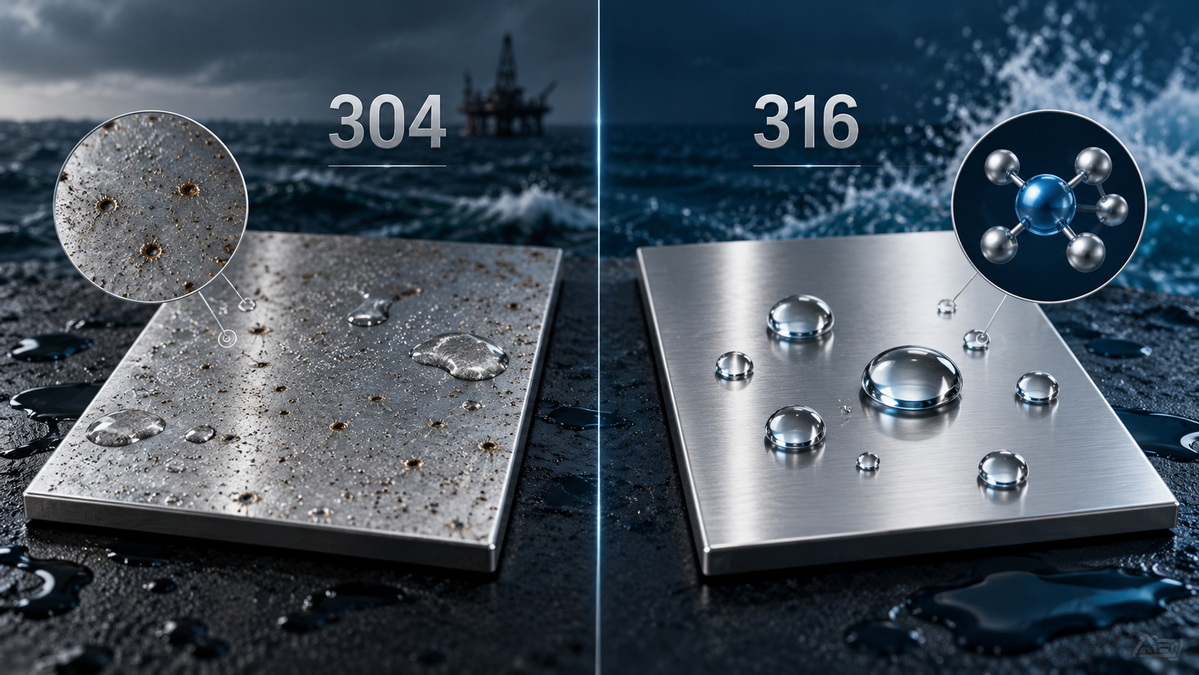
304 stainless steel is usually the preferred option when the environment is relatively clean, dry, and low in chlorides.
It is a practical choice for general manufacturing projects because it combines good corrosion resistance with cost efficiency and flexible fabrication performance.
304 is often suitable for:
- Indoor machinery
- Industrial equipment in dry facilities
- Office and commercial fixtures
- Standard sheet-metal enclosures
- Machine covers
- General brackets and mounting plates
- Indoor food-service equipment
- Commercial kitchen hardware
- Storage cabinets
- Non-marine outdoor products
- Decorative stainless-steel trim
- Retail and display components
- Automotive interior components
- General-purpose CNC-machined parts
- Equipment with routine maintenance and cleaning
304 is usually the better value when:
- The component will remain indoors
- Chloride exposure is limited
- The part is not in contact with seawater or brine
- Chemical exposure is low
- Cleaning agents are mild and non-chloride based
- Corrosion failure would not create a critical safety or production issue
- The part must meet a competitive cost target
- The design includes good drainage and accessible cleaning surfaces
For many fabricated and machined parts, 304 provides the right balance between cost, manufacturability, surface quality, and durability.
316 stainless steel should be considered when corrosion risk is higher and part failure could create significant maintenance, replacement, quality, or downtime costs.
The higher material cost may be justified when the part will face salt, chlorides, chemicals, washdown cycles, humidity, or aggressive environmental exposure.
316 is often the stronger material choice for:
- Marine equipment
- Coastal outdoor installations
- Boat hardware
- Saltwater pump components
- Water-treatment equipment
- Chemical-processing systems
- Pharmaceutical machinery
- Medical equipment
- Laboratory assemblies
- Food-processing equipment with harsh sanitation cycles
- Outdoor hardware near the ocean
- Chloride-rich industrial environments
- High-humidity production areas
- Chemical storage systems
- Corrosion-critical fittings and fasteners
- Precision-machined components exposed to saline fluids
316 can create better long-term value when:
- Saltwater or salt spray is present
- The installation is located near the coast
- Chloride-containing cleaners are used regularly
- The part comes into contact with brine or chlorinated water
- Cleaning and maintenance access is limited
- Equipment failure could stop a production line
- A corrosion-related leak would create safety risks
- The component is difficult or expensive to replace
- The product must maintain a clean, polished appearance for years
- The component is used in a regulated or hygiene-sensitive industry
The decision should focus on total ownership cost rather than raw-material cost alone.
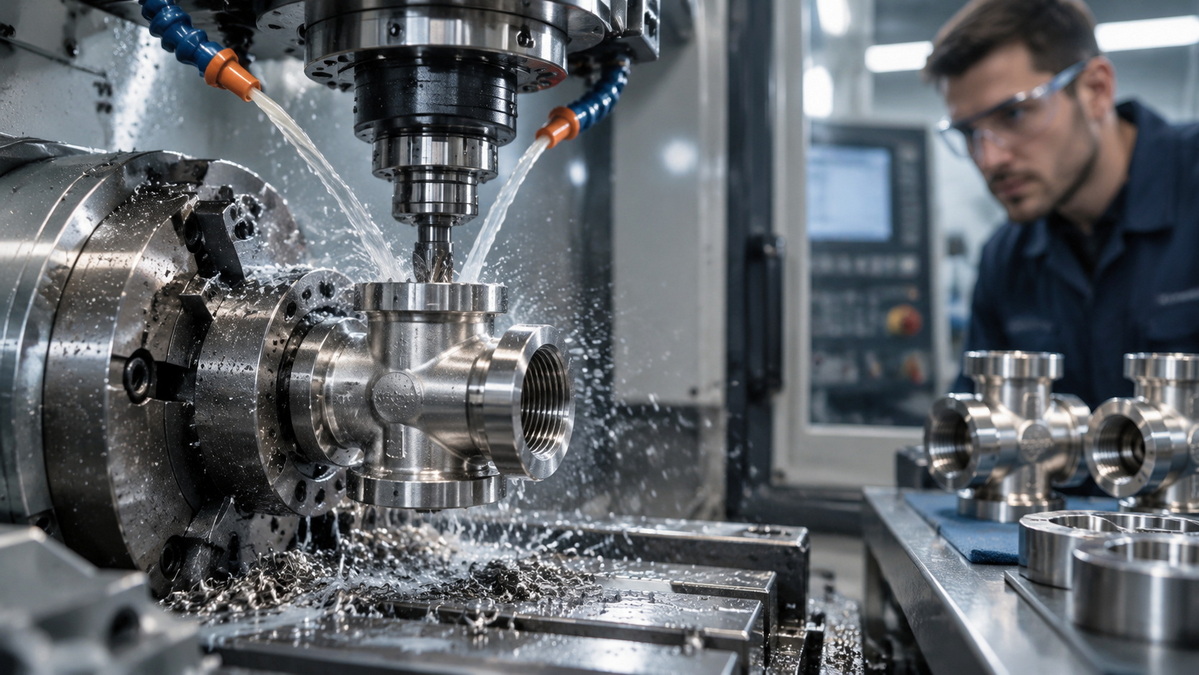
Both grades are suitable for custom CNC machining. They can be machined into precision parts such as shafts, bushings, fittings, flanges, valve components, housings, medical-device parts, mechanical assemblies, and custom hardware.
However, stainless steel behaves differently from aluminum, brass, or mild steel during machining.
304 and 316 stainless steels can work-harden during machining. Work hardening occurs when the metal becomes harder and stronger near the cutting surface as it is plastically deformed.
If machining parameters are poorly controlled, work hardening can lead to:
- Faster tool wear
- Poorer surface finish
- Increased heat generation
- Chip-control issues
- Dimensional inconsistency
- Longer machining time
- Tool breakage
- Higher production cost
304 is widely used for precision machining because it offers a strong balance of corrosion resistance and processing efficiency.
Manufacturers typically focus on:
- Stable workholding
- Sharp carbide tools
- Consistent feed rates
- Adequate coolant
- Proper chip evacuation
- Avoiding tool dwell
- Minimizing unnecessary re-cutting
304 is suitable for a wide range of tight-tolerance precision parts when the manufacturing process is properly controlled.
316 may require additional attention because it can be more demanding during machining.
For 316 stainless-steel precision parts, manufacturers may need to optimize:
- Cutting speed
- Feed rate
- Tool coating
- Coolant pressure
- Toolpath strategy
- Fixture rigidity
- Chip control
- Surface-finish requirements
- Tool-change schedules
For buyers, this may affect quotation cost, lead time, machining cycle time, and tool consumption.
The goal is not to avoid 316. The goal is to select it when its corrosion-resistance advantage is necessary for the application.
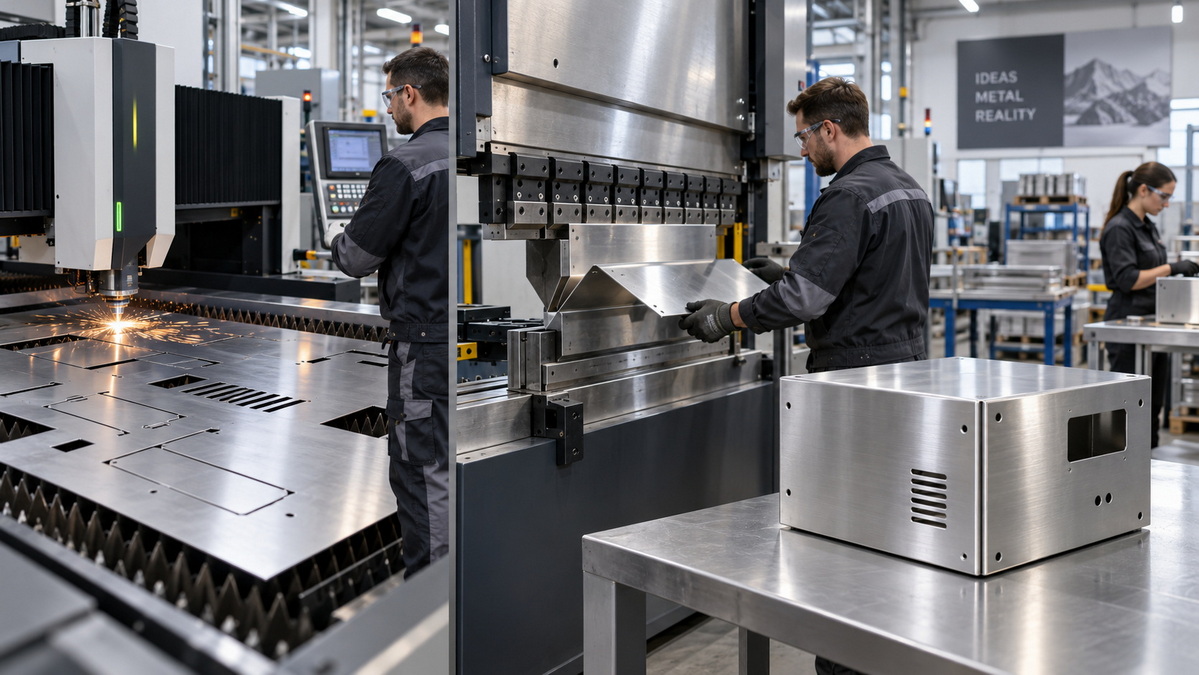
304 and 316 are both widely used in laser cutting, bending, stamping, welding, polishing, and custom sheet-metal fabrication.
Typical stainless-steel sheet-metal products include:
- Electrical enclosures
- Machine covers
- Cabinets
- Brackets
- Frames
- Panels
- Food-equipment components
- Industrial housings
- Covers and guards
- Custom control boxes
- Ventilation parts
- Chassis assemblies
- Welded equipment structures
Both grades can be laser cut and bent into complex geometries. However, fabricators must consider material thickness, bend radius, grain direction, springback, surface condition, and finished-part appearance.
304 is frequently selected for general sheet-metal products because it is widely available and economical.
316 is more appropriate when the fabricated assembly will operate in corrosive, wet, coastal, marine, chemical, or high-sanitation environments.
Stainless steel can be stamped into repeatable production components, including clips, brackets, covers, deep-drawn components, and formed panels.
For stamped parts, the material selection should account for:
- Part complexity
- Draw depth
- Bend radius
- Material thickness
- Surface finish
- Production quantity
- Tooling design
- Required corrosion resistance
- Post-processing needs
For high-volume production, choosing the right grade early helps avoid costly changes to stamping dies, molds, fixtures, inspection gauges, and finishing processes.
The "L" in 304L and 316L means low carbon.
Low-carbon stainless steels are commonly used for welded structures because they reduce the risk of corrosion near weld zones.
During welding, heat can affect the microstructure of standard stainless steel. In some situations, this may reduce corrosion resistance in the heat-affected zone.
304L and 316L are often preferred for:
- Welded tanks
- Pipe assemblies
- Fabricated frames
- Hygienic equipment
- Chemical-processing components
- Marine structures
- Pharmaceutical systems
- Sheet-metal housings
- Welded brackets
- Complex fabricated assemblies
For a welded product exposed to chlorides or chemicals, 316L is often the preferred starting point. For general welded indoor applications, 304L may provide the best balance of corrosion performance and cost.
Material selection is important, but the design of the part or assembly can have an equally large effect on corrosion resistance.
A poorly designed 316 component may fail earlier than a well-designed 304 component operating in a mild environment.
Design features should encourage drainage and easy cleaning.
Avoid:
- Flat surfaces that collect water
- Deep, unventilated cavities
- Narrow gaps beneath fasteners
- Overlapping sheets without sealing
- Sharp internal corners
- Unsealed lap joints
- Hidden areas that cannot be cleaned
- Threaded areas exposed to standing liquid
- Horizontal ledges exposed to salt deposits
Prefer:
- Sloped surfaces
- Drain holes
- Smooth transitions
- Accessible welds
- Sealed joints where appropriate
- Rounded internal corners
- Cleanable surfaces
- Properly designed gasket interfaces
Surface finish influences cleaning performance, appearance, contamination retention, and corrosion behavior.
A rough surface can retain:
- Dirt
- Salt
- Process residue
- Cleaning chemicals
- Moisture
- Microbial deposits
- Airborne contamination
A smoother finish is usually easier to clean and maintain. For hygienic, medical, pharmaceutical, food-processing, and decorative applications, the finish specification should be included clearly on engineering drawings.
Common options may include:
- Mill finish
- Brushed finish
- Satin finish
- Polished finish
- Mirror finish
- Bead-blasted finish
- Electropolished finish
- Passivated finish
The correct finish depends on the functional environment, cleaning method, appearance requirements, and budget.
Stainless steel can be contaminated during cutting, grinding, handling, or assembly if carbon-steel particles are transferred to its surface.
This can create rust-colored staining that appears to be stainless-steel corrosion but is actually caused by embedded foreign iron.
Good fabrication practices include:
- Dedicated stainless-steel work areas
- Clean handling equipment
- Stainless-compatible grinding tools
- Proper post-weld cleaning
- Surface protection during transport
- Separate storage from carbon-steel stock
- Final cleaning before packaging
Before requesting a quotation for 304 or 316 stainless-steel parts, define the full application requirements.
Document the real conditions the part will face.
Consider:
- Indoor or outdoor use
- Coastal distance
- Salt spray exposure
- Contact with seawater
- Chloride concentration
- Cleaning chemicals
- Process-fluid composition
- Humidity
- Condensation
- Operating temperature
- Exposure frequency
- Maintenance schedule
- Contact with other metals
Consider what happens if the material develops corrosion.
Questions to ask include:
- Would corrosion be only cosmetic?
- Could it affect sealing performance?
- Could it contaminate a product?
- Could it create a safety concern?
- Could it cause machine downtime?
- Is the part difficult to replace?
- Would replacement require shutdown or disassembly?
- Could corrosion lead to warranty claims?
The greater the consequence of failure, the more important it becomes to choose a material with adequate corrosion resistance.
Review drawings for corrosion-risk features such as:
- Tight crevices
- Trapped-liquid zones
- Welded corners
- Gasket interfaces
- Threaded joints
- Poor drainage
- Unsealed seams
- Areas that are difficult to clean
A Design for Manufacturability review can help identify these issues before prototyping or mass production.
A complete manufacturing request should include:
- Part drawings
- 3D CAD files
- Material grade
- Material condition
- Required certification
- Surface-finish requirements
- Welding requirements
- Post-processing requirements
- Critical tolerances
- Quantity
- Target lead time
- Operating environment details
Clear documentation helps prevent material substitution, quotation misunderstandings, quality problems, and production delays.
| Application | Recommended Starting Grade | Reason |
|---|---|---|
| Indoor machine enclosure | 304 | Good corrosion resistance and strong cost efficiency |
| General CNC-machined bracket | 304 | Suitable for dry and low-corrosion industrial environments |
| Commercial kitchen component | 304 | Suitable for many food-service and cleaning conditions |
| Food-processing equipment with harsh cleaners | 316 or 316L | Better resistance to frequent chemical exposure |
| Coastal outdoor enclosure | 316 | Better resistance to salt-laden air |
| Marine fastener | 316 | Better protection against saltwater-related corrosion |
| Boat fitting | 316 | More suitable for chloride-rich environments |
| Chemical-processing component | 316 or 316L | Better performance in many aggressive conditions |
| Pharmaceutical fabrication | 316L | Common choice for welded and hygienic assemblies |
| Water-treatment equipment | 316 | Better resistance to chloride exposure |
| Decorative indoor trim | 304 | Attractive finish and cost-effective performance |
| Saltwater pump fitting | 316 | Better pitting-corrosion resistance |
| High-risk chemical or seawater service | Engineering review required | 316 may not provide sufficient resistance in every case |
The best choice between 304 and 316 stainless steel depends on the application, not the grade name alone.
304 stainless steel is an excellent solution for many general-purpose manufactured parts. It is durable, corrosion resistant, cost effective, and highly suitable for CNC machining, laser cutting, bending, stamping, welding, and fabricated assemblies.
316 stainless steel provides a stronger corrosion-resistance margin in environments containing salt, chlorides, chemical cleaners, seawater, coastal humidity, and aggressive process fluids. Its higher initial cost can be justified when failure, maintenance, product contamination, or replacement downtime would be costly.
The most effective approach is to evaluate the operating environment, part geometry, manufacturing method, welding requirements, surface finish, and expected lifecycle before releasing the design for production.
For custom precision machining, mold manufacturing, sheet metal fabrication, stamping, laser cutting, bending, and corrosion-resistant production parts, U-Need can help review your drawings and material requirements to support a practical, manufacturable solution.
No. 316 stainless steel offers better resistance to chloride-related pitting and crevice corrosion, but it is usually more expensive. For indoor, dry, and low-chloride applications, 304 stainless steel often provides the best overall value.
Yes. 304 stainless steel can develop corrosion or staining when exposed to salt, chlorides, harsh cleaning chemicals, trapped moisture, poor drainage, contaminated surfaces, or unsuitable fabrication practices.
316 stainless steel contains molybdenum, which improves its resistance to pitting and crevice corrosion in chloride-rich environments. This makes it more suitable for marine hardware, coastal equipment, saltwater systems, and outdoor installations near the ocean.
The mechanical strength of 304 and 316 stainless steel is generally similar in common annealed conditions. The main reason to choose 316 is improved corrosion resistance rather than significantly higher strength.
304L and 316L are low-carbon versions of standard 304 and 316. They are often preferred for welded fabrications because they help preserve corrosion resistance around weld zones. For chloride-rich or chemical environments, 316L is often the stronger choice.
Yes. 304 stainless steel is widely used in food-processing and commercial-kitchen applications because it is corrosion resistant, easy to clean, formable, and weldable. However, equipment exposed to aggressive chloride-based cleaners, brine, or demanding washdown conditions may require 316 or 316L.
Yes. Although 316 stainless steel has better corrosion resistance than 304, it can still corrode in severe environments. Poor design, trapped saltwater, rough surface finish, weld contamination, chemical deposits, and insufficient cleaning can all reduce its long-term performance.
Provide detailed 2D drawings, 3D CAD files, material grade, surface-finish requirements, tolerances, welding specifications, certification requirements, quantity, operating environment, and expected application conditions. This information helps ensure the selected stainless-steel grade matches the real production and service requirements.
1. Outokumpu. [What Makes Stainless Steel Corrosion Resistant?]
2. Rolled Alloys. [304 vs 316 Stainless Steel: Corrosion Resistance, Properties, and Applications]
3. Xometry. [316 Stainless Steel: Composition and Density]
4. Outokumpu. [Stainless Steels for Corrosive Environments]
5. RpProto. [304 vs 316 Stainless Steel: Which One Should You Choose?]


