Views: 210 Author: U-Need Publish Time: 2026-11-02 Origin: Site
Content Menu
● High Precision Machined Parts vs Complex Geometries: What Actually Differs?
>> Precision Is a Drawing Requirement, Not an Axis Count
>> Complexity Is Often an Accessibility Problem
● How 3-Axis, 3+2, and Simultaneous 5-Axis Machining Compare
>> 3-Axis Machining: Effective for Accessible Features
>> 3+2 Machining: Reorient, Then Cut
>> Simultaneous 5-Axis Machining: Change Orientation During Cutting
● When Is 5-Axis CNC Machining Worth It?
>> 1. Multiple Setups Threaten Critical Relationships
>> 2. Tool Access Forces Long, Flexible Cutters
>> 3. Continuous Surfaces Require Changing Tool Orientation
>> 4. Setup Reduction Offsets the Higher Processing Rate
● When 5-Axis Machining Is Not Worth the Premium
● A Practical Cost Model: Compare Accepted Parts, Not Machine Rates
>> Illustrative Break-Even Example
● Precision Reality Check: More Axes Also Mean More Variables
>> Thermal Stability Can Change the Result
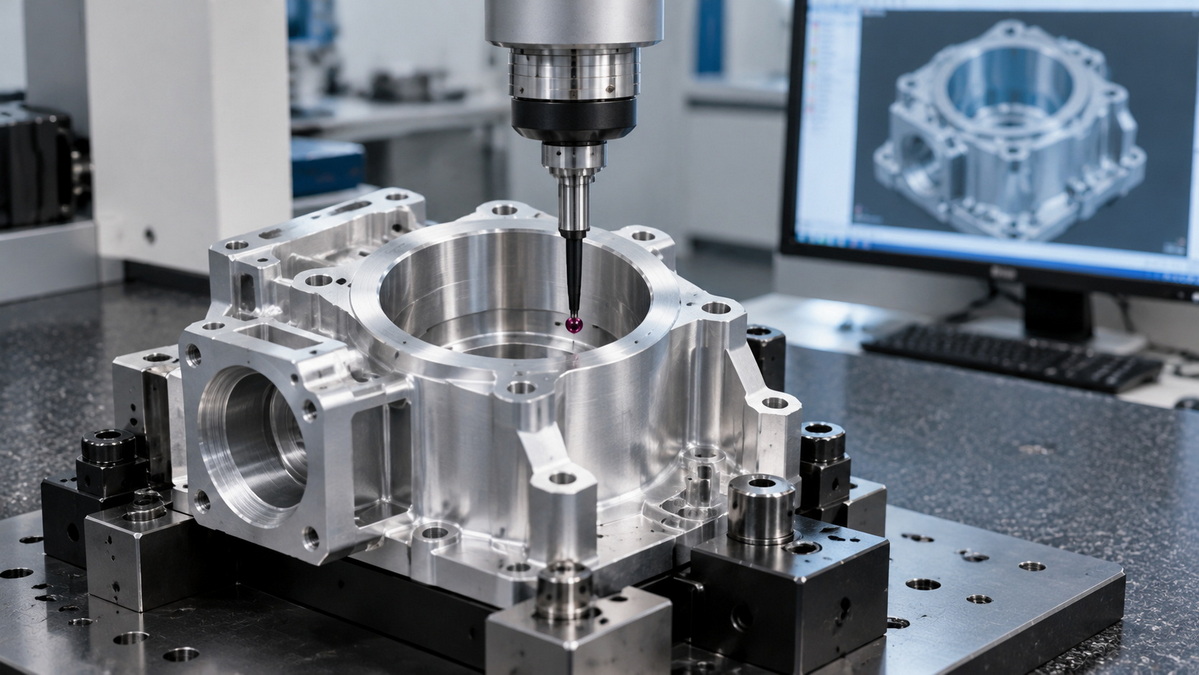
>> Inspection Must Match the Requirement
● Three Application Scenarios: Where the Decision Changes
>> Precision Housing: Indexed Machining May Be Enough
>> Impeller-Like Component: Continuous Motion May Be Necessary
>> Mold Insert: A Hybrid Route May Be Better
● An RFQ Checklist for High Precision Machined Parts and Complex Geometries
● Discuss the Right Manufacturing Route With U-Need
>> Are high precision machined parts always complex?
>> Is 5-axis CNC machining always more accurate than 3-axis machining?
>> What is the difference between 3+2 and simultaneous 5-axis machining?
>> Does 5-axis machining eliminate secondary operations?
>> Is five-axis machining economical for prototypes?
>> What should I submit for an accurate machining quotation?
High precision machined parts and complex geometries often appear together in manufacturing discussions, but they describe different challenges. Precision concerns how closely a finished component meets its specified dimensions and geometric requirements. Complexity concerns the shapes, surfaces, and features that a cutting tool must reach.
For buyers evaluating 5-axis CNC machining, the practical question is not whether more axes sound better. It is whether those additional movements improve access, protect critical feature relationships, or reduce the total cost of producing acceptable parts.
My starting recommendation is straightforward: choose the simplest machining strategy that reliably meets the drawing. Upgrade to 5-axis machining when its benefits outweigh its additional programming, equipment, and verification requirements.

A straightforward component can demand extremely tight tolerances. Meanwhile, a visually intricate component may have relatively generous dimensional requirements.
That distinction matters because precision and complexity do not automatically require the same manufacturing solution.
| Comparison factor | High precision machined parts | Complex geometries |
|---|---|---|
| Primary requirement | Meet dimensional and geometric specifications | Produce difficult shapes and access challenging features |
| Typical challenges | Position, flatness, roundness, and consistent fits | Angled features, curved surfaces, deep cavities, and tool clearance |
| Main process concern | Stability and measurement confidence | Tool orientation and collision-free access |
| Possible machining approach | Turning, 3-axis milling, grinding, or multi-axis machining | Indexed or simultaneous multi-axis machining |
| When 5-axis adds value | Critical relationships span several faces | Tool orientation must change to reach or generate features |
| Acceptance evidence | Inspection against the drawing | Geometric conformity plus dimensional verification |
The important overlap occurs when a component needs both demanding tolerances and difficult access. That is where 5-axis machining deserves particularly careful consideration.
"High precision" should never substitute for a complete specification.
A useful drawing identifies datum references, critical dimensions, geometric tolerances, surface requirements, material, and any finishing conditions that affect acceptance.
For example, maintaining the position of two bores on different faces may be more important than tightening every external dimension.
From a procurement perspective, I would rather receive a clear explanation of datum control and inspection than an unsupported promise that a machine is "ultra-precise."
Complexity is not limited to sculpted surfaces.
A rectangular housing with holes on several angled faces may create more setup difficulty than a curved part machined entirely from above.
The relevant questions are:
- Can the cutter reach every required surface?
- Can it reach those surfaces without excessive overhang?
- Will the holder or spindle collide with the workpiece?
- Can critical features remain referenced to a consistent setup?
These questions reveal whether additional axes solve a real manufacturing problem.
Not every job placed on a five-axis machine requires simultaneous five-axis cutting.
Understanding this distinction can prevent unnecessary spending.
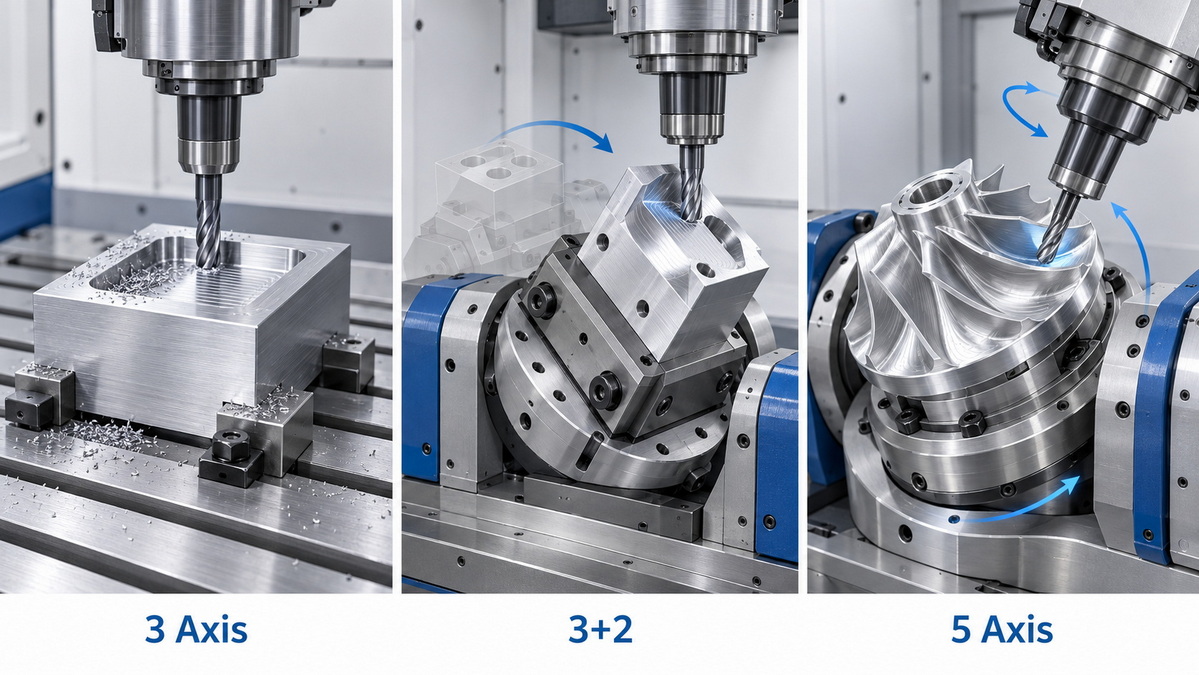
A conventional 3-axis mill moves along X, Y, and Z.
It is often appropriate for plates, pockets, mounting blocks, and components whose features are accessible from a limited number of directions.
Additional faces can be machined by repositioning the workpiece. However, each repositioning introduces another setup operation and another opportunity for locating variation.
In 3+2 machining, two rotary axes position the workpiece or tool at an angle. Cutting then proceeds with that orientation fixed.
This approach can simplify machining across multiple faces without requiring continuous rotary movement during cutting.
For many housings, brackets, and tooling components, indexed machining provides the access benefits buyers need without the full complexity of simultaneous five-axis toolpaths.
Simultaneous 5-axis machining coordinates linear and rotary motion during the cut.
It becomes particularly useful when the tool must continuously change orientation to follow a surface or maintain access through a changing geometry.
Examples include certain impeller passages, blade surfaces, and sculpted mold features.
| Process | Tool orientation during cutting | Typical reason to choose it |
|---|---|---|
| 3-axis | Fixed relative to the setup | Accessible geometry and economical machining |
| 3+2 | Reoriented between cutting operations | Multiple faces and angled features |
| Simultaneous 5-axis | Changes continuously when required | Continuous contours and restricted access |
The strongest justification is usually a combination of better access, fewer setups, and more reliable feature relationships.
Consider a housing with precision bores distributed across several faces.
A conventional process might require repeated clamping and alignment. Each transfer creates another interface between the drawing's datum structure and the physical setup.
A five-axis strategy may allow more of those features to be machined without removing the part.
That does not eliminate error. It can, however, reduce dependence on repeated manual relocation.
Also, "one setup" does not mean every surface is accessible. The clamped area may still require a second operation.
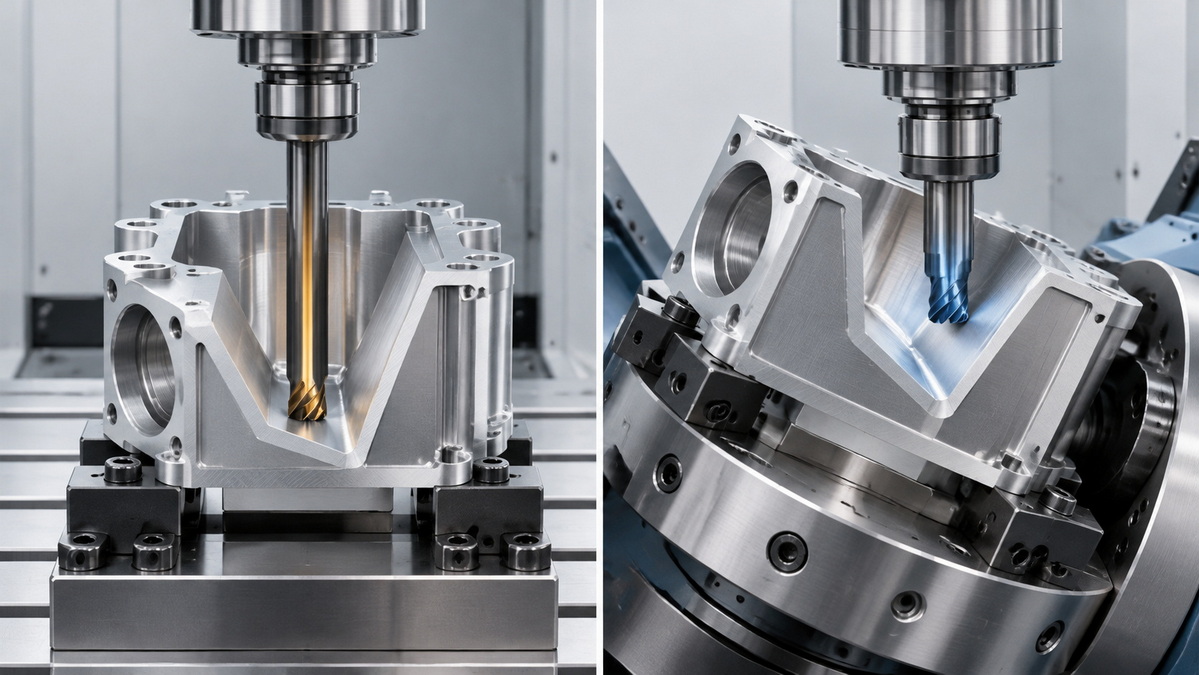
Deep or angled features can force a 3-axis process to use extended tooling.
Tilting the workpiece may permit a shorter tool and more favorable access. Depending on the application, this can improve cutting stability and reduce deflection-related problems.
The benefit must be checked against the actual machine envelope, holder geometry, and fixture arrangement. Five axes do not make every undercut or enclosed passage machinable.
Some surfaces are inefficient or impractical to finish with a fixed tool direction.
Simultaneous machining can manage tool orientation as the surface changes, helping the programmer balance access, clearance, and cutting conditions.
Nevertheless, surface finish remains dependent on toolpath strategy, cutter condition, material behavior, and machine dynamics—not simply axis count.
A higher hourly machine rate does not automatically mean a higher finished-part cost.
If one process removes several fixtures, repeated alignments, or costly secondary operations, its overall economics may improve.
The relevant measure is cost per accepted part, not the lowest quoted spindle-hour rate.
Five-axis machining is not the default answer for every precision component.
A simpler process may be preferable when:
- Most features are accessible from one or two directions.
- The component is primarily rotational and better suited to turning.
- Existing fixtures already deliver stable, repeatable results.
- Production volume supports a highly optimized dedicated process.
- A secondary process, such as grinding or EDM, better addresses the difficult feature.
- Additional rotary motion offers little reduction in setup work or inspection risk.
Tight tolerances alone are insufficient justification. A stable 3-axis process can be more suitable than a poorly controlled five-axis process.
For sourcing decisions, I recommend separating one-time engineering costs from recurring production costs.
A useful comparison is:
Value comes from reducing total engineering, setup, machining, inspection, finishing, and expected nonconformance costs—not from maximizing machine sophistication.
The following figures are hypothetical planning assumptions, not market benchmarks or a U-Need quotation.
Assume two qualified processes produce equivalent acceptable parts:
| Cost element | Multi-setup 3-axis route | Five-axis route |
|---|---|---|
| One-time programming and fixtures | $600 | $1,200 |
| Recurring cost per accepted part | $85 | $60 |
| Total for 10 accepted parts | $1,450 | $1,800 |
| Total for 50 accepted parts | $4,850 | $4,200 |
The five-axis route requires $600 more upfront but saves $25 per accepted part.
Under these assumptions, the costs are equal at 24 parts. Above that quantity, the five-axis route becomes less expensive.
Actual comparisons should also consider revision frequency, repeat orders, material value, inspection requirements, and delivery constraints.
For a low-volume project, reduced technical risk may justify the premium even before direct cost break-even.
A five-axis machine introduces rotary-axis positioning and alignment considerations alongside the familiar linear-axis errors.
Renishaw's machine-tool verification guidance explains why measurements at one position cannot fully represent spatial accuracy across the machine's working volume.
This has an important purchasing implication: a machine specification is not equivalent to demonstrated capability on your component.
Heat generated during operation can influence positioning accuracy.
In one Renishaw ballscrew study, a tested semi-closed-loop configuration showed approximately 120 µm of thermal-related error under a particular operating condition. With linear-encoder feedback enabled, accuracy was maintained within 15 µm.
Those figures describe that test configuration, not a universal performance difference or a tolerance promise.
The practical lesson is broader: evaluate warm-up conditions, feedback systems, calibration, and production stability rather than relying on axis count.
For critical components, agree on:
1. The datum alignment used for acceptance.
2. Which features require dimensional inspection.
3. How freeform surfaces will be evaluated.
4. Whether inspection occurs before or after finishing.
5. What first-article documentation is required.
6. Whether production capability evidence is necessary.
On-machine probing can support setup and process control. It should not automatically be treated as sufficient independent acceptance evidence.
These are application-based examples, not claimed customer case studies.
A housing has bores and threaded holes on several angled faces.
The challenge is access and maintaining feature relationships, not continuously sculpting a surface.
A 3+2 strategy may provide the necessary benefit. Simultaneous five-axis cutting could add complexity without improving the outcome.
A component contains curved passages between blades.
The cutter may need to change orientation continuously to maintain clearance and follow the required geometry.
Here, simultaneous five-axis machining may be justified by geometric feasibility before cost savings are considered.
A mold insert combines accessible pockets, sculpted surfaces, and narrow internal features.
An effective route may combine conventional roughing, multi-axis finishing, and EDM where milling access is unsuitable.
The best manufacturing plan does not force every feature through one process.
A detailed request for quotation helps suppliers compare realistic process options.
Provide:
- A current 3D model and revision-controlled drawing.
- Material grade and required condition.
- Prototype, initial-order, and forecast quantities.
- Critical dimensions and datum references.
- Surface texture and cosmetic requirements.
- Heat treatment, coating, or plating requirements.
- Inspection and traceability expectations.
- Required delivery dates.
Then ask the supplier:
- Which features justify 3+2 or simultaneous five-axis machining?
- How many setups remain necessary?
- What limits the achievable result?
- Which drawing changes would reduce cost without harming function?
- What evidence will demonstrate acceptance?
A strong quotation explains the proposed route and its limitations rather than simply listing equipment.
U-Need supports global brands, distributors, and manufacturers with custom precision parts machining, mold manufacturing, and sheet metal fabrication in China.
Its stated service scope includes injection molds, stamping dies, cold-forging dies, laser cutting, bending, and stamping.
That broader manufacturing context is useful when a project involves both machined components and related tooling or fabricated assemblies.
Send U-Need your CAD model, drawing, material requirements, quantities, and inspection expectations. Request a manufacturability review comparing conventional machining, indexed machining, and simultaneous five-axis machining where applicable.
The objective is a justified production route—not an automatic upgrade to the most elaborate process.
No. A simple pin, plate, or block can have demanding tolerances. Precision describes conformity to requirements; complexity describes geometric and access challenges.
No. Five-axis machining can reduce repositioning, but calibration, thermal behavior, workholding, tooling, and inspection determine the actual result.
In 3+2 machining, rotary axes establish an orientation before cutting. In simultaneous machining, linear and rotary axes can move together during cutting.
Not necessarily. Clamped surfaces, inaccessible details, heat treatment, grinding, EDM, or finishing may still require additional operations.
Sometimes. Its higher preparation cost may be offset by simpler fixturing, fewer setups, or otherwise difficult geometry. Compare complete quotations rather than assuming a minimum economical quantity.
Provide a 3D model, controlled drawing, material specification, quantities, finishing requirements, critical tolerances, and inspection expectations.
1.Haas Automation. "5-Axis Overview." Technical training document explaining indexed positioning, simultaneous machining, and setup considerations [haascnc]: https://haascnc.com/content/dam/haascnc/hfo-microsite/hfo-morris-trident/Morris_Trident_TMT-5-Axis-Overview.pdf
2.Haas Automation. "UMC-750: 5-Axis Mill." Machine information distinguishing 3+2 machining from simultaneous five-axis capability [haascnc]: https://haascnc.com/machines/vertical-mills/universal-machine/models/umc-750
3.Haas Automation. "Simplify 3+2 and 5-Axis Machining with DWO/TCPC." Technical explanation of dynamic work offsets and tool-center-point control [haascnc]: https://haascnc.com/video/tipoftheday/hxpjh4v5ieg.html
4.Renishaw. "Precision Calibration Products Help Produce High-Quality, High-End Machine Tools." Discussion of spatial errors, five-axis verification, and calibration limitations [renishaw]: https://www.renishaw.com/en/precision-calibration-products-help-produce-high-quality-high-end-machine-tools--48718
5.Renishaw. "The Effect of Heat on Ballscrew Accuracy in a CNC Machine Tool." Application study supporting the thermal-error example and its configuration-specific limitations [renishaw]: https://www.renishaw.com/it/the-effect-of-heat-on-ballscrew-accuracy-in-a-cnc-machine-tool--49580
6.Protolabs. "Online CNC Machining Service." Manufacturing guidance covering indexed milling, drawing-dependent tolerances, manufacturability review, and quotation variables [protolabs]: https://www.protolabs.com/services/cnc-machining/


