Views: 222 Author: Rebecca Publish Time: 2026-01-26 Origin: Site
Content Menu
● What Is Aerospace Injection Molding?
● Why the Aerospace Industry Uses Injection Molding
>> Design Flexibility and Complex Geometry
>> Wide Material Selection for Harsh Environments
>> Tight Tolerances and Precision
>> Lightweighting and Performance
>> Consistent Quality at Scale
>> Cost Efficiency Over the Product Lifecycle
● Aerospace Injection Molding Materials
>> Common Polymers and Their Properties
>> Matching Materials to Applications
● Core Injection Molding Processes Used in Aerospace
>> Standard Plastic Injection Molding
>> Overmolding (Two Shot Molding)
● Common Aerospace Injection Molded Parts
● Design for Manufacturability in Aerospace Injection Molding
● Quality, Compliance, and Traceability Requirements
● Market Trends in Aerospace Plastic Injection Molding
● Process Flow: From Aerospace Prototype to Certified Production Part
● Practical Design Tips for Aerospace Engineers
● When to Choose Aerospace Injection Molding vs Other Processes
● Clear, Targeted Call to Action
● FAQs About Aerospace Injection Molding
>> 1. What is aerospace injection molding used for?
>> 2. Which plastics are most common in aerospace injection molding?
>> 3. How does injection molding help reduce aircraft weight?
>> 4. Is injection molding suitable for safety critical aerospace parts?
>> 5. What should I look for in an aerospace injection molding supplier?
Aerospace injection molding has become a strategic manufacturing method for lightweight, high precision plastic components across aircraft, spacecraft, drones, and advanced defense systems. It combines design freedom, tight tolerances, and cost effective scaling that traditional machining or casting often cannot match.

Aerospace injection molding is the use of industrial plastic injection molding processes to manufacture structural and non structural parts for aircraft, spacecraft, satellites, drones, and avionics systems. Molten thermoplastic or thermoset material is injected into a precision mold cavity, cooled, and ejected to form complex geometries with repeatable tolerances.
Engineers rely on aerospace plastic injection molding to replace heavier metal components, reduce assembly steps, and improve performance without compromising safety or compliance. For OEMs and Tier 1 suppliers, it is a core method for both rapid prototyping and mass production of certified flight hardware.
Injection molding supports complex 3D shapes, undercuts, thin wall sections, living hinges, and integrated clips that are difficult or expensive to machine. Modern rapid tooling and 3D printed prototype molds allow fast iterations before freezing the design for high volume production.
This flexibility lets engineers consolidate multiple parts into a single molded component, reduce fasteners, and optimize airflow or ergonomics in cockpit, cabin, and drone assemblies.
Aerospace plastic injection molding works with commodity thermoplastics and high performance engineering polymers, including glass and carbon fiber reinforced grades. This broad palette allows designers to match strength, thermal performance, chemical resistance, flammability ratings, and dielectric properties to each application.
Materials such as PEEK, high impact polystyrene, ABS, and specialized fluoropolymers give engineers options for everything from interior trims to radomes and sensor housings.
Well designed injection molds can routinely achieve tight tolerances for critical features on aerospace components. Once the mold and process are validated, thousands of parts can be produced with consistent dimensions and surface finishes.
This level of precision is essential for parts like pitot tube housings, instrument bezels, battery enclosures, and snap fit assemblies that interface with metallic or composite structures.
Reducing aircraft weight has a direct impact on fuel burn, emissions, payload, and range. Plastic injection molded components offer high strength to weight ratios, enabling engineers to replace heavier metal components in non critical load paths and interior systems.
In drones and small aircraft, injection molded blades, housings, and chassis parts contribute significantly to endurance and maneuverability while keeping overall system cost under control.
Once a mold is optimized, aerospace injection molding can deliver large production runs with highly repeatable part quality when properly maintained. Automated processing, real time monitoring, and statistical process control help maintain dimensional stability and surface integrity across batches.
This repeatability supports aerospace quality systems, where consistent performance, full traceability, and low variability are non negotiable.
While precision aerospace molds require upfront investment, the per part cost drops rapidly as volumes increase. The process minimizes raw material waste, shortens cycle times, and reduces downstream finishing and assembly operations.
Lightweight plastic parts also help lower shipping and storage costs, adding further savings across the supply chain for global aerospace OEMs and MRO providers.
| Material | Key Aerospace Properties | Typical Uses |
|---|---|---|
| Polypropylene (PP) | Toughness, chemical resistance, thermal stability, translucent options. | Interior clips, covers, non critical panels. |
| High density polyethylene (HDPE) | Low temperature toughness, flexibility, weather resistance. | Protective covers, flexible conduits. |
| ABS | Good tensile strength, hardness, chemical and abrasion resistance, dimensional stability. | Interior trim, bezels, housings. |
| High impact polystyrene (HIPS) | Dimensional stability, impact strength, thermal resistance, low cost. | Non structural interior components. |
| PEEK (often GF or CF reinforced) | High mechanical, thermal, and chemical resistance. | High temperature brackets, sensor housings, under hood UAV parts. |
| TPU and TPV | High ductility, durability, abrasion and compression resistance. | Seals, grommets, vibration damping elements. |
When selecting aerospace plastics, engineers must consider flammability performance, smoke and toxicity, outgassing, and compatibility with fuels, hydraulic fluids, cleaning agents, and de icing chemicals.
- Interior cabin parts often use ABS or HIPS for a balance of rigidity, cosmetic quality, and cost.
- External housings and covers exposed to weather may use HDPE or UV stabilized PP.
- High temperature or chemically aggressive zones can benefit from PEEK or other high performance polymers.
- Sealing and damping elements frequently use TPU or TPV to maintain flexibility over a wide temperature range.
Aligning material choice with real operating conditions directly affects durability, inspection intervals, and lifecycle cost.
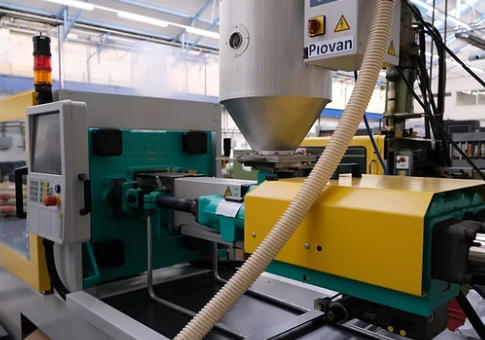
Standard injection molding uses a single material mold to form the entire part in one cycle. A screw unit melts plastic pellets and injects them into a cooled steel or aluminum mold cavity designed as a negative of the part geometry.
Once the material solidifies, ejector pins release the finished part and the cycle repeats, making this ideal for high volume interior components, housings, and clips.
Overmolding combines two materials or two separately molded components into a single bonded part. First, a rigid substrate is molded; then it is transferred to a second cavity, where a softer or different material is molded directly over selected areas.
In aerospace, overmolding is used for latches, handles, grips, and components requiring a hard structural core with a comfortable or high friction outer surface. The chemical bond between materials improves durability and eliminates separate assembly steps.
Insert molding embeds a metal or pre formed insert into a plastic matrix during the molding cycle. The insert is placed into the mold cavity and encapsulated when molten plastic flows around it.
Typical aerospace uses include threaded metal inserts, electrical terminals, and connector pins where designers need strong fastening points, reliable electrical contact, or electromagnetic shielding within lightweight plastic structures.
Micro molding focuses on extremely small parts with very low part weights and fine features. It uses high precision molds, advanced controls, and specialized machines to achieve accurate micro scale geometries.
This process supports miniature gears, bearings, micro lenses, and sensor components in avionics, UAVs, and satellites, where packaging density and weight are critical.
Aerospace injection molding supports a wide variety of critical and semi critical components across platforms.
- Battery housings designed to contain cells and fluids, resist in flight vibration, and withstand aggressive battery chemistries.
- Circuit enclosures that protect printed circuit boards from shock, vibration, and moisture while maintaining dielectric strength.
- Radome structures that shield antennae and RF systems from weather while minimizing signal attenuation.
- Pitot tube related components with smooth, aerodynamically clean shapes that withstand low temperatures and high wind speeds at altitude.
- Turbine or propeller blades for small aircraft and UAVs with optimized airfoils to improve propulsion efficiency.
- Chassis and structural brackets for drones, balancing stiffness, impact resistance, and low weight.
- Window bezels and trims that support cabin pressure control and provide consistent visual quality.
These examples show how injection molded plastics appear in both visible passenger facing parts and hidden functional elements.
Design for manufacturability is a critical step to ensure aerospace plastic parts are moldable, reliable, and economical. Well executed DFM reduces tooling changes, shortens qualification time, and minimizes scrap on certified programs.
Key aerospace DFM considerations include:
- Draft angles: Add adequate draft on vertical walls to allow smooth ejection and reduce scuffing or drag marks.
- Wall thickness: Keep walls as uniform as possible to reduce warpage and sink; use ribs instead of solid masses to increase stiffness.
- Gate and runner layout: Place gates to balance flow, reduce weld lines on critical surfaces, and control fiber orientation.
- Tolerances: Reserve very tight tolerances for dimensions that directly affect fit, sealing, or function, and allow more generous tolerances elsewhere.
- Assembly features: Integrate snap fits, bosses, and alignment features that simplify assembly and reduce fasteners.
Early DFM review with experienced manufacturing engineers helps identify risk areas in the part design, such as thick sections, sharp corners, or undercuts that complicate tooling.
Aerospace injection molding must align with stringent quality and regulatory frameworks, along with platform specific OEM standards. Robust quality systems are essential to maintain long term program approval.
Typical quality and compliance practices include:
- Documented process control plans, risk analyses, and control charts for critical features.
- Material traceability from resin batch to finished part and, if required, to aircraft tail number or system serial number.
- First article inspection for new molds, new programs, and major engineering changes.
- Dimensional inspection using calibrated equipment, including coordinate measuring machines for tight tolerance features.
- Environmental and functional testing such as temperature cycling, vibration, humidity, salt fog, and chemical exposure for critical parts.
Suppliers that can combine precision tooling with strong documentation and traceability are better positioned to support long term aerospace programs and aftermarket requirements.
The aerospace plastics field continues to grow as airframe and system manufacturers look for weight reduction, cost efficiency, and design flexibility. Injection molding plays a central role because of its ability to produce complex, lightweight parts at scale.
Key trends include:
- Increased use of high performance polymers such as PEEK and other advanced materials in high temperature and chemically aggressive environments.
- Integration of smarter process monitoring and data collection to improve yield and support predictive maintenance of molds and presses.
- Sustainability initiatives, including recyclable resins, weight reduction strategies, and energy efficient molding equipment to reduce environmental impact.
- Growing demand from unmanned aircraft, small satellites, and urban air mobility projects, which often require compact, high precision plastic components.
Understanding these directions helps engineering and sourcing teams choose technologies and partners that will remain competitive for the lifetime of a platform.
A typical aerospace injection molding project follows a structured lifecycle that connects design, tooling, validation, and serial production.
1. Concept and requirements
Define functional loads, environmental conditions, regulatory and customer requirements, target cost, and annual volume.
2. Material and process selection
Screen candidate resins based on mechanical, thermal, chemical, and flammability performance, then choose standard molding, overmolding, insert molding, or micro molding according to part needs.
3. Design and DFM review
Develop 3D models, run DFM and mold flow analyses to evaluate filling, potential weld lines, air traps, and warpage, and adjust geometry or gating where necessary.
4. Tooling design and fabrication
Design the mold with appropriate cavities, cooling channels, gates, and ejection systems; then fabricate prototype or production tooling in the chosen tool steel or aluminum.
5. Sampling and validation
Run initial trials, tune processing parameters, confirm dimension and appearance, and complete first article inspection and functional tests.
6. Production ramp up and process control
Lock validated process windows, implement statistical process control for key dimensions and visual criteria, and define inspection frequency and sampling plans.
7. Ongoing optimization and engineering changes
Refine molds or process parameters based on field feedback, updated requirements, or cost improvement projects while maintaining full traceability and configuration control.
To make aerospace plastic components both manufacturable and reliable, engineers can follow several practical guidelines.
- Define clear functional requirements so that materials and tolerances match real loads and environments.
- Verify creep, fatigue, and long term exposure data for polymers in high stress or high temperature applications.
- Avoid sharp internal corners and use fillets and radii to reduce stress concentrations and improve flow.
- Decide early which interfaces require metal inserts versus molded snap fits or other plastic fastening features.
- Ensure that parts requiring inspection or replacement can be accessed without damaging surrounding structures.
Coordinated work between mechanical, materials, and manufacturing engineers reduces redesign cycles and supports smoother qualification.
| Scenario | Injection Molding | CNC Machining | 3D Printing |
|---|---|---|---|
| Volume (thousands of parts per year) | Strong choice after tooling investment. | Costly at scale. | Often higher cost for large series. |
| Geometry complexity | Very good for complex, repeatable shapes with undercuts and thin walls. | Limited by tool access and machining strategy. | Excellent, especially for complex and lattice structures. |
| Lead time for first prototypes | Moderate with rapid tooling; faster with soft tools. | Fast for simple parts and short runs. | Fast for intricate prototypes. |
| Unit cost at scale | Low per part once tool cost is amortized. | Higher per part, especially at large volumes. | Usually higher per part for serial production. |
| Surface finish | Mold dependent; can be very smooth or intentionally textured. | Excellent, can be polished or ground. | Varies; often needs secondary finishing. |
For recurring programs or platforms with stable designs and predictable demand, injection molding usually offers the best balance of cost, precision, and repeatability.
If you are an aerospace brand owner, wholesaler, or equipment manufacturer looking for reliable, high precision plastic parts, this is the right time to evaluate injection molding for your next project. By collaborating with a manufacturing partner that can also provide precision machining, metal stamping, and plastic or silicone product production, you can streamline development, improve consistency, and shorten time to market. Share your drawings, technical requirements, and expected volumes, and request a detailed manufacturability and cost evaluation so you can move from concept to flight ready parts with confidence.
Contact us to get more information!
Aerospace injection molding is used to produce lightweight, high precision plastic parts such as battery housings, radomes, interior trims, drone chassis, and electronic enclosures for aircraft and space systems. It supports both visible cabin components and hidden structural or functional parts.
Frequently used plastics include PP, HDPE, ABS, HIPS, PEEK, and TPU or TPV. The choice depends on required strength, operating temperature, chemical exposure, flammability performance, and long term durability in the target environment.
Injection molding enables the replacement of heavier metal components with high strength engineering plastics. This weight reduction supports lower fuel consumption, higher payload capability, longer range, and potentially lower emissions over the life of the aircraft or UAV.
Injection molded parts can be suitable for demanding and safety relevant applications when materials, part design, tooling, and processing are properly validated. Compliance with aerospace quality standards, full traceability, and rigorous testing are essential to qualify such components.
A strong supplier offers experience with aerospace programs, robust quality certifications, support for DFM and material selection, comprehensive traceability, and the ability to handle processes such as overmolding and insert molding. Integrated capabilities, including machining and other forming methods, are also valuable for complex assemblies.


