Views: 222 Author: Rebecca Publish Time: 2026-02-10 Origin: Site
Content Menu
● What Is CNC Jewelry Manufacturing?
● Why CNC Is Transforming Jewelry Production
● Unmatched Precision in Jewelry Design
● Speed and Efficiency From Prototype to Mass Production
● Customization and Personalization at Scale
● Working With Diverse Materials in Jewelry CNC
● Sustainability: Less Waste, More Value
● Consistency and Quality Control in CNC Jewelry Production
● Typical CNC Workflow for OEM Jewelry Orders
● Key CNC Parameters That Influence Jewelry Quality
● How CNC Jewelry Manufacturing Supports Global OEM and ODM
● Practical Checklist for Evaluating a CNC Jewelry OEM Supplier
● Why CNC Jewelry Manufacturing Matters for the Future
● FAQs About CNC Jewelry Manufacturing
>> 1. Is CNC jewelry manufacturing suitable only for large orders?
>> 2. Will CNC jewelry lose the “handmade” feel?
>> 3. Can CNC machines work with very small jewelry parts?
>> 4. How long does it take to launch a new CNC jewelry design?
>> 5. Is CNC jewelry manufacturing more environmentally friendly?
Efficiency, precision, and innovation are reshaping how global jewelry brands design and manufacture their products, with CNC (Computer Numerical Control) machining at the heart of this shift. From high-end custom rings to mass-produced pendants, CNC technology allows jewelers to deliver intricate, repeatable designs faster, with less waste and more consistent quality than traditional handcraft methods.

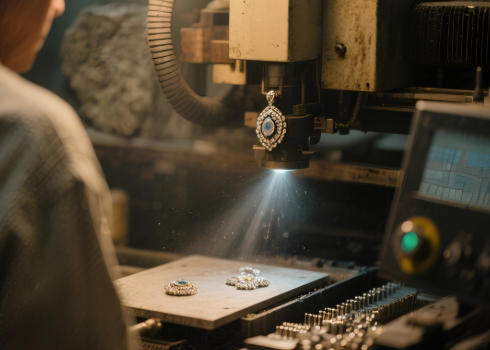
CNC jewelry manufacturing uses computer-controlled machines to cut, mill, drill, and engrave metals and other materials based on digital 2D or 3D designs. Instead of relying solely on manual skills, the jeweler or OEM partner programs the CNC equipment to reproduce the same design with micrometer-level accuracy.
Key characteristics of CNC jewelry machining include:
- Digital workflows driven by CAD/CAM files from prototype to mass production.
- High repeatability, with the same design reproduced in hundreds or thousands of identical pieces.
- Material versatility, as multiple metals and alternative materials can be processed on the same platform.
For brands working with OEM manufacturers, CNC machining turns creative concepts into stable, scalable product lines that are easier to manage and optimize.
CNC jewelry manufacturing is disrupting traditional workshop processes by combining artisan design with industrial-grade precision. Compared with purely hand-crafted methods, CNC jewelry machining delivers faster development of new collections, lower defect rates, and stronger control over cost and quality per piece.
For overseas brands and wholesalers, especially those outsourcing to professional OEM manufacturers, CNC jewelry production offers predictable lead times and consistent quality across large orders.
One of the biggest advantages of CNC jewelry machining is its unparalleled precision when reproducing complex designs. CNC machines can cut and engrave extremely fine features on tiny surfaces, including details that would be very difficult or inconsistent by hand.
With CNC technology, jewelers and OEM factories can:
- Create ultra-fine engravings, micro-patterns, and filigree on rings and pendants.
- Maintain tight dimensional tolerances on prong settings, bezels, and stone seats.
- Ensure that matching items, such as a pair of earrings, are perfectly symmetrical and aligned.
Because designs are translated directly from CAD models to the CNC machine, there is no need for repeated manual correction. This reduces trial and error, shortens development time, and helps each batch meet the original design requirements.
Traditional jewelry making involves multiple manual steps, such as cutting, filing, carving, engraving, and polishing, which can slow down production and increase labor cost. CNC jewelry manufacturing automates many of these operations, allowing factories to complete tasks in a fraction of the time.
Key efficiency benefits include:
- Rapid prototyping, where the first physical sample can be machined quickly once the 3D model is ready.
- Shorter lead times, because factories can move from sample approval to stable production with minimal process change.
- Higher throughput, as multiple parts can be machined in a single setup.
This is particularly valuable for custom projects, where clients require small-batch or personalized designs but still expect fast delivery. Design adjustments can be made digitally in the CAD file and then applied directly on the machine without restarting the whole process.
Consumer demand for personalized jewelry, such as names, dates, initials, and special patterns, has grown rapidly in recent years. CNC jewelry machining enables brands and OEM suppliers to deliver this level of personalization without sacrificing consistency or efficiency.
With CNC technology, manufacturers can:
- Add custom engraving such as names, dates, logos, and symbols on rings, bracelets, and pendants.
- Modify dimensions, including ring sizes, thickness, and width, while keeping the core design structure.
- Offer modular collections where base designs are fixed but details like patterns or textures can be customized for each order.
Once a design is finalized, it can be saved as a digital template and reproduced with identical precision in future batches. This allows brands to build long-term product lines and reorder successful models with confidence.
Modern CNC jewelry manufacturing is not limited to traditional precious metals. CNC machines can process a wide range of materials used in contemporary jewelry design.
Common materials for CNC jewelry machining include:
- Precious metals such as gold, silver, and platinum.
- Hard metals such as titanium and stainless steel.
- Alternative materials including resin, ceramics, and selected engineering plastics.
Tougher metals such as titanium or platinum, which are difficult to shape with conventional methods, can be machined into complex forms and smooth surfaces using CNC equipment. This opens new design possibilities for high-strength, lightweight, or hypoallergenic jewelry collections.
In traditional workshops, cutting and shaping precious metals by hand often leads to significant material waste. Scrap metal generated in these processes reduces material utilization and increases overall cost.
CNC jewelry manufacturing improves sustainability by:
- Precisely calculating tool paths to minimize unnecessary cuts.
- Reducing off-cuts and scrap through accurate nesting and optimized layouts.
- Enabling better material recovery and recycling because waste is more predictable.
Because CNC machines cut with high precision, each piece uses closer to the exact required volume of material. This lowers cost per unit and supports more environmentally responsible production practices.
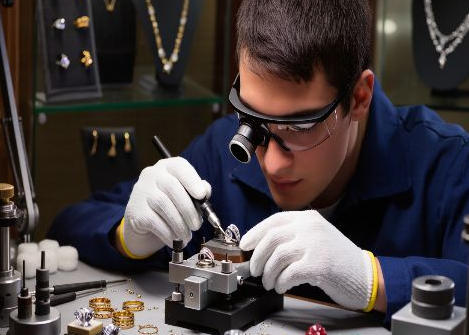
For brands and wholesalers ordering hundreds or thousands of pieces, consistency is critical. CNC machines excel at generating uniform parts where every piece matches the approved sample.
With CNC jewelry machining, factories can:
- Maintain identical engraving depths, line widths, and geometric features.
- Ensure that logos and design elements are applied in exactly the same position on every item.
- Reduce human error, which directly lowers defect rates and rework.
This repeatability builds a stable foundation for long-term supply, especially for overseas buyers who need every shipment to match previous batches in quality and appearance.
To give a clearer view of actual operations, it is useful to understand how a professional OEM CNC jewelry project usually runs.
A typical CNC jewelry OEM workflow includes:
1. Design input
The client provides drawings, CAD models, or physical samples as the starting point.
2. DFM (Design for Manufacturability) review
Engineers evaluate tolerances, structures, and material feasibility to ensure that the design is suitable for CNC machining.
3. Prototype machining
The factory produces a small number of samples for the customer to confirm appearance, size, and fine details.
4. Process optimization
Cutting parameters, tool selection, and fixture design are adjusted to balance surface quality, accuracy, and productivity.
5. Mass production
The final program is locked, and CNC machines run stable batches supported by continuous quality inspection.
6. Finishing and assembly
Polishing, plating, stone setting, assembly, and packaging are performed according to the brand's standards and market positioning.
This structured approach gives buyers a clear path from concept to finished product and reduces risk during development.
Beyond the general process, several technical parameters directly affect the quality and feel of a CNC-machined jewelry piece.
Important factors include:
- Tolerance
Tolerance defines how close the actual size is to the design size, and tighter tolerances are crucial for stone seats, clasps, and moving components.
- Surface roughness
Roughness determines how smooth the jewelry feels and how well it reflects light before polishing and plating.
- Tool selection
Smaller tools can produce finer details but must be combined with suitable cutting speeds and feeds to avoid tool breakage and surface defects.
- Machine stability
High-precision machines with rigid structures and stable spindles create cleaner edges and more accurate details.
Understanding these parameters helps brands communicate their requirements more clearly and evaluate the capabilities of potential suppliers.
For overseas brands, wholesalers, and producers, CNC jewelry machining is both a technical solution and a strategic supply chain choice.
CNC-based OEM and ODM jewelry production supports:
- Brand expansion, through reliable replication of logos, textures, and signature design elements.
- Development of multiple categories, including earrings, rings, bracelets, pendants, and accessory parts, within a single machining platform.
- More stable cost control, because lower waste, fewer defects, and standardized workflows make long-term pricing more predictable.
By partnering with experienced CNC machining manufacturers, overseas customers can launch new collections faster while maintaining consistent quality across regions and product lines.
When selecting a CNC jewelry machining partner, overseas brands can follow this practical checklist:
1. Technical capability
Confirm supported materials, minimum feature size, tolerance range, and typical surface quality.
2. Portfolio and reference projects
Review samples or case studies for similar jewelry styles to match design complexity and finish level.
3. Quality management
Ask about inspection methods, test equipment, sampling frequency, and traceability.
4. Engineering and communication
Evaluate whether the supplier can provide design suggestions, respond quickly, and support changes during development.
5. Production capacity and lead time
Ensure that the factory can handle both small customized batches and large seasonal orders within your required schedule.
A clear evaluation process helps brands build sustainable cooperation with CNC jewelry OEM partners and avoid unnecessary delays or quality issues.
As consumers continue to demand more personalization, shorter delivery times, and higher quality, CNC jewelry manufacturing will play an increasingly important role in the industry. The technology supports hybrid models that combine machine precision and hand finishing, preserving artistic value while meeting modern expectations for consistency and durability.
For brands, wholesalers, and producers, adopting CNC jewelry machining helps create more competitive product portfolios and supports long-term growth in both online and offline channels.
If you are a brand owner, wholesaler, or manufacturer looking to upgrade your jewelry collections with high-precision machining, reliable quality, and flexible customization, consider working with a professional CNC jewelry OEM partner. By collaborating with an experienced machining team that understands materials, tolerances, and finishing requirements, you can turn complex designs into stable, market-ready products and respond more quickly to changing customer demands.
Contact us to get more information!
No. CNC jewelry machining is suitable for both small-batch custom projects and large-volume orders. Once the program is created and verified, it can be used efficiently for any batch size.
Not necessarily. Many brands use CNC machining to create the base shape and fine details, then apply manual polishing, stone setting, and other finishing steps. This combination often delivers a handcrafted look with more consistent quality.
Yes. With proper tools, fixtures, and process settings, CNC machines can handle very small components such as fine ring details, earring parts, and elements used in watch or accessory designs.
The timeline depends on design complexity and required approval steps. However, digital workflows with CAD modeling and rapid prototyping usually allow faster iterations and shorter lead times than purely manual development.
CNC jewelry manufacturing can be more environmentally friendly than traditional methods, because precise tool paths and optimized layouts reduce scrap and make it easier to collect and recycle remaining material, improving overall resource utilization.


