Views: 222 Author: Loretta Publish Time: 2025-12-21 Origin: Site
Content Menu
● Core Drill Bit Keywords and Concepts
>> Carbide-Tipped and Masonry Designs
>> Coatings
>> Center Drill and Spot Drill
● Drill Bit Geometry: Point, Helix, and Flutes
>> Helix Angle and Flute Shape
● How to Choose the Right Drill Bit
>> Step 1: Identify the Workpiece Material
>> Step 2: Define Hole Function and Quality
>> Step 3: Match Machine, Setup, and Coolant
● Practical Tips for CNC Drilling
● How U-NEED Supports OEM Drilling Projects
● Work With U-NEED on Your Next Drilling and OEM Project
● FAQs
>> 1. What are the most common types of drill bits for metal?
>> 2. Which drill bit material is best for stainless steel?
>> 3. When should I use a step drill bit?
>> 4. Why does my drill bit burn or wear out quickly?
>> 5. Do I always need a center drill before drilling?
>> 6. Can one drill bit work for both metal and plastic?
Choosing the right drill bit type and material is critical for hole quality, tool life, and machining cost in CNC manufacturing, especially for metals, plastics, and composite fixtures. This guide explains the main types of drill bits, how to select materials and geometries, and how U-NEED supports OEM drilling projects with precision machining, plastic, silicone, and metal stamping capabilities.[1]

In CNC machining and general workshop use, engineers most often search for types of drill bits, drill bit types, CNC drill bits, HSS drill bits, cobalt drill bits, carbide drill bits, twist drill bits, step drill bits, center drills, countersinks, flat bottom drills, masonry bits, and reamers. Understanding these key terms helps you choose tools that match your workpiece material, tolerance requirements, and production volume.[2][1]
A drill bit is a rotating cutting tool used with a drilling machine, CNC machining center, or lathe to create round holes in metal, plastic, wood, and other materials. In CNC machining, drill bits handle most hole-making operations and directly affect tolerance, surface finish, and cycle time.[1][2]
Typical functions of drill bits include:
- Creating through holes and blind holes for fasteners and fluid passages
- Preparing holes for tapping, reaming, countersinking, or counterboring
- Generating multi-diameter stepped holes in a single setup
- Providing accurate pilot and center holes for subsequent machining
Choosing the correct drill bit material is as important as selecting the geometry, especially for drilling metals. Material determines hardness, toughness, temperature resistance, wear life, and resharpening options.[3][1]
HSS drill bits are widely used because they are versatile, economical, and tough. They work well for general drilling in wood, plastics, aluminum, copper alloys, and low-carbon steels when cutting speeds and feeds are properly controlled.[1]
Cobalt-containing HSS, often 5–8% cobalt, offers higher hot hardness and wear resistance than standard HSS. These drill bits are better for stainless steel, heat-resistant alloys, and tougher metals where heat buildup is a major concern.[3]
Carbide drill bits provide excellent hardness and heat resistance, making them suitable for abrasive and hardened materials at higher cutting speeds. They are often used in production CNC environments drilling hardened steels, cast irons, composites, and other demanding materials where tool life and dimensional stability are critical.[4][2]
Carbide-tipped drill bits combine a tough steel body with carbide cutting edges to balance cost and durability. These tools are frequently used as masonry drill bits for concrete, brick, and stone, often paired with hammer action.[1]
Common coatings such as TiN, TiAlN, and black oxide improve wear resistance, reduce friction, and help manage heat, especially during high-speed drilling of steels and stainless steels. Correct coating selection enhances tool life in both manual and CNC applications.[4][1]
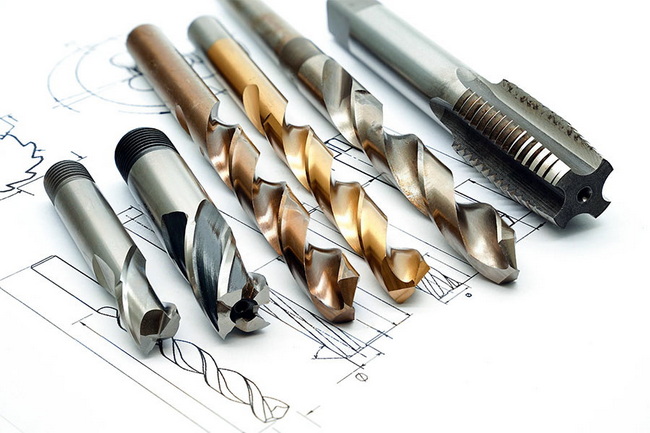
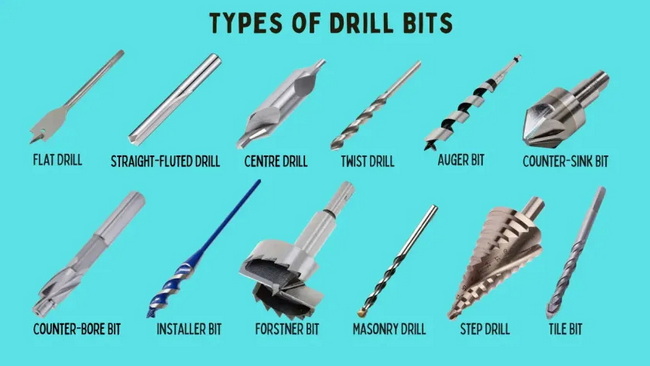
Different types of drill bits are designed for specific hole shapes, materials, and machining strategies. Selecting the right type is essential for reliable production, consistent quality, and cost control.[2][1]
The twist drill bit is the most widely used drill bit in CNC machining and manual drilling. It has helical flutes that evacuate chips and usually features a point angle around 118° or 135° depending on material and application.[2][1]
Key characteristics:
- Spiral flutes for chip evacuation and coolant access
- Available in HSS, cobalt, and carbide with or without coatings
- Wide range of diameters, lengths, and tolerances
Typical applications:
- General drilling in metals and plastics
- Pre-holes for tapping and reaming
- Fixture plates, machine frames, and standard fastener holes
Center drills and spot drills are short, rigid tools used to accurately start holes before larger drills or turning center operations. They reduce tool wandering and improve concentricity in both CNC and conventional machines.[5][2]
When to use:
- Creating center holes on lathes for live centers
- Spotting precise locations before deep drilling
- Starting holes where positional accuracy is critical
Flat bottom drills are designed to make flat-bottom blind holes or counterbores for screws and locating surfaces. Unlike standard twist drills, they leave minimal cone at the hole bottom, which is beneficial for seating surfaces and sealing areas.[2]
Common uses:
- Counterbores for socket head cap screws
- Flat seats for washers, seals, and plugs
- Spotfacing around existing holes on machined components
Step drill bits combine multiple diameters in one tool, usually arranged as a conical stepped profile. They are especially efficient for thin materials and panels because they can create several hole sizes without changing tools.[6][2]
Advantages:
- Fewer tool changes and shorter cycle times
- Smooth transitions for cable entries and fittings
- Improved coaxiality between different diameters
Typical materials:
- Sheet metal, control panels, electrical boxes
- Thin-wall plastic panels and housings
Countersink bits are used to cut conical recesses so screw heads sit flush or below the surface of a part. They are usually applied after drilling to finish the hole entrance.[5][1]
Key parameters:
- Common angles include 82° and 90° depending on screw standard
- Multiple flutes reduce chatter and achieve better surface finish
- Suitable for metals, plastics, and wood when parameters are correct
A reamer is not a drill bit, but it is a finishing tool used after drilling to achieve tighter tolerances and smoother surfaces. Reaming removes a small amount of material to improve cylindrical form and diameter accuracy.[1][2]
Typical workflow:
- Drill hole slightly undersize with a twist drill
- Ream to final dimension for precise fits and alignment features
This combination is widely used for dowel pin holes, alignment holes in fixtures, and mounting interfaces where tight fit is essential.[1]
Masonry drill bits are designed for concrete, masonry, and stone, often used with hammer drills or rotary hammers. They typically feature a carbide tip brazed onto a steel shank to resist abrasive wear.[7][1]
Applications:
- Anchoring and fastening in building structures
- Mounting brackets, conduits, and industrial equipment on walls and floors
Specialty drill bits cover a broad category of tools tailored for specific materials or hole geometries. Examples include hole saws for large-diameter openings, glass and tile bits with special tips, and custom step or form drills for unique multi-step holes.[8][6]
These tools are frequently engineered for OEM production lines where cycle time and repeatability are critical.[2]
Beyond type and material, geometry strongly influences cutting forces, chip evacuation, and tool life. Correct geometry selection ensures stable drilling and reduces the risk of broken tools and poor surface quality.[9][2]
The point angle affects how aggressively the tool enters the material and how axial force is distributed. Standard 118° points are common for softer materials, while 135° split points are often used for hard materials and self-centering performance.[2]
The web (core thickness) needs to balance strength and chip flow, and web thinning can help reduce thrust and improve deep-hole performance.[2]
The helix angle and flute shape control chip removal and cutting edge engagement. Standard helix angles around 30° work well for many materials, while higher helix angles improve chip evacuation in long-chipping materials such as stainless steel and aluminum.[2]
Straight flutes provide greater rigidity and are useful for some brittle materials and thin sections where spiral action might cause grabbing.[1]
Selecting the correct drill bit requires a systematic look at material, hole function, machine capability, and production volume. A structured approach helps prevent tool failure, scrap, and unnecessary cost.[3][1]
- Soft metals like aluminum, brass, and mild steels often work well with HSS or coated HSS twist drills when coolant and speeds are optimized.[1]
- Stainless steels and high-temperature alloys usually require cobalt or carbide drill bits with appropriate coatings and lower surface speeds.[3]
- Concrete, brick, and stone require carbide-tipped masonry bits with hammer action.[1]
- Standard through holes for bolts or general assembly can rely on twist drills only.
- High-accuracy holes typically use a combination of spot drill + twist drill + reamer to meet tight tolerances.[1]
- Flush or countersunk screws require a drill + countersink sequence with matching angles.[5]
- Multi-diameter holes in thin materials benefit from step drill bits for efficiency and alignment.[6]
CNC machining centers and lathes can run high-performance carbide drills at elevated speeds with internal coolant. Handheld drills and low-rigidity setups require tougher, less brittle materials like HSS or cobalt and more conservative parameters.[2][1]
For metals, proper use of coolant or cutting fluid helps control heat, extend tool life, and improve hole quality.[9]
Good CNC drilling practice combines correct drill bit selection with optimized cutting parameters and chip control.[2]
Useful guidelines include:
- Use spot drills or center drills before long or small-diameter drills to improve positional accuracy and reduce walking.[2]
- Apply peck drilling for deep holes to clear chips and avoid packing inside flutes.[2]
- Monitor wear on cutting edges and replace or resharpen tools before they cause dimensional issues or surface damage.[1]
- Adjust feed and speed based on material, drill bit material, and coating to avoid burning and edge chipping.[3]
U-NEED is a Chinese manufacturing company specializing in high-precision machined parts, plastic product manufacturing, silicone product manufacturing, and metal stamping, serving overseas brands, wholesalers, and manufacturers with OEM services. In these projects, optimized drill bit selection and machining strategies are essential for reliable performance, stable quality, and competitive cost.[2]
By combining CNC machining, plastic and silicone molding processes, and metal stamping, U-NEED can:
- Help select suitable types of drill bits, materials, and coatings for different metals and plastics in a single assembly
- Optimize hole patterns, diameters, and tolerances for mass production, improving assembly efficiency and product consistency
- Provide integrated OEM support from design for manufacturability (DFM) and prototyping to full-scale production and quality assurance
If you need precision holes, complex multi-step drilling, or integrated metal and plastic components for your products, collaborating with a capable OEM partner is crucial. U-NEED offers experience in CNC machining, plastic and silicone manufacturing, and metal stamping to support demanding international customers from concept to finished parts.
Send your drawings, 3D models, or technical requirements to U-NEED, and the engineering team can recommend the most appropriate drill bit types, materials, and machining strategies for your project, along with competitive quotations and lead times. Get in touch with U-NEED today to start optimizing your drilled parts and assemblies for performance, cost, and long-term reliability in your target markets.
The most common types of drill bits for metal are twist drills, step drills, center drills, countersinks, and reamers, often made of HSS, cobalt, or carbide.
For stainless steel, cobalt and carbide drill bits offer better heat resistance and wear performance than standard HSS, making them more suitable for harder metals.
Use a step drill bit when you need multiple diameters in thin materials such as sheet metal or panels, or when you want to avoid frequent tool changes and still maintain good hole quality.
Drill bits often burn or wear quickly because of excessive speed, insufficient coolant, wrong drill bit material, or poor chip evacuation, especially in hard metals or deep holes.
Center or spot drills are strongly recommended for small diameter holes, deep holes, or high‑precision hole patterns, as they reduce walking and improve positional accuracy.
Many HSS twist drills can work for both metal and plastic, but cutting parameters and chip control must be adjusted to avoid melting plastics and overheating metals.
[1](https://trdsf.com/blogs/news/drill-bit-selection-guide-types-uses-and-maintenance)
[2](https://www.cncmillingtools.com/cnc-drill-bits/)
[3](https://benchmarkabrasives.com/blogs/news/hss-vs-cobalt-vs-carbide-drill-bits-what-to-choose)
[4](https://www.drillbitwarehouse.com/the-ultimate-guide-to-different-drill-bit-materials/)
[5](https://jiahuicustom.com/blogs/guide-on-cnc-drilling-and-drill-bits/)
[6](https://www.baucor.com/blogs/news/top-7-types-of-specialty-drill-bits-and-their-uses-in-precision-drilling)
[7](https://www.foxwoll.com/blogs/different-types-of-drill-bits/)
[8](https://carbideprocessors.com/pages/technical-info/types-of-drill-bits.html)
[9](https://www.kennametal.com/us/en/resources/blog/metal-cutting/how-to-choose-the-right-carbide-drill-bit.html)


