Views: 222 Author: Rebecca Publish Time: 2026-01-20 Origin: Site
Content Menu
● What Is 4-Axis CNC Machining?
>> Key Advantages of 4-Axis CNC
● What Is 5-Axis CNC Machining?
● 4-Axis vs 5-Axis CNC: Core Differences
● Benefits of 4-Axis CNC for OEM Projects
● Benefits of 5-Axis CNC for Complex Parts
● When to Use 4-Axis vs 5-Axis (Decision Checklist)
● Design Tips to Leverage 4- and 5-Axis Machining
● Typical Applications of 4- and 5-Axis CNC
● Cost, Budget, and ROI Considerations
● How to Choose the Right CNC Partner
● Call to Action: Share Your Drawings and Get an Optimized Solution
● FAQs About 4-Axis and 5-Axis CNC
>> 1. Is 5-axis CNC always better than 4-axis?
>> 2. Can 4-axis CNC machine all five sides of a part?
>> 3. What is the difference between 3+2 and continuous 5-axis machining?
>> 4. Why does 5-axis machining improve surface finish?
>> 5. How should OEM buyers decide which axis count they need?
For overseas OEM buyers, the core difference between 4-axis and 5-axis CNC machining lies in how many directions the tool and workpiece can move, which directly affects geometry capability, accuracy, lead time, and total cost. Understanding these axes helps you decide which process is right for complex parts such as turbine blades, medical implants, automotive components, and precision housings.

CNC axes describe how many directions the cutting tool and/or workpiece can move during machining. In milling and turning, more axes mean more complex motion combinations and the ability to machine more sides or angles in a single setup.
- X-axis: Left–right movement across the table
- Y-axis: Front–back movement across the table
- Z-axis: Up–down movement of the tool
- A / B / C axes: Rotary motions around X, Y, and Z respectively
For most OEM applications, the practical comparison is between 3-axis, 4-axis, and 5-axis equipment.
3-axis CNC machining is still the most widely used configuration in the industry and forms the foundation for understanding 4-axis and 5-axis. In a typical 3-axis mill, the spindle moves up and down while the table moves in X and Y to create the part.
- Suitable for prismatic parts, flat surfaces, pockets, and simple holes
- Cost-effective for simple geometries and moderate tolerances
- Widely available worldwide, including in China-based job shops
However, keeping the cutting tool at a fixed angle makes it difficult to reach undercuts or complex 3D contours, and often requires multiple setups, which increases time and stack-up error.
4-axis CNC machining builds on 3-axis by adding a rotary A-axis around X, enabling the workpiece to rotate while the tool cuts. This allows machining on multiple sides of a part in a single setup.
In a standard 4-axis configuration:
- X, Y, Z control linear tool movement
- A-axis rotates the workpiece around X while it remains fixtured to the table
This extra indexed or continuous rotation makes it ideal for:
- Machining features around the circumference of shafts or cylinders
- Drilling radial holes and slots
- Engraving logos or patterns around a part
4-axis machining is often chosen over 3-axis because it offers a better cost–performance balance for medium-complexity parts.
- Multi-side machining in a single setup (up to four sides)
- Fewer setups, therefore better accuracy and shorter cycle time
- Lower cost than 5-axis equipment and programming
- Very suitable for high-volume production of similar parts
For many OEM components, 4-axis is the sweet spot when you need more capability than 3-axis but do not require full 5-axis flexibility.
5-axis CNC machining adds two rotary axes to the three linear axes, allowing the tool or workpiece to tilt and rotate so the tool can approach the part from many directions. With five coordinated motions, the tool can stay optimally oriented to complex surfaces.
A 5-axis machine still uses X, Y, and Z for linear motion, but it adds two of the following rotations:
- A-axis: Rotation around X
- B-axis: Rotation around Y
- C-axis: Rotation around Z
Common configurations include AC 5-axis and BC 5-axis, depending on which axes rotate. By combining rotations with linear travel, the machine can continuously reposition the tool to maintain the correct cutting angle.
There are two major 5-axis machining modes.
- 3+2-axis (positional 5-axis)
- Table or head tilts to a fixed angle, then the part is cut using 3-axis motion
- Ideal for deep cavities and tilted surfaces
- Fast machining, easier setup, lower risk of tool interference
- Continuous (simultaneous) 5-axis
- Linear and rotary axes move together during cutting
- Tool can stay nearly perpendicular to the surface
- Provides excellent surface finish and access to very complex geometries
Both modes can dramatically reduce the number of setups and allow machining of features impossible on 3-axis machines.
The table below summarizes the practical differences between 4-axis and 5-axis CNC machining for OEM projects.
| Aspect | 4-Axis CNC Machining | 5-Axis CNC Machining |
|---|---|---|
| Extra axes | Adds A-axis rotation around X | Adds two rotary axes (A/B/C) depending on configuration |
| Typical motion | 3 linear + 1 rotary; often indexed rotation | 3 linear + 2 rotary; 3+2 positional or continuous 5-axis |
| Geometries | Shafts, prismatic parts with features on sides, radial holes | Highly contoured 3D shapes, freeform surfaces, complex undercuts |
| Setups | Fewer setups than 3-axis, but more than 5-axis | Often single-setup machining for 5 sides of a part |
| Accuracy | High; improved by reduced fixturing changes | Very high; minimal repositioning and optimal tool angle |
| Surface finish | Good; may require extra passes for complex surfaces | Excellent; shorter tools and stable tool angle reduce vibration |
| Programming & operation | Simpler than 5-axis; moderate CAM complexity | More complex programming and process planning |
| Typical machine cost | Lower initial investment and hourly rate | Higher equipment and operating cost |
| Ideal use cases | Medium-complexity, multi-sided parts; cost-sensitive projects | High-value parts with complex shapes or tight tolerances |
4-axis machining is often the most economical upgrade from 3-axis, offering clear productivity gains without the full cost of 5-axis.
Main benefits include:
- Fewer setups, higher throughput
- Machine several sides of a part in one clamping
- Reduce fixture changes and manual handling
- Improved accuracy
- Less repositioning means fewer cumulative tolerancing errors
- Better repeatability across large batches
- Lower per-part cost at volume
- Faster production and less labor reduce overall cost
- 4-axis machines and CAM are generally cheaper than 5-axis
For OEMs ordering shafts, pins, connectors, manifolds, and flanges, a well-optimized 4-axis process is often enough to hit required tolerances and delivery targets.
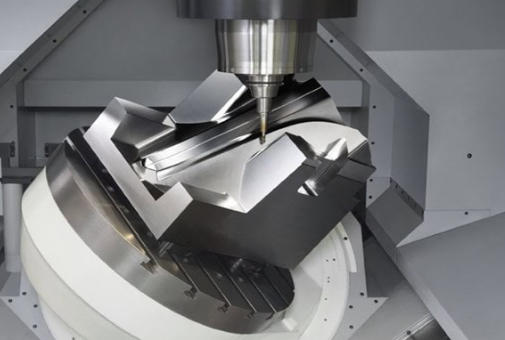
5-axis machining stands out when you need maximum flexibility, performance, and quality in demanding applications.
Key advantages include:
- Higher precision and accuracy
- Minimal setups and stable fixturing improve dimensional control
- Tool can approach at optimal angles to maintain tolerances
- Superior surface finish
- Shorter tools and consistent tool angle reduce vibration
- Ideal for freeform surfaces and smooth aerodynamic profiles
- Faster production and shorter lead times
- Single-setup machining of multiple sides
- Reduced manual intervention and fewer errors
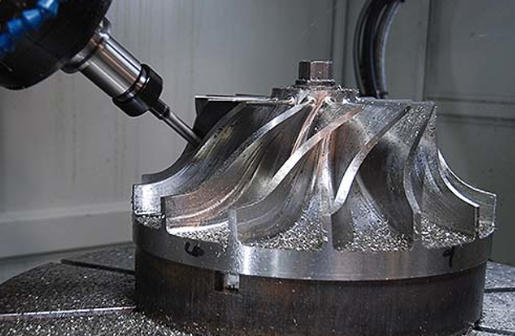
Industries such as aerospace, medical, automotive, and energy rely heavily on 5-axis for parts like turbine blades, orthopedic implants, impellers, and structural brackets.
Choosing between 4-axis and 5-axis is not just a technical question; it is a business decision involving cost, risk, and long-term part strategy.
1. Part geometry is medium complexity
- Multiple sides, but no extreme undercuts or deep twisted surfaces
2. Cost sensitivity is high
- You need competitive pricing for high-volume components
3. Tolerances are tight but standard
- Typical mechanical parts for industrial, consumer, or automotive use
1. Geometry is complex or freeform
- 3D contours, organic surfaces, integrated undercuts
2. You need best-in-class accuracy and finish
- Aerospace, medical, and high-end automotive applications
3. You want to reduce setups and lead time
- Short runs of high-value parts where every minute of setup matters
For many OEM programs, it is common to prototype in 5-axis to verify complex geometry and then optimize for 4-axis or mixed processes for series production where possible.
Good design-for-manufacturing decisions help you get the most from advanced axis capability.
- Align key features to natural machine axes to simplify machining
- Use consistent datum structures to make fixturing and inspection easier
- Avoid unnecessary undercuts if a slight geometry change will eliminate them, which may allow 4-axis instead of 5-axis and reduce cost
On complex parts, collaborating early with an experienced CNC supplier helps identify which features truly require 5-axis and where simpler setups are sufficient.
Both 4-axis and 5-axis are widely used across modern manufacturing, but they excel in different application profiles.
- Rotational parts with side features, such as shafts, pins, and valve bodies
- Housings and brackets requiring machining on several faces
- High-volume components where unit cost is critical
- Turbine blades, blisks, and impellers
- Orthopedic implants and dental components
- Complex molds with deep cavities and freeform surfaces
5-axis is especially powerful when combined with high-performance CAM and stable fixturing, enabling aggressive toolpaths and reduced cycle times.
From a purchasing perspective, the key is understanding what you really need and how that affects both price and risk.
- Machine and hourly rate
- 5-axis machines have significantly higher capital and operating costs
- Hourly rates are higher, but per-part cost may be lower on complex jobs
- Programming and setup
- 5-axis requires advanced CAM and more skilled programmers
- The gain is saved setups, fewer fixtures, and less rework
- Total cost of ownership
- For high-value parts, avoiding scrap and delays often justifies 5-axis
- For straightforward geometries, 4-axis is usually the best value
Discussing annual volume, target price, and quality requirements with your supplier helps determine the best axis strategy for your program.
Beyond axis count, your success depends on working with a reliable CNC machining partner that understands OEM expectations.
Look for:
- Proven experience with 4-axis and 5-axis projects in your industry
- Ability to handle metals, engineering plastics, and elastomers
- Robust quality control, including incoming inspection, in-process checks, and CMM measurement
- Clear communication about tolerances, critical features, and lead time
A good supplier will not simply sell you 5-axis capacity; instead, they will recommend the most economical process that still satisfies your performance requirements.
If you are planning a new project and are not sure whether 4-axis or 5-axis is more suitable, the fastest way to move forward is to share your part information and let an experienced engineering team evaluate it.
Prepare your 3D CAD files, 2D drawings, material and surface finish requirements, tolerance specifications, and estimated order quantities, then send them to your machining partner for a detailed review. A professional OEM supplier can provide practical design feedback, recommend the best axis configuration, and offer a clear quotation and lead-time plan tailored to your project.
Contact us to get more information!
No. 5-axis offers more flexibility and better access to complex geometries, but it also comes with higher equipment and programming costs. For many medium-complexity parts, 4-axis provides a better price–performance ratio.
A 4-axis machine can rotate the part around one axis and reach several sides in a single setup, but it cannot typically address every face and undercut in one clamping like true 5-axis equipment. Complex freeform surfaces and deep cavities usually still require 5-axis.
In 3+2 machining, the rotary axes position the part at a fixed angle and then cutting proceeds using 3 linear axes, while in continuous 5-axis, all five axes move simultaneously during cutting. Continuous 5-axis provides better surface finish and access but is more complex and often slower.
By allowing the tool to stay at an optimal angle and keeping the workpiece closer to the spindle, 5-axis machining supports shorter tools that vibrate less and follow curved surfaces more smoothly. This leads to finer surface finishes and reduced need for secondary polishing.
OEM buyers should evaluate part geometry, tolerance requirements, surface finish, annual volume, and budget, then discuss these with a trusted CNC supplier. The supplier can propose 3-axis, 4-axis, or 5-axis, or a combination, to meet both technical and commercial targets.
1. https://www.rapiddirect.com/blog/4-axis-and-5-axis-cnc-machining/
2. https://www.rapiddirect.com/blog/what-is-5-axis-cnc-machining/
3. https://www.3erp.com/blog/3-axis-vs-4-axis-vs-5-axis-cnc-machining/
4. https://amfg.ai/2023/11/07/cnc-machining-3-axis-4-axis-5-axis-milling/
5. https://www.xometry.com/resources/machining/3-axis-vs-5-axis-cnc/


