Views: 222 Author: Rebecca Publish Time: 2026-01-19 Origin: Site
Content Menu
● What Is Rapid Prototyping vs CNC Machining?
● Key Differences Between CNC Machining and Rapid Prototyping
>> Process, Materials, and Accuracy
● When to Use Rapid Prototyping Alone
>> Early Concept and Design Validation
>> Marketing Samples and Visual Models
● When to Use CNC Machining Alone
>> High-Precision Functional Prototypes
>> Low-Volume Production and Bridge Manufacturing
● When to Combine CNC Machining and Rapid Prototyping
>> Scenario 1: Complex Parts with Internal Channels
>> Scenario 2: Rapid Molds and Tooling Inserts
>> Scenario 3: Small-Batch Customization
● Three Core Strategies for a Hybrid CNC–Rapid Prototyping Workflow
>> 1. Data Chain Synergy: CAD to CAM Without Friction
>> 2. Material and Process Matching
>> 3. Balancing Cost and Efficiency by Volume
● Practical Step-by-Step Workflow for OEM Projects
>> Step 1 – Concept and Ergonomic Prototypes
>> Step 2 – Functional Validation with CNC and RP
>> Step 3 – Design for Manufacturing (DFM) Review
>> Step 4 – Small-Batch Pilot Runs
>> Step 5 – Scale-Up and Multi-Process Integration
● Industry Use Cases: How Hybrid CNC–RP Works in Practice
>> Aerospace and Automotive Components
>> Medical and Wearable Devices
● How an Integrated OEM Partner Adds Value
● Take the Next Step with an Integrated Hybrid Strategy
● FAQs: CNC Machining vs Rapid Prototyping
>> 1. Is rapid prototyping replacing CNC machining?
>> 2. When should I move from printed prototypes to CNC-machined parts?
>> 3. Can I use rapid prototyping materials for functional testing?
>> 4. How does a hybrid workflow affect total project cost?
>> 5. What information should I send to an OEM partner to get the right process recommendation?
Choosing between CNC machining and rapid prototyping is no longer about picking a winner. For OEM brands and manufacturers, the most competitive strategy is knowing when to use each and when to combine both in a hybrid workflow. This guide is written for overseas buyers working with integrated OEM partners like U-NEED, helping you reduce risk, control cost, and accelerate time to market.

Rapid prototyping (RP) is an umbrella term for fast, iterative fabrication of physical parts directly from 3D CAD data, usually using 3D printing technologies such as SLA, SLS, FDM, or metal additive manufacturing.
CNC machining, by contrast, is a subtractive manufacturing process where cutting tools remove material from metal or plastic stock under computer control to achieve tight tolerances and stable repeatability.
- Rapid prototyping prioritizes speed, design freedom, and iteration in the early development stages.
- CNC machining prioritizes precision, surface finish, and mechanical performance, making it ideal for functional prototypes and production parts.
For OEM projects, the most effective approach is often not “RP vs CNC” but a CNC-assisted rapid prototyping workflow that moves from printed concepts to machined, production-grade parts as the design matures.
Understanding the core differences helps you decide which process to use at each stage of the product lifecycle.
- Rapid prototyping builds parts layer by layer, which supports very complex internal geometries but can leave visible layer lines and anisotropic properties.
- CNC machining removes material from a solid billet, delivering excellent accuracy and surface quality but with more constraints on internal features.
| Aspect | CNC Machining | Rapid Prototyping (3D Printing, etc.) |
|---|---|---|
| Manufacturing mode | Subtractive cutting from solid metal or plastic stock | Additive, layer-by-layer build from resins, powders, or filament |
| Typical tolerance | Around ±0.005–0.02 mm on precision equipment | Often ±0.05–0.2 mm depending on process and size |
| Design freedom | Limited by tool access and fixturing | Supports highly complex internal channels and lattices |
| Surface finish | Very smooth with proper tooling and parameters | Layer lines, often needs post-processing for critical surfaces |
| Material choices | Wide range of metals and engineering plastics | Photopolymer resins, nylons, metal powders, some elastomers |
| Best for | Functional prototypes, jigs, end-use parts, production | Concept models, early prototypes, complex test geometries |
For overseas OEM buyers, a mixed strategy is usually optimal: rapid prototyping for early validation and CNC machining for final performance verification and production-equivalent parts.
There are phases where rapid prototyping delivers maximum value on its own, before CNC machining becomes necessary.
Use rapid prototyping alone when:
- You need fast, low-cost models to validate overall form, fit, and ergonomics.
- Design is still unstable, and frequent design changes are expected.
In this stage, technologies like SLA and SLS allow you to print multiple design variants overnight, drastically shortening the design feedback loop.
Rapid prototyping is also ideal for:
- Appearance models for internal reviews, exhibitions, or early customer demos, where cosmetic quality is more important than mechanical strength.
- Low-risk market testing where you need visually realistic samples but do not yet require engineering-grade materials.
At this point, investing in CNC machining or tooling is usually premature. Speed and flexibility are more important than tolerance.
There are also clear situations where going straight to CNC machining is the most efficient, even before any printed prototype is considered.
Use CNC machining alone when:
- The part must meet tight tolerances and specific surface roughness for sealing, sliding, or assembly.
- You need to test in production-grade materials such as aerospace aluminum, medical stainless steel, PEEK, or glass-filled nylon.
Examples include precision housings, optical mounts, metal brackets, or jigs and fixtures that will be used in production lines. In these cases, rapid prototyping may not offer the material consistency or accuracy your test requires.
CNC machining is the natural choice when:
- Volumes are low (for example, 1–200 pcs per design) but dimensional stability and durability are critical.
- You need bridge production before injection molds or other tooling are ready.
For many OEM buyers, CNC machining becomes a practical “mini-production” method. You can deliver real parts to early adopters while your mass-production tooling is being developed.
The strongest competitive advantage comes from hybrid workflows that deliberately combine rapid prototyping and CNC machining at different stages of the same project.
For parts such as turbine blades, cooling plates, or fluid manifolds, it is very difficult to create internal structures by CNC alone.
- Step 1 – Rapid prototyping: Use SLS or metal 3D printing to create a near-net-shape blank with complex internal channels and lattices.
- Step 2 – CNC finishing: Machine critical surfaces (flanges, sealing faces, bearing seats) to achieve required tolerances and surface finish.
This approach can shorten development time and reduce trial-and-error cost significantly, especially for complex metal parts.
Hybrid workflows are also powerful for rapid tooling in plastic and silicone molding.
- Rapid prototyping: Print master patterns, trial cavities, or conformal-cooled inserts to validate flow and cooling performance.
- CNC machining: Use 3-axis or 5-axis machining to cut the final mold steel, guided by the validated prototype.
This can reduce mold delivery time from months to a few weeks and cut the risk of expensive rework on hardened steel tools.
For customized enclosures, wearables, medical devices, and high-end consumer products:
- Rapid prototyping enables personalized designs to be printed quickly in different styles, textures, or engravings.
- CNC machining then produces the final parts in titanium, aluminum, or engineering plastic with tight accuracy where needed.
Brands use this hybrid approach to deliver small batches of premium customized products with both design freedom and high-quality finish.
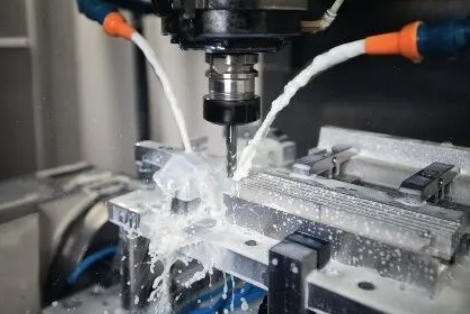
Beyond choosing scenarios, OEM buyers need practical strategies to make CNC machining and rapid prototyping work together smoothly.
A key success factor is a unified digital workflow.
- Use a consistent CAD environment and ensure that both rapid prototyping and CNC machining run from the same master CAD model.
- Minimize format conversions that can introduce tolerance stack-ups, misalignment, or geometry errors between printed and machined stages.
Factories that integrate CAD, rapid prototyping build preparation, and CNC CAM programming in one data chain reduce duplicated modeling work and lower error risk.
Choosing the right combination of materials and manufacturing steps is critical for hybrid workflows.
- Metals: Print near-net-shape metal blanks (or wax patterns for casting) and use CNC machining for the precision envelope.
- Plastics: Use FDM or SLS to print functional trial parts, then machine jigs, fixtures, or final housings from reinforced engineering plastics.
This approach maximizes the strengths of each technology. Rapid prototyping provides flexibility and complex geometry, while CNC machining guarantees dimensional accuracy and structural performance.
A practical rule of thumb for hybrid manufacturing is to look at batch size and complexity.
- When quantity is below roughly 50 pcs, a hybrid solution (rapid prototyping for concept and near-net shape, CNC for finishing) is often economical.
- When quantity exceeds around 500 pcs and the design is frozen, moving to pure CNC or tooling-based production is usually more cost-effective.
You can think of total manufacturing cost as a combination of rapid prototyping cost per piece and CNC finishing cost. By adjusting how much finishing is done by CNC, OEM buyers can minimize total cost while still meeting performance requirements.
To help overseas brands, wholesalers, and manufacturers work more effectively with an integrated OEM partner, the following five-step hybrid workflow is widely used in modern product development.
- Share CAD models and basic specification targets with the factory.
- Use rapid prototyping to create quick visual and ergonomic prototypes for internal discussions and early feedback.
- Identify critical features, such as mounting interfaces, sealing surfaces, and load-bearing areas.
- Combine rapid prototyping for non-critical geometry with CNC machining for high-precision features where performance matters.
- Ask your OEM partner to provide DFM feedback for both rapid prototyping and CNC machining, including draft angles, wall thickness, tool access, and fixturing.
- Adjust the design so that it can be built efficiently using your planned hybrid sequence.
- Run small pilot batches using CNC machining, with or without printed near-net blanks, to validate production workflows and assembly lines.
- Check dimensional reports, stability under real operating conditions, and customer feedback during pilot deployment.
- Once demand is proven, decide whether to move certain parts to molding, casting, or stamping, while still using CNC and rapid prototyping for redesigns and engineering changes.
- Use the same OEM partner to coordinate machining, plastic molding, silicone parts, and metal stamping, reducing logistics complexity and lead time.
Real-world applications show how combining CNC machining and rapid prototyping reduces risk and accelerates market entry.
- Turbine or turbocharger blades: Rapid prototyping is used to validate intricate cooling passages and aerodynamic profiles, then CNC machining refines the final blade surface to a demanding roughness and tolerance.
- Lightweight brackets and housings: Topology-optimized shapes are first printed to confirm stiffness, and later machined in aluminum or titanium for flight- or road-worthy performance.
These hybrid workflows can cut development cycles significantly and lower the cost of each design iteration.
- Orthopedic implants and dental parts: Rapid prototyping or metal additive manufacturing creates porous or lattice structures, while CNC machining finishes threads, tapers, and sealing geometries for reliable assembly.
- Patient-specific models: Rapid machining of anatomical models and fixtures makes it easier to verify surgical tools and positioning devices before mass production.
For regulated applications, hybrid workflows support both fast iteration and compliance with strict dimensional and material standards.
For overseas buyers, the technology choice is only one part of the picture. The capabilities and integration level of your supplier have a direct impact on cost, lead time, and quality.
An experienced OEM partner that combines CNC machining, rapid prototyping, plastic and silicone molding, and metal stamping can help you:
- Choose the right process mix at each stage, from prototype to pilot to mass production, instead of locking into a single technology too early.
- Keep your entire project on one digital and logistical chain, reducing communication errors and delays.
Working with a factory that understands both rapid prototyping and CNC machining allows you to treat manufacturing as a flexible toolbox, not a fixed constraint.
If you are planning a new product or redesign, consider a hybrid CNC–rapid prototyping strategy from the very beginning instead of waiting until problems appear in production. Share your CAD files, target quantities, application conditions, and quality requirements with an integrated OEM partner like U-NEED, so they can design a combined roadmap for rapid prototyping, CNC machining, plastic and silicone molding, and metal stamping that matches every stage of your product lifecycle. By aligning process choice with volume, performance, and schedule, you will bring better parts to market faster, with lower risk and more predictable costs.
Contact us to get more information!
No. Rapid prototyping is complementary to CNC machining rather than a replacement. RP is ideal for early, flexible iterations, while CNC machining is essential for tight tolerance, production-grade parts and long-term stability.
Most OEM teams transition once the design is largely frozen and they need to validate performance in final materials and tolerances. At this stage, using CNC machining for key functional features reveals issues that printed resins or powders may not show.
Some rapid prototyping materials can support functional testing, but they often differ from production materials in behavior and durability. For critical loads, temperature, or fatigue performance, testing with CNC-machined parts in the final alloy or plastic is strongly recommended.
Hybrid workflows usually reduce overall cost by cutting the number of failed iterations and tooling changes. By using RP for early risk reduction and CNC only where necessary, OEM buyers shift spending to the most impactful parts of the development cycle.
Provide 3D CAD files, expected annual and batch quantities, target materials, tolerance requirements, and any regulatory or industry standards that apply. This allows the OEM to design a tailored combination of rapid prototyping, CNC machining, and other processes that match your performance and budget goals.
1. https://jlccnc.com/blog/cnc-vs-rapid-prototyping
2. https://jetcrafted.com/cnc-vs-rapid-prototyping/
3. https://jiga.io/cnc-machining/cnc-prototyping/
4. https://www.saivs.com/blog/CNC-vs-Rapid-Prototyping-Which-Machining-Process-is-Right-for-You.html
5. https://www.newaydiecast.com/hi/knowledge-hub/fast-3d-printing-and-cnc-machining-for-rapid-prototype-development
6. https://www.zintilon.com/blog/guide-on-rapid-prototypes/
7. https://quickparts.com/rapid-manufacturing-services-for-oem/
8. https://xtj-cnc.com/blogs/news/cnc-machining-in-rapid-prototyping-integrated-workflow-from-digital-design-to-precision-machining
9. https://www.ysfbone.com/article_d.php?lang=en&tb=8&id=610
10. https://www.americanmicroinc.com/resources/understanding-influence-cnc-machining-rapid-prototyping/


