Views: 222 Author: Loretta Publish Time: 2025-12-21 Origin: Site
Content Menu
● What Are CNC Motorcycle Parts?
● Why Precision Matters for Motorcycle Parts
● Core CNC Processes for Motorcycle Components
>> CNC Milling for Complex Shapes
>> CNC Turning for Rotational Parts
● Materials for CNC Motorcycle Parts
>> Plastic and High-Performance Materials
● Surface Finishes and Visual Impact
● Typical CNC Motorcycle Parts for OEM Projects
● Step-by-Step Manufacturing Process
>> 2. CAM Programming and Toolpath Simulation
>> 3. Material Preparation and CNC Machining
>> 4. Deburring, Surface Finishing, and Coloring
>> 5. Inspection, Packaging, and Shipping
● Quality Control and Tolerances
● Advantages of Partnering With a Chinese CNC OEM Supplier
● How to Evaluate a CNC Motorcycle Parts Supplier
● OEM and Customization Capabilities for Global Brands
● Market and Design Trends in CNC Motorcycle Parts
● Practical Steps to Start a CNC Motorcycle Parts Project
● Take the Next Step: Launch Your CNC Motorcycle Parts Program
● FAQs About CNC Motorcycle Parts OEM
>> 1. What information is required to get a CNC motorcycle parts quotation?
>> 2. Can small brands order low quantities of CNC motorcycle parts?
>> 3. How long does it usually take to receive custom CNC motorcycle parts?
>> 4. Are CNC motorcycle parts suitable for street bikes as well as racing motorcycles?
>> 5. What quality standards should a CNC motorcycle parts supplier meet?
CNC motorcycle parts are precision-engineered components produced with Computer Numerical Control (CNC) technology to deliver high accuracy, reliable performance, and consistent quality for street, racing, and custom motorcycles. For overseas brands, wholesalers, and manufacturers, partnering with a skilled CNC supplier in China is one of the fastest ways to launch or expand a competitive motorcycle parts line.[1][2][3][4]

CNC motorcycle parts are components machined from metal or plastic blocks using automated CNC equipment that follows digital CAD/CAM data. This process allows complex shapes and tight tolerances that traditional manual machining cannot achieve consistently.[2][5][1]
Typical CNC motorcycle parts include:[5][2]
- Handlebars, risers, and triple clamps
- Foot pegs, rearsets, levers, and brake pedals
- Engine covers, mounts, and internal engine components
- Hubs, spacers, axle blocks, and wheel-related parts
For brands focusing on customization, CNC machining also supports small-batch and highly personalized designs without the high tooling costs of casting or forging.[6][5]
On a motorcycle, every component affects safety, handling, and rider confidence, so precision is critical for both performance and comfort. CNC machining delivers repeatable tolerances that help ensure correct fitment, reduced vibration, and stable behavior at high speeds.[1][2][5]
Key benefits of high-precision CNC motorcycle parts:[2][5]
- Better fitment and reduced play in joints, pivots, and mounting points
- Increased durability by optimizing geometry and wall thickness
- Consistent performance, with every batch matching the original digital model
For performance and racing applications, these advantages translate into improved braking feel, more predictable steering, and more efficient power transfer.[7][2]
Modern motorcycle components are produced with a combination of CNC processes, each suited to specific geometries and functional requirements.[5][6]
CNC milling uses rotating cutting tools to remove material from a fixed workpiece along multiple axes. This method is ideal for 3D contours and intricate designs commonly found in premium motorcycle accessories.[6][2][5]
Typical CNC-milled motorcycle parts:[2][6]
- Custom triple clamps and handlebar mounts
- Engine covers, cam covers, and decorative guards
- Rearsets, foot control plates, and brackets
- Mounts for fairings, radiators, and accessories
CNC turning rotates the workpiece while a cutting tool moves linearly to generate cylindrical shapes. This process offers excellent concentricity and is widely used for engine and wheel components that must run smoothly at high RPM.[5][6]
Typical CNC-turned motorcycle parts:[6][5]
- Axles, spacers, bushings, and wheel hubs
- Pistons, shafts, and other engine internals
- Special fasteners, nuts, and threaded inserts
The right material choice balances strength, weight, cost, and corrosion resistance for each part. A professional supplier will match materials to performance targets and price positioning.[4][5][6]
- Aluminum alloys (6061, 7075) - Lightweight, strong, and easy to machine; widely used for brackets, guards, rearsets, and visual accessories.[4][5]
- Stainless steel - High strength and corrosion resistance; ideal for fasteners, axles, and exhaust components.[4][5]
- Steel and alloy steel - Used where maximum strength and wear resistance are required.[4][5]
- Titanium - Premium lightweight solution for racing bolts, exhaust elements, and structural brackets.[7][4]
- Engineering plastics (ABS, POM, Nylon, PC) are suitable for housings, spacers, knobs, and non-structural parts where weight and noise reduction matter.[5][4]
- High-performance plastics such as PEEK can withstand elevated temperatures and aggressive environments in specialized applications.[4]
Surface finishing enhances both appearance and performance, giving CNC motorcycle parts a premium look and improved protection.[7][4]
Common finishes for motorcycle components:[7][4]
- Anodizing (clear, black, colors) for aluminum to provide corrosion resistance and brand-consistent colors
- Bead blasting and brushing for uniform matte or satin textures that hide minor marks
- Powder coating for thick, durable coatings on high-wear parts and structural elements
- Electroplating and passivation for extra corrosion protection on steel and stainless steel
For visually exposed parts like levers, clamps, and reservoirs, the combination of 3D machining textures and colored anodizing is especially attractive to riders.[2][7]
Overseas brands often combine several CNC motorcycle parts categories to create coordinated upgrade kits.[8][2]
Part category | Typical process | Typical material | Key value for brands |
Rearsets & foot pegs | CNC milling | Aluminum 6061/7075 | Lightweight structure and adjustable ergonomics for riders |
Levers & controls | CNC milling/turning | Aluminum, stainless steel | Precise control feel, safety, and strong customization potential |
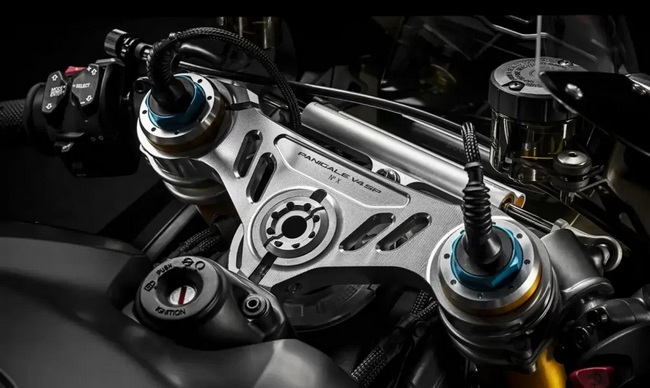
Triple clamps & risers | CNC milling | Aluminum 7075 | Higher stiffness and improved steering accuracy |
Engine covers & guards | CNC milling | Aluminum, stainless steel | Protection for key areas plus visible branding surface |
Axles, spacers, hubs | CNC turning | Stainless steel, aluminum | Smooth rotation, exact alignment, and reliable durability |
A complete product line can include separate SKUs and bundled kits to match popular motorcycle models and riding styles.[2][5]
Understanding the basic production flow helps buyers coordinate development, evaluate lead times, and plan inventory.[1][6]
The process starts with a 3D CAD model that defines geometry, tolerances, and surface finishes for each part. Engineering teams review the design for manufacturability and may adjust fillets, wall thickness, and tool access to improve quality and reduce cost.[1][5][2][4]
Specialized CAM software converts the CAD model into G-code that controls the CNC machines. Toolpaths are simulated to avoid collisions, reduce cycle time, and protect both tools and workpieces.[6][1][2]
Certified raw material is cut to size, labeled, and loaded onto milling or turning centers. Multi-axis machining completes roughing and finishing passes, forming all functional surfaces and features.[5][6][4]
Parts are deburred and edges are smoothed to remove sharp burrs and chips. After that, required finishes such as anodizing, powder coating, or polishing are applied to achieve the specified appearance and corrosion resistance.[3][9][7][4]
Dimensional checks with calipers, gauges, and CMMs verify that critical features meet tolerance requirements. Once parts pass inspection, they are cleaned, packaged according to customer needs, and shipped to global destinations.[3][4]
Reliable motorcycle parts must pass strict quality control before reaching riders. A robust system reduces the risk of fitment issues, premature wear, and safety problems in the field.[2][4][5]
Typical quality measures include:[4]
- Incoming material inspection and traceability for each batch
- In-process inspection during machining to detect deviations early
- Final inspection using CMMs, optical projectors, and dedicated gauges
Well-maintained CNC machines can achieve tolerances around ±0.01 mm or tighter on critical dimensions such as bearing seats and alignment bores when needed. This level of control supports consistent assembly, better riding feel, and lower warranty costs for brands.[1][2][4]
China has become a major hub for CNC machining services, serving global automotive and motorcycle markets. Overseas buyers benefit from strong capabilities, flexible quantities, and competitive pricing for both standard and customized parts.[3][4]
Key advantages include:[3][4]
- Full-range capacity with 3/4/5-axis CNC milling, turning, Swiss machining, and additional processes in one network
- Multi-material options across aluminum, steel, stainless steel, titanium, and engineering plastics
- Fast turnaround, with many CNC orders completed within roughly 7-10 days depending on complexity
- Support for prototypes and small batches, allowing gradual scaling to mass production
For motorcycle brands and wholesalers, this combination makes it easier to react quickly to market trends and rider feedback.[3][5]
Choosing a reliable partner is essential for long-term growth and brand reputation. A structured evaluation process helps reduce risk and ensures stable cooperation.[5][4]
Important criteria to assess:[10][4]
- Quality systems such as ISO 9001:2015 and documented inspection procedures
- Equipment list, including 4- and 5-axis machining centers, turning machines, and inspection tools
- Engineering and DFM support to optimize designs and reduce machining costs
- Communication, response speed, and ability to provide clear English documentation
- Industry experience in motorcycle, automotive, or similar high-precision sectors
Requesting sample parts and a small pilot batch lets purchasing teams verify performance on real motorcycles before large-scale orders.[4][5]
CNC machining provides the flexibility that overseas brands need for unique designs, private-label solutions, and differentiated product lines.[3][5]
Typical OEM and customization options:[11][2]
- Logo engraving and branding on visible surfaces such as levers, rearsets, and engine covers
- Custom color schemes through anodizing or coating aligned with brand identity and target riders
- Model-specific fitment for popular motorcycles from major manufacturers such as Honda, Yamaha, KTM, BMW, and Ducati
- Bundled upgrade kits combining several parts, for example levers plus rearsets plus guards for a given model
For OEM motorcycle manufacturers, CNC machining also supports pre-production sample runs and engineering validation builds before entering mass production.[5][4]
The global motorcycle components market continues to evolve as riders seek both performance and personalization. CNC machining plays a central role in delivering these expectations.[7][2]
Current trends include:[7][5]
- Wider use of lightweight alloys and titanium to reduce unsprung mass and improve handling
- Integrated design for aerodynamics and protection, such as streamlined engine guards and compact mounting systems
- Faster product development by combining CNC machining with 3D printing for rapid prototypes
- Growing demand for personalized shapes, limited editions, and color-matched accessories
Brands that collaborate closely with their CNC suppliers can refresh collections frequently and capture emerging niches in the market.[2][5]
A clear ordering process helps reduce communication issues and keeps projects on schedule.[4][5]
Before sending a request for quotation, prepare:[1][4]
- 3D models (such as STEP) and 2D drawings with tolerances and key dimensions
- Material selection, surface finish requirements, and special performance notes
- Target quantities, delivery schedules, and packaging or labeling needs
- Fitment information including motorcycle brand, model, and model year
Professional CNC suppliers can often provide quick quotations and DFM feedback, helping purchasing teams make decisions efficiently.[3][4]
High-precision CNC motorcycle parts give your brand a strong combination of performance, styling, and reliability that riders can feel on every ride. Working with an experienced Chinese CNC machining partner allows you to turn concepts and drawings into market-ready products with flexible quantities and competitive lead times.[7][2][3][4]
If you are ready to develop or upgrade your CNC motorcycle parts line, send your drawings, 3D models, or ideas to a dedicated engineering team today and request a detailed quotation. You can discuss materials, finishes, and packaging options tailored to your market, review DFM suggestions, and move quickly from prototype samples to stable mass production for global distribution.[3][4]
You should provide 3D models, 2D drawings with tolerances, material and surface finish requirements, planned quantities, and target delivery dates so that the quotation reflects actual production conditions.[1][4]
Yes, many CNC suppliers support prototypes and small batches with low or no minimum order quantities, which is ideal for start-ups and new product lines.[4][3]
Lead times depend on part complexity and volume, but typical CNC orders are often completed in around 7-10 days, with expedited services available in some cases.[4]
CNC parts are widely used in both street and racing applications to achieve better fitment, durability, styling, and ergonomic adjustability compared with many standard components.[2][5]
Look for ISO 9001:2015 or equivalent quality management, stable inspection procedures, up-to-date CNC equipment, and a proven track record in motorcycle or automotive components.[5][4]
[1](https://www.linkedin.com/pulse/what-cnc-motorcycle-parts-tuofa-technology-co-ltd--rhosc)
[2](https://www.worthyhardware.com/news/cnc-motorcycle-parts/)
[3](https://tirapid.com)
[4](https://tirapid.com/cnc-machining/)
[5](https://www.runsom.com/blog/machining-motorcycle-parts/)
[6](https://www.dekmake.com/cnc-machining-motorcycle-parts/)
[7](https://protowrk.com/how-advanced-motorcycle-parts-unlock-peak-performance/)
[8](https://tirapid.com/cnc-motorcycle-parts/)
[9](https://www.youtube.com/watch?v=KP3JKmOXC7I)
[10](https://tirapid.com/large-format-custom-cnc-machining-up-to-1500mm/)
[11](https://tirapid.com/cnc-racing-motorcycle-parts/)


