Views: 222 Author: Loretta Publish Time: 2025-12-22 Origin: Site
Content Menu
● Key Properties Of Nylon For Machining
● Common Nylon Grades Used In CNC Machining
>> Nylon Grade Selection Overview
● Design For Manufacturability (DFM) With Nylon
● CNC Machining Processes For Nylon
>> CNC Milling
>> CNC Turning
● Recommended Cutting Parameters For Nylon
● Fixturing, Cooling And Chip Control
● Typical Applications Of Machined Nylon Parts
● Nylon Machining Vs. Other Plastics
● Step-By-Step Nylon CNC Machining Workflow
>> 1. Material And Grade Selection
>> 2. CAD Model And DFM Review
>> 3. Tooling And Parameter Setup
>> 4. Trial Machining And Optimization
>> 5. Inspection, Packaging And Shipping
● Pro Tips For Achieving Tight Tolerances In Nylon
● Common Nylon Machining Defects And How To Avoid Them
● Suggested Visuals To Enhance Nylon Machining Content
● When To Choose CNC Machined Nylon Instead Of Injection Molding
● How A Professional Nylon Machining Partner Supports OEM Projects
● Start Your Nylon Machining Project Today
● Frequently Asked Questions About Nylon Machining
>> 1: Is nylon suitable for CNC machining?
>> 2: What tolerances can be achieved when machining nylon?
>> 3: How does moisture affect nylon machining?
>> 4: Which nylon grade should be used for high-strength components?
>> 5: When is CNC machining better than injection molding for nylon parts?
Nylon machining is a core solution for lightweight, wear-resistant and cost-effective components in industries such as automotive, machinery, electronics and consumer products. When the right nylon grade, cutting parameters and fixturing strategy are selected, CNC machining can deliver stable tolerances, clean surface finish and long-term durability for demanding OEM projects.[1][2][3]

Nylon machining refers to CNC milling, turning and drilling operations performed on nylon (polyamide) stock such as PA6, PA66, PA12 and glass-fiber-reinforced grades. These processes convert plates, rods or molded blanks into precision parts like gears, bushings, brackets, pulleys and housings.[2][3][1]
- Nylon offers high tensile strength, low friction, good wear resistance and noise reduction compared with metals.[3][2]
- It is widely used where low weight, self-lubrication and electrical insulation are required.[4][3]
For overseas brands, wholesalers and manufacturers, working with an experienced nylon CNC machining supplier helps shorten development cycles and reduce tooling investment compared with injection molding in early or medium production stages.[2][4]
Nylon's material behavior strongly affects machining strategy and achievable tolerances. Understanding these properties is essential for engineers and buyers.[5][6]
- Mechanical strength: Unfilled PA6/PA66 typically provides tensile strength around 60–80 MPa, while 30% glass fiber reinforced grades can exceed 90–130 MPa.[5][1]
- Wear and friction: Nylon has a low coefficient of friction and good abrasion resistance, making it suitable for sliding and rotating parts.[3][2]
- Moisture absorption: Nylon is hygroscopic; absorbed water influences dimensions, toughness and stiffness.[6][1]
- Thermal behavior: Nylon has higher thermal expansion than metals and can soften if heat is not controlled during cutting.[7][6]
These characteristics mean nylon parts must be designed with moisture and temperature in mind, especially for tight-tolerance assemblies or long-term outdoor use.[6][5]
Different nylon grades balance strength, toughness, wear resistance and processability. Selecting the correct grade early will save time and cost later.[8][4][2]
1. PA6 (Nylon 6)
- Good toughness, impact resistance and general machinability.[9][1]
- Suitable for gears, rollers, structural components and general machinery parts.[1][2]
2. PA66 (Nylon 66 / 6-6)
- Higher strength, stiffness and temperature resistance compared with PA6.[10][3]
- Recommended for load-bearing bushings, high-speed gears and precision wear parts.[10][3]
3. PA12
- Lower moisture absorption and better dimensional stability than PA6/PA66.[4][8]
- Preferred for fluid handling, pneumatic fittings and parts needing stable dimensions in humid environments.[8][4]
4. Glass-Fiber-Reinforced Nylon (e.g. PA66-GF30)
- Tensile strength can exceed 90 MPa and may reach about 130 MPa in some formulations.[1][6]
- Very rigid with improved heat deflection, but causes higher tool wear and requires more robust cutting tools.[7][1]
Application need | Recommended grade | Key advantages |
General mechanical components | PA6 | Toughness, good machinability, cost-effective. |
High-load gears and bushings | PA66 / PA66-GF30 | Higher strength and heat resistance. |
Dimensionally stable fluid parts | PA12 | Low moisture absorption, good stability. |
Structural brackets and housings | 30% GF-reinforced PA | High stiffness and rigidity. |
Lightweight, noise-reduced drives | PA6/PA66 with modifiers | Low friction and noise, good wear. |
Thoughtful DFM helps nylon parts achieve stable machining and consistent quality. Engineers should consider geometry, wall thickness and tolerances when designing nylon parts.[11][5]
- Avoid extremely thin walls and long unsupported ribs that can deflect under cutting forces.[11][5]
- Add generous fillets at corners to reduce stress concentration and improve toolpath smoothness.[9][5]
- Use gradual transitions in wall thickness to minimize warpage and uneven shrinkage.[5][6]
For tolerances, unfilled nylon can usually maintain ±0.05 mm on well-fixtured features; ±0.02 mm is achievable for critical areas on dry material, but ±0.1 mm is safer for complex parts that will absorb moisture in service.[6][1]
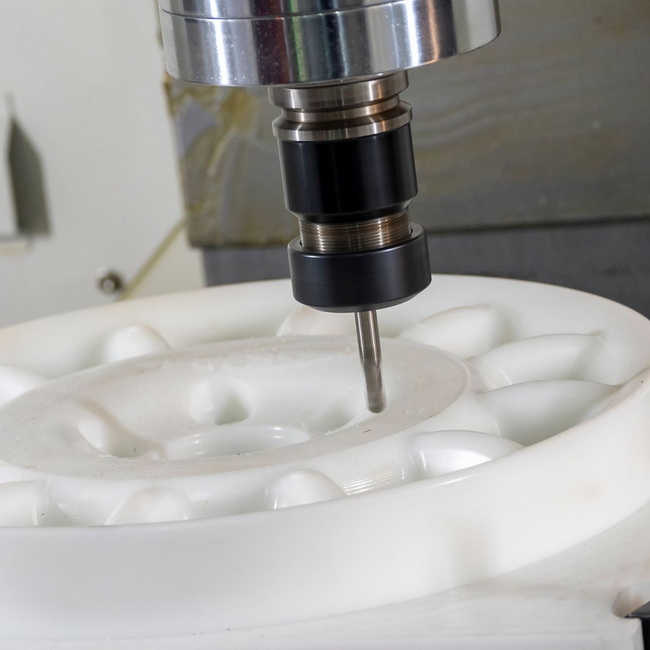
Nylon can be machined with the same core CNC processes used for metals, but parameter control and cooling are more critical.[12][9]
CNC milling is widely used for plates, housings, brackets and complex 3D shapes.[11][2]
- Use sharp HSS or carbide end mills with high helix angles (around 35–45 degrees) to improve chip evacuation and reduce heat.[12][7]
- Two-flute cutters often provide better chip space and lower heat for nylon than multi-flute tools.[7]
CNC turning is used for bushings, rollers, pulleys and sleeves.[2][10]
- Positive rake inserts and sharp edges reduce cutting forces and improve surface finish.[9][12]
- Support slender parts with centers or steady rests to prevent deflection and chatter.[13][11]
Drilling and tapping nylon require careful chip control and cooling.[13][11]
- Use twist drills with suitable clearance and avoid excessive feed that can cause melting or “smearing”.[13][12]
- Use taps designed for plastics rather than taps used on metal, and consider slightly oversized HSS taps for cast nylon.[9][13]
Exact cutting parameters depend on grade, tooling and machine, but reference ranges help set up safe starting points.[12][1]
- For PA6/PA66, cutting speed around 180–250 m/min, feed rate 0.1–0.3 mm/rev and depth of cut 0.5–1.5 mm are practical ranges in many CNC operations.[11][1]
- Common nylon guidelines also suggest speeds of roughly 200–300 ft/min with feed rates of about 0.002–0.008 in/tooth and depths of cut around 0.020–0.050 in.[9]
Because nylon is sensitive to heat, it is better to start with conservative parameters and then increase speed and feed gradually while monitoring surface finish, burr formation and part temperature.[7][12]
Good fixturing and cooling are crucial to stabilize nylon parts during machining. Proper chip evacuation also protects surface quality.[13][7]
- Use soft jaws, vacuum fixtures or custom fixtures that support the part over a large area and prevent deformation.[1][11]
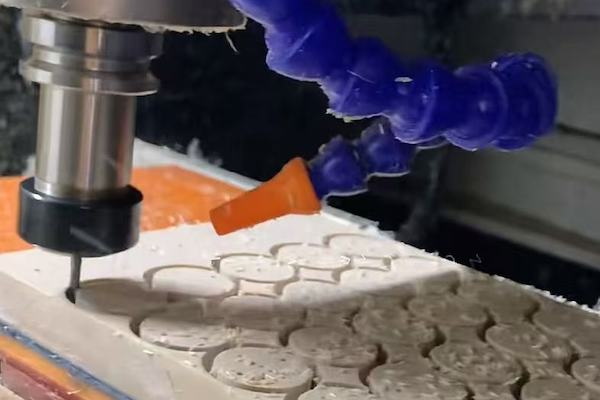
- Apply compressed air, mist coolant or compatible water-soluble coolant to remove heat and chips without attacking the polymer.[14][12]
- Choose sharp tools and appropriate helix angles to avoid material welding onto the cutting edge.[12][7]
For long-chip materials like nylon, high helix tools with fewer flutes help move chips away from the cut, reduce heat buildup and lower the risk of tool jamming.[11][7]
Nylon CNC parts appear in many end-use industries that require quiet operation, chemical resistance and weight reduction.[4][3]
- Automotive: Wear-resistant gears, chain guides, brackets, clips for wire harnesses and fluid lines.[3][1]
- Machinery: Bushings, bearings, rollers, low-friction sliders and wear plates.[2][3]
- Electronics and appliances: Insulating spacers, structural frames, cable clamps and housings.[4][2]
- Consumer products: Sports equipment components, handles, pulleys and functional hardware.[3][4]
Glass-fiber-reinforced nylon is widely used when metal replacement is needed, such as structural brackets and load-bearing shells that must combine stiffness with corrosion resistance.[6][1]
Engineers often compare nylon with POM (acetal), PEEK and other engineering plastics when choosing materials.[2][4]
Material | Key strengths | Typical trade-offs |
Nylon (PA) | High wear resistance, low friction, strong, cost-effective. | Absorbs moisture, higher thermal expansion. |
POM (Acetal) | Excellent dimensional stability, low friction. | Lower impact resistance than some nylons. |
PEEK | Very high temperature and chemical resistance. | Much higher material and machining cost. |
Nylon is often the most economical choice when moderate heat resistance, good wear behavior and lower weight are needed, especially in high-volume OEM projects.[6][2]
A clear machining workflow helps buyers understand what to expect when starting nylon projects. The typical process can be broken into several steps.[11][9]
- Confirm operating temperature, load, friction conditions and environment (humidity, chemicals).[8][6]
- Choose PA6/PA66 for general performance, PA12 for low moisture, or glass-filled grades for higher stiffness.[1][4]
- Check wall thickness, fillets, undercuts and tolerances for manufacturability.[5][11]
- Adjust designs to reduce warpage risk and simplify fixturing.
- Select sharp HSS or carbide tools with suitable geometry and helix.[7][12]
- Define initial cutting speeds, feeds and depths of cut within recommended ranges.[12][1]
- Run sample parts, verify dimensions and surface finish, and adjust parameters.[9][11]
- Evaluate moisture conditioning if tight assemblies are required.
- Inspect critical dimensions and functional surfaces with calibrated measurement tools.[10][13]
- Package parts to avoid deformation, contamination and mechanical damage in transit.
Holding tight tolerances in nylon requires special attention to environment, fixturing and process control. These pro tips are especially important for aerospace- or medical-grade applications.[7][6]
- Control humidity and temperature in both machining and inspection areas to reduce dimensional drift.[16][6]
- Dry or condition nylon stock consistently before machining when very tight tolerances are specified.[1][7]
- Use multiple light passes rather than aggressive roughing on slender features to avoid deflection.[11][7]
- Apply probing and in-process measurement for critical fits to compensate for small thermal or moisture-related changes.[16][10]
In many cases, specifying functional tolerances instead of extremely tight general tolerances can significantly improve yield and reduce cost without harming performance.[8][5]
Understanding typical defects helps engineers and buyers discuss root causes with their suppliers. Proper prevention measures reduce scrap and rework.[9][11]
1. Burrs and smearing
- Causes: Dull tools, excessive speed, inadequate chip evacuation.[17][12]
- Solutions: Use sharp cutters, adjust feed and speed, improve air blast or coolant.
2. Warping and distortion
- Causes: Uneven residual stress, moisture absorption, thin walls without support.[16][6]
- Solutions: Optimize part design, use balanced machining strategies, condition material and store parts properly.
3. Tool wear with glass-filled nylon
- Causes: Abrasive glass fibers.[1][7]
- Solutions: Use carbide tools, reduce cutting speed, ensure effective cooling and plan for regular tool replacement.
Relevant visuals make nylon machining content more engaging and easier to understand for engineers and buyers.[3][2]
- Cross-section diagrams comparing unfilled and glass-filled nylon microstructures to highlight stiffness and wear differences.[6][1]
- Process flow chart showing the nylon CNC machining workflow from material selection to final inspection.[11][9]
- Application photos of gears, bushings, brackets and housings made from different nylon grades in automotive and machinery contexts.[4][3]
Short demonstration videos of CNC milling nylon and slow-motion clips of chip evacuation are also helpful for conveying toolpath strategies and heat management to non-specialist buyers.[15][7]
Nylon parts can be produced by both CNC machining and injection molding, and each approach has its ideal use cases.[2][4]
- CNC machining is preferred for low- to medium-volume production, frequent design changes, complex prototypes and parts requiring tight tolerances without investing in molds.[2][11]
- Injection molding becomes cost-effective at higher volumes when designs are stable and tooling investment can be amortized.[4][2]
For many overseas OEM buyers, the best strategy is to start with CNC-machined nylon prototypes and small batches, then move to molding once the design and market demand have been validated.[8][2]
Working with a capable OEM manufacturer streamlines nylon component development from concept to mass production. A reliable partner typically offers:[10][2]
- Multi-axis CNC machining centers capable of handling nylon, metals and other plastics in one facility.[18][1]
- Engineering support for material selection, DFM, tolerance optimization and cost reduction.[18][2]
- Quality systems with documented inspection, material traceability and sample reports for overseas customers.[18][10]
By integrating nylon machining with metal machining, plastic molding, silicone production and metal stamping under one supply chain, OEM customers can reduce supplier count and simplify logistics for complex assemblies.[18][1]
If your next project requires high-precision nylon parts—gears, bushings, structural brackets or custom housings—it is important to cooperate with a dedicated OEM machining partner that understands nylon's unique behavior and application requirements. Share your 2D/3D drawings, target quantities and performance expectations to receive a tailored quotation, engineering suggestions and sample plan so you can launch reliable nylon components to your market quickly and with competitive cost control.[10][3][6][2]
Yes. Nylon is widely used in CNC machining because it combines good strength, wear resistance, low friction and relatively easy machinability when heat and moisture are properly controlled during processing.[3][2]
For many machined nylon parts, tolerances around ±0.05 mm are achievable, while ±0.02 mm is possible on critical features in controlled conditions, though ±0.1 mm is a safer general guideline for complex parts that will absorb moisture.[7][1]
Because nylon absorbs moisture, its dimensions and mechanical properties change with humidity; this can relax very tight fits or alter stiffness, so conditioning, environmental control and appropriate tolerance selection are important for precision assemblies.[19][7]
Glass-fiber-reinforced grades such as PA66-GF30 are often chosen for high-strength applications because they significantly increase stiffness and heat resistance compared with unfilled PA6 or PA66, while still offering lower weight than metals.[6][1]
CNC machining is the better choice for low- to medium-volume production, prototypes, frequent design iterations and very tight tolerances where mold investment is not yet justified, while injection molding is suitable for stable designs at high volumes.[2][11]
[1](https://tirapid.com/nylon-machining/)
[2](https://www.protolabs.com/services/cnc-machining/plastics/nylon/)
[3](https://hplmachining.com/blog/can-nylon-be-cnc-machined/)
[4](https://www.fictiv.com/materials/cnc-machining-nylon)
[5](https://aipprecision.com/machining-nylon-polyamide-a-plastics-guide/)
[6](https://www.ptsmake.com/is-nylon-good-for-machining/)
[7](https://www.ptsmake.com/precision-nylon-machining-aerospace-grade-tolerances-pro-tips/)
[8](https://at-machining.com/nylon-cnc-machining-choosing/)
[9](https://www.davantech.com/machining-pa66-or-nylon-a-comprehensive-guide/)
[10](https://www.xometry.com/capabilities/cnc-machining-service/nylon-66/)
[11](https://www.partmfg.com/machining-nylon/)
[12](https://www.atlasfibre.com/effective-techniques-for-machining-nylon-polyamide/)
[13](https://www.nylatech.com/machining-guidelines-for-cast-nylon/)
[14](https://www.nylatech.com/technical/)
[15](https://www.youtube.com/watch?v=5K9j32AX5tc)
[16](https://aipprecision.com/engineering-success-critical-tolerances-for-dimensionally-stable-plastic-parts/)
[17](https://www.worthyhardware.com/uncategorized/cnc-machining-nylon-vs-other-plastic/)
[18](https://tirapid.com)
[19](https://www.runsom.com/blog/nylon-cnc-machining-what-engineers-should-know/)
[20](https://zmorph3d.com/blog/nylon-cnc-machining-materials-overview/)
[21](https://modernplastics.com/machining-tips-how-to-select-the-right-coolant-for-machining-plastics/)
[22](https://adaptplastics.com/example-projects/cnc-machining-of-a-nylon-plastic-part/)
[23](https://www.facebook.com/groups/769782850345135/posts/1758808314775912/)
[24](https://www.ensinger-pc.com/resources/blog/which-cnc-machining-plastics-are-best-for-your-application/)
[25](https://www.partzpro.com/blog/machinability-of-various-nylon-materials-and-their-composites)
[26](https://www.mcam.com/dam/jcr:7a0e118b-f524-452b-98fa-35c0a3340687/MCG-Machinist-Toolkit-A4-rgb-stg-Dec22.pdf)


