Views: 222 Author: Rebecca Publish Time: 2026-01-07 Origin: Site
Content Menu
● What Is Simultaneous 5-Axis Machining?
● Motion and Geometry Differences
>> Access to Features and Faces
● Programming and Control Requirements
● Advantages of 3+2 Axis Machining
● Advantages of Simultaneous 5-Axis Machining
>> Precision and Surface Quality
● Comparison of 3+2 and Simultaneous 5-Axis
● How Engineers and Buyers Should Decide
● FAQ
>> 1. What is the main difference between 3+2 and 5-axis machining?
>> 2. Is 3+2 machining usually more economical?
>> 3. Can a single CNC machine support both 3+2 and continuous 5-axis?
>> 4. Which sectors gain most from simultaneous 5-axis machining?
>> 5. When is 3+2 machining usually preferred?
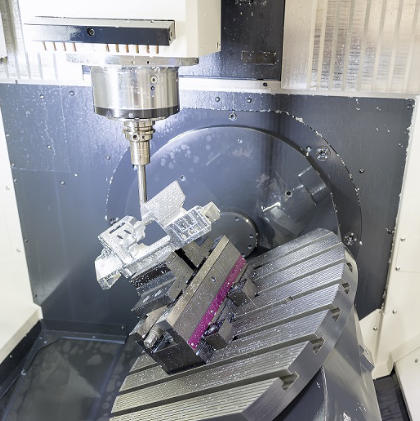
3+2 axis machining is a positional strategy that combines 3 linear axes with two rotary axes used only to orient the workpiece before cutting. Once the part is tilted and clamped, the machine performs a standard 3-axis toolpath on that orientation.[3][1]
- The 4th and 5th axes rotate to the required angle, then remain locked during cutting.[1][3]
- Multiple faces of the part can be machined in one setup, reducing manual repositioning and fixture changes.[3][1]
Because 3+2 allows shorter, more rigid tools, it often improves stability and reduces chatter compared with using long tools on 3-axis machines. It is particularly attractive for shops upgrading from 3-axis because it uses familiar programming concepts with added accessibility.[4][1][3]

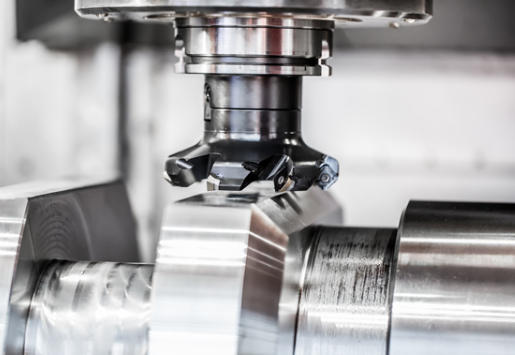
Simultaneous 5-axis machining, also called continuous 5-axis, moves all three linear axes and both rotary axes at the same time during cutting. The tool continuously adjusts its orientation to maintain the best angle and contact with the workpiece surface.[2][5][1]
- The machine dynamically aligns tool and workpiece to keep optimal cutting conditions across complex curves and transitions.[5][2]
- Freeform surfaces, deep cavities, and organic geometries can often be machined in one setup with excellent surface quality.[2][5]
Continuous 5-axis machining requires a more advanced CNC control, powerful CAM software, and experienced programmers, but it delivers higher accuracy and productivity for demanding components.[5][2]
The essential difference between 3+2 and full 5-axis machining is static vs dynamic use of rotary motion during cutting. This leads to distinct behavior in surface finish, cycle time, and tolerance control.[1][2][5]
- In 3+2, rotary axes index to an angle and then remain fixed; all interpolation happens on X, Y, and Z.[3][1]
- In simultaneous 5-axis, all five axes interpolate together, enabling smooth tool orientation changes along the toolpath.[2][5]
Dynamic 5-axis motion maintains more consistent tool load and cusp height on complex surfaces, often producing superior surface finish and tighter shape accuracy.[5][2]
3+2 machining significantly improves tool access compared with pure 3-axis machining by letting the part be tilted so more faces can be reached in a single clamping. However, it cannot continuously follow steeply changing surface normals.[4][1][2]
- 3+2 is efficient for parts with multiple flat or moderately angled faces and angled holes.[4][1]
- Simultaneous 5-axis is more suitable for parts where surface normal changes are continuous, such as impellers, turbine blades, or complex molds.[2][5]
For many prismatic parts that only require a few tilted operations, 3+2 provides most of the practical benefits of 5-axis without the complexity of continuous control.[1][4]
Programming complexity is an important factor when choosing a machining strategy. 3+2 programs are similar to traditional 3-axis toolpaths with additional steps for indexing the rotary axes.[4][5][1]
- 3+2 often uses simpler CAM strategies and postprocessors than full simultaneous 5-axis paths.[1][4]
- Continuous 5-axis typically requires advanced CAM functions such as swarf milling, morphing between surfaces, and automatic collision avoidance.[5][2]
The CNC control must support high-speed 5-axis interpolation and dynamic error compensation to achieve the precision potential of continuous 5-axis machining.[2][5]
3+2 axis machining is often the most economical way to expand beyond simple 3-axis work. It offers a balanced combination of flexibility, accuracy, and cost.[4][1]
- Fewer setups are needed because multiple faces of a part can be machined in one clamping.[3][1]
- Shorter tools can reach deep features at better angles, improving rigidity and reducing vibration.[3][1]
Entry cost and training demands for 3+2 are usually lower than for full 5-axis, while still enabling many advanced part geometries.[1][4]
3+2 axis machining is well-suited for parts that need machining on several sides but do not have extremely complex freeform surfaces.[4][1]
- Angled holes in manifolds, blocks, or housings.
- Multi-face prismatic parts with features on different orientations.
- Parts that need undercuts or steep walls accessed by tilting rather than long, slender tools.[1][4]
Many machine shops start with 3+2 strategies on 5-axis capable machines and gradually introduce more continuous 5-axis work as experience and software capabilities grow.[4][1]
Simultaneous 5-axis machining offers maximum flexibility and performance for highly complex parts. The ability to keep the tool at an ideal orientation throughout the cut improves both part quality and overall productivity.[5][2]
- Cycle times are often shorter, and even very complex shapes can be completed in one setup.[2][5]
- Surface finishes are more uniform on sculpted surfaces, often reducing or eliminating manual polishing.[5][2]
For industries where geometry is highly three-dimensional and tolerances are extremely tight, continuous 5-axis becomes a practical necessity rather than an option.[2][5]
Dynamic 5-axis motion maintains optimal tool engagement, which stabilizes chip thickness and cutting forces. This has a direct impact on dimensional accuracy and surface quality.[5][2]
- A single setup reduces datum transfer, lowering the risk of accumulated positional errors.[2][5]
- Advanced controls can include real-time compensation for deflection and thermal effects, improving stability during long cycles.[5][2]
This combination of control and motion makes continuous 5-axis particularly attractive for high-end aerospace, medical, and mold components.[2][5]
| Factor | 3+2 Axis Machining | Simultaneous 5-Axis Machining |
|---|---|---|
| Rotary motion during cutting | Axes index, then stay static during 3-axis cutting. | All five axes move continuously during cutting. |
| Part complexity | Medium complexity, multi-face parts. | Highly complex freeform surfaces and organic shapes. |
| Setups | Fewer setups than 3-axis; some reorientation may still be needed. | Often single-setup machining for very complex parts. |
| Surface finish | Good; transitions between indexed positions may show blend lines. | Very smooth transitions and high surface quality. |
| Programming difficulty | Moderate; similar to 3-axis with added indexing. | High; needs advanced CAM and experienced programmers. |
| Machine and control needs | 5-axis capable machine, less demanding control functions. | High-performance 5-axis control and interpolation. |
| Investment level | Lower entry cost and shorter learning curve. | Higher machine, software, and training investment. |
| Best-suited parts | Angled holes, multi-face prismatic parts, transition from 3-axis. | Blisks, impellers, turbine blades, complex molds, implants. |
From an investment perspective, 3+2 machining provides a practical upgrade path from conventional 3-axis capability. Many shops can add a rotary table or tilt-trunnion to existing vertical machining centers to gain 3+2 functionality.[3][1][4]
- Initial costs for high-spec continuous 5-axis machines and advanced CAM systems are significantly higher.[1][5]
- For suitable mixes of high-value complex parts, continuous 5-axis can repay this investment through shorter lead times and higher throughput.[5][2]
OEM buyers should evaluate total cost, including fixturing complexity, risk of scrap, and rework, rather than focusing on cycle time alone.[6][2]
Engineering and sourcing teams should align design requirements with available machining technology and supplier capabilities. Clear understanding of tolerance targets, surface finish needs, and long-term volume helps avoid both over- and under-specifying machining processes.[7][6][4]
- For simple to moderately complex parts with multiple faces, 3+2 machining often provides the best balance of quality and cost.[6][1]
- For critical components with complex curvature and demanding surfaces, full 5-axis machining offers more robust process control.[2][5]
Early collaboration with a manufacturing partner that runs both 3+2 and continuous 5-axis on modern equipment helps optimize design and cost before locking in final drawings.[8][4]
For overseas brands, wholesalers, and manufacturers, choosing the right machining strategy is essential to secure reliable quality, competitive cost, and stable lead times. Partnering with a supplier that understands both 3+2 and simultaneous 5-axis machining makes it easier to turn complex designs into repeatable production.
U-NEED focuses on high-precision machined parts, plastic components, silicone products, and metal stamping for international OEM projects and can recommend the most efficient process for each part. To review your drawings and discuss whether 3+2 or full 5-axis machining is better for your next project, contact U-NEED's engineering team today for a detailed manufacturability and cost evaluation.
The main difference is how rotary axes behave during cutting: 3+2 uses them only to position the part before machining, while simultaneous 5-axis keeps all five axes moving together during cutting.[1][2]
3+2 machining is often more economical because it uses simpler programming and less demanding control functions, allowing shops to deploy 5-axis capable machines without the highest-end software and training.[4][1]
Modern 5-axis CNC machines commonly support both 3+2 and continuous 5-axis toolpaths as long as the control and CAM software provide the required features.[1][5]
Aerospace, medical, and high-end mold and die sectors gain the most from continuous 5-axis because they rely on complex curved geometries, tight tolerances, and critical surface finishes.[5][2]
3+2 machining is usually preferred for parts with multiple faces or angled features that do not need continuous tool orientation changes, especially when cost control and programming simplicity are priorities.[4][1]
[1](https://www.rapiddirect.com/blog/32-vs-5-axis-machining/)
[2](https://www.lsrpf.com/en/blog/simultaneous-5-axis-vs-3-2-axis-machining-a-comprehensive-guide-ls-manufacturing)
[3](https://www.manufacturingtomorrow.com/article/2019/09/32-vs-5-axis-whats-the-difference/14074)
[4](https://www.ampcnc.com/blog/accurate-machine-products-blogs-1/3-2-vs-5-axis-machining-97)
[5](https://bobcad.com/32-vs-full-5-axis-machining-key-differences-fixtures-programming/)
[6](https://www.lsrpf.com/en/blog/3-axis-vs-5-axis-cnc-machining-how-to-choose-and-avoid-costly-mistakes)
[7](https://www.protolabs.com/resources/blog/cnc-machining-3-axis-vs-5-axis-indexed-vs-5-axis-continuous/)
[8](https://chiggofactory.com/the-differences-between-simultaneous-5-axis-and-32-axis-machining/)


