Views: 222 Author: Rebecca Publish Time: 2026-02-09 Origin: Site
Content Menu
>> Machine Setup And Wire Preparation
>> Workpiece Mounting And Dielectric Fluid
>> Spark Generation And Material Removal
>> CNC Motion And Path Control
>> Continuous Wire Feeding And Multi-Pass Cutting
● Key Benefits Of EDM Wire Cutting
>> No Mechanical Cutting Forces
>> Ultra-High Precision And Tolerances
>> Independence From Material Hardness
>> Complex Geometries And Sharp Internal Corners
● Limitations And Considerations Of Wire EDM
>> Restricted To Conductive Materials
>> Higher Consumable And Operating Costs
● Main Application Fields Of Wire EDM
● CNC Milling Versus EDM Wire Cutting
● Wire EDM Compared With Laser And Waterjet Cutting
● Practical Design Tips For Wire EDM
● Quality, Surface Integrity, And Tolerances
● When Wire EDM Is The Right Choice
● Clear Action Call: Get Engineering Support For Your Precision Parts
>> 1. What materials can be cut with wire EDM
>> 2. How accurate is EDM wire cutting
>> 3. Does wire EDM leave a heat-affected zone
>> 4. Is EDM wire cutting faster than CNC milling
>> 5. When should I choose wire EDM instead of laser or waterjet cutting
Electrical Discharge Machining (EDM) wire cutting is one of the most powerful processes for producing ultra-precise metal parts with complex geometries and tight tolerances. This guide explains in clear language how EDM wire cutting works, when to use it, and how it compares to other machining methods, so you can make better manufacturing decisions.

Wire EDM cutting, short for Electrical Discharge Machining with wire, is a non-contact machining process that uses a thin metal wire as an electrode to erode material from a conductive workpiece using controlled electrical sparks. Instead of a physical tool pushing against the metal, material is removed by microscopic electrical discharges in a dielectric fluid.
Key characteristics of wire EDM include:
- Use of a continuously fed brass or copper wire (typically 0.1–0.3 mm in diameter).
- Ability to cut only electrically conductive materials, regardless of hardness.
- Capability to achieve extremely tight tolerances, often in the micron range.
- Production of sharp internal corners and intricate shapes that are difficult for conventional tools.
This combination makes wire EDM ideal for tooling, molds, dies, medical devices, and aerospace parts where accuracy and surface integrity are critical.
To understand how wire EDM works, imagine slicing material with a heated wire, but here the cutting is done by energy from controlled sparks rather than by temperature alone. The process is precisely controlled by CNC (Computer Numerical Control) to follow complex paths.
A spool of brass or copper wire is loaded into the wire EDM machine and threaded through upper and lower guides. The wire is kept under constant tension to ensure straightness and stability during cutting.
- Typical wire diameter ranges from 0.1 to 0.3 mm for fine details and narrow kerfs.
- Wire is continuously fed from a supply spool and collected on a take-up spool, so a fresh section is always in the cutting zone.
- This greatly reduces traditional tool wear issues, because the “tool” is constantly renewed.
The workpiece is fixed on the machine table and usually submerged in deionized water, which acts as the dielectric fluid.
The dielectric fluid performs several essential functions:
- Provides electrical insulation until the voltage is high enough to create a spark.
- Cools the cutting zone and stabilizes the process temperature.
- Flushes away eroded metal particles to keep the gap clean and prevent short circuits.
Stable flushing and proper water quality are crucial for consistent cutting performance and dimensional accuracy.
Wire EDM works by creating a series of controlled electrical discharges between the wire and the workpiece.
- A small, controlled gap (spark gap) is maintained between the wire and the workpiece surface.
- When sufficient voltage is applied, a spark jumps across the gap.
- Each spark instantaneously melts and vaporizes a tiny amount of material.
- The dielectric fluid quickly cools and carries away these microscopic particles.
Material is removed through this controlled erosion mechanism, repeated thousands of times per second along the programmed cutting path.
The motion of the wire EDM machine is governed by a CNC system, which interprets the programmed path for cutting.
- The X and Y axes control the motion of the table, while U and V axes can move the upper wire guide for tapered or complex cuts.
- As there is no mechanical contact, there are no cutting forces, which significantly reduces the risk of deformation on thin walls or delicate sections.
- For internal profiles, a start hole is drilled first, and then the wire is threaded through this hole to cut the internal contour.
This high level of motion control enables wire EDM to produce intricate profiles, narrow slots, and accurate internal features.
During operation, the wire is continuously advanced from the supply spool to the take-up spool. This maintains a clean and stable electrode surface in the cutting zone.
Many parts are produced using multiple passes:
- A roughing pass removes most of the material at higher power and speed.
- One or more finishing passes refine the dimension and improve the surface quality.
The final result is a smooth and burr-free surface that often requires little or no additional finishing.
EDM wire cutting offers several important advantages compared with conventional mechanical machining methods.
Because there is no direct contact between the wire and the workpiece, the process does not introduce mechanical stress or cutting forces.
Benefits include:
- No tool pressure on thin or delicate features.
- Minimal deformation of narrow walls and small components.
- Suitability for fragile or complex parts where mechanical cutting might cause distortion.
Wire EDM is widely recognized for its high precision and repeatability, often reaching tolerances in the micron range when the machine, tooling, and setup are properly optimized.
This level of precision is ideal for:
- Injection molds and die components.
- Precision mechanical parts and gauges.
- Medical instruments and implants.
- Aerospace and defense components that require strict dimensional control.
Material hardness has very little influence on wire EDM performance, as the process is based on electrical discharge rather than physical cutting.
It can easily process:
- Hardened tool steels and heat-treated materials.
- High-temperature alloys such as titanium and Inconel.
- Other tough and wear-resistant metals that are difficult to machine with standard tools.
The main requirement is that the material must be electrically conductive.
The small diameter of the wire, combined with the absence of a tool radius at the corner, allows wire EDM to create extremely sharp internal corners and complex shapes.
Typical uses include:
- Punches and dies with tight internal radii.
- Gear profiles, splines, and micro-sized components.
- Features that require very small internal corner radii, which cannot be achieved with rotating tools.
Parts produced by wire EDM typically feature smooth, high-quality surfaces with minimal burr formation.
- Many profiles are ready for use without secondary deburring operations.
- This reduces overall lead time and finishing costs.
- Fine surface finishes can enhance the performance of sealing areas, sliding surfaces, and mating interfaces.
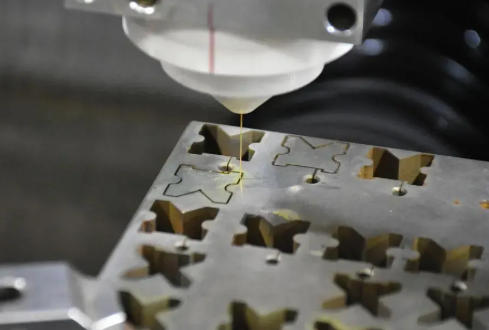
Wire EDM is not suitable for every situation. Understanding its limitations helps you make better process choices.
Wire EDM is generally slower than processes like milling or turning when you need to remove a large volume of material.
- It is better suited for final shape creation or for cutting contours after rough machining.
- Many shops use a combination of conventional machining for roughing and wire EDM for the final precision cuts.
Wire EDM works only with materials that conduct electricity.
This excludes:
- Plastics and composites.
- Wood and glass.
- Ceramics and other insulators, unless they have a conductive coating.
For these materials, other technologies such as CNC machining, laser cutting, waterjet cutting, or molding are usually used.
Wire EDM systems involve specific consumables and supporting equipment.
Main cost factors include:
- Ongoing wire consumption (brass, coated, or other specialty wires).
- Deionized water and filtration systems to maintain dielectric quality.
- Electrical power usage related to the discharge process.
These costs are often justified when the part requires high precision, complex geometry, and excellent surface quality.
Wire EDM is widely applied in sectors where dimensional accuracy and complex shapes are critical.
Key application areas include:
- Tool and die industry: punches, dies, mold inserts, and precision cavities.
- Aerospace: turbine components, structural brackets, and precision fixtures.
- Medical industry: surgical tools, orthopedic implants, and delicate assemblies.
- Electronics and micro-mechanics: connectors, lead frames, and miniature metal parts.
In these fields, the ability of wire EDM to combine precision, repeatability, and design freedom makes it a preferred solution.
Even though EDM wire machines and milling machines both use CNC control, the underlying processes are quite different. This directly affects their practical use.
| Feature | CNC Milling | EDM Wire Cutting |
|---|---|---|
| Contact method | Physical cutting with rotating tools | Electrical erosion through sparks |
| Material range | Metals, plastics, composites, many other solids | Only electrically conductive materials |
| Precision | High, depending on setup and tooling | Very high, often in the micron range |
| Tool wear | Cutting tools wear and must be replaced | Continuous wire feed minimizes tool wear |
| Internal corners | Rounded, limited by cutter radius | Very sharp internal corners possible |
| Surface finish | Often requires secondary finishing | Often smooth and nearly burr-free |
| Cutting forces | Significant, may cause deflection or vibration | Negligible, as there is no mechanical contact |
In many projects, the best strategy is to use CNC milling for roughing and wire EDM for final precision features and critical contours.
Although wire EDM, laser cutting, and waterjet cutting are all used for profile cutting, they differ in how they interact with the material.
- Laser cutting is very fast for thin plates and simple shapes and can work with metals and some non-metals. It creates a heat-affected zone and may produce taper or micro-cracks in certain applications.
- Waterjet cutting is a cold process that can cut almost any material, including metals, stone, glass, and composites, but usually cannot reach the same level of precision or detail as wire EDM.
- Wire EDM is slower but offers superior precision, surface quality, and sharp internal corners in conductive metals, especially hardened and high-strength alloys.
Selecting the correct process depends on your material, thickness, tolerances, and functional requirements.
When you design a part that will be produced using wire EDM, a few design habits can help reduce cost and lead time.
- Plan start hole locations for internal geometries to make threading easier.
- Control section thickness, because very thick materials significantly increase cutting time.
- Concentrate tight tolerances only on critical functional features to avoid unnecessary process time.
- Use sharp corners where they bring real functional benefits, and allow small radii where possible to improve efficiency.
Good collaboration between design engineers and the EDM shop helps optimize designs for both performance and manufacturability.
Since wire EDM is a thermal process, it influences the surface layer of the workpiece. Correct process settings keep these effects under control.
- A thin recast layer can form on the surface, which is usually minimized by finishing passes.
- Mechanical residual stress is generally lower than in conventional cutting processes, because there are no cutting forces.
- Surface roughness can be tuned by adjusting cutting speed, discharge parameters, and the number of trim cuts, balancing cycle time with required surface quality.
For highly critical components, process validation and inspection are essential to ensure that all functional and safety requirements are met.
Wire EDM is the right choice when your part demands a combination of precision, complex geometry, and material performance that is difficult to achieve with other methods.
You should consider wire EDM when:
- The design includes tight tolerances and sharp internal corners.
- The material is a hardened or high-performance alloy that is hard to machine mechanically.
- You want to avoid burrs, tool marks, and distortion on delicate sections.
- Repeatability and dimensional stability are critical across multiple production batches.
If your project mainly requires fast bulk material removal, uses non-conductive materials, or tolerances are relatively loose, other cutting or forming processes may be more economical.
If you are planning new precision components and are not sure whether they are better suited to wire EDM, CNC machining, or another process, you can gain significant value by involving a professional machining partner early in your project. By sharing your drawings, 3D models, and material requirements, you can obtain detailed feedback on feasibility, tolerance strategies, and potential cost optimizations. A responsive engineering team can help you combine EDM wire cutting with milling, turning, and other processes to achieve the best balance of accuracy, durability, and lead time for your parts. Take the next step by sending your specifications for a technical review and manufacturing quotation tailored to your application.
Contact us to get more information!
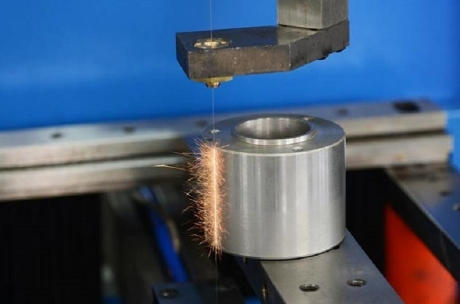
Wire EDM can cut any electrically conductive material, including hardened tool steels, stainless steels, titanium, Inconel, and many other metal alloys. Non-conductive materials such as plastics, wood, or glass cannot be cut with this process.
Wire EDM is known for its high accuracy, and under controlled conditions, tolerances in the micron range can be achieved. This makes it suitable for demanding applications in tooling, aerospace, medical, and precision engineering fields.
Wire EDM does generate heat during the discharge process, so a thin recast layer forms on the surface. However, with appropriate cutting parameters and finishing passes, this layer is very thin and surface integrity remains suitable for most high-precision uses.
For parts that require large amounts of material removal, EDM wire cutting is generally slower than CNC milling. However, for intricate profiles and tight-tolerance features, EDM can be more effective because it creates the final shape directly and reduces the need for additional finishing work.
Wire EDM is a strong choice when you need very tight tolerances, sharp internal corners, and high-quality surfaces in conductive metals. Laser and waterjet cutting are better suited for rapid cutting of plates or non-conductive materials but usually cannot match the precision and detail available with wire EDM.


