Views: 228 Author: U-Need Publish Time: 2026-09-30 Origin: Site
Content Menu
● Why Choose Machined PVC Parts?
● PVC Machining Challenges to Consider
>> Heat Buildup During Cutting
>> Dimensional Movement and Thermal Expansion
● Best Practices for CNC Machining PVC
>> Maintain Proper Speed, Feed, and Chip Load
>> Improve Part Design Before Production
● Common PVC Machining Operations
>> PVC Turning
● Common PVC Machining Problems and Solutions
● How U-Need Supports Custom PVC Parts
● Summary
>> Is PVC easy to CNC machine?
>> What PVC grade is best for machining?
>> Can PVC parts hold tight tolerances?
>> Why does PVC melt during machining?
>> Can PVC be drilled and tapped?
>> Is PVC suitable for chemical-resistant components?
>> Should I use CNC machining or injection molding for PVC parts?
PVC machining can produce accurate, durable, and cost-effective industrial components when material selection, cutting conditions, workholding, and inspection are properly controlled. Although PVC is widely used in piping, construction, and electrical applications, precision-machined PVC parts require a different level of planning than standard extruded pipe or sheet products.
For engineers, product developers, procurement teams, and manufacturers, the objective is not simply to cut PVC into shape. The objective is to produce clean, dimensionally stable, application-ready components that meet drawing requirements while avoiding melting, burrs, stress marks, warpage, and unnecessary production cost.
U-Need supports global brands, distributors, and manufacturers with integrated manufacturing solutions. Our capabilities include custom precision parts machining, mold manufacturing, injection molds, stamping dies, cold-forging dies, laser cutting, bending, stamping, and sheet metal fabrication. For PVC machining projects, we help turn drawings, samples, and functional requirements into practical production solutions.
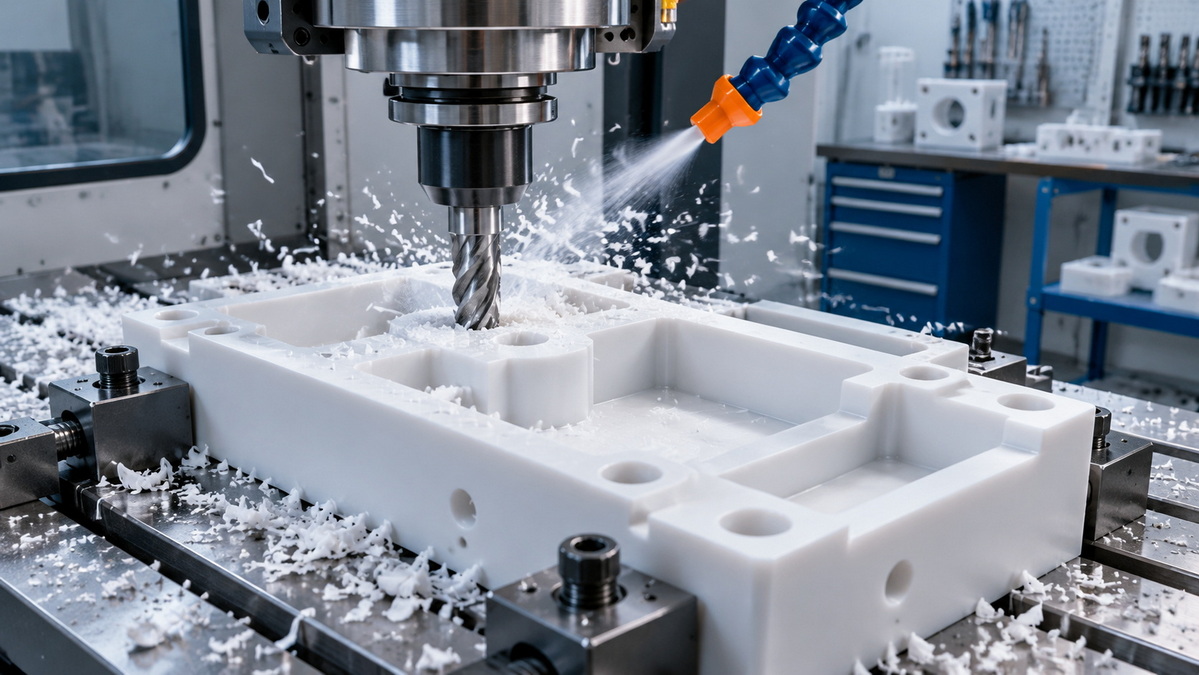
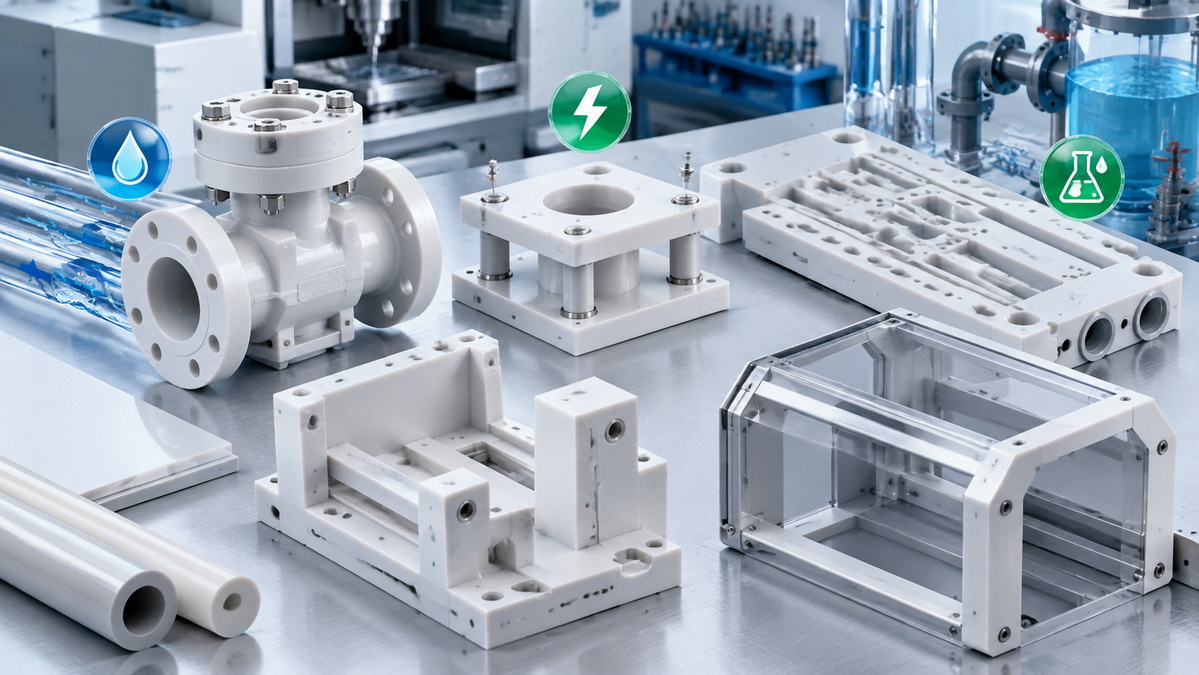
PVC machining is the process of cutting, drilling, milling, turning, tapping, or routing polyvinyl chloride into custom components. It is commonly used to manufacture chemical-resistant parts, electrical insulation components, machine guards, fluid-handling accessories, test fixtures, custom housings, and industrial replacement parts.
Rigid PVC, often called uPVC, PVC-U, or Type I PVC, is the grade most commonly selected for machined components. It combines good chemical resistance, electrical insulation, stiffness, corrosion resistance, and relatively low material cost.
However, PVC does not machine in the same way as aluminum, steel, brass, or many engineering plastics. It has relatively low thermal conductivity, which means heat can remain concentrated near the cutting edge. If a tool rubs rather than cuts, the material may soften, smear, discolor, develop burrs, or change dimension after cooling.
The best PVC machining process is built around one principle: remove material efficiently while keeping heat, stress, and part movement under control.
Machined PVC is a practical choice when a product requires custom geometry but does not justify the cost or lead time of dedicated mass-production tooling. CNC machining is especially useful for prototypes, low- to medium-volume production, replacement parts, design validation, and industrial assemblies with complex features.
PVC offers several advantages for industrial parts:
- Chemical resistance for many acids, alkalis, salts, and moisture-rich environments
- Electrical insulation for nonconductive spacers, panels, and equipment components
- Corrosion resistance in applications where untreated metals may oxidize or degrade
- Low water absorption compared with some other engineering plastics
- Efficient customization for holes, slots, pockets, profiles, and irregular contours
- No mold tooling required for early-stage prototypes and short production runs
- Material affordability for many industrial applications
- Lightweight construction compared with steel, stainless steel, and aluminum
PVC is frequently used in equipment where corrosion resistance and electrical insulation are more important than high-temperature performance. It is not the right choice for every project. Designers should evaluate operating temperature, mechanical loading, chemical exposure, UV exposure, fire requirements, assembly method, and expected service life before confirming the material.
Rigid PVC has a useful balance of physical, electrical, and chemical properties. These characteristics explain why it appears in industries such as chemical processing, water treatment, electronics, laboratory equipment, construction, food-processing support equipment, and industrial automation.
| Property | Practical Value for Machined Parts |
|---|---|
| Chemical resistance | Suitable for many chemical-processing and fluid-handling environments |
| Electrical insulation | Useful for electrical panels, spacers, fixtures, and nonconductive components |
| Corrosion resistance | Performs well in wet, salt-rich, and many chemically active environments |
| Stiffness | Supports structural shapes, flat panels, brackets, and machine components |
| Low density | Reduces component weight compared with most metal alternatives |
| Ease of fabrication | Can be cut, drilled, milled, routed, turned, and bonded |
| Cost efficiency | Often more affordable than high-performance engineering plastics |
| Low thermal conductivity | Requires careful heat management during machining |
Rigid PVC generally performs best in moderate-temperature industrial environments. When the working temperature becomes too high, the material may soften, lose stiffness, or experience long-term dimensional change. Applications involving persistent heat, high pressure, high mechanical load, or repeated impact may require an alternative material such as CPVC, polypropylene, nylon, acetal, PTFE, PEEK, aluminum, or stainless steel.
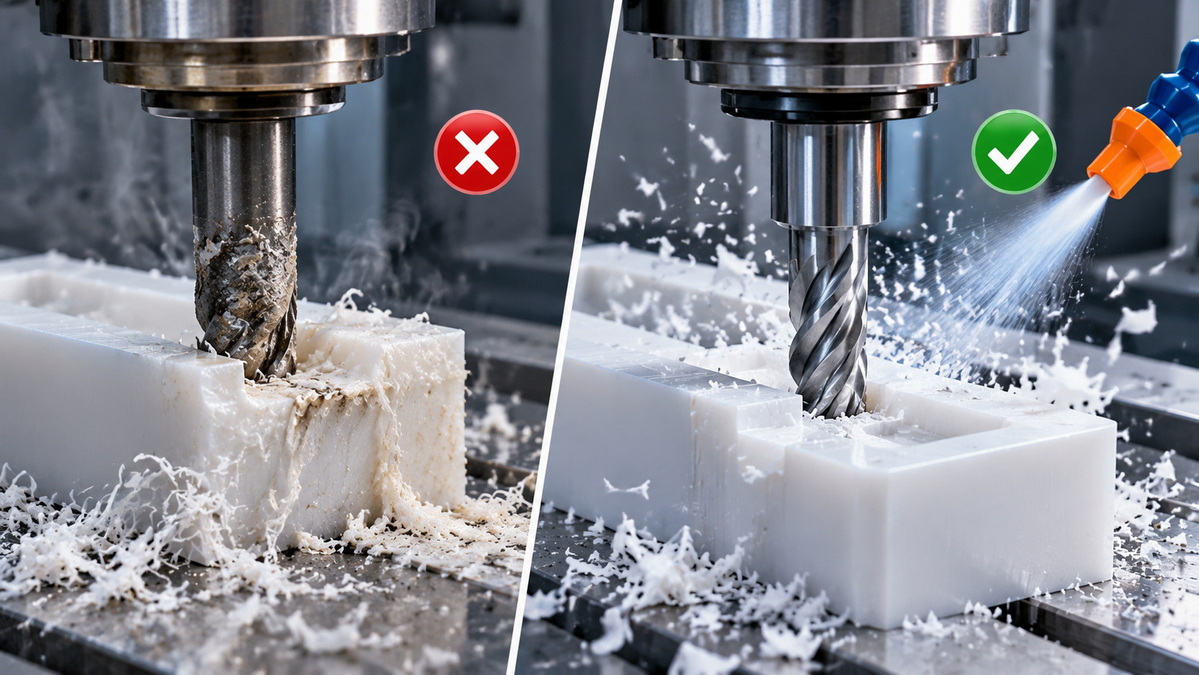
PVC is machinable, but it is not a "set it and forget it" material. High-quality results depend on correct programming, sharp tools, balanced material removal, effective chip evacuation, and appropriate clamping force.
One of the most common PVC machining problems is excessive heat at the cutting edge. Because PVC does not dissipate heat as quickly as metal, poor cutting conditions can cause local softening.
Typical signs of excessive heat include:
- Melted or smeared edges
- Glossy, discolored surfaces
- White stress marks
- Long stringy chips sticking to the cutter
- Burrs around holes and profiles
- Burn marks near corners or tight pockets
- Dimensional variation after the part cools
Heat buildup is usually related to dull tooling, insufficient chip load, poor chip removal, excessive tool rubbing, or incorrect spindle speed.
To reduce heat, manufacturers should use sharp tools, stable cutting conditions, continuous chip evacuation, and suitable tool geometry. Air blast is commonly used to move chips away from the cutting zone and reduce the likelihood of chip recutting.
PVC expands and contracts more than metal. A part may appear accurate immediately after machining but change slightly as it cools and reaches a stable room temperature.
This becomes more important when the part includes:
- Long overall dimensions
- Tight hole-to-hole spacing
- Thin walls
- Flat sealing surfaces
- Close-fitting assembly features
- Large pockets or cutouts
- Symmetrical patterns
- Precision mating surfaces
For this reason, dimensional inspection should be performed after the part has stabilized. Measuring a warm component can create misleading results, particularly when tolerances are tight.
A good drawing should identify only the tolerances that are essential to function. Applying extremely tight tolerances to every feature may increase cost without improving the finished product.
PVC is less rigid than metal, so it can deform under excessive vise pressure or poorly designed fixtures. When the part is released, it may spring back and fail flatness, thickness, or profile requirements.
Common workholding methods for PVC include:
- Soft jaws
- Custom-machined nests
- Vacuum fixtures
- Low-force clamping systems
- Double-sided machining fixtures
- Wide support surfaces
- Protective sacrificial layers
- Edge supports for thin or long parts
The objective is to hold the workpiece firmly enough to resist cutting forces without squeezing, bending, or marking the material.
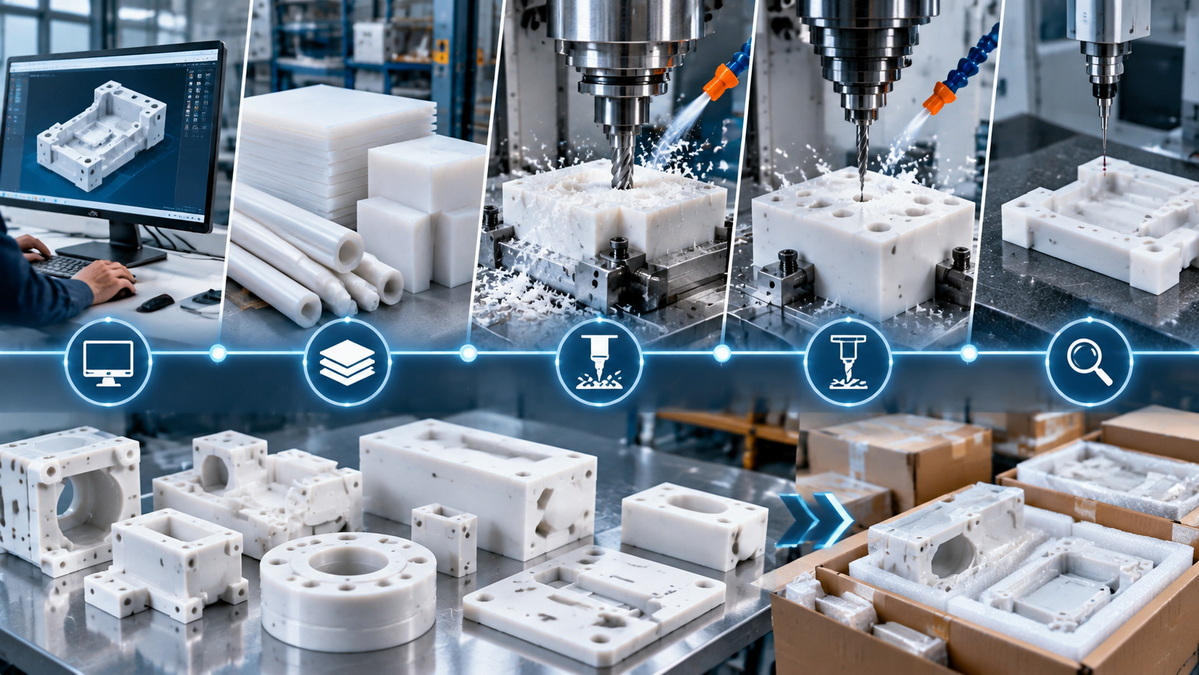
A stable machining process begins before the machine starts. Material selection, part geometry, tool choice, workholding, programming, inspection, and packaging all influence the final result.
PVC is available in different formulations, and not every grade is suitable for precision machining. The final material choice should reflect the application rather than simply the initial price.
| PVC Type | Key Characteristics | Typical Uses |
|---|---|---|
| Rigid PVC / PVC-U | Stiff, chemical-resistant, electrically insulating | Industrial panels, valve parts, fixtures, covers |
| Impact-Modified PVC | Improved toughness and handling resistance | Guards, machine covers, enclosures |
| CPVC | Better temperature resistance than standard PVC | Process piping, chemical equipment, warmer service environments |
| Foamed PVC | Lightweight and easy to route | Signs, displays, low-load panels |
| Flexible PVC | Soft, plasticized, and less suitable for precision components | Tubing, flexible guards, seals |
For important projects, clearly define the required PVC grade, color, thickness, stock form, certification needs, operating environment, and appearance requirements before manufacturing begins.
Tool condition has a direct influence on edge quality, surface finish, heat generation, and dimensional consistency. Sharp carbide tools are often preferred for production PVC machining because they retain their cutting edge and provide reliable performance.
Useful tool-selection practices include:
- Use sharp solid-carbide end mills for CNC milling
- Select one-flute or two-flute cutters when chip evacuation is critical
- Use polished cutting edges where appropriate
- Avoid worn or chipped tools
- Use sufficient flute clearance for chip removal
- Reduce tool overhang whenever possible
- Select drill geometry that minimizes heat and exit-side chipping
- Use a finishing pass for critical dimensions or visible surfaces
A tool should cut the material cleanly. If it produces powder, smearing, or excessive heat, the machining parameters or tool condition should be reviewed.
There is no single spindle speed or feed rate that applies to every PVC project. The correct settings depend on cutter diameter, number of flutes, tool geometry, stock thickness, part rigidity, cutting depth, machine condition, and required finish.
However, the objective remains the same: create clean chips instead of heat.
| Operation | Main Process Focus | Common Risk |
|---|---|---|
| CNC milling | Sharp tool, stable workholding, controlled chip removal | Smearing, chatter, melting |
| Drilling | Heat control, chip clearing, supported hole exit | Burrs, oversized holes, localized melting |
| Turning | Positive cutting geometry, stable support, controlled pressure | Surface tearing, deflection, heat buildup |
| Saw cutting | Correct blade selection and secure stock support | Rough edges, blade marks, binding |
| Tapping | Controlled torque and sufficient thread engagement | Cracking, stripped threads, distorted holes |
Deep drilling deserves additional planning. As drill depth increases, chips can become trapped in the hole and raise the local temperature. Periodic drill withdrawal can help clear chips and improve surface quality.
Small design decisions can have a major effect on machining cost, quality, and delivery reliability. A manufacturable design does not compromise the product's function; it removes avoidable complexity.
Consider the following design principles:
1. Add internal corner radii. Standard end mills cannot create perfectly sharp internal corners without additional operations.
2. Avoid extremely thin walls. Thin PVC features can vibrate, deform, or crack during machining and assembly.
3. Use standard hole sizes. Standard drill sizes can reduce setup time and improve repeatability.
4. Limit deep narrow pockets. Long-reach cutters are more likely to flex and create poor surface finish.
5. Specify critical tolerances selectively. Tight tolerances should be used only where parts must seal, locate, align, slide, or assemble.
6. Provide support around threads. Threaded holes too close to an edge can crack under assembly force.
7. Identify visible surfaces. Cosmetic requirements should be communicated in advance so that handling and packaging can protect the part.
8. Consider assembly loads. A plastic thread may not be suitable for repeated high-torque fastening. Metal inserts or through-bolt designs may be more reliable.
PVC can be processed with several CNC and conventional machining methods. The preferred method depends on the part shape, required accuracy, material stock form, order quantity, and application.
CNC milling is one of the most common methods for producing custom PVC components. It is suitable for flat plates, manifolds, brackets, spacers, enclosures, profiles, custom fixtures, and parts with pockets, slots, holes, contours, and complex surface features.
Typical CNC-milled PVC applications include:
- Chemical-processing equipment panels
- Pump and valve mounting components
- Electrical insulation boards
- Cable-management components
- Custom assembly fixtures
- Machine guards and covers
- Laboratory equipment parts
- Fluid-handling mounting plates
- Industrial automation components
- Replacement components for existing machinery
For high-quality milling, chip removal, tool sharpness, fixture stability, and balanced material removal should be carefully controlled.
PVC can be drilled effectively, but deep holes need additional care because heat and chips can accumulate inside the workpiece. A poor drilling process can lead to melted hole walls, oversized holes, burrs, cracking, or poor thread quality.
For better results:
- Use sharp drill bits
- Support the workpiece near the hole exit
- Avoid excessive pressure
- Clear chips regularly in deeper holes
- Use a controlled feed rate near breakthrough
- Review thread depth and wall thickness before tapping
- Avoid overtightening fasteners during assembly
For repeatedly assembled products, threaded inserts, through-bolts, or captive hardware may be preferable to direct plastic threads.
CNC turning is useful for cylindrical PVC components such as bushings, sleeves, plugs, rings, spacers, adapters, and valve-related parts.
Turned PVC parts require stable support because long, thin shapes may deflect under cutting pressure. Sharp inserts, controlled feed rates, and conservative clamping are important for maintaining roundness and surface quality.
Saw cutting and routing are often used to prepare PVC sheet, rod, tube, or plate before CNC finishing. These methods can efficiently produce simple profiles, blank sizes, and large-format panel shapes.
The final edge quality depends on blade condition, tooth geometry, feed rate, material support, and the amount of heat created during cutting.
The table below outlines common production issues and practical ways to reduce them.
| Manufacturing Method | Best For | Main Advantage | Main Limitation |
|---|---|---|---|
| CNC Machining | Prototypes, low-volume parts, complex custom features | No dedicated mold tooling and easy design changes | Unit cost can rise at very high volumes |
| Injection Molding | High-volume, repeatable production | Low unit cost after tooling is complete | High upfront tooling investment |
| Sheet Metal Fabrication | Structural brackets, enclosures, covers | Strong and durable metal construction | Not suitable when electrical insulation is required |
| Laser Cutting and Bending | Flat metal profiles and bent assemblies | Fast fabrication for sheet-metal parts | Limited to sheet-based structures |
| Thermoforming | Large thin-wall covers and housings | Cost-effective for shell-like plastic parts | Less precise for detailed functional features |
| 3D Printing | Early prototypes and low-demand validation | Fast design iteration with minimal setup | May not match PVC performance or finish requirements |
For projects involving machined PVC parts, metal brackets, stamped components, custom molds, and fabricated sheet-metal assemblies, working with one manufacturing partner can simplify communication and reduce supplier coordination.
U-Need provides integrated manufacturing support for customers that need more than one isolated process. We help evaluate the complete part requirement, including material selection, manufacturability, machining approach, tooling needs, sheet-metal integration, inspection planning, and shipment protection.
Our manufacturing capabilities include:
- Custom CNC precision machining
- PVC and engineering plastic machining
- Aluminum, stainless steel, brass, steel, and other metal machining
- Injection mold manufacturing
- Stamping die manufacturing
- Cold-forging die manufacturing
- Laser cutting and sheet-metal fabrication
- Sheet-metal bending and stamping
- Prototype support
- Low- and medium-volume production
- Design-for-manufacturing feedback
- Inspection planning for key dimensions
- Protective packaging for cosmetic and precision components
For the most accurate manufacturing review, prepare the following information:
- 2D drawing with dimensions and tolerances
- 3D CAD model in STEP, IGES, X_T, or another common format
- Required PVC grade or acceptable material alternatives
- Quantity and annual demand estimate
- Surface-finish and cosmetic requirements
- Color requirement
- Thread, insert, or hardware details
- Application environment
- Chemical exposure information
- Operating temperature
- Assembly method
- Packaging and shipping requirements
When a complete technical package is not yet available, a functional description, sample part, assembly photo, or hand sketch can still provide a useful starting point for manufacturing evaluation.
PVC is a versatile industrial material that can be machined into precise, corrosion-resistant, electrically insulating, and cost-efficient custom components. Its performance depends not only on the material itself but also on the quality of the machining strategy.
Successful PVC machining requires sharp tools, controlled heat, effective chip removal, stable workholding, practical tolerances, and design features that match the material's behavior. When these factors are addressed early, PVC can become a dependable choice for prototypes, replacement parts, production components, fixtures, housings, fluid-handling assemblies, and industrial equipment.
U-Need combines custom precision machining with mold manufacturing, sheet-metal fabrication, laser cutting, bending, and stamping capabilities. This integrated approach helps customers develop practical, manufacturable solutions for PVC parts and multi-process industrial projects.
PVC is generally machinable, but it requires control of cutting heat, chip evacuation, clamping pressure, and tool sharpness. With the right process, it can be milled, drilled, turned, tapped, routed, and cut into precise industrial components.
Rigid PVC, also known as PVC-U or unplasticized PVC, is commonly selected for precision-machined industrial parts. The most suitable grade depends on chemical exposure, temperature, impact requirements, appearance, certification needs, and mechanical loading.
PVC can be machined to controlled tolerances, especially on small functional features. However, PVC expands and contracts more than metal, so tolerance requirements should consider temperature, part size, wall thickness, workholding method, and final application conditions.
PVC may melt when excessive friction creates too much heat. Common causes include dull tools, incorrect feed rates, low chip load, poor chip evacuation, excessive spindle speed, tool rubbing, or repeated cutting of trapped chips.
Yes. PVC can be drilled and tapped, but thread design should account for wall thickness, tightening torque, assembly frequency, and proximity to edges. For high-load or frequently assembled joints, threaded inserts or through-bolts may provide better long-term reliability.
PVC has good resistance to many acids, alkalis, salts, and moisture-rich environments. However, chemical compatibility should always be checked against the specific chemical concentration, temperature, exposure duration, and mechanical stress of the final application.
CNC machining is generally preferable for prototypes, short runs, replacement parts, and designs that may change. Injection molding becomes more economical when the design is stable and production volume is high enough to justify mold tooling costs.
1. RapidMade. "[Engineers' Guide to Industrial Thermoforming of PVC]." Discusses PVC thermal behavior, processing considerations, and material limitations.
2. Quadrant Engineering Plastics / The Plastic Shop. "[Machining Instructions for Engineering Plastics]." Covers tooling, heat control, drilling, workholding, chip removal, tolerances, and general thermoplastic machining guidance.
3. AIP Precision Machining. "[Plastic Machining Guide]." Provides practical information on machining plastics, including milling, drilling, turning, inspection, and dimensional stability.
4. Ready Plastics. "[Machining PVC Plastic: Cutting, Drilling, and Welding Guide]." Offers practical PVC cutting, drilling, routing, and fabrication guidance.
5. Tangram Technology. "[Plastics Data File: PVC]." Provides technical background on PVC properties, service-temperature limits, processing, and general applications.


