Views: 255 Author: U-Need Publish Time: 2026-09-23 Origin: Site
Content Menu
● Why Delrin Is Popular for Precision Parts
● Why CNC Machining Delrin Requires Process Control
>> Common Delrin Machining Challenges
● Recommended Tooling for CNC Machining Delrin
● Delrin CNC Machining Parameters
>> General Machining Guidelines
● How to Prevent Melting and Surface Smearing
>> Practical Methods to Control Heat
● How to Control Warping and Residual Stress
>> Recommended Machining Sequence
● Workholding Methods for Delrin Parts
>> Effective Workholding Options
● Design Rules for Machined Delrin Parts
>> Practical Design Recommendations
>> Recommended Information for a Manufacturing Drawing
● Common Applications of CNC Machined Delrin
>> Industrial Automation Components
>> Automotive and Mobility Components
>> Electronics and Electrical Components
>> Medical and Laboratory Components
● Quality Inspection for Delrin Machined Parts
>> Quality Documents That May Be Required
● From Prototype to Production
● Summary
>> Is Delrin easy to CNC machine?
>> Can CNC-machined Delrin hold tight tolerances?
>> What is the difference between Delrin and POM?
>> Does Delrin need coolant during machining?
>> Is Delrin suitable for gears and bushings?
>> Can Delrin replace metal parts?
>> Is Delrin suitable for food-contact or medical applications?
>> What files are needed for a Delrin machining project?
CNC machining Delrin is a reliable way to manufacture durable, low-friction, and dimensionally stable parts such as gears, bushings, valve components, jigs, fixtures, and electrical insulation components.
Delrin® is a well-known acetal homopolymer, often classified as POM-H. It offers high strength, stiffness, fatigue resistance, low moisture absorption, and excellent wear performance. These characteristics make it a practical material for precision components that must slide, rotate, repeat motion, or operate in moderately humid environments.
However, high-quality Delrin machining requires more than selecting the right plastic. Tool sharpness, cutting heat, chip evacuation, workholding pressure, part geometry, and inspection timing all influence the final result. When these factors are controlled correctly, Delrin can deliver a clean surface finish, dependable fit, and stable performance across prototypes and production batches.
U-Need supports global brands, distributors, and manufacturers with integrated manufacturing solutions. Our capabilities include custom precision parts machining, injection mold manufacturing, stamping die manufacturing, cold-forging die manufacturing, laser cutting, sheet metal bending, and sheet metal stamping.
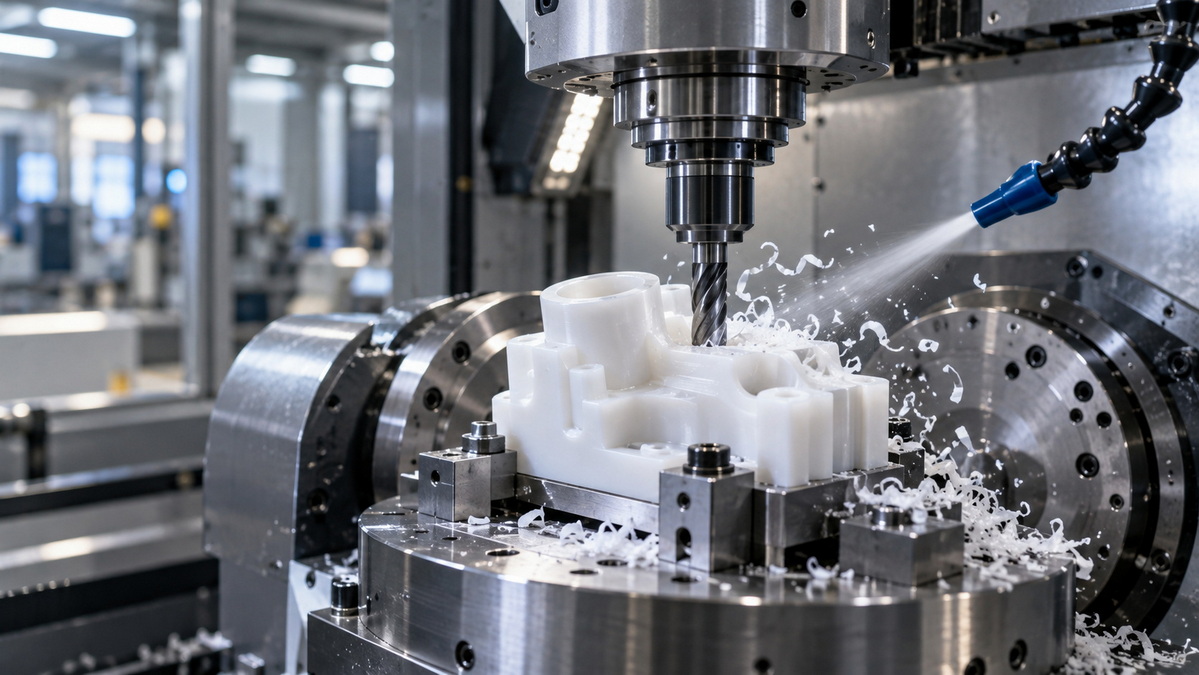
Delrin is a high-performance engineering thermoplastic based on acetal homopolymer chemistry. It is commonly selected for components that require good mechanical strength, low friction, wear resistance, and stable dimensions.
The material is widely used in industrial equipment, automotive assemblies, electronics, consumer products, medical devices, and automation systems. It is especially useful when a part must move smoothly without excessive lubrication or when a lightweight alternative to metal is required.
Delrin is often confused with acetal or POM. These terms are related but not identical.
- POM stands for polyoxymethylene, the broader engineering plastic family.
- Acetal is another common name for POM materials.
- Delrin is a branded acetal homopolymer.
- POM-H generally refers to acetal homopolymer materials.
- POM-C generally refers to acetal copolymer materials.
For manufacturing projects, it is important to specify the exact material grade, color, performance requirement, certification requirement, and intended operating environment. A general request for "Delrin parts" may not provide enough detail for material selection.
Delrin combines several performance advantages that are useful for mechanical and industrial components. It is stronger and stiffer than many standard plastics while remaining much lighter than metals such as steel, brass, or aluminum.
Its natural low-friction behavior makes it suitable for moving interfaces. In many assemblies, Delrin parts can reduce noise, wear, and lubrication requirements.
- High mechanical strength for lightweight structural and motion components
- Good stiffness for parts that must maintain shape under moderate load
- Low friction for gears, bushings, guides, rollers, and sliding components
- Good wear resistance for repeated mechanical movement
- Excellent fatigue resistance for parts exposed to repeated loading cycles
- Low moisture absorption compared with materials such as nylon
- Good electrical insulation properties for electrical and electronic applications
- Good machinability for CNC turning, milling, drilling, threading, and finishing
- Low weight for transportation, automation, and consumer-product applications
- Quiet operation in low-noise mechanical assemblies
| Property | Why It Matters | Typical Delrin Behavior |
|---|---|---|
| Tensile strength | Supports mechanical loads | High for an engineering plastic |
| Stiffness | Helps parts retain their form | Good rigidity |
| Friction behavior | Supports smooth movement | Naturally low friction |
| Wear resistance | Extends service life in moving parts | Strong performance |
| Moisture absorption | Supports dimensional stability | Relatively low |
| Electrical insulation | Suitable for selected electrical uses | Good insulating properties |
| Density | Reduces overall component weight | Lower than most metals |
| Machinability | Supports accurate production | Excellent with suitable tools |
Delrin is not the correct material for every application. High temperatures, extreme structural loads, aggressive chemical environments, high-pressure fluid systems, and safety-critical metal replacement projects require careful engineering review.
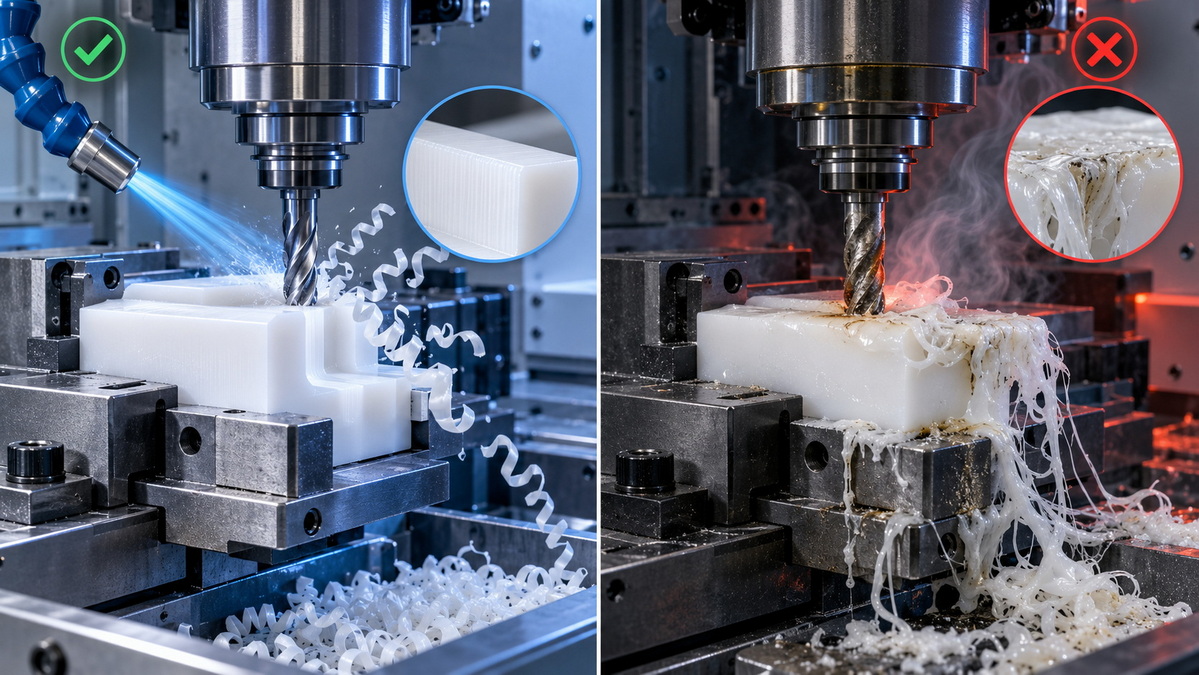
Delrin is often described as easy to machine. This is generally true, but it can create quality issues if the cutting process is not controlled carefully.
Unlike metals, Delrin does not remove heat quickly from the cutting area. When the tool rubs instead of cuts, heat can build up rapidly. Excessive heat may cause the surface to soften, smear, discolor, or deform.
This makes machining strategy important. The goal is to create clean chips, remove heat efficiently, and avoid placing excessive pressure on the workpiece.
- Heat buildup during milling, drilling, and turning
- Surface smearing caused by dull tools
- Burrs around holes, pockets, and sharp edges
- Chip wrapping around tools or parts
- Part distortion caused by excessive clamping force
- Dimensional movement after rough machining
- Warping caused by uneven material removal
- Tool marks on cosmetic surfaces
- Thread damage from aggressive tapping operations
- Inspection errors when measuring parts before they cool
A professional machining process should consider the full manufacturing sequence instead of treating Delrin like a softer version of metal.
Sharp cutting tools are essential for achieving a clean finish on Delrin. Dull tools increase friction, generate excessive heat, and can pull or smear the material instead of cutting it cleanly.
Polished carbide tools with positive rake geometry are often preferred because they reduce cutting resistance and improve chip evacuation.
- Sharp carbide end mills
- Polished O-flute end mills
- One-flute or two-flute cutters for chip clearance
- Positive-rake turning inserts
- Sharp twist drills for general drilling
- Peck drilling cycles for deep holes
- Form tools for consistent radii and profiles
- Custom soft jaws for complex workholding
- Deburring tools for edges and holes
For cosmetic parts, tool condition should be monitored closely. A cutter that performs well on the first batch may produce visible surface marks after extended production time.
Tool replacement schedules, first-piece inspection, and visual standards help maintain a consistent result.
There is no single cutting-speed or feed-rate setting that works for every Delrin part. The best program depends on material grade, tool diameter, flute count, wall thickness, machine rigidity, cutting depth, required finish, and workholding method.
The correct approach is to begin with stable machining parameters and make adjustments based on chip shape, surface appearance, spindle load, part temperature, and inspection results.
| Machining Variable | Recommended Approach | Expected Benefit |
|---|---|---|
| Cutting tool | Use sharp, polished carbide tooling | Reduces heat and surface smearing |
| Flute count | Use one to three flutes where practical | Improves chip clearance |
| Chip load | Maintain a real cutting load | Prevents rubbing and heat buildup |
| Spindle speed | Start conservatively and optimize | Reduces melting risk |
| Feed rate | Match feed to tool diameter and finish requirement | Supports efficient chip formation |
| Coolant method | Use air blast, mist, or compatible coolant | Improves temperature and chip control |
| Drilling method | Use peck cycles for deep holes | Reduces chip packing |
| Finishing pass | Use a controlled final pass | Improves dimensional consistency |
| Inspection timing | Measure after cooling | Avoids false measurements |
A common mistake is using an extremely light feed rate to create a "gentle" cut. In practice, this can cause the cutting edge to rub against the material. Rubbing produces heat, and heat reduces the quality of the cut.
The correct feed rate should create a proper chip while maintaining control of the part.
This is only a starting point. Final settings should be validated during production trials.
Heat is one of the most important factors in Delrin machining. When cutting heat becomes excessive, the material can soften around the tool edge. This may cause glossy surfaces, burrs, poor dimensional accuracy, or visible melt marks.
- Use sharp and clean cutting tools
- Avoid excessive tool dwell
- Maintain sufficient feed per tooth
- Use effective air blast for chip removal
- Reduce cutting depth for thin-wall features
- Use multiple passes for deeper pockets
- Avoid trapping chips in narrow slots
- Select tools with good chip clearance
- Use compatible mist or coolant when required
- Allow critical parts to cool before final measurement
For thin features, a machining sequence with lighter passes can reduce heat and deflection. Removing too much material in one pass may cause the wall to flex away from the cutter. Once the tool moves away, the wall can spring back, leading to an inaccurate final dimension.
Delrin stock is often supplied as rod, sheet, plate, or block. Depending on how it was manufactured, internal stress may exist inside the material.
When large amounts of material are removed from only one side of a workpiece, the internal balance can change. The part may move, bow, twist, or warp after machining.
This risk becomes more important for flat plates, thin-wall housings, long components, and precision assemblies.
1. Rough-machine the workpiece while leaving extra material for final finishing.
2. Remove material evenly from both sides whenever possible.
3. Allow the workpiece to stabilize after rough machining.
4. Re-fixture the part using low-stress workholding.
5. Finish-machine critical dimensions, bores, pockets, and datum surfaces.
6. Inspect the part after it reaches room temperature.
7. Confirm flatness, position, diameter, and critical dimensions before release.
Balanced material removal is especially important for parts with tight flatness requirements. If a plate is heavily pocketed on one side, the remaining material can pull the part out of shape.
A machining team should review the part geometry before production and recommend changes where necessary.
Delrin can deform under excessive clamp pressure. A component may appear dimensionally correct while it is tightly held in a vise, but it may move after the clamps are released.
This creates a common quality problem: the part passes the in-process measurement but fails final inspection.
- Soft jaws machined to match the part profile
- Custom nesting fixtures
- Vacuum fixtures for flat components
- Wide clamping surfaces with low pressure
- Sacrificial tabs for thin-wall parts
- Double-sided tape for selected lightweight parts
- Adhesive fixturing for special flat components
- Collets for round turned parts
- Mandrels for concentricity-critical components
The best fixture depends on the geometry, material thickness, tolerance requirement, and production volume.
For high-volume programs, custom fixtures can improve repeatability, reduce setup time, and lower the risk of clamp marks.
Design for manufacturability helps reduce cost, improve quality, and shorten production lead time. A part may be possible to machine, but that does not always mean it is the most efficient or reliable design.
The best Delrin parts balance functional requirements with realistic machining conditions.
- Use tolerances only where they affect function.
- Add internal corner radii where possible.
- Avoid deep and narrow pockets.
- Avoid extremely thin walls unless necessary.
- Use standard drill sizes and thread sizes.
- Provide access for cutting tools.
- Minimize unnecessary undercuts.
- Avoid sharp internal corners where stress may concentrate.
- Separate cosmetic surfaces from functional surfaces.
- Identify critical dimensions clearly on the drawing.
- Use GD&T for important relationships between features.
- Consider assembly conditions before defining bore and shaft fits.
- Specify edge-break requirements for assembly safety.
- State the required color, grade, certification, and finish.
A complete drawing should include:
- Part number and revision number
- Material grade
- Color requirement
- General tolerance standard
- Critical dimensions
- Datum references
- Surface-finish requirements
- Thread specifications
- Flatness or perpendicularity requirements
- Position tolerances
- Inspection requirements
- Quantity requirements
- Packaging requirements
A clear 2D drawing prevents confusion and reduces the risk of expensive revisions after machining begins.
Delrin and acetal copolymer are both part of the POM family. They share many useful characteristics, including good machinability, low friction, wear resistance, and dimensional stability.
However, they are not identical materials.
| Selection Factor | Delrin / POM-H | Acetal Copolymer / POM-C |
|---|---|---|
| Material type | Acetal homopolymer | Acetal copolymer |
| Mechanical strength | Often higher | Generally slightly lower |
| Stiffness | High | Good |
| Fatigue resistance | Excellent | Excellent |
| Wear resistance | Strong | Strong |
| Machinability | Excellent | Excellent |
| Chemical resistance | Good in many environments | Often preferred for some chemical environments |
| Hot-water performance | Requires careful grade review | Often selected for improved stability in some conditions |
| Typical applications | Gears, bushings, mechanical parts | Fluid components, precision parts, chemical-facing parts |
Material selection should not be based only on strength. The correct grade depends on the final operating environment.
Important factors include:
- Operating temperature
- Mechanical load
- Repeated movement
- Exposure to water or humidity
- Chemical contact
- Cleaning agents
- Lubrication conditions
- Mating material
- Food-contact or medical requirements
- Electrical requirements
- Regulatory documentation
For example, a gear inside an industrial mechanism may benefit from Delrin's stiffness and fatigue performance. A component exposed to certain chemicals or hot-water conditions may require closer evaluation of acetal copolymer alternatives.
Delrin is widely used in precision manufacturing because it provides smooth motion, good durability, and lightweight performance.
Industrial automation systems often use Delrin for:
- Conveyor guides
- Wear strips
- Rollers
- Bushings
- Guide blocks
- Chain guides
- Fixture components
- Cam followers
- Low-friction sliding elements
- Packaging-machine components
These parts benefit from reduced noise, smooth movement, and resistance to repeated motion.
Delrin may be used for:
- Interior mechanism components
- Small gears
- Latches
- Clips
- Seat-adjustment components
- Bushings
- Cable guides
- Low-noise moving parts
- Locking components
- Sensor housings
Automotive applications require specific material validation based on heat, chemical exposure, vibration, and long-term durability requirements.
Delrin can be used in:
- Electrical insulators
- Connector components
- Switch housings
- Cable-management parts
- Sensor fixtures
- Precision spacers
- Actuator components
- Test fixtures
- Assembly jigs
Its electrical insulation properties and dimensional stability make it useful for selected electrical and electronic assemblies.
Possible applications include:
- Equipment housings
- Instrument handles
- Laboratory fixtures
- Mechanical test components
- Positioning elements
- Device subassemblies
- Low-friction moving parts
For medical applications, the exact grade, processing history, sterilization method, colorant, and intended contact conditions should be reviewed before material approval.
Delrin is often used in:
- Appliance gears
- Sporting-goods components
- Zippers
- Fasteners
- Printer parts
- Hand-tool components
- Furniture mechanisms
- Durable clips
- Mechanical toy components
- Household equipment parts
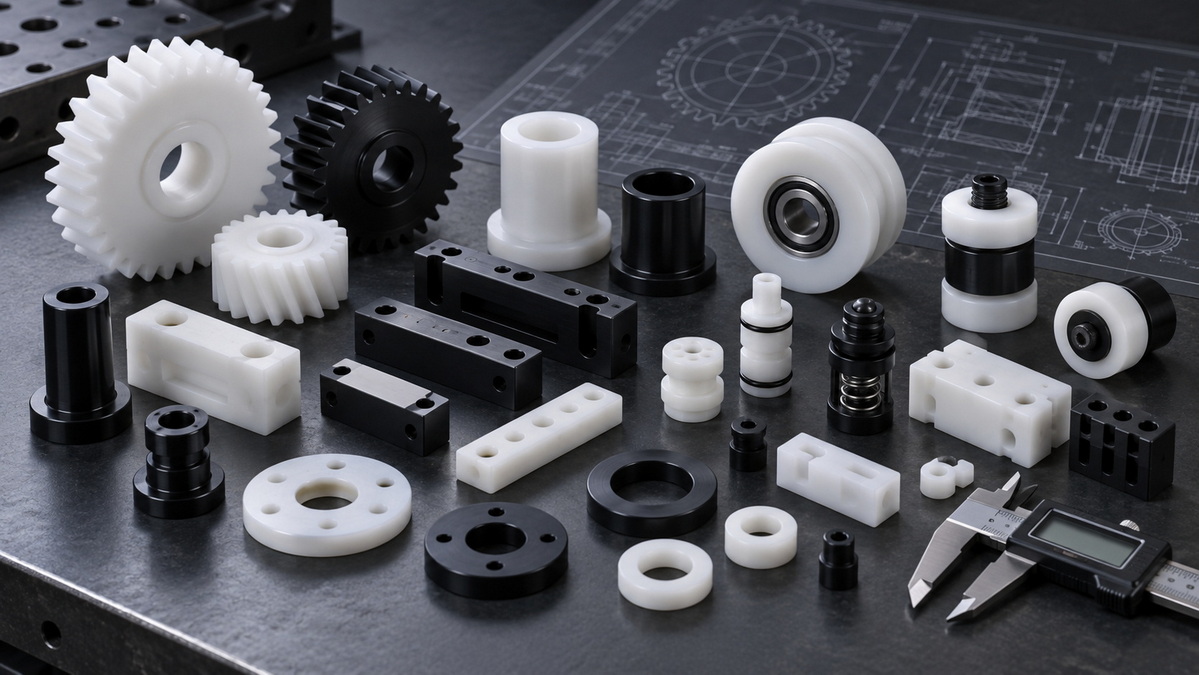
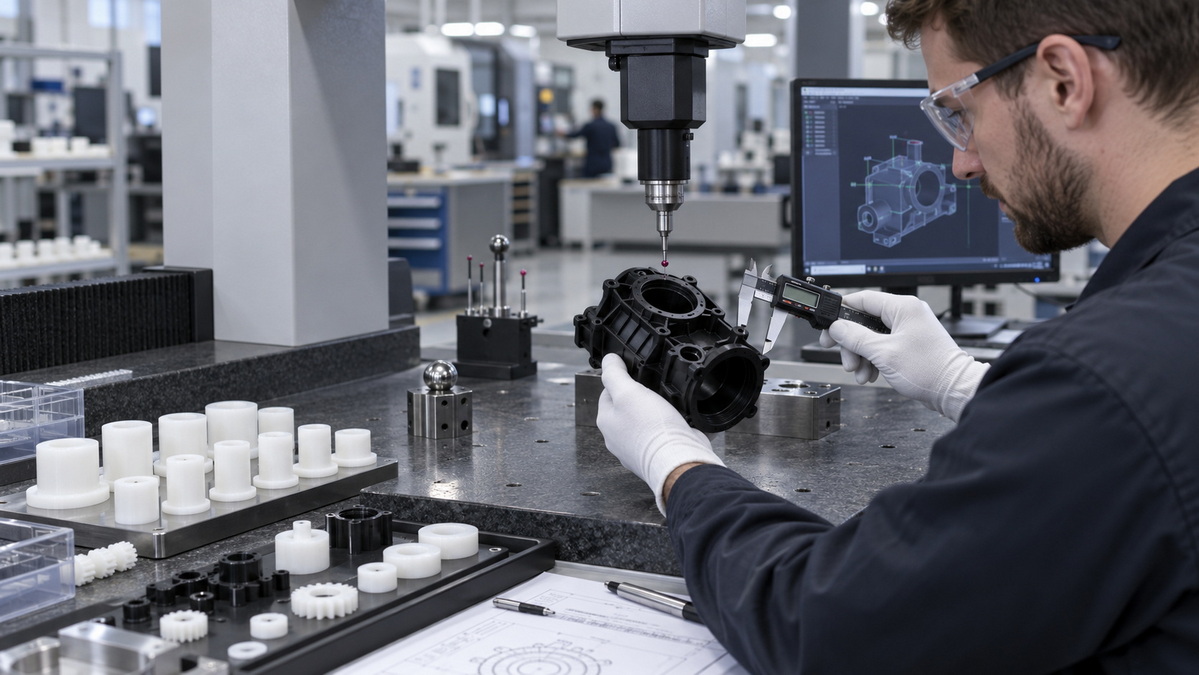
Precision machining requires inspection methods that match the part's functional requirements. A basic visual inspection may be enough for a simple spacer, while a precision gear housing may require detailed dimensional inspection.
- Digital calipers
- Micrometers
- Height gauges
- Pin gauges
- Thread gauges
- Bore gauges
- Optical comparators
- Surface roughness testers
- Coordinate measuring machines
- Go/no-go gauges
- Visual inspection under controlled lighting
For critical Delrin parts, measurements should be taken after the part has cooled and stabilized. This is particularly important for bores, thin-wall features, long profiles, and flat surfaces.
- First article inspection report
- Dimensional inspection report
- Material certificate
- Certificate of conformity
- RoHS declaration
- REACH declaration
- PPAP documentation
- Process capability report
- Packaging inspection report
- Appearance approval sample
The required documentation should be defined before production begins. This helps prevent delays during supplier qualification, customer approval, or final shipment inspection.
CNC machining is especially useful for prototypes, low-volume production, bridge production, and complex components that require frequent design changes.
A CNC-machined Delrin prototype can help engineers evaluate:
- Assembly fit
- Motion performance
- Gear engagement
- Clearance requirements
- Noise reduction
- Surface appearance
- Wear behavior
- Fixture compatibility
- Installation method
- Overall product usability
Once the design is stable and annual demand increases, injection molding may become more economical for high-volume production. The best manufacturing route depends on annual volume, part geometry, tooling cost, design maturity, and required delivery schedule.
U-Need can support this transition by combining CNC machining capability with injection mold manufacturing, stamping die manufacturing, cold-forging die manufacturing, laser cutting, bending, and sheet metal fabrication.
This integrated approach is valuable for products that include multiple materials or processes, such as a Delrin gear assembled with a sheet metal bracket, precision-machined shaft, molded housing, or stamped spring component.
CNC machining Delrin is an effective solution for precision plastic components that require low friction, good wear resistance, high fatigue performance, and stable dimensions.
The highest-quality results come from more than the material itself. Successful Delrin manufacturing depends on sharp tooling, controlled heat, effective chip evacuation, low-stress workholding, balanced material removal, realistic tolerance design, and inspection after cooling.
For gears, bushings, guides, fixtures, housings, electrical insulators, and other precision POM parts, the manufacturing process should begin with a clear understanding of the material grade, working environment, critical dimensions, assembly conditions, and expected production volume.
U-Need provides custom precision machining and integrated manufacturing support for projects ranging from prototype validation to repeat production. With CNC machining, mold manufacturing, cold-forging dies, stamping dies, laser cutting, bending, and sheet metal fabrication under one manufacturing partner, complex product programs can be managed with greater process continuity and production flexibility.
For custom Delrin or POM precision parts, provide a 3D CAD file, 2D drawing, material requirement, quantity, and application details for a manufacturing review.
Yes. Delrin is generally considered easy to CNC machine because it cuts cleanly with sharp tools and can achieve a smooth finish. However, the machining process must control heat, chip evacuation, tool sharpness, clamping pressure, and part cooling before inspection.
Yes, Delrin can hold tight tolerances when the part geometry, machining strategy, inspection method, and temperature conditions are properly controlled. Critical dimensions should be checked after the component returns to room temperature.
POM is the general name for polyoxymethylene engineering plastics, also called acetal. Delrin is a branded acetal homopolymer, often called POM-H. Other POM materials, including acetal copolymers, may have different chemical and mechanical characteristics.
Not always. Many Delrin operations can be machined dry with strong air blast and effective chip evacuation. Mist or compatible coolant can be useful for deep drilling, thin-wall machining, finishing operations, or situations where additional heat control is needed.
Yes. Delrin is widely used for gears, bushings, rollers, guides, and sliding components because it has low friction, good wear resistance, fatigue strength, and quiet operating behavior. Final suitability depends on load, speed, operating temperature, mating material, and environmental conditions.
In some applications, yes. Delrin can replace metal when mechanical loads, temperatures, safety requirements, chemical exposure, and stiffness requirements are within the material's capability. It can reduce weight, reduce noise, and avoid corrosion issues in appropriate environments.
Suitability depends on the exact material grade, supplier documentation, additives, colorants, manufacturing process, sterilization method, and destination-market requirements. A generic Delrin designation is not enough to confirm compliance. The selected grade must be reviewed against the application requirement.
A complete project package should include a 3D CAD file, a dimensioned 2D drawing, material grade, color requirement, quantity, tolerance requirements, surface-finish requirements, critical dimensions, and any inspection or certification needs.
1. [TOPS: Machining Delrin – Tips, Advantages & Applications]
2. [Delrin® Design Guide—Module III]
3. [True Precision Machining: Delrin / POM Machining Datasheet]
4. [Clarwe: Delrin (POM) CNC Machining Guide]


