Views: 253 Author: U-Need Publish Time: 2026-08-10 Origin: Site
Content Menu
● Why End Milling Matters in Precision Manufacturing
>> Drill Mills
● How to Choose the Right End Mill
● Cutting Parameters That Affect Performance
>> Depth of Cut
>> Step-Over
● Best Practices for Better Surface Finish
>> What Usually Causes Poor Finish
● Common End Milling Mistakes to Avoid
● Material-Specific End Milling Tips
>> Aluminum
>> Steel
>> Plastics
● How to Improve End Milling Efficiency
>> Practical Ways to Improve Efficiency
● Design Tips Before Machining
● Summary
● FAQ
>> 1. What is the difference between milling and end milling?
>> 2. Which end mill is best for aluminum?
>> 3. Why does my end mill chatter?
>> 4. Is climb milling always better?
>> 5. How can I extend end mill tool life?
>> 6. When should I use a ball nose end mill?
End milling is a machining process that uses a rotating cutting tool, called an end mill, to remove material from a workpiece. Unlike a drill bit, an end mill can cut sideways, plunge into material, and move along multiple axes to produce a wide range of features.
End milling is widely used in CNC machining because it can handle both simple and complex geometries. It is suitable for slots, pockets, contours, steps, shoulders, and surface finishing.
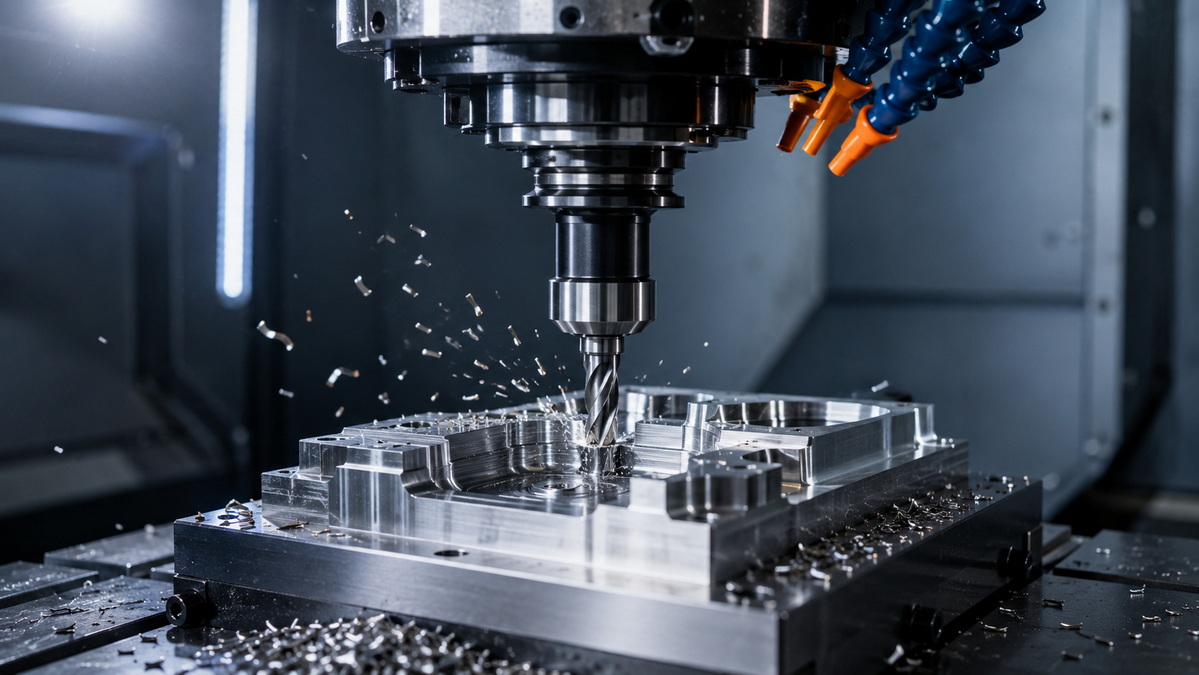
End milling plays a central role in part quality, machining efficiency, and production consistency. The choice of tool, cutting strategy, and setup directly affects tolerance control, surface finish, tool wear, and cycle time.
For manufacturers producing custom parts, molds, dies, and metal components, end milling is often one of the most important operations in the workflow. A stable process reduces rework and helps maintain predictable delivery schedules.
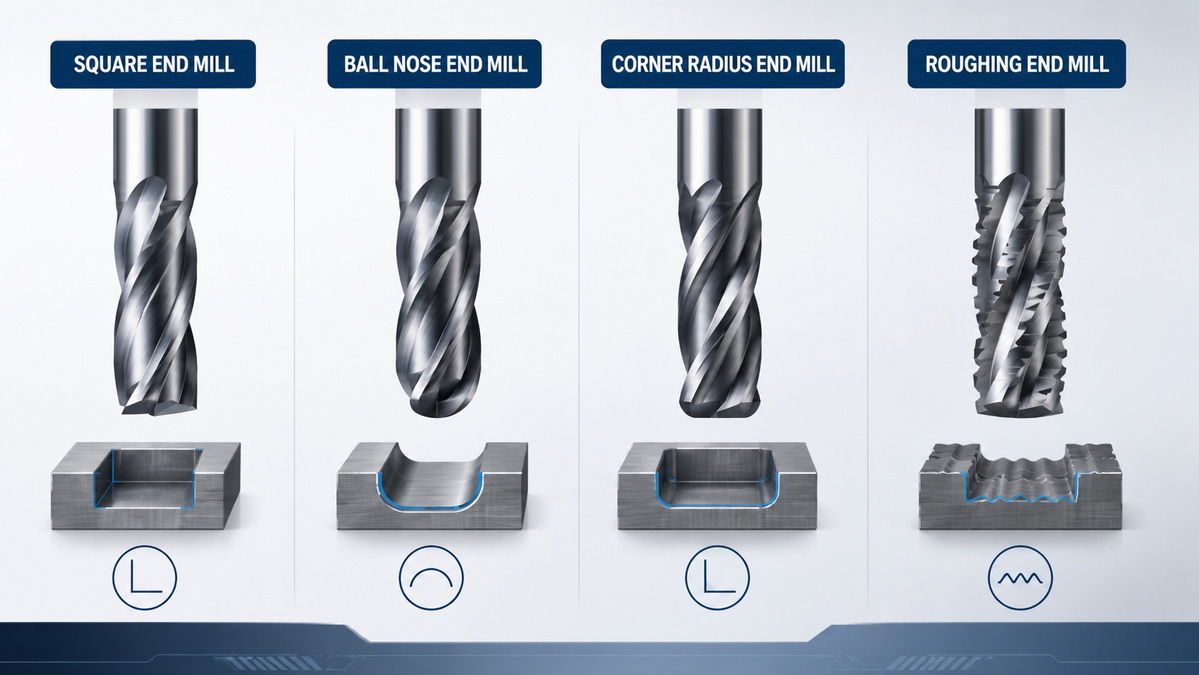
Different end mills are designed for different geometries, materials, and cutting goals. Choosing the right tool improves machining performance and helps extend tool life.
Square end mills have a flat cutting edge and are commonly used for general milling tasks. They are ideal for flat-bottom pockets, slots, and sharp internal corners.
Ball nose end mills have a rounded tip and are commonly used for 3D contouring and curved surfaces. They are especially useful in mold and die machining where smooth surface transitions are important.
Corner radius end mills combine a flat cutting edge with a rounded corner. They offer better edge strength than square end mills and are often used when both durability and finish quality matter.
Roughing end mills are designed to remove large amounts of material quickly. Their geometry helps break chips more efficiently and reduces cutting load during rough machining.
Tapered end mills are used for deep cavities, angled walls, and certain mold features. They offer better access in narrow areas and help control tool reach.
Drill mills can perform both drilling and milling functions in some applications. They are useful for spotting, counterbores, and flat-bottom hole features.
Selecting the right end mill depends on the material, the feature being machined, the required finish, and the rigidity of the machine setup. In many cases, the best choice is the shortest tool with the largest possible diameter that can still reach the feature.
- Material type: Aluminum, steel, stainless steel, plastics, and hardened materials all require different tool behavior.
- Tool diameter: Larger diameters improve rigidity, while smaller diameters help reach tight features.
- Cut length and reach: Shorter tools reduce vibration and deflection.
- Flute count: Fewer flutes help with chip evacuation, while more flutes can improve finish.
- Coating: Tool coatings can improve wear resistance and reduce heat.
- Tool geometry: Square, ball nose, roughing, and radius tools each serve different purposes.
If the part design allows it, use the shortest tool possible and avoid unnecessary reach. Tool rigidity is one of the most important factors in stable end milling.

Even a high-quality tool can perform poorly if the cutting conditions are wrong. Feed rate, spindle speed, depth of cut, and step-over all influence machining stability and finish quality.
Feed and speed should match the tool, material, and operation. Excessively slow cutting can create rubbing and heat, while overly aggressive settings can overload the cutter.
Shallower cuts are often safer for deep slots and hard materials. When machining full-width slots, reducing depth of cut can help control cutting force.
A larger step-over is useful for roughing, while a smaller step-over generally produces a better finish. The right balance depends on whether productivity or surface quality is the priority.
Chip removal is essential in end milling. Poor evacuation can cause recutting, heat buildup, chatter, and premature wear.
Surface finish depends on tool stability, path strategy, and cutting behavior. A clean finish often comes from a combination of the right cutter and a stable setup rather than from any single setting.
- Use climb milling when the machine and setup allow it.
- Keep the tool overhang short whenever possible.
- Maintain proper coolant or air blast to remove chips.
- Avoid excessive tool engagement in finishing passes.
- Use a cutter designed for the specific material.
- Check fixture rigidity before increasing speed or feed.
Poor finish is often caused by tool deflection, chatter, weak clamping, or incorrect tool selection. In many cases, improving setup stability produces better results than changing the machine program alone.
Many machining issues come from avoidable setup or planning errors. Fixing these problems can improve quality and reduce tool cost.
- Using a tool that is too long for the job.
- Ignoring chip buildup in deep pockets.
- Running aggressive cuts in hard materials without adjusting parameters.
- Choosing the wrong flute count for the material.
- Using the same cutting settings for roughing and finishing.
- Clamping the workpiece too weakly.
- Machining without checking tool path clearance.
A stable setup and proper tool selection are usually more important than trying to cut as fast as possible.
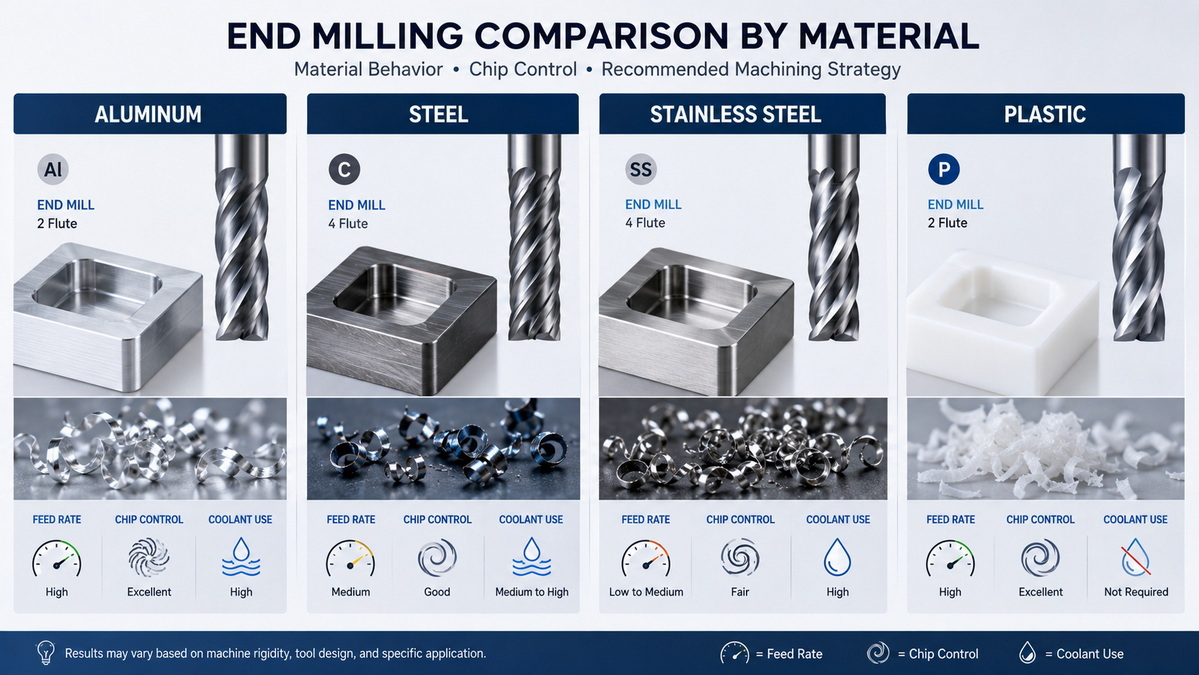
Different materials require different machining strategies. Treating them the same often leads to poor tool life or unstable cutting.
Aluminum usually works well with tools that support strong chip evacuation. Clear chips efficiently and avoid conditions that cause built-up edge.
Steel machining often requires rigid setups and controlled cutting conditions. Heat management and chip control are especially important.
Stainless steel can work-harden quickly if cutting conditions are poor. Conservative parameters and stable fixturing are important.
Plastics require sharp tools and careful heat control. Too much friction can cause melting, burrs, or poor edge quality.
Hardened materials usually require carbide tools, light cuts, and careful toolpath planning. Stability is critical because tool wear can rise quickly.
Efficiency is not just about higher spindle speed. Real productivity comes from better tool selection, fewer interruptions, and more reliable machining.
1. Use adaptive or trochoidal toolpaths for heavy material removal.
2. Match flute count to the chip evacuation requirement.
3. Reduce unnecessary tool changes.
4. Standardize proven cutters for repeat jobs.
5. Review part design before production to reduce difficult features.
6. Leave suitable stock for finishing after roughing.
These steps can reduce cycle time while improving consistency and tool life.
Good end milling starts with good part design. If geometry is difficult to machine, the cost and lead time usually increase.
- Make internal corner radii as large as possible.
- Avoid very deep and narrow pockets unless necessary.
- Keep walls thick enough to resist vibration.
- Use standard cutter sizes whenever possible.
- Apply tight tolerances only where they are truly needed.
- Plan features with tool access in mind.
These decisions make machining easier, faster, and more predictable.
End milling is widely used in CNC machining for parts that require precision features and flexible geometry. Common applications include prototypes, custom parts, industrial components, molds, dies, and low-to-medium batch production.
It is especially useful when a part needs flat-bottom pockets, profiles, slots, or complex contoured surfaces that cannot be produced efficiently by drilling or turning alone.
End milling is a versatile and essential machining process for producing accurate, functional, and complex parts. The best results come from selecting the right tool, using stable cutting conditions, controlling chip evacuation, and designing parts with machining in mind.
For manufacturers and buyers, understanding end milling helps improve part quality, reduce tooling risk, and make production more efficient.
Milling is the general process of removing material with a rotating cutter, while end milling specifically uses an end mill to cut slots, pockets, profiles, and contours.
For aluminum, 2-flute or 3-flute end mills are often preferred because they provide better chip evacuation and help reduce chip packing.
Chatter is often caused by tool overhang, weak fixturing, incorrect cutting parameters, or excessive cutting forces.
Climb milling often improves surface finish and reduces cutting forces, but the machine and setup must be stable enough to handle it safely.
Use the correct tool geometry, maintain proper chip evacuation, keep the setup rigid, and avoid cutting conditions that generate excess heat or vibration.
Ball nose end mills are best for curved surfaces, 3D contouring, and mold or die features that require smooth transitions.
1. RapidDirect, End Mills Buying Guide. [https://www.rapiddirect.com/blog/end-mills-buying-guide/]
2. RapidDirect, Beginner's Guide to End Mills. [https://www.rapiddirect.com/blog/beginners-guide-to-end-mills/]
3. RapidDirect, End Milling: Definition, Process, Types, and Operations. [https://www.rapiddirect.com/blog/end-milling/]
4. RapidDirect, CNC Machining Design Guideline: Maximizing Your Results. [https://www.rapiddirect.com/blog/cnc-machining-design-guideline/]
5. RapidDirect, How Can You Master End Milling for Superior Machining. [https://www.rapiddirect.com/blog/master-end-milling/]
6. RapidDirect, End Milling in CNC Machining: Best Applications and .... [https://www.rapiddirect.com/blog/end-milling-in-cnc-machining/]
7. RapidDirect, Guide: How to Choose the Right End Mill. [https://www.rapiddirect.com/blog/how-to-choose-the-right-end-mill/]
8. RapidDirect, End Mill Cutter Types Guide: Uses, Sizes, Geometry & Selection. [https://www.rapiddirect.com/blog/end-mill-cutter-types-guide/]
9. RapidDirect, End Mills Explained: Types, Uses & Tips for CNC .... [https://www.rapiddirect.com/blog/end-mills-explained/]
10. RapidDirect, The Beginner's Guide to End Mills. [https://www.rapiddirect.com/blog/the-beginners-guide-to-end-mills/]


