Views: 288 Author: U-Need Publish Time: 2026-07-19 Origin: Site
Content Menu
● Why Milling Cutter Selection Matters in Precision Manufacturing
● Understanding Flute Count: Core Differences Explained
● 2-Flute End Mills: Best for Soft Materials and High Chip Removal
● 3-Flute End Mills: Balanced Performance for Versatile Applications
● 4-Flute End Mills: Ideal for Hard Materials and Fine Finishing
● Multi-Flute End Mills: High-Speed Finishing and Precision Work
● How to Choose the Right Milling Cutter: A Practical Framework
● Tool Selection and Cost Optimization in Global Manufacturing
● CNC Machining for Aluminum Enclosures
● Why Work with a Precision Manufacturing Partner Like U-Need
● FAQs
>> 1. What is the best flute count for aluminum machining?
>> 2. Can I use a 4-flute end mill for soft materials?
>> 3. Why do more flutes improve surface finish?
>> 4. What is the main limitation of multi-flute cutters?
>> 5. How does flute count affect tool life?
Selecting the right milling cutter is not just a tooling decision—it directly impacts machining efficiency, surface finish, and overall production cost. For manufacturers sourcing custom precision parts machining in China, understanding how cutter geometry affects performance is critical to achieving consistent, high-quality results at scale.
In this expert guide, we break down the differences between 2-flute, 3-flute, 4-flute, and multi-flute milling cutters, combining practical machining insights with industry-level expertise from precision manufacturing environments like U-Need. Whether you are a procurement manager, product engineer, or CNC operator, this article will help you make better tooling decisions aligned with real-world production demands.

In modern CNC machining, especially in high-mix, low-volume production and export-oriented manufacturing, tool selection determines:
- Cutting efficiency and cycle time
- Surface finish quality
- Tool life and cost per part
- Machining stability and vibration control
From my experience working with B2B manufacturing clients, one of the most common inefficiencies comes from misaligned tool selection—using the wrong flute count for the material or cutting condition.
For example, using a 4-flute cutter on aluminum may seem efficient, but in reality, it can lead to chip clogging and tool breakage. Conversely, using a 2-flute cutter on hardened steel often results in poor surface finish and excessive vibration.
The number of flutes on a milling cutter affects three key aspects:
- Chip evacuation capacity
- Cutting force distribution
- Surface finish quality
Below is a structured breakdown of each type.
Key Characteristics:
- Large chip evacuation space
- Higher rake angle
- Lower cutting resistance
Advantages:
- Excellent for soft materials such as:
- Aluminum
- Plastics
- Wood
- Enables high feed rates
- Reduces risk of chip clogging
- Ideal for:
- Slotting
- Roughing
- Side milling
Limitations:
- Lower surface finish quality
- Higher vibration due to fewer cutting edges
- Limited load distribution
Expert Insight:
In export manufacturing projects involving aluminum housings or plastic components, 2-flute tools are often the default choice for roughing operations, especially when speed and chip evacuation are priorities.
Key Characteristics:
- Moderate chip evacuation
- Balanced cutting geometry
Advantages:
- Ideal for:
- Aluminum alloys
- Copper
- Composites
- Provides a balance between efficiency and finish
- Reduced vibration compared to 2-flute tools
- Suitable for:
- Semi-finishing
- Medium-load machining
- Slotting and side milling
Limitations:
- Not optimal for ultra-high precision finishing
- Faster wear under high-load or hard material conditions
Industry Application:
Many CNC machining service providers in China, including U-Need, use 3-flute cutters for mid-stage machining, where both productivity and acceptable surface quality are required.
Key Characteristics:
- Smaller chip pockets
- More cutting edges for load distribution
Advantages:
- Suitable for hard materials, including:
- Stainless steel
- Tool steel
- Titanium alloys
- Improved surface finish and dimensional accuracy
- Reduced vibration and chatter
- Supports higher feed rates in stable conditions
Limitations:
- Limited chip evacuation capacity
- Risk of chip clogging in deep slots
- Requires controlled cutting parameters
Practical Example:
When machining stainless steel valve components or aerospace-grade titanium parts, 4-flute cutters are often preferred for finishing operations, ensuring tight tolerances and smooth surfaces.
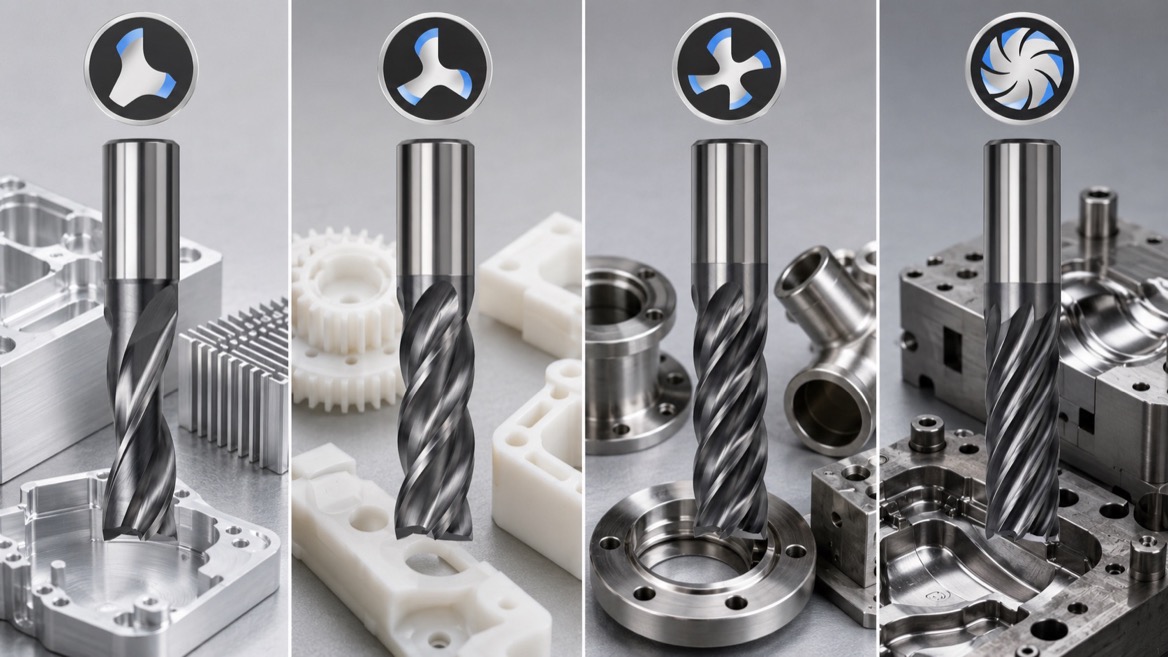
Key Characteristics:
- 5 or more cutting edges
- Minimal chip space
Advantages:
- Superior surface finish quality
- High cutting stability
- Reduced tool vibration
- Suitable for:
- High-speed machining
- Finishing passes
- Hard materials like:
- Cast iron
- Superalloys
Limitations:
- Limited chip evacuation
- Requires low radial engagement (typically 5–8% of tool diameter)
- Not suitable for heavy roughing
Advanced Insight:
In precision mold manufacturing, multi-flute cutters are commonly used for final contour finishing, where surface integrity directly affects mold performance and product quality.
To optimize machining results, consider the following decision factors:
1. Material Type
- Soft materials → 2 or 3 flutes
- Hard materials → 4 or multi-flute
2. Machining Stage
- Roughing → 2 flutes
- Semi-finishing → 3 flutes
- Finishing → 4 or multi-flute
3. Cutting Depth and Width
- Deep slotting → fewer flutes
- Shallow finishing → more flutes
4. Surface Finish Requirements
- Low requirement → 2–3 flutes
- High precision → 4+ flutes
One often overlooked factor in cutter selection is its impact on total manufacturing cost, especially in outsourced production.
From a cost engineering perspective:
- Using fewer flutes can reduce cycle time but may increase finishing costs
- Using more flutes improves quality but may require slower feeds
Optimized strategy:
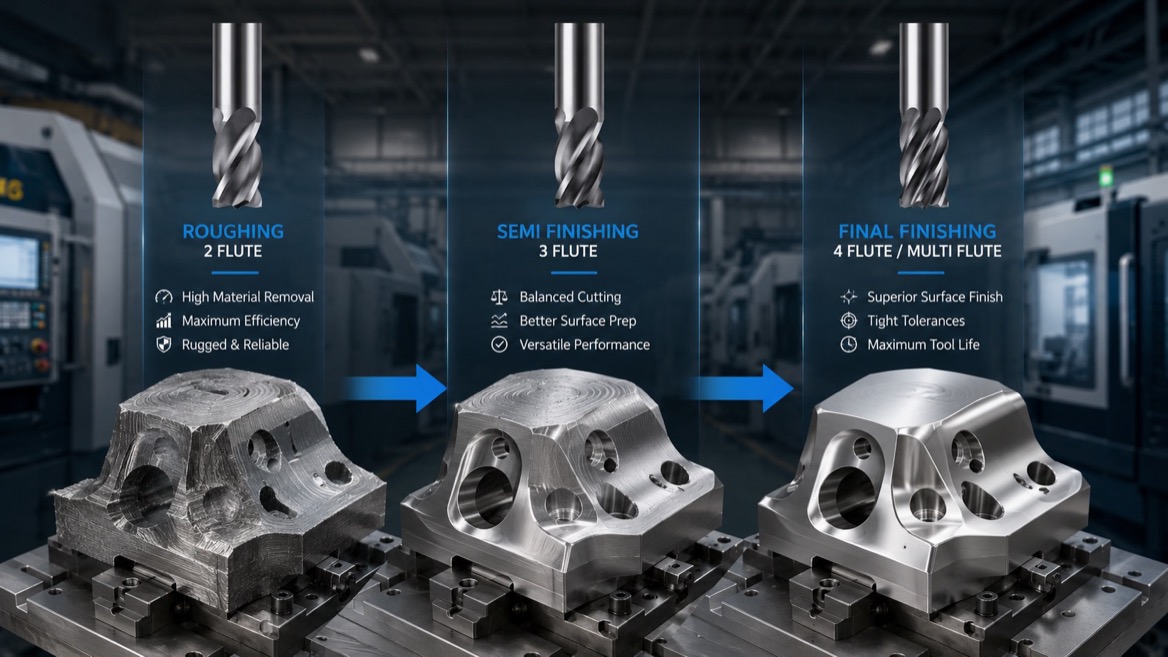
- Combine tools across stages:
- 2-flute for roughing
- 3-flute for semi-finishing
- 4-flute for finishing
This hybrid approach is widely used by precision manufacturers like U-Need to balance efficiency and quality, particularly in export projects where both cost and consistency are critical.
A European electronics brand outsourced aluminum enclosure production to a Chinese precision manufacturer.
Initial issue:
- Poor surface finish
- Tool wear and chip clogging
Solution:
- Switched from 4-flute to 3-flute cutters for roughing
- Introduced 4-flute cutters only in finishing stage
Results:
- 18% reduction in machining time
- 25% improvement in surface quality
- Reduced tool replacement frequency
This highlights how correct flute selection directly improves ROI.
Choosing the right tool is only part of the equation. Execution matters.
U-Need provides:
- Custom precision parts machining
- Injection mold and die manufacturing
- Sheet metal fabrication (laser cutting, bending, stamping)
What differentiates experienced partners:
- Deep understanding of tooling strategies
- Ability to match tool selection with production scale
- Strong quality control systems
For global buyers, this ensures consistent results across batches, which is essential in B2B manufacturing.
- Always align flute count with material hardness and chip behavior
- Avoid using high-flute tools in deep slotting operations
- Use multi-stage tooling strategies to optimize cost and quality
- Partner with manufacturers who understand process engineering, not just machining
If you are sourcing precision machined parts, molds, or sheet metal components from China, working with a technically capable partner can significantly improve your product quality and reduce production risks.
Contact U-Need today to discuss your project requirements and get expert recommendations on tooling strategies and manufacturing optimization.
For aluminum, 2-flute or 3-flute cutters are typically best due to their superior chip evacuation and reduced risk of clogging.
Yes, but it is not ideal. 4-flute tools may cause chip congestion in soft materials like aluminum or plastic.
More flutes increase the number of cutting edges in contact with the material, leading to smoother cuts and reduced vibration.
Their main limitation is poor chip evacuation, making them unsuitable for deep or heavy cuts.
Higher flute counts distribute cutting forces more evenly, which can extend tool life under controlled conditions.
1. Sandvik Coromant. Milling Tools and Application Guide. https://www.sandvik.coromant.com
2. Kennametal. End Milling Fundamentals. https://www.kennametal.com
3. MSC Industrial Supply. Milling Cutter Selection Guide. https://www.mscdirect.com
4. Modern Machine Shop. Tool Selection Strategies for CNC Machining. https://www.mmsonline.com
5. U-Need Precision Manufacturing (Company Overview & Services). https://www.u-need.com


