Views: 288 Author: U-Need Publish Time: 2026-07-03 Origin: Site
Content Menu
● Why 316L Stainless Steel Is So Difficult To Machine
● U-Need As Your Precision Manufacturing Partner In China
● Practical 316L Machining Recipe From The Shop Floor
>> Tooling Setup With AlCrN Coated Carbide
● Cutting Parameters For Stable 316L Milling
● Process Strategy: Climb Milling And High Pressure Internal Coolant
>> Why Climb Milling Helps 316L
>> Role Of High Pressure Internal Coolant
● Expert Guideline: Do Not Be Greedy With 316L
● Case Study: Medical 316L Component Production
● How U-Need Supports Global Brands End To End
● Practical Checklist For Machining 316L Stainless Steel
● 316L Machining Recommendations Table
● Call To Action: Partner With U-Need For Complex 316L Projects
● FAQs About 316L Machining And U-Need
>> FAQ 1: Why is 316L stainless steel harder to machine than many other grades?
>> FAQ 2: What type of cutting tools work best on medical 316L?
>> FAQ 3: How can I reduce built up edge when milling 316L?
>> FAQ 4: What services does U-Need offer to medical OEMs?
>> FAQ 5: Can U-Need support small batch prototyping before mass production?
U-Need is a specialized precision manufacturing partner in China that understands how difficult it is to machine medical grade 316L stainless steel without built up edge, especially in high purity medical and surgical applications. In this article, I share hands on machining experience and industry level insights that turn a problematic material into a stable, repeatable process and show how U-Need supports global brands with end to end precision solutions.
Medical grade 316L stainless steel combines high corrosion resistance with relatively low machinability compared to free machining steels. Its toughness and tendency to work harden make it prone to built up edge, tool wear and poor surface finish if parameters and tooling are not carefully controlled.
From a practical shop floor perspective, the typical symptoms are:
- Cutting edges quickly become dull and sticky
- Chips weld to the tool, causing built up edge and chatter
- Surface finish becomes inconsistent, especially on components that must be burr free
For medical OEMs and precision manufacturers, these problems directly impact quality, throughput and cost per part, which is why the machining strategy matters as much as the material selection.
U-Need positions itself as a global expert in precision parts and mold customization, serving medical, automotive, aerospace and industrial automation clients across multiple regions. Since its establishment, the company has focused on OEM and ODM manufacturing services with competitive pricing, tight tolerances and standardized quality systems.
Key strengths that matter for machining 316L and other difficult materials include:
- Senior engineers with extensive experience in precision machining and tooling design
- Integrated capabilities in custom precision parts machining, mold manufacturing and sheet metal fabrication
- Stable quality performance supported by systematic inspection and process control
For international brands, distributors and manufacturers, this combination of process know how and integrated capability is often more valuable than simply adding more machines.
The original process description provides a concise but powerful recipe for machining medical 316L stainless steel without sticking the tool. Below, that recipe is translated into a structured, practical guide from an expert viewpoint.
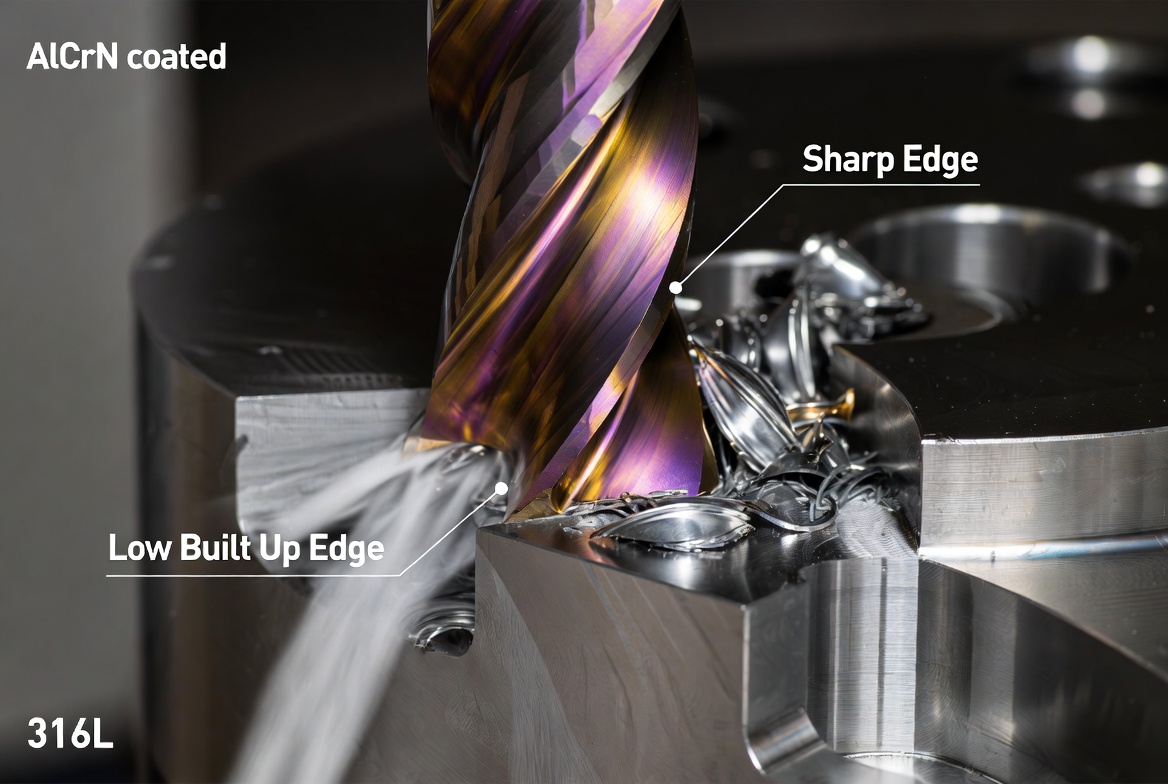
For medical 316L, the baseline tooling setup is:
- Tool type: carbide end mill
- Coating: AlCrN, aluminum chromium nitride
- Geometry: positive rake angle around 15 degrees, sharp cutting edges
AlCrN coatings are known for high hardness and good wear resistance, with strong performance on stainless steels due to their thermal stability and reduced friction at elevated temperatures. Choosing sharp, positive rake geometry reduces cutting forces and helps chip flow, which is critical to minimizing built up edge on tough austenitic stainless steels.
In practical terms, a very sharp edge on a high performance AlCrN carbide tool feels like shifting from pushing metal to peeling metal. The difference in chip consistency and surface finish is noticeable even to experienced machinists.
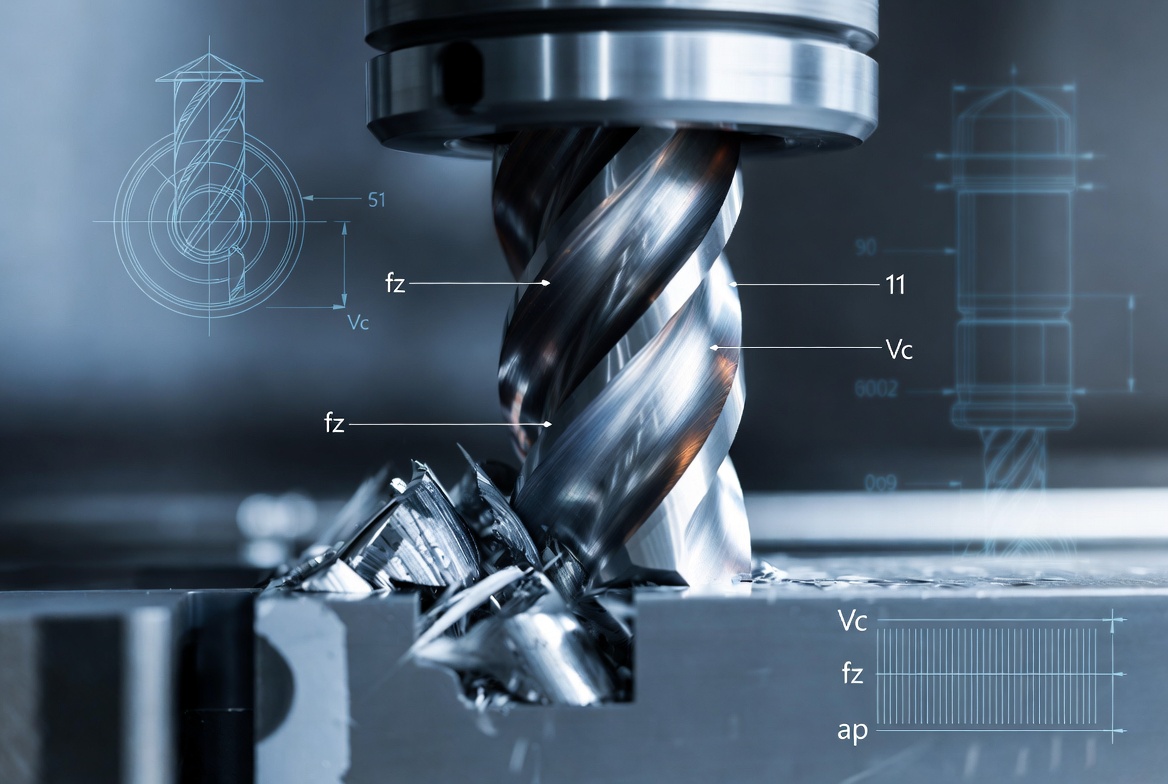
The baseline cutting parameters for 316L milling in this context are:
- Cutting speed Vc: 60 to 80 meters per minute
- Feed per tooth fz: 0.08 to 0.12 millimeters per tooth
- Axial depth of cut ap: 0.5 to 1.5 millimeters
These values fall within a conservative and safe range for 316L milling. Starting at the lower end of the speed range and gradually optimizing upwards is a practical way to reduce built up edge while preserving tool life.
In real production environments, teams treat these parameters as baseline windows and then fine tune them according to machine rigidity, tool brand, fixture design and coolant performance. A rigid setup with strong coolant can safely push toward the upper end of the speed and feed range without sacrificing surface finish.
Machining strategy is just as important as tooling and parameters when dealing with 316L. An effective strategy combines:
- Climb milling instead of conventional milling
- High pressure internal coolant
- Constant cutting depth
- Retract moves designed to clear chips from the cutting zone
In climb milling, the cutter engages with maximum chip thickness at entry and minimum at exit. That engagement pattern improves chip evacuation and reduces rubbing, which is especially important on 316L.
The benefits include:
- Lower tendency for chips to smear onto the cutting edge
- More stable cutting forces and reduced vibration
- Better surface finish on precision parts with strict cosmetic and functional requirements
For sticky stainless steels, high pressure internal coolant is both a heat management and chip control tool:
- It flushes chips away from the cutting zone, reducing recutting and built up edge
- It maintains lower tool and workpiece temperatures, limiting work hardening
- It allows deeper cuts at moderate speeds without burning the tool
When internal coolant is properly tuned, you can see the difference in chip color and shape. Chips become shorter, more uniform and less likely to weld to the tool, and cutting noise becomes smoother and more continuous.
One of the most important pieces of expert advice for 316L is simple: do not be greedy with speed.
In practice that means:
- Use lower spindle speed and moderate feed
- Keep depth of cut relatively shallow and constant
- Combine these with strong cooling to reduce built up edge events significantly
Many troubleshooting guides for stainless steels echo the same idea. Aggressive parameters with poor cooling almost guarantee built up edge, while conservative cuts with good coolant and sharp tools drastically reduce sticking and improve tool life.
A practical step by step framework for teams setting up a new 316L job would be:
1. Start with conservative parameters: low cutting speed, moderate feed per tooth, shallow depth of cut.
2. Monitor chips and tool edges after short trial runs.
3. Increase feed per tooth slightly before raising speed, because feed often helps break chips more cleanly.
4. Only push cutting speed when coolant performance, fixturing and vibration levels are proven stable.
To add unique value beyond parameter lists, it is useful to look at a realistic case scenario.
A medical device brand needs small 316L components for a minimally invasive surgical instrument, with tight tolerances, polished surfaces and no burrs. They partner with U-Need in China for:
- Custom CNC machining of 316L stainless steel parts
- Precision mold manufacturing for polymer components that interface with the metal parts
- Precision laser cutting and bending on thin sheet metal sections
U-Need's engineering team:
- Selects AlCrN coated carbide tools with 15 degree positive rake and sharp edges for main milling operations
- Sets initial parameters around Vc 60 meters per minute, fz 0.09 millimeters per tooth and ap 0.8 millimeters for pocketing features, then tunes based on tool wear data
- Implements high pressure internal coolant and climb milling, plus optimized retraction paths to avoid dwell marks and chip dragging
The result is a measurable reduction in built up edge compared with earlier aggressive cutting experiments, and consistent surface quality that meets medical OEM requirements. Deburring time drops, tools last longer and overall cycle time per part becomes more predictable.
This kind of end to end process tuning is what differentiates a general machine shop from a precision manufacturing partner capable of long term OEM relationships.
Beyond cutting parameters, global brands care about supply chain reliability and design to manufacture collaboration.
U-Need provides:
- Design for manufacturability support, where engineers review drawings and suggest small geometry or tolerance adjustments to improve machining stability on 316L and other tough materials
- Integrated tooling and mold manufacturing, including injection molds, stamping dies and cold forging dies that shorten development lead times
- Sheet metal fabrication with laser cutting, bending and stamping processes under the same quality system, enabling hybrid assemblies of machined and formed parts
For distributors and OEMs who want fewer suppliers and more predictable timelines, this end to end capability reduces project complexity and accelerates time to market.

To help teams translate theory into stable production, here is a compact checklist for 316L machining setup.
Before machining:
- Verify material grade and condition, ensuring true 316L
- Ensure rigid fixturing and minimize tool overhang
Tooling:
- Select AlCrN coated carbide tools or equivalent coatings optimized for stainless steel
- Use sharp edges and positive rake geometry to reduce cutting forces
Parameters:
- Start with cutting speed 60 to 80 meters per minute, feed per tooth 0.08 to 0.12 millimeters per tooth and depth of cut 0.5 to 1.5 millimeters
- Avoid excessive speed at the beginning, tune feed before speed
Process:
- Use climb milling, high pressure internal coolant and constant cutting depths
- Implement retract paths that clear chips away from the cutting zone
Troubleshooting built up edge:
- If built up edge occurs, first adjust speed and feed and confirm coolant delivery, because low speed and poor chip evacuation can promote sticking
- If flank wear dominates, reduce speed, review coating choice and consider a harder insert grade
This checklist reflects real world machining practices and can be adapted to different machine brands and tooling systems.
| Aspect | Recommendation | Note |
|---|---|---|
| Material | Medical grade 316L stainless steel | Tough, low machinability, high corrosion resistance |
| Tool | Carbide end mill with AlCrN coating | High hardness and wear resistance |
| Geometry | 15 degree positive rake, sharp edges | Lower cutting forces and built up edge |
| Speed Vc | 60 to 80 meters per minute | Start low, then optimize upwards |
| Feed per tooth fz | 0.08 to 0.12 millimeters per tooth | Supports stable chip formation |
| Depth of cut ap | 0.5 to 1.5 millimeters | Keep depth constant where possible |
| Strategy | Climb milling, high pressure internal coolant | Better chip evacuation and surface finish |
| Key guideline | Avoid overly aggressive speeds | Strong cooling and conservative parameters reduce sticking |
If you are a global brand, distributor or manufacturer struggling with 316L stainless steel machining or with multi step precision manufacturing projects, U-Need can serve as your trusted precision manufacturing partner in China. From custom precision parts machining to mold manufacturing and sheet metal fabrication, U-Need provides OEM and ODM services, technical support and stable quality to keep your projects on schedule and within budget.
Ready to turn 316L from a problem material into a profitable one? Contact U-Need's engineering team to discuss your drawings, tolerance requirements and volume needs, and co create a stable machining process tailored to your products.
316L has higher toughness and an austenitic structure that tends to work harden under cutting loads. This combination lowers its machinability compared with free machining steels and makes chip control, heat management and tool selection more critical.
AlCrN coated carbide tools with sharp edges and positive rake angles usually perform well on 316L. They provide good wear resistance and lower friction in stainless steel machining, helping maintain surface finish and reduce built up edge on the cutting edge.
You can reduce built up edge by using climb milling, high pressure internal coolant, conservative cutting speeds, moderate feed per tooth and shallow, constant depths of cut. Combining these strategies with sharp, coated carbide tools can significantly cut the frequency of built up edge events compared with aggressive dry cutting.
U-Need offers custom CNC parts machining, precision mold manufacturing and sheet metal fabrication under one coordinated system. This allows medical OEMs to source critical metal and plastic components from a single partner and simplify supplier management.
Yes, U-Need works with both small batch prototyping and full scale OEM and ODM production. The team provides design for manufacturability feedback and iterative process optimization so brands can validate designs and machining strategies before committing to large volumes.
1. U-Need Internal Engineering Insights uneedprecisionmachine
2. ScienceDirect – Machining Deformation https://www.sciencedirect.com/topics/engineering/machining-deformation
3. Machining Doctor – Cutting Heat Knowledge Center https://www.machiningdoctor.com/knowledge-center/cutting-heat/
4. Engineering ToolBox – Linear Thermal Expansion Coefficients of Materials https://www.engineeringtoolbox.com/linear-expansion-coefficients-d_95.html
5. CTE Magazine – Reducing Machining Distortion https://www.ctemag.com/articles/reducing-machining-distortion
6. NIST – Residual Stress and Its Role in Manufacturing https://www.nist.gov/publications/residual-stress-and-its-role-manufacturing


