Views: 233 Author: U-Need Publish Time: 2026-08-14 Origin: Site
Content Menu
● Why material selection matters in injection molding
● Common injection molding materials and their uses
>> ABS
>> Nylon (PA)
>> POM
>> PE
>> PMMA
>> TPE
>> TPU
>> PS
● How to choose the right material
>> 1. Define the working environment
>> 2. Identify the mechanical requirement
>> 4. Consider production volume
>> 5. Check dimensional stability
>> 6. Confirm compliance requirements
● Comparison table of popular materials
● New trends in material selection
>> Recycled and bio-based options
>> More precision-focused applications
● Real-world material examples
● Practical advice from manufacturing experience
● How U-Need supports your project
● FAQ
>> What is the most common injection molding material?
>> Which injection molding material is cheapest?
>> What material is best for strong and transparent parts?
>> Why does nylon absorb moisture?
>> Is material selection important before mold making?
Injection molding materials influence almost every stage of product development. The right resin can improve part strength, reduce defects, shorten cycle time, and support stable mass production. The wrong one can lead to warping, cracking, poor appearance, or unnecessary tooling risk.
For manufacturers, designers, and sourcing teams, material selection is not just a technical detail. It is one of the most important decisions in the entire molding process.
A material that works well in one product may perform poorly in another. Factors such as heat exposure, chemical contact, moisture absorption, impact load, and appearance requirements all affect the final choice.
In practice, the best injection molding material is the one that balances performance, manufacturability, compliance, and cost. That means the selection should always be based on the real working environment of the part, not just on a datasheet value.
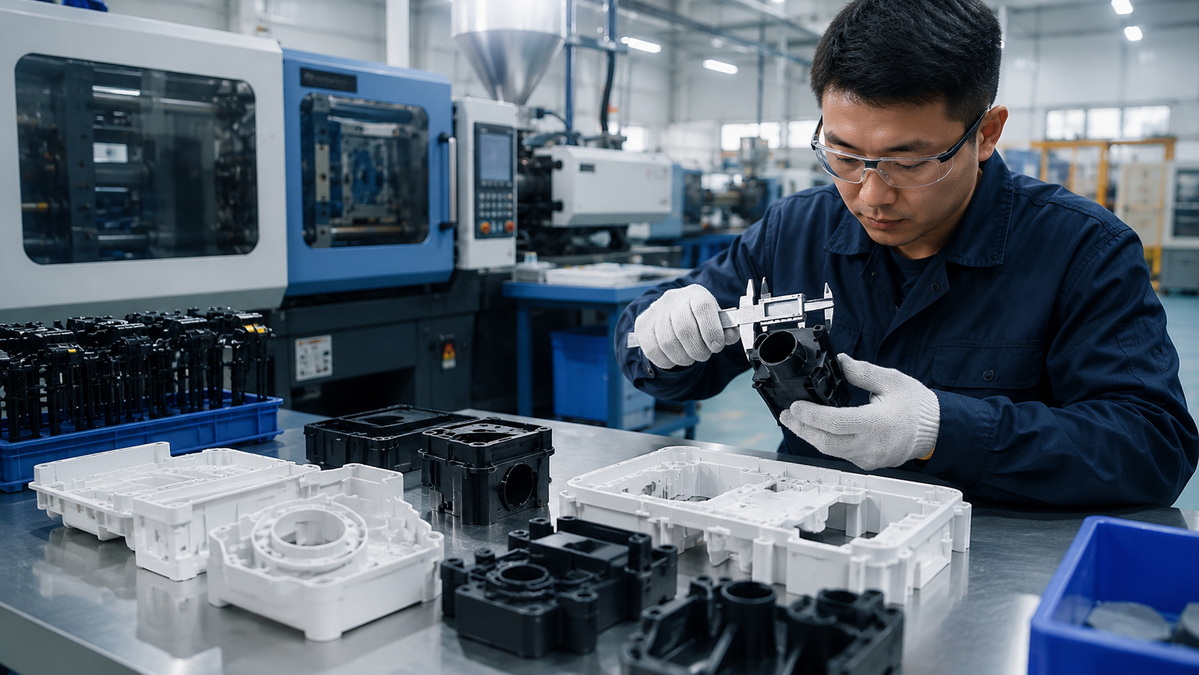
The following materials are among the most widely used in injection molding. Each one offers a different balance of strength, cost, appearance, and processability.
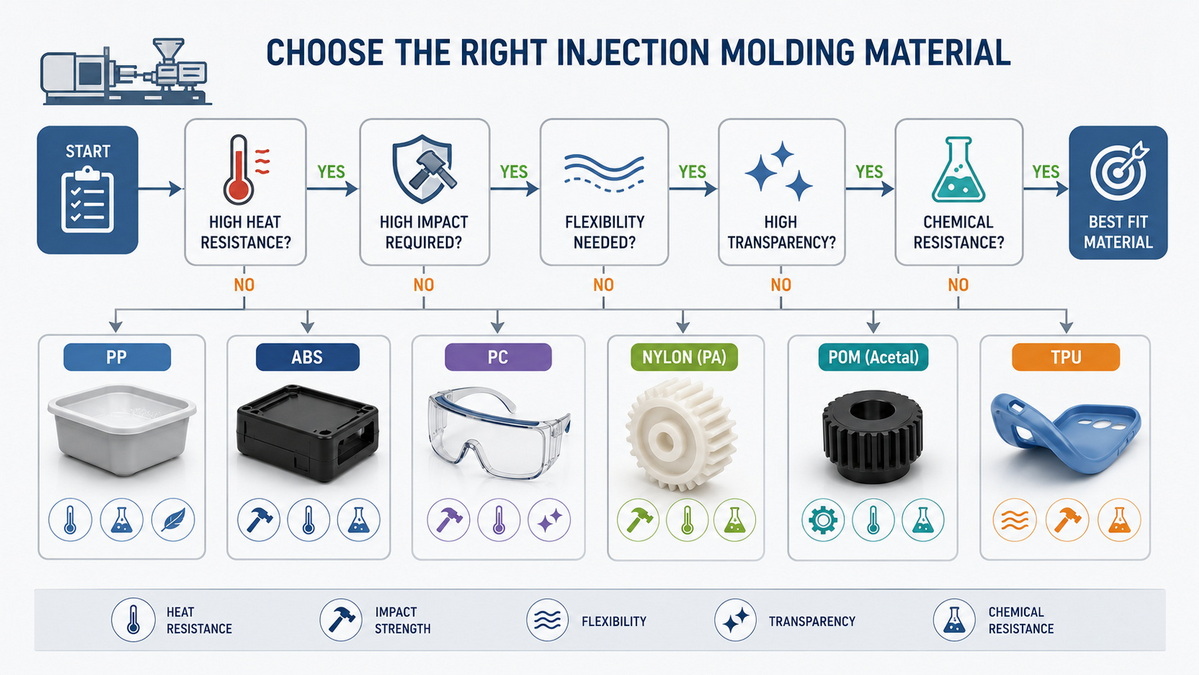
ABS is one of the most versatile injection molding plastics. It offers a strong balance of toughness, impact resistance, and affordability, which makes it suitable for housings, covers, automotive interior parts, and consumer products.
It is also easy to process and can produce a good surface finish. However, standard ABS is not the best option for outdoor exposure unless it is specially modified for UV resistance.
PP is widely used because it is lightweight, chemically resistant, and economical. It works well for packaging, caps, containers, household products, and many industrial applications.
Its low cost and good fatigue resistance make it attractive for high-volume production. Still, PP is not ideal when high rigidity, premium appearance, or strong bonding performance is required.
PC is often selected when a part needs high impact resistance and transparency. It is commonly used for safety shields, lenses, lighting parts, and protective covers.
It performs well in applications that require strength and clarity at the same time. However, it can be more expensive than general-purpose plastics and may be sensitive to certain chemicals.
Nylon is a strong engineering plastic with excellent wear resistance, fatigue resistance, and mechanical strength. It is often used for gears, brackets, clips, and moving mechanical parts.
One of its main challenges is moisture absorption, which can affect dimensions and long-term performance. For precision parts, this factor must be considered early in the design stage.
POM is well known for dimensional stability, low friction, and high wear resistance. These characteristics make it a reliable choice for gears, fasteners, switches, and precision mechanical components.
It is particularly useful when the part needs smooth movement and consistent fit. For many precision applications, POM is one of the most practical engineering plastics available.
PE is a broad material family used in many types of molded products. It offers good chemical resistance, low moisture absorption, and strong impact behavior at a relatively low cost.
HDPE is commonly used for rigid parts, while LDPE is better suited for flexible applications. The right grade depends on the required stiffness, toughness, and form.
PMMA is valued for its excellent clarity and attractive appearance. It is often used in light covers, display components, cosmetic parts, and transparent panels.
Its optical performance is a major advantage, but it is more brittle than PC. If impact resistance is critical, another material may be more suitable.
TPE provides rubber-like flexibility with the processing advantages of thermoplastics. It is often used in grips, seals, soft-touch parts, and flexible consumer products.
Its softness and comfort make it useful in products that require a pleasant tactile feel. However, it may not be the best option for parts that must carry heavy long-term loads.
TPU is known for abrasion resistance, elasticity, and toughness. It is commonly used in protective parts, wheels, wearable products, and flexible mechanical components.
Compared with many other elastomers, TPU usually offers better wear performance. This makes it a strong choice when durability and flexibility must work together.
PS is easy to mold and relatively low in cost. It is often used in disposable items, simple housings, and products where rigidity matters more than impact strength.
Its main limitation is brittleness. For applications that require repeated stress or impact resistance, other materials are usually a better choice.

Selecting the correct injection molding material is easier when the process is structured. A practical evaluation should include the following factors.
Start with the conditions the part will face during use. Ask whether it will be exposed to heat, moisture, UV light, vibration, chemicals, or repeated impact.
Some parts need stiffness. Others need flexibility, wear resistance, or impact protection. Material choice should always follow the main functional load.
If the product must look premium, material finish matters. Transparency, gloss, color consistency, and surface texture can all influence the final result.
High-volume production often benefits from low-cost, easy-flow materials. Lower-volume or technical products may justify engineering plastics with higher performance.
Some materials shrink more than others, and some absorb more moisture. These characteristics can influence tolerance control and long-term fit.
Export markets and regulated industries may require specific material certifications. These should be confirmed before tooling begins.
| Material | Main strengths | Main limitations | Common applications |
|---|---|---|---|
| ABS | Tough, affordable, easy to mold | Limited outdoor durability | Housings, covers, consumer products |
| PP | Lightweight, chemical resistant, low cost | Lower rigidity | Packaging, caps, household items |
| PC | High impact strength, transparent | More expensive, chemical sensitivity | Lenses, shields, covers |
| Nylon (PA) | Strong, wear resistant, fatigue resistant | Moisture absorption | Gears, brackets, moving parts |
| POM | Low friction, stable dimensions | Limited chemical resistance to strong acids | Precision mechanical parts |
| PE | Chemical resistant, low moisture absorption | Lower stiffness | Containers, utility parts |
| PMMA | Excellent clarity, attractive finish | Brittle compared with PC | Light covers, display parts |
| TPE | Flexible, soft-touch, comfortable | Limited load-bearing performance | Grips, seals, bumpers |
| TPU | Abrasion resistant, elastic, tough | More difficult to process than basic plastics | Protective parts, wheels, wearable components |
| PS | Easy molding, low cost | Brittle, low impact resistance | Disposable products, simple housings |
Material selection is changing as manufacturing requirements become more demanding. Sustainability, precision, and process stability now play a larger role in the decision-making process.
Many manufacturers are exploring recycled resins and bio-based plastics to meet environmental targets and reduce material footprint. These options are especially common in consumer packaging and brand-sensitive products.
Modern molding operations increasingly use monitoring systems to improve consistency and reduce scrap. Better control over temperature, pressure, and cycle timing helps ensure that material performance stays stable from batch to batch.
As products become smaller and more technical, material selection must support tighter tolerances and more demanding performance standards. This is especially important in electronics, medical devices, and industrial components.
A dashboard clip in the automotive industry may need toughness, heat resistance, and cost efficiency. In that case, ABS is often a practical and reliable option.
A gear or sliding component may require low friction and strong dimensional stability. POM is frequently chosen for this type of part.
A transparent protective cover may require both clarity and impact resistance. PC is often a better fit than acrylic when durability matters more than optical brilliance alone.
These examples show why material choice should always follow the application, not simply the price per kilogram.
Material datasheets are useful, but real production behavior matters more. The same resin may behave differently depending on mold design, wall thickness, gate location, cooling layout, and processing conditions.
Before tooling, it is usually best to review:
- Part geometry.
- Required tolerance.
- Surface finish.
- Environmental exposure.
- Production volume.
- Assembly method.
A good material choice should reduce risk, support consistent quality, and fit the full manufacturing plan.
U-Need is a precision manufacturing partner in China, supporting global brands, distributors, and manufacturers with custom precision parts machining, mold manufacturing, and sheet metal fabrication. For injection molding-related projects, that means more than production capacity—it means practical support for material decisions, tooling feasibility, and part quality.
Whether you are developing a new molded product or improving an existing one, a well-matched material can make the difference between a difficult process and a stable production result.
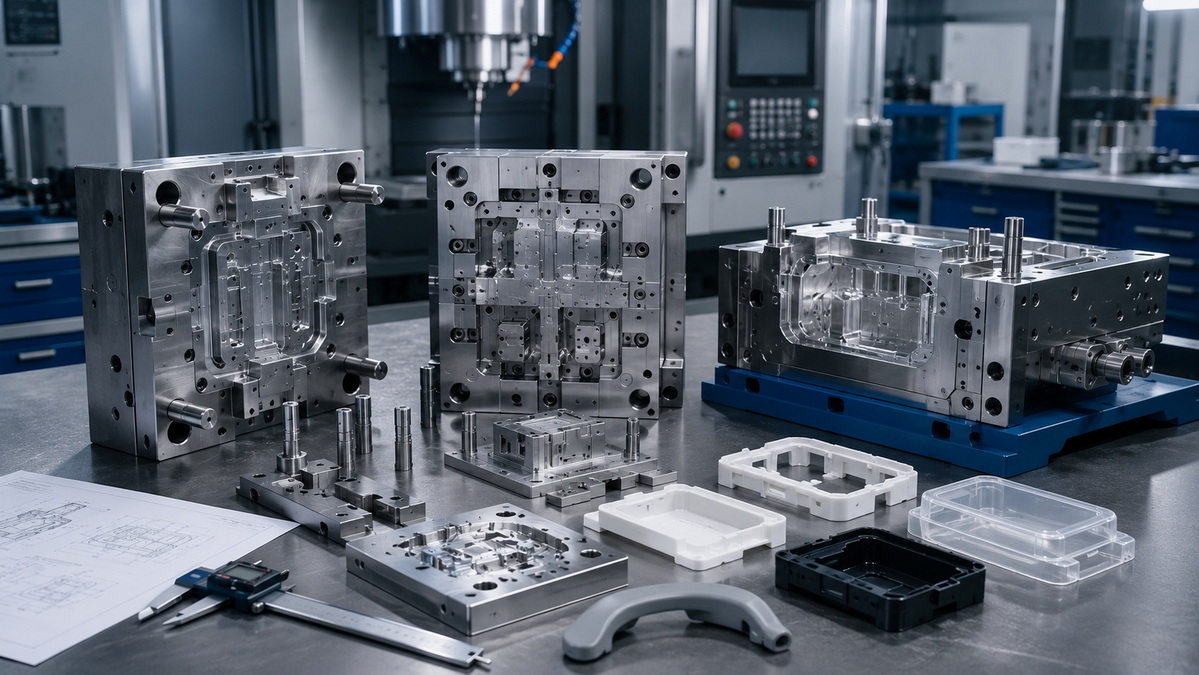
Choosing the right injection molding material is one of the most important steps in product development. The best option is not always the strongest, the cheapest, or the most widely used—it is the one that fits the part's real requirements.
With a clear understanding of material properties, production constraints, and end-use conditions, manufacturers can reduce risk and improve both quality and efficiency.
ABS, PP, PC, nylon, PE, and POM are among the most common materials used in injection molding because they cover a wide range of performance and cost requirements.
PP and PS are often among the lower-cost choices, although the best option still depends on the application and required performance.
Polycarbonate is often the best choice when both impact resistance and transparency are important.
Nylon has a molecular structure that attracts water, which can affect its dimensions and mechanical behavior. This should be considered during design and processing.
POM is a strong choice for parts that need low friction, stable dimensions, and good wear resistance, such as gears and precision mechanical components.
Yes. Material choice affects shrinkage, cycle time, cooling, surface quality, and dimensional control, so it should be finalized early in the project.
1.RapidDirect. 10 Types of Injection Molding Materials.
https://www.rapiddirect.com/blog/injection-molding-materials/
2.RapidDirect. How To Choose Materials for Injection Molding?
https://www.rapiddirect.com/blog/injection-molding-materials/
3.RapidDirect. The Future of Injection Molding | 7 Trends to Watch in 2025.
https://www.rapiddirect.com/blog/injection-molding-materials/
4.RapidDirect. The Biggest Injection Molding Trends for 2025.
https://www.rapiddirect.com/blog/injection-molding-materials/
5.RapidDirect. Injection Molding Material Selection Guide.
https://www.rapiddirect.com/blog/injection-molding-materials/
6.U-Need. China Custom CNC Machining Services | OEM Parts.
https://www.rapiddirect.com/blog/injection-molding-materials/
7.U-Need. U-Need Precision Machining | Custom CNC Parts & Molds.
https://www.rapiddirect.com/blog/injection-molding-materials/


