Views: 222 Author: U-Need Publish Time: 2026-05-24 Origin: Site
CNC Toolpaths are the invisible "roadmaps" that decide whether your machining job runs smoothly, scraps parts, or quietly prints money in saved cycle time. As a precision manufacturing partner at U‑Need in China, I have seen poorly planned toolpaths turn a seemingly simple aluminum housing into a week-long headache—and optimized toolpaths turn the same part into a repeatable, profitable job for global OEMs and distributors. [grzsoftware]
In CNC machining, a toolpath is the programmed route a cutting tool follows to remove material and create the final part geometry. It includes not only position in X, Y, and Z, but also feed rate, spindle speed, direction of movement, and depth of cut at every point along the path. [cs.cmu]
Most modern toolpaths are generated by CAM software, which converts a 3D model into G‑code that your CNC machine can execute. The quality of that path directly impacts machining time, tool life, and dimensional accuracy. [blog.hurco]
You can imagine a toolpath as a GPS route for your cutting tool: choose the wrong "road," and you get traffic, delays, and unnecessary wear. Choose the right "road," and the tool moves smoothly, safely, and efficiently. [fuson-cncmachining]

From a manufacturing and sourcing perspective, toolpath strategy is one of the fastest ways to improve part cost without changing the design. At U‑Need, the same drawing can run with very different cycle times depending on how intelligently the programmer defines the paths. [scientific]
Key impacts of well‑optimized toolpaths include: [sciencedirect]
- Dimensional accuracy and surface finish – Smoother, more consistent engagement improves tolerances and reduces post‑processing.
- Tool life and machine health – Stable cutting forces reduce chatter, heat, and tool breakage.
- Cycle time and cost per part – Efficient roughing and finishing strategies shorten machining time and energy consumption.
- Process reliability – Predictable chip load and minimized sudden direction changes reduce the risk of unexpected failures.
For global buyers and engineering teams, this is why choosing a machining supplier who understands toolpath optimization, not just "CNC capability," is so critical. [3erp]
2D and 2.5D toolpaths control movement primarily in a plane, with limited step‑downs in Z. They are the workhorse strategies for many industrial parts. [cs.cmu]
Common 2D/2.5D toolpaths: [blog.hurco]
- Profile / contour – Follows the outer or inner boundary of the part.
- Pocketing – Clears material inside cavities or recesses.
- Drilling / peck drilling – Axial movements for holes.
- Facing – Flattens the top surface of raw stock.
These are especially efficient for brackets, flanges, plates, and prismatic components widely used in machinery, automation frames, and enclosures. [fuson-cncmachining]
3D toolpaths follow complex surfaces and continuously vary in X, Y, and Z. They are essential for: [sciencedirect]
- Mold cavities and cores
- Aerospace and automotive housings
- Ergonomic, organic product designs
Because 3D surfaces are more sensitive to step‑over and direction changes, toolpath strategy here has an outsized effect on cycle time and finish.
Several classic toolpath patterns show up across CAM systems: [3erp]
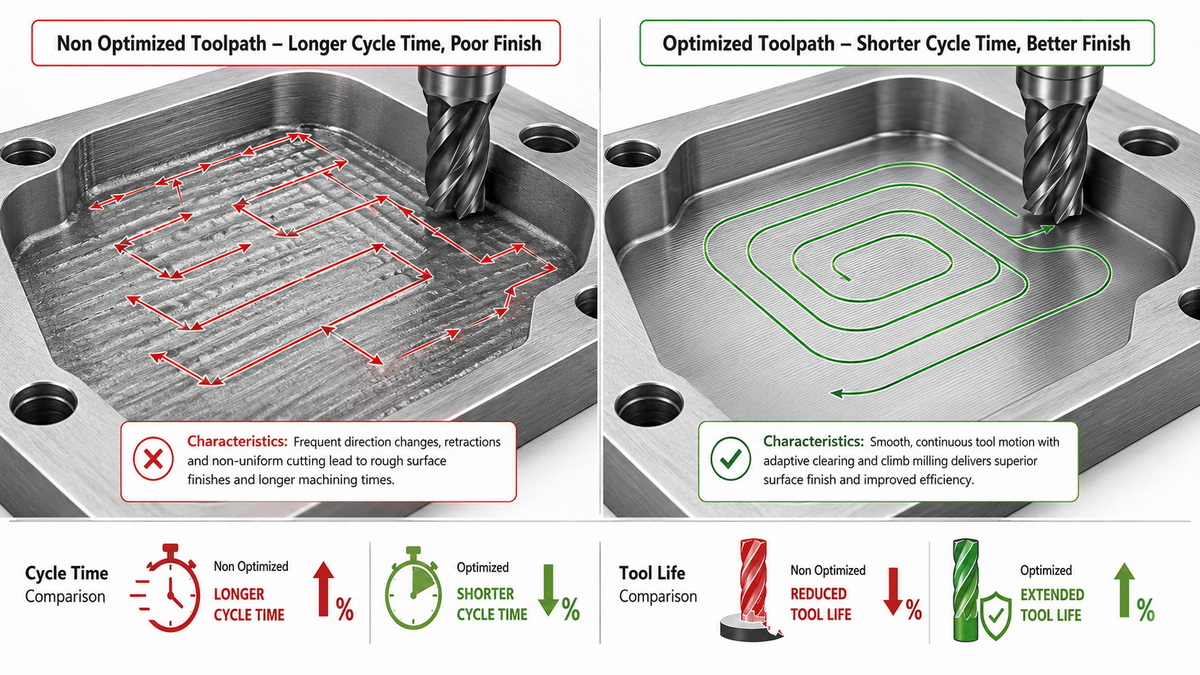
- Zig‑zag (bidirectional) – Back‑and‑forth passes, good for pocketing but can leave visible marks when direction changes.
- One‑way (unidirectional) – Cuts in one direction, returns in rapid; smoother finish but often longer cycle time.
- Parallel – Constant step‑over passes for planar or gently curved surfaces.
- Spiral – Starts at the center or edge and spirals outward or inward, ideal for cavities and circular pockets.
- Radial – Radiating passes from a center, used for circular or contoured geometries.
- Contour / rest contour – Follows the part boundary or remaining material, useful for finishing and semi‑finishing.
Each pattern balances efficiency, surface quality, and machine dynamics differently. An experienced programmer will mix patterns within a single job rather than relying on one default strategy. [blog.hurco]
The direction of cutter rotation relative to feed is another key decision: [fuson-cncmachining]
- Climb milling – Cutter rotates with the feed direction. It generally improves surface finish, reduces cutting forces, and extends tool life in modern CNC machines.
- Conventional milling – Cutter rotates against the feed direction. Sometimes useful for older machines or specific materials but less common in high‑efficiency setups.
Most high‑precision shops now prefer climb milling for both roughing and finishing whenever machine rigidity allows. [3erp]
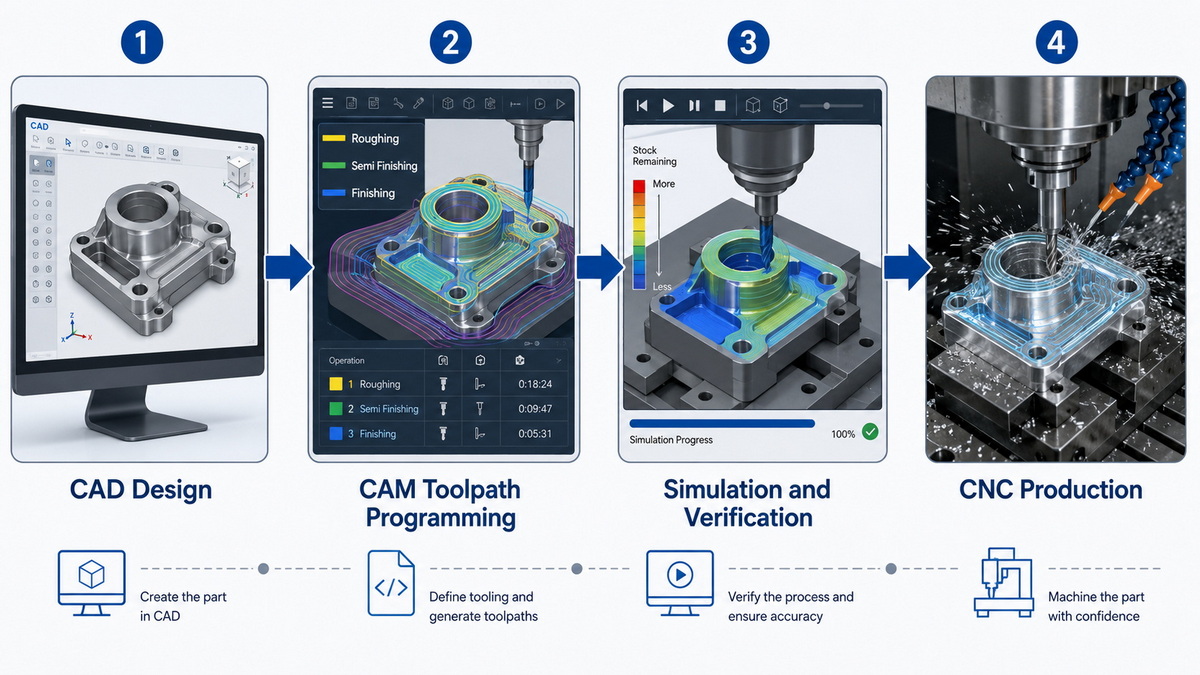
In a typical professional workflow, the toolpath development process looks like this: [grzsoftware]
1. Import CAD model and define stock
The programmer brings the 3D model into CAM and defines raw stock size and orientation to optimize clamping and minimize waste.
2. Choose coordinate system and datums
A stable, repeatable work offset is chosen so the machine can find the part accurately every time.
3. Select tools and cutting conditions
Tool diameter, flute count, material, and coatings are chosen based on the workpiece material and feature geometry. [fuson-cncmachining]
4. Define roughing toolpaths
High‑material‑removal strategies (such as adaptive clearing or trochoidal milling) are applied to clear bulk material efficiently. [blog.hurco]
5. Define semi‑finishing and finishing toolpaths
Lighter cuts refine the geometry and surface to tolerance, often with smaller tools and tighter step‑overs. [3erp]
6. Simulate and verify
CAM simulation checks for collisions, gouging, missed material, and excessive tool load before any chip is cut. [grzsoftware]
7. Post‑process and transfer to CNC
The CAM system outputs G‑code tailored to the specific control (Fanuc, Siemens, etc.), which is then sent to the machine.
8. First‑article run and optimization
On the shop floor, the machinist watches chips, sound, and spindle load, then fine‑tunes feed, speed, and step‑down based on real‑world behavior.
This closed‑loop between programmer and machinist is where practical expertise turns a standard toolpath into a highly optimized process.
Modern CNC machining goes far beyond simple raster passes. Advanced strategies deliver substantial gains in efficiency and predictability.
Adaptive clearing uses dynamic tool engagement to maintain a nearly constant chip load and avoid sudden spikes in cutting forces. It automatically adjusts the path to prevent the cutter from being buried in material. [blog.hurco]
Trochoidal milling adds small circular arcs in the toolpath, allowing high feed rates with shallow radial engagement. Benefits include: [fuson-cncmachining]
- Lower heat and vibration in the cut
- Dramatically extended tool life
- Shorter cycle times in difficult materials
For stainless steel, tool steels, and superalloys, these strategies often make the difference between a barely viable process and a robust, repeatable one. [3erp]
Beyond traditional CAM algorithms, recent research applies reinforcement learning and machine learning to optimize toolpaths. Studies show that RL‑based approaches can outperform older heuristic and evolutionary methods in complex cavity milling, improving efficiency and reducing cost. [scientific]
Machine learning frameworks are also being used to predict the best toolpath strategy for a given part, based on geometry, material, and process constraints. These techniques help shorten programming time and reduce trial‑and‑error on the shop floor. [sciencedirect]
While many of these systems live inside advanced CAM or custom research environments today, the underlying idea is already visible in commercial software: smarter defaults, automated strategy selection, and more predictive simulation. [scientific]
Based on both industry guidelines and day‑to‑day experience, several practical best practices consistently pay off. [blog.hurco]
- Simplify geometry where possible
Avoid unnecessarily sharp internal corners, deep narrow slots, and tiny fillets that force small, fragile tools and complex paths. [fuson-cncmachining]
- Separate roughing and finishing passes
Use aggressive roughing to remove bulk material, then leave a light, consistent stock allowance for finishing. [3erp]
- Optimize tool selection
Use the largest, most rigid tool that can reach, especially for roughing. Switch to smaller tools only where feature size demands it. [fuson-cncmachining]
- Avoid too many tiny line segments
Over‑segmented toolpaths stress machine control and can cause jerky motion. Use arcs and smoothing where possible. [sciencedirect]
- Continuously refine feeds and speeds
Default CAM data is conservative. Watching chip color, chip shape, and spindle load is essential to unlock more performance safely. [fuson-cncmachining]
These are the habits that separate a basic CNC operation from a high‑performance machining partner capable of supporting demanding global customers.
At U‑Need, toolpath optimization is built into our end‑to‑end workflow for custom precision parts machining, mold manufacturing, and sheet metal fabrication. Our programming team and on‑machine machinists work together to match toolpaths to the realities of each project—material, part function, and customer priorities. [uneedpm]
Here is how we typically approach new jobs for international brands, distributors, and OEMs:
- Design for manufacturability feedback – We review your drawings or 3D models and highlight areas where minor geometry changes could dramatically simplify toolpaths and reduce cost.
- Process‑focused toolpath selection – For mold cavities, we prioritize 3D finishing strategies that control scallop height and minimize polishing. For sheet‑metal stamping dies, we optimize pockets and reliefs for rigidity and life.
- Data‑driven refinement – We track cycle times, tool wear patterns, and quality data across batches to refine paths over time, especially for repeat production.
- Cross‑process expertise – Because we handle machining, molds, and sheet metal fabrication under one roof, we can align toolpaths with downstream processes such as molding, assembly, and finishing.
For buyers, this means more than "just CNC machining." It means a partner who uses toolpath strategy as a lever to reduce total landed cost and quality risk across the entire supply chain.
A quick comparison helps clarify how different toolpaths support different manufacturing goals.
| Application scenario | Typical toolpath focus | Key benefit for buyer |
|---|---|---|
| High‑volume aluminum housings | Adaptive roughing + parallel finishing blog.hurco | Shorter cycle time and consistent finish |
| Hardened steel mold cavities | 3D contour + spiral + rest machining blog.hurco | Accurate surfaces, less polishing rework |
| Stainless steel brackets (2.5D) | Pocketing + climb milling profiles fuson-cncmachining | Improved tool life and edge quality |
| Thin‑walled parts | Light step‑downs + smooth paths blog.hurco | Reduced deformation and chatter |
| Complex freeform surfaces (aerospace) | Optimized 3D isoscallop paths + smoothing scientific | Tight tolerances and stable machine motion |
This is the practical layer that many generic CNC articles overlook—but it is what purchasing, engineering, and operations teams actually feel in lead times, quality reports, and cost breakdowns.
For many global buyers, the question is: When should I get into toolpath discussions with my machining partner—and when is it overkill?
You should explicitly discuss toolpath strategy when: [scientific]
- Tolerances are tight (especially on 3D surfaces or sealing faces)
- Materials are difficult to machine (stainless, titanium, hardened steels)
- Parts are high‑value or safety‑critical
- Projected volumes are high and cycle time has a major cost impact
In early RFQ stages, you do not need to dictate toolpaths, but you can ask questions such as:
- "How do you approach toolpath optimization for this material?"
- "Do you use adaptive clearing or similar high‑efficiency strategies?"
- "How do you verify toolpaths before first‑article production?"
Partners who can answer clearly usually have the internal process maturity to manage your parts reliably.
If you are planning a new project—or struggling with long cycle times, inconsistent quality, or tooling failures from an existing supplier—this is the right time to use toolpath optimization as a lever for improvement.
U‑Need's engineering team can review your drawings, suggest manufacturability improvements, and propose optimized CNC, mold, and sheet‑metal processes tailored to your volumes and quality targets. Whether you are an established brand, a growing distributor, or a contract manufacturer, you can turn better toolpaths into a tangible cost and quality advantage in your market. [uneedpm]
You can share your CAD models, technical requirements, and target volumes with us, and our experts will respond with a practical, data‑driven machining proposal.
A CNC program is the full set of G‑code instructions sent to the machine, while a toolpath is the specific route and motion pattern created in CAM that the program encodes. [grzsoftware]
Depending on part geometry and material, optimized toolpaths can reduce cycle time by double‑digit percentages and significantly extend tool life, especially when using adaptive and high‑efficiency strategies. [scientific]
Generally no. You specify geometry, tolerances, and material, and a capable machining partner designs the toolpaths. However, asking about their toolpath strategies is a useful way to assess expertise.
Path pattern, step‑over, feed rate, and direction all influence surface texture. Smooth, continuous paths with consistent engagement usually produce better finishes and reduce polishing or secondary operations. [blog.hurco]
Yes. Research shows reinforcement learning and other machine‑learning techniques can discover more efficient toolpath parameters and strategies for complex parts than manual tuning alone, improving efficiency and accuracy. [sciencedirect]
1- Grz Software – "Toolpath" (definition and basics of CNC toolpaths). [https://www.grzsoftware.com/learn-cnc/terms/toolpath/] [grzsoftware]
2- Hurco – "Mastering Toolpath Strategies: A CNC Machinist's Guide to Efficiency". [https://blog.hurco.com/mastering-toolpath-strategies-a-cnc-machinists-guide-to-efficiency] [blog.hurco]
3- Scientific.net – "Optimization of CNC Machining Tool Paths Using Reinforcement Learning Techniques". [https://www.scientific.net/AMM.923.39] [scientific]
4- Carnegie Mellon University – "CNC Milling – CNC Toolpathing". [https://www.cs.cmu.edu/~rapidproto/students.03/zdb/project2/CNCToolpathing.htm] [cs.cmu]
5- Fuson CNC Machining – "Mastering Toolpath Strategies: CNC Machinist Efficiency Guide". [https://www.fuson-cncmachining.com/mastering-toolpath-strategies/] [fuson-cncmachining]
6- ScienceDirect – "Optimal toolpath planning strategy prediction using machine learning technique". [https://www.sciencedirect.com/science/article/abs/pii/S0952197623006486] [sciencedirect]
7- 3ERP – "What is CNC Toolpath: Definition, Applications and Types". [https://www.3erp.com/blog/cnc-machining-toolpath/] [3erp]
8- Knowledge TV CNC – "How to Use the Mastercam Toolpath Manager for Maximum Efficiency" (YouTube video). [https://www.youtube.com/watch?v=yIpjqWb8LRU] [youtube]
9- U‑Need Precision Machinery – Contact and company information. [https://www.uneedpm.com/contact-us/] [uneedpm]


