Views: 214 Author: U-Need Publish Time: 2026-11-30 Origin: Site
Content Menu
● Quick Answer: Speed Comparison at a Glance
● What Is Rapid Prototype Machining?
● What Is Traditional Tooling?
● Head-to-Head: Which Is Faster for Design Validation?
>> The Middle Path: Rapid (Soft) Tooling
● Our Experience: A Practical Validation Workflow
>> Step-by-Step Validation Process
>> Design Mistakes We See Often
● When Rapid Prototype Machining Is the Right Choice
● When Traditional Tooling Makes Sense
● Cost and Risk: The Hidden Side of Speed
● Sheet Metal Prototypes: A Special Case
● How to Choose: A Simple Decision Checklist
● Optimizing Lead Time on Any Route
● Conclusion: Speed Depends on the Question You Are Asking
● Talk to U-Need About Your Validation Plan
>> 1. How fast can a CNC prototype be delivered?
>> 2. Is rapid tooling faster than traditional injection molding?
>> 3. Can a machined prototype replace a molded sample?
>> 4. When should I move from CNC prototypes to soft tooling?
>> 5. How much cheaper is soft tooling than hard tooling?
>> 6. Does CNC prototyping suit sheet metal parts?
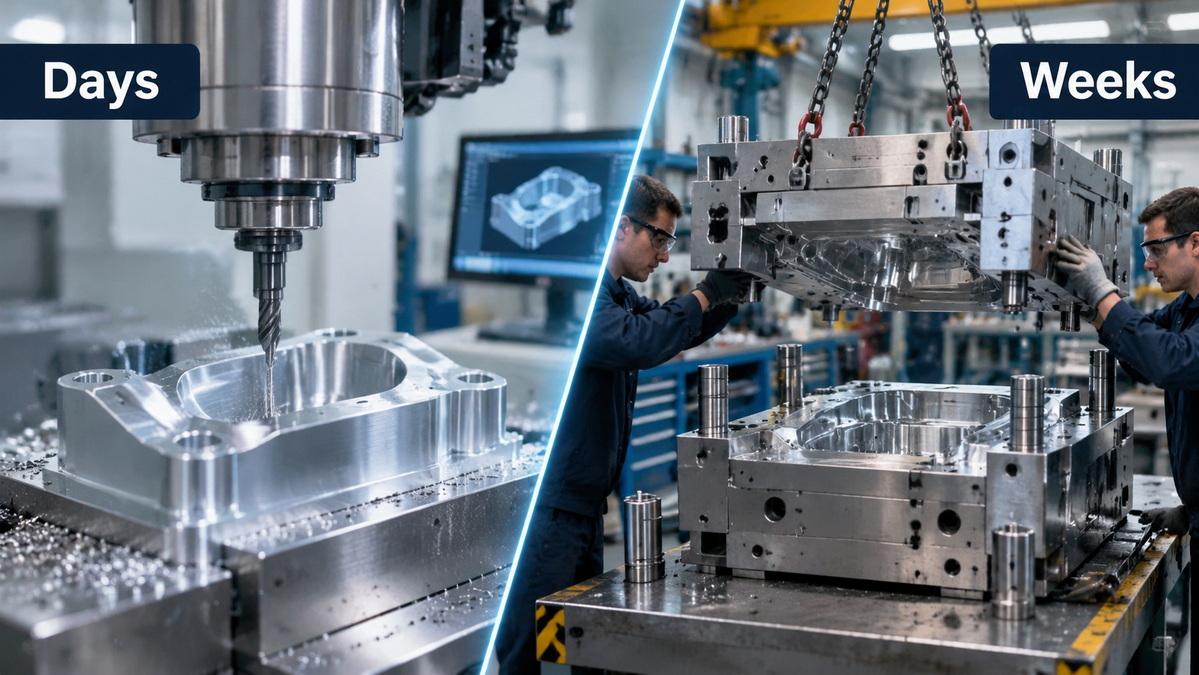
Rapid prototype machining is almost always faster for the first physical part. Traditional tooling is slower to start, but it validates the real production process. At U-Need, we run both CNC machining and mold manufacturing in-house. Our experience is that the fastest route to a validated design usually combines the two.
| Factor | Rapid Prototype Machining | Rapid (Soft) Tooling | Traditional (Hard) Tooling |
|---|---|---|---|
| Typical lead time | 3–10 working days | 1–4 weeks | 4–12 weeks |
| Upfront tooling cost | None beyond fixtures | Low to moderate | High |
| Design change cost | Update the CAD/CAM program | Rework the aluminum mold | Costly steel rework |
| Best quantity | 1–50 parts | 100–10,000 parts | 10,000+ parts |
| Validates the production process | No | Partly | Yes |
Lead times vary with geometry, material and finish. These ranges come from published industry data (see References).
Rapid prototype machining uses CNC milling, turning and drilling to cut a part directly from solid stock. It needs no mold, die or fixture library. Production starts as soon as the CAD model is ready and the toolpaths are programmed.
That is why it suits design validation. The part is made from real metals or engineering plastics, so you can test fit, strength, sealing and motion on a physical sample. Machined prototypes can be assembled, loaded, pressure tested and thermally cycled like production parts.
- Simple parts often ship in 3–5 business days.
- Complex geometries or tight finishing requirements add time.
- Industry sources generally quote 3–10 working days before shipping.
Lead time depends less on the word "prototype" than on geometry, material availability, programming difficulty, inspection scope and finishing.
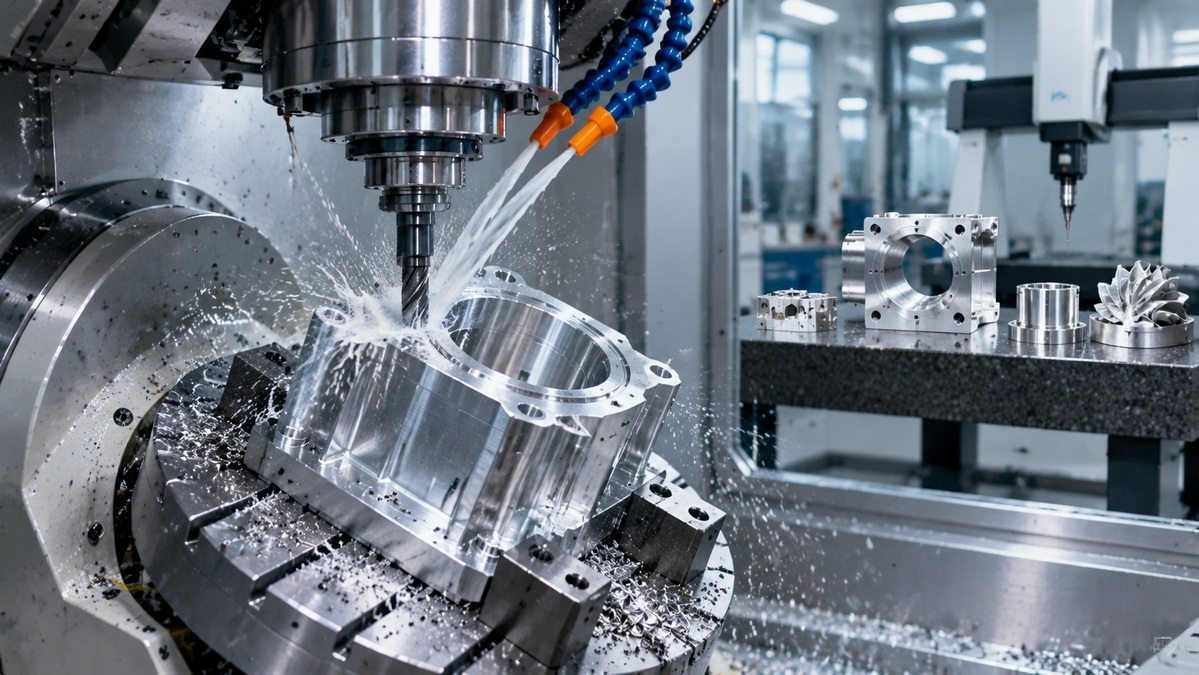
Traditional tooling means building hardened steel molds or dies for production processes such as injection molding, stamping and cold forging. These tools are built for durability and repeatability. Hard tooling can last for millions of cycles and hold tolerances near ±0.01 mm.
The trade-off is time and capital. A production-grade P20 steel mold can take about 10 weeks. That covers design approval, rough machining, heat treatment, finish machining, EDM, polishing and trial runs. Costs can range from about $5,000 to well over $100,000, depending on complexity.
- Hard steel cuts more slowly than aluminum.
- Heat treatment adds days or weeks.
- EDM and polishing are needed for fine details.
- Trial runs often reveal adjustments that need more tool work.
For the first physical part, machining wins. A hard tool must be built and approved before the first part exists. With CNC, one part can be in your hands within days.
For repeated design loops, the gap widens. A revision to a machined part needs only an updated model and program. A steel mold revision means modifying or recutting hardened steel. In the time one mold is built, a team can run several machining iterations.
The picture changes when you need hundreds of parts. Machining cost and time scale roughly linearly with quantity, while a mold's cycle time is measured in seconds. This is where rapid tooling takes over.
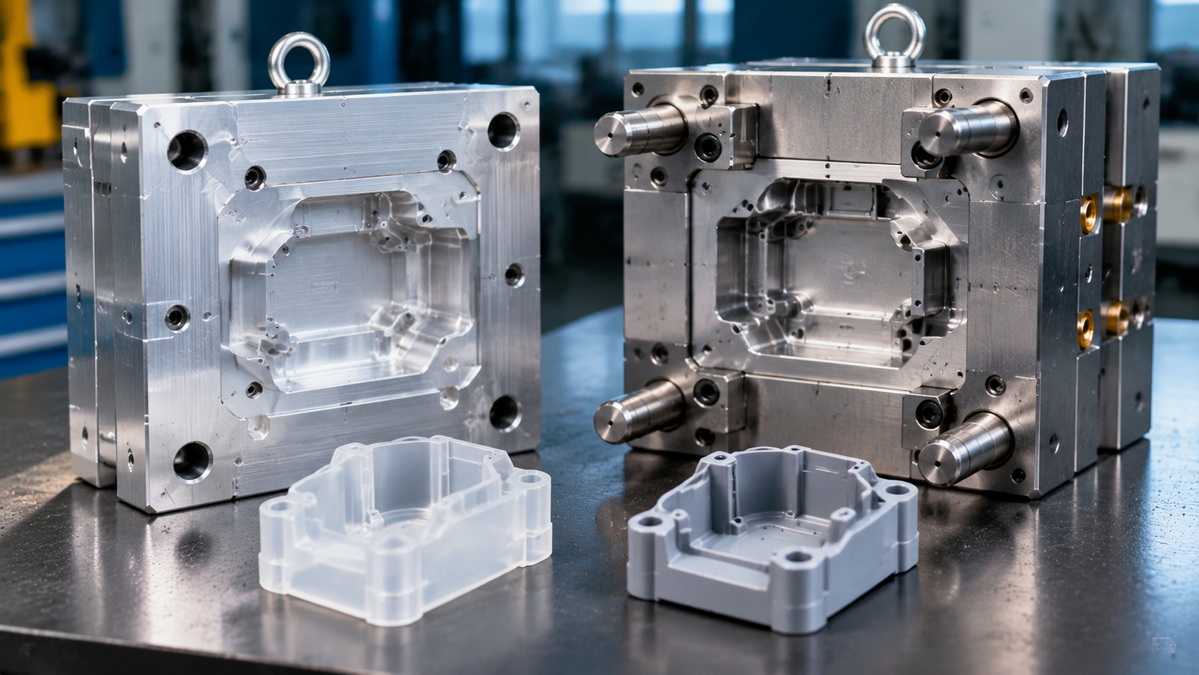
Aluminum and soft-steel molds sit between the two options. Industry sources report rapid tooling at about 2–4 weeks, against 8–12 weeks for traditional steel production tools. One shop data set shows a single-cavity aluminum mold finished in about 13 days.
Soft tooling also lets you mold parts in the intended production resin. You can then evaluate dimensions, assembly, appearance and function before committing to a steel mold.
In our workshop, we rarely treat this as an either/or choice. We follow a staged approach that keeps schedules short and avoids expensive tool changes.
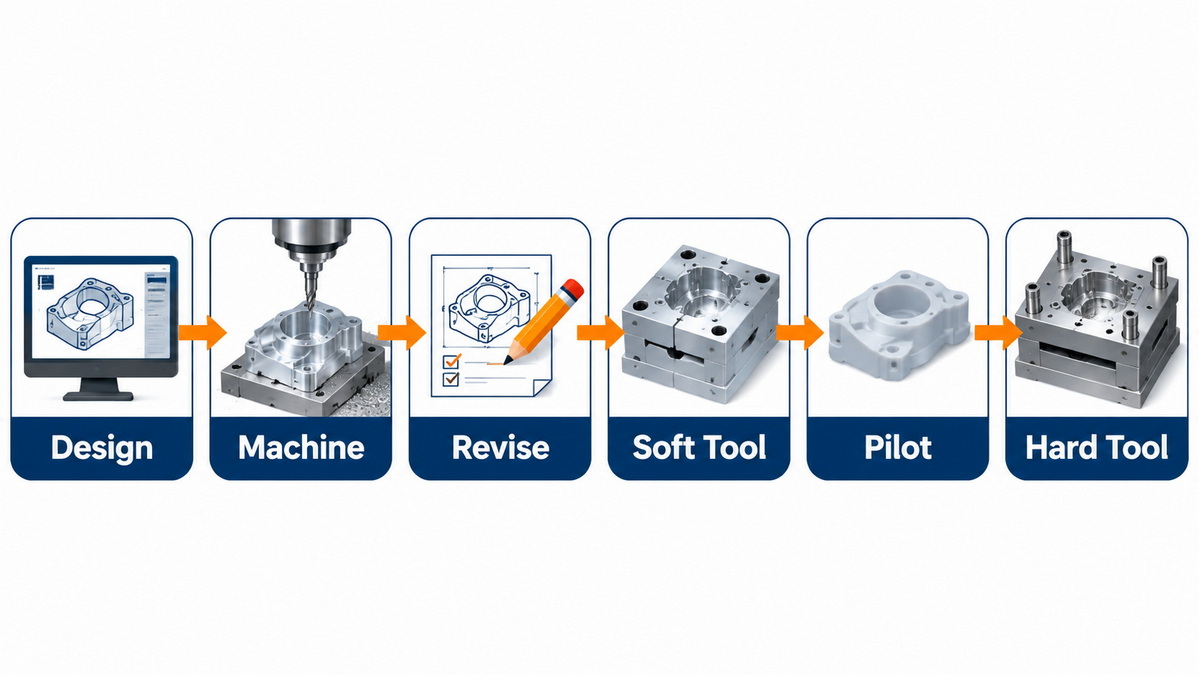
1. Run a DFM review. Check wall thickness, draft angles, undercuts and tolerances before cutting anything.
2. Machine 1–5 prototypes. Use the intended material to test fit, function and assembly.
3. Revise the design. Update the CAD model and re-machine. Repeat until the geometry is stable.
4. Build a soft tool. Once the design is nearly frozen, cut an aluminum mold for 100–1,000 parts.
5. Run pilot validation. Test process-related features such as shrinkage, gate position and cosmetic surfaces.
6. Release the hard tool. Commit to hardened steel only when the design and the process are both proven.
This sequence trades a few extra days early on for much lower risk later. A flawed steel mold can cost far more than the machined samples that would have caught the problem.
- Freezing the design too early and ordering a steel mold before any physical test.
- Ignoring material differences. A part machined from plate does not reproduce the grain flow, porosity, draft or wall distribution of a future casting or molding.
- Over-specifying tolerances on prototypes, which adds cost and delay without improving the test.
- Skipping assembly checks. Datum errors, interference and inaccessible tool paths often show up only on a physical part.
Choose machining when:
- You need 1–50 functional parts quickly.
- The design is still changing frequently.
- You require production-grade materials, such as aluminum, stainless steel, brass or engineering plastics.
- Tight tolerances or precise mating features must be tested.
- You want to avoid tooling that may be scrapped after the next revision.
Typical examples include valve bodies, gear housings, brackets, sensor enclosures and robotic end effectors. For these parts, a machined sample can reveal problems a cosmetic model cannot.
Choose hard tooling when:
- The design is fully frozen and validated.
- You expect high volumes, typically thousands to millions of parts.
- You need the lowest cost per part at scale.
- You must validate process-specific behavior, such as warpage, flow lines or die wear.
- Your program has the budget and schedule for a longer upfront investment.
For stamping dies, cold-forging dies and production injection molds, there is no substitute for the real tool. A prototype cannot prove how a part behaves under real forming pressures or repeated cycles.
Speed is not only about days on a calendar. It is also about the cost of being wrong.
| Risk Factor | Machined Prototype | Hard Tool |
|---|---|---|
| Cost of a design error | Low (re-machine one part) | High (modify or recut steel) |
| Schedule impact of a change | Days | Weeks |
| Capital at risk before validation | Minimal | Significant |
| Process-specific defects found | Late | Early, once tool is running |
Soft tooling is often one-fifth to one-tenth the cost of hard tooling, which limits financial exposure on a first trial. Some shops report about 3 weeks from design freeze to 100 trial parts with soft tooling.
Sheet metal parts follow a similar logic. Laser cutting and bending need no dedicated die, so prototype sheet metal parts can often be produced in days. A progressive stamping die, by contrast, takes weeks to build.
For validation, we typically laser-cut and bend the first samples. We switch to stamping dies only after the flat pattern, bend allowances and hole positions are confirmed. This approach works well for enclosures, brackets and chassis components.
Answer these questions before you commit:
1. How many parts do you need for testing? Under 50 points to machining. Several hundred points to soft tooling.
2. How stable is the design? If you expect changes, avoid tooling.
3. Does the test depend on the manufacturing process? If yes, use soft or hard tooling.
4. What material must the prototype use? Production-grade needs favor machining or soft tooling in the final resin.
5. What is your launch date? Work backward and leave room for at least two design iterations.
Simple habits shorten schedules for both approaches:
- Send complete files. Provide 3D models and 2D drawings with tolerances marked.
- Flag critical features. Tell the shop which dimensions matter for testing.
- Use standard materials that are already in stock.
- Relax cosmetic finishes on early samples.
- Ask for DFM feedback before quoting. It catches costly issues early.
If your question is "Does this design fit and function?", rapid prototype machining is faster. If your question is "Will this design run well in mass production?", you will eventually need the production tool. The quickest overall path is to machine first, move to soft tooling next, and invest in hard tooling only when the design is proven.
U-Need is a precision manufacturing partner in China, serving global brands, distributors and manufacturers. We provide custom CNC machining, injection molds, stamping dies, cold-forging dies and sheet metal fabrication under one roof.
Send us your drawings or 3D files. Our engineers will review them and recommend the fastest validation route, with a lead-time and cost estimate.
Simple parts often ship in 3–5 business days. Complex parts or those needing special finishing can take 7–10 working days, plus shipping.
Yes. Rapid aluminum tooling is commonly reported at 2–4 weeks, against 8–12 weeks for steel production tools.
Not entirely. Machined parts validate geometry, fit and function, but they do not reproduce molding effects such as draft, shrinkage, weld lines or wall-flow behavior.
Move when the design is nearly frozen and you need hundreds of parts. At that point, CNC unit costs rise and an aluminum mold becomes more economical.
Published comparisons put soft tooling at roughly one-fifth to one-tenth the cost of hard tooling. Costs depend on mold size and complexity.
Laser cutting and bending can produce sheet metal prototypes without a die. This is usually faster and cheaper than stamping tools for early samples.
1.[Soft Tooling vs Hard Tooling: Cost, Lead Time & Volume Guide – Yanmee] [yanmee]
2.[CNC Prototyping Service: How to Validate Design Before Production – Neway Machining] [newaymachining]
3.[CNC Machining vs Injection Molding – EC International Group] [ec-international-group]
4.[Soft Tooling vs Hard Tooling – PrecisionFab] [cncfabworks]
5.[CNC Machining Prototype Guide for Functional Parts and Design Validation – Mechmeld] [mechmeld]
6.[CNC Prototype Machining: How It Works & Benefits – Madearia] [madearia]
7.[Soft Tooling vs. Hard Tooling: Key Differences for Injection Molding – SWCPU] [swcpu]
8.[How Long Does Rapid Prototyping Take? Lead Time Guide – Yanmee] [yanmee]
9.[Which Manufacturing Process Offers the Shortest Lead Time – KT CNC Machining] [ktcncmachining]


