Views: 236 Author: U-Need Publish Time: 2026-11-08 Origin: Site
Content Menu
● CNC Machining vs Injection Molding: Key Differences
● How CNC Machining and Injection Molding Work
>> CNC machining: cutting directly from stock
>> Injection molding: repeating a validated shape
● CNC Machining vs Injection Molding Cost: Find Your Break-Even Point
>> Illustrative example: a plastic housing
>> Why production volume alone is insufficient
● Material Selection: Compare Grades, Not Just Polymer Names
>> Define the operating requirements first
● Precision and Tolerances: Specify What Actually Matters
>> Mold accuracy is not finished-part accuracy
● Design for Manufacturing: Different Processes Need Different Geometry
>> CNC machining design considerations
>> Injection molding design considerations
● From Machined Prototype to Molded Production: A Validation Plan
>> Step 1: Test fit and function
>> Step 2: Redesign for molding
>> Step 3: Validate molded samples
>> Step 4: Approve repeat-production controls
● Lead Time and Supply Risk: Compare the Whole Schedule
● When a Hybrid Manufacturing Strategy Makes Sense
● How to Request a Useful Manufacturing Quotation
● Plan Your Manufacturing Route with U-Need
>> Is CNC machining cheaper than injection molding?
>> Can CNC machining make plastic parts?
>> Which process provides tighter tolerances?
>> Can the same CAD model be used for both processes?
>> Does injection molding always require very high quantities?
>> Will machined prototypes perform exactly like molded parts?
CNC machining vs injection molding is a decision about more than production volume. The right choice depends on your material, geometry, tolerances, launch schedule, and confidence that the design will remain unchanged. CNC machining often suits prototypes and smaller batches, while injection molding becomes attractive when repeat demand justifies dedicated tooling.
For global brands, distributors, and manufacturers, the practical question is: which process delivers acceptable parts at the lowest total project risk?
This guide focuses on CNC machining and plastic injection molding. Metal injection molding is a different process and requires a separate comparison.
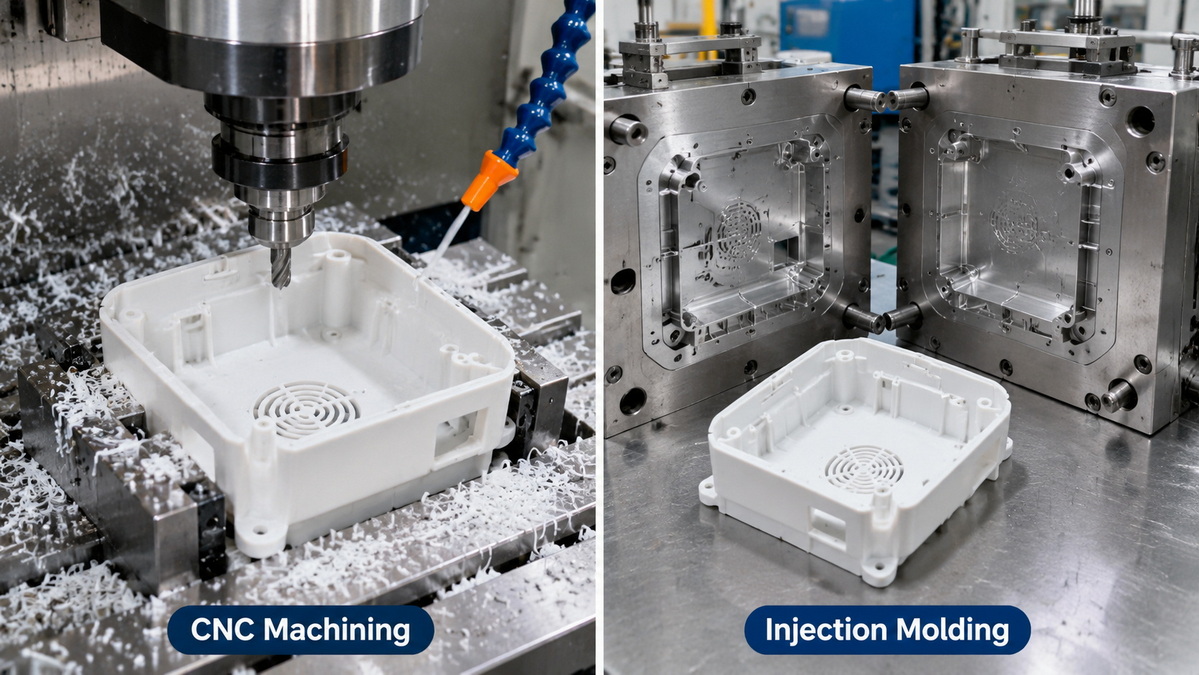
CNC machining removes material from solid stock using computer-controlled cutting tools. Injection molding shapes material inside a dedicated mold.
That distinction explains most differences in cost, flexibility, and production planning.
| Decision factor | CNC machining | Plastic injection molding |
|---|---|---|
| Basic process | Subtractive cutting | Forming material inside a mold |
| Upfront investment | Programming, setup, and possible fixtures | Mold design, manufacturing, and validation |
| Suitable materials | Metals and machinable plastics | Primarily moldable polymers |
| Design changes | Usually require updated programming and setup | May require mold modification or replacement |
| Production economics | Attractive for prototypes and smaller batches | Attractive when tooling costs spread across repeat production |
| Main geometry constraints | Cutter access, tool radius, and workholding | Draft, wall thickness, gating, and ejection |
| Quality considerations | Tool wear, deflection, setup, and material behavior | Shrinkage, cooling, filling, and process stability |
Neither process automatically produces better parts. Each requires geometry and specifications suited to its manufacturing method.
CNC milling and turning start with a digital model and an appropriate stock material. A manufacturer develops toolpaths, secures the workpiece, and removes material through controlled cutting operations.
Parts may then require deburring, finishing, cleaning, and inspection.
Because no dedicated mold is necessary, machining makes it relatively straightforward to test alternative dimensions or release revised designs. However, deep pockets, thin walls, difficult materials, and multiple setups can increase machining time.
Plastic injection molding begins with a purpose-built mold. Heated polymer enters the cavity, cools, and solidifies before the part is ejected.
Tooling introduces upfront cost and development work. Once validated, however, the mold can produce repeated parts efficiently.
Injection molding is not additive manufacturing in the layer-by-layer sense. It is a molding process. Its success depends on both the part design and the mold's ability to fill, cool, and release that design consistently.
A useful cost comparison separates fixed expenses from recurring production expenses.
For machining, include programming, fixtures, material, machine time, finishing, and inspection.
For molding, include tool design, mold manufacturing, trials, resin, production cycles, secondary operations, and inspection.
Consider these hypothetical figures:
| Cost item | CNC machining | Injection molding |
|---|---|---|
| Fixed project cost | $500 | $12,500 |
| Variable cost per accepted part | $25 | $5 |
The modeled break-even quantity is 600 parts.
At 200 parts, machining totals $5,500, compared with $13,500 for molding. At 2,000 parts, machining totals $50,500, compared with $22,500 for molding.
These figures demonstrate the calculation; they are not U-Need quotations or market averages.
A tooling investment becomes less attractive if demand falls or the design changes before enough parts ship.
Compare realistic scenarios rather than one optimistic forecast:
- Confirmed purchase quantity.
- Expected repeat orders.
- A lower-demand scenario.
- A likely engineering revision.
- Tool maintenance and replacement obligations.
There is no universal quantity at which injection molding becomes cheaper. Geometry, cycle time, material, tooling complexity, and quality requirements change the answer.

CNC machining supports metals such as aluminum and steel, alongside engineering plastics. Plastic injection molding serves a different material category and cannot replace a metal component merely because its production cost looks attractive.
For plastic parts, both processes may offer ABS, polycarbonate, nylon, acetal, or PEEK options. Nevertheless, the same polymer family does not guarantee identical performance.
Stock shape, resin grade, reinforcement, processing history, and moisture condition can affect the result.
Before selecting a process, document:
- Continuous and peak operating temperatures.
- Mechanical loads and impact exposure.
- Chemical contact.
- Moisture and outdoor exposure.
- Electrical or flammability requirements.
- Applicable product-specific compliance requirements.
Use the selected grade's technical documentation rather than relying on general descriptions such as "strong plastic."
A machined prototype can answer valuable fit and assembly questions. It does not automatically establish the performance of the future molded version.
Both processes can produce accurate components, but neither should receive a blanket tolerance promise without reviewing the part.
Machined accuracy depends on material stability, tool access, workholding, cutting conditions, and measurement methods.
Molded accuracy also depends on resin shrinkage, cooling, cavity geometry, and process consistency.
A precisely machined mold does not guarantee that the molded component will reproduce every cavity dimension exactly. Polymer shrinkage and distortion remain relevant after the tooling is complete.
Supplier tolerance statements therefore need context. Confirm whether a quoted figure applies to the tool, the finished part, or a particular feature.
For functional interfaces, identify:
1. The critical dimension.
2. Its datum references.
3. Its permitted variation.
4. The measurement method.
5. Any conditioning required before inspection.
Avoid imposing the tightest tolerance across every surface. Targeted requirements make quotations clearer and reduce unnecessary manufacturing difficulty.
A cutter must physically reach the surface being machined.
Deep, narrow pockets may require slender tools. Thin walls can deflect. Internal corners usually retain a radius related to cutter geometry.
To improve manufacturability:
- Provide practical tool access.
- Use internal radii where possible.
- Avoid unnecessarily deep cavities.
- Limit fragile features.
- Keep workholding surfaces available.
Complex shapes are not automatically easy to machine simply because the equipment has multiple axes.
A molded part must fill, cool, and leave the mold without unacceptable damage or distortion.
Consistent wall thickness helps control cooling differences. Thick sections can contribute to sink marks and longer cooling requirements.
Draft helps release surfaces from the mold. A starting range of approximately 1–2 degrees is common, but texture, depth, material, and tooling arrangement can require a different value.
Undercuts may need slides, lifters, or design changes. These features can increase tooling complexity.
Review gate locations, parting lines, ejector marks, ribs, and bosses before approving the mold—not after cosmetic expectations have been set.
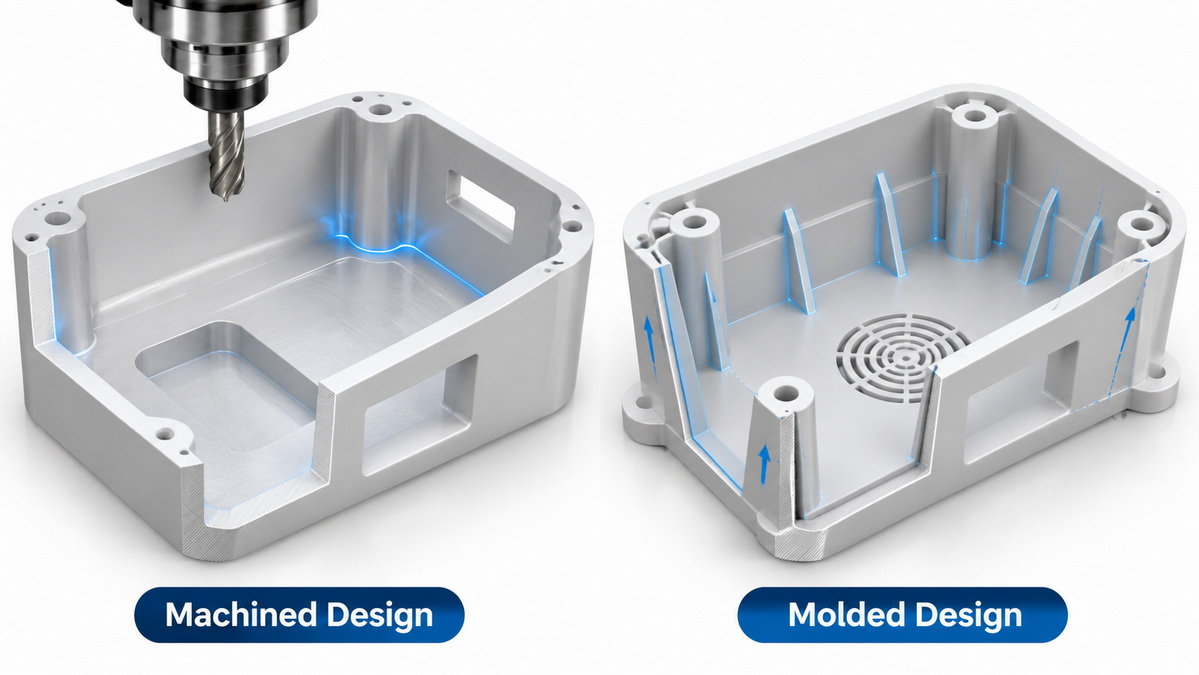
One of the most important planning mistakes is treating a successful machined prototype as proof that the molded version is ready.
Machining cannot reveal every issue created by mold filling and cooling.
Use prototypes to check assembly access, interfaces, dimensions, and basic performance.
Record which requirements the prototype actually demonstrates and which remain unverified.
Review wall thickness, draft, ribs, bosses, undercuts, and cosmetic surfaces.
Preserve functional requirements while adapting geometry to the intended manufacturing process.
Inspect trial parts against an agreed drawing and test plan.
Where relevant, evaluate warpage, weld lines, appearance, assembly behavior, and performance in the intended environment.
Agree on material identification, inspection frequency, sample approval, packaging, and change notification.
This staged approach separates design validation from process validation and makes production approval more meaningful.
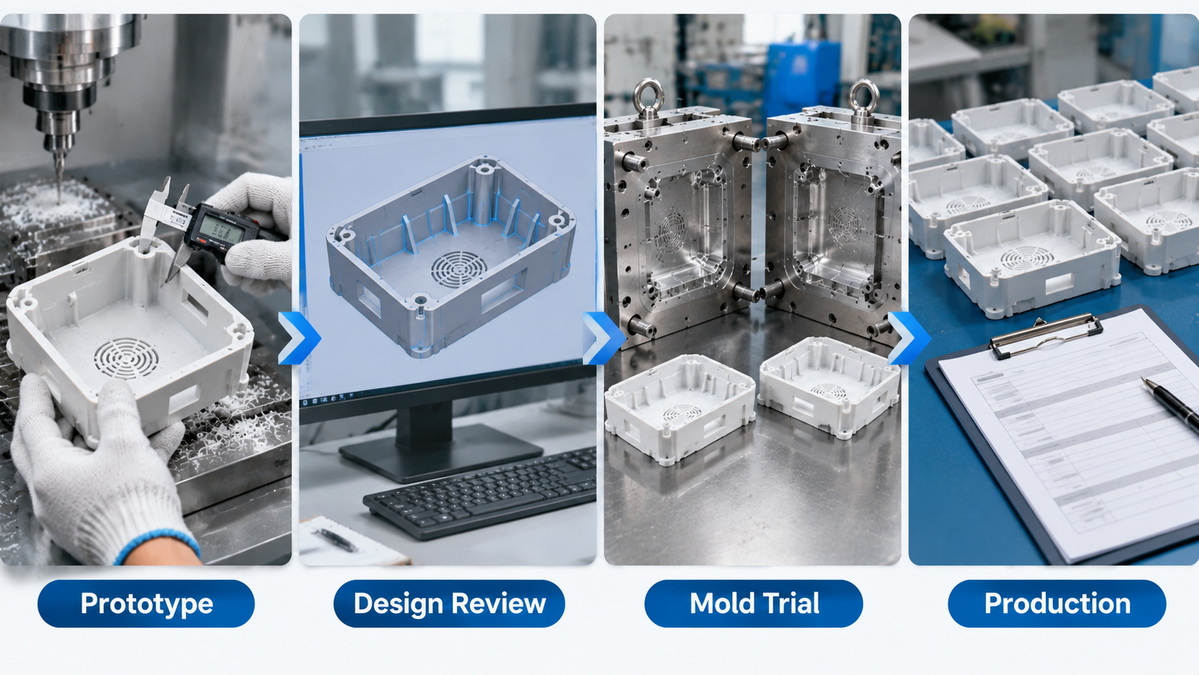
Machining can avoid the initial mold-building stage, making it useful when early parts are needed before the design is fully settled.
Molding adds tool development and sampling before routine production begins. Once approved, the tool can support efficient repeat orders.
Compare more than the quoted manufacturing window:
- Design review and drawing approval.
- Material availability.
- Tool or fixture preparation.
- First-sample evaluation.
- Revision allowance.
- Finishing, inspection, and shipping.
For overseas sourcing, clarify who approves samples and how quickly inspection results will be reviewed. A delayed approval can affect delivery even when manufacturing proceeds as planned.
The best route may use both processes.
A product team can machine early prototypes, refine the design, and introduce molding after requirements stabilize. Alternatively, a molded component may receive secondary machining on selected critical features.
This approach can preserve molding's repeat-production advantages while addressing a specific interface or precision requirement.
However, secondary machining adds handling, fixtures, inspection, and cost. Include those operations in the original comparison rather than treating them as minor extras.
Also consider whether the assembly contains metal brackets, inserts, or other parts requiring a separate manufacturing route.
A detailed request helps suppliers compare the same scope and reduces misleading price differences.
Provide:
1. A current 3D model and revision-controlled drawing.
2. Material grade and any permitted alternatives.
3. Prototype, first-order, and expected repeat quantities.
4. Critical dimensions and acceptance criteria.
5. Surface finish and cosmetic requirements.
6. Required tests and documentation.
7. Assembly and packaging needs.
8. Delivery destination and target schedule.
9. Tool ownership, storage, and maintenance expectations.
Ask suppliers to identify assumptions and exclusions.
For example, confirm whether a molding quotation includes trial samples, texture, inserts, inspection reports, and anticipated secondary operations.
U-Need is a precision manufacturing partner in China serving global brands, distributors, and manufacturers.
Its stated service scope includes custom precision parts machining; injection molds, stamping dies, and cold-forging dies; and sheet metal fabrication, including laser cutting, bending, and stamping.
For a project involving molded parts, distinguish mold manufacturing from responsibility for molding trials and ongoing part production. Confirm the complete scope before placing an order.
Send U-Need your CAD files, drawings, material requirements, order quantities, and delivery objectives. Request a manufacturability review and a clearly scoped quotation covering the relevant machining, tooling, or sheet metal work.
The goal is a production plan that fits your design maturity, quality requirements, and purchasing forecast—not simply the lowest initial unit price.
It often is for prototypes and smaller batches because it avoids dedicated mold investment. Injection molding can become cheaper as repeat quantities increase. Compare total costs using actual quotations rather than a fixed volume rule.
Yes. Many engineering plastics can be machined into prototypes and production components. Select a suitable stock grade and account for the material's dimensional behavior, operating conditions, and inspection requirements.
The answer depends on the feature, material, and manufacturing conditions. Machining offers direct dimensional control, while molding must also account for shrinkage and cooling. Have the supplier review critical features individually.
Sometimes, but revisions are often necessary. A machined design may need draft, more consistent walls, revised bosses, or fewer undercuts before molding. Review these changes before investing in tooling.
No. Low-volume molding can make sense when the design, material, geometry, or validation requirements justify tooling. Quantity matters, but it is only one part of the decision.
Not necessarily. Even within the same polymer family, material grade and processing can affect performance. Use machined prototypes for appropriate early tests, then validate molded samples before approving production.
1.TOPS Precision. "CNC Machining vs Injection Molding: A Brief Comparison." Original article reviewed and substantially restructured; its process-classification errors were not retained. [topsbest-precision]
2.Protolabs. "Injection Molding Guide: Process, Design Tips & Materials." Supports the discussion of tooling economics, molding workflow, shrinkage, draft, and wall thickness. [protolabs]
3.Protolabs. "Understanding Injection Molding Tolerances." Supports the distinction between tool accuracy and finished molded-part dimensional variation. [protolabs]
4.Protolabs. "Design Guidelines: Plastic Injection Molding." Provides supplier-specific guidance on draft, resin-dependent dimensions, and wall thickness. These are not presented as U-Need capabilities. [protolabs]
5.Protolabs. "Injection Molding Material Selection Guide." Supports material selection based on application requirements and polymer-specific behavior. [protolabs]
6.Protolabs. "Plastic CNC Machining." Documents machinable engineering plastics and grade-specific material properties. [protolabs]
7.Protolabs. "Manufacturing Considerations for Plastic Prototyping." Supports the discussion of prototype selection and transition toward molded production. [protolabs]


