Views: 246 Author: U-Need Publish Time: 2026-07-24 Origin: Site
Content Menu
>> Passive and Active Heat Sinks
● Why Heat Sink Design Matters
● Core Principles of Heat Sink Design
>> Fin Geometry
● Practical Tips for Better Performance
>> Match the Design to the Cooling Method
>> Avoid Excessive Fin Density
>> Improve the Thermal Interface
● Heat Sink Design for Different Applications
>> Electronics and Power Devices
>> LED Lighting
● Manufacturing Methods for Custom Heat Sinks
>> Extrusion
>> Stamping and Sheet Metal Fabrication
>> Folded Fin and Brazed Assemblies
>> Choose the Cooling Strategy
● Custom Heat Sink Solutions from U-Need
● FAQ
>> What is the most important factor in heat sink design?
>> Is aluminum or copper better for heat sinks?
>> How do I know if my fin spacing is correct?
>> Why does a heat sink perform poorly even when the design looks good?
>> When should I use a custom heat sink instead of a standard one?
>> Can heat sink performance be improved without increasing size?
Heat sink design plays a vital role in controlling temperature, protecting components, and improving the long-term reliability of electronic systems. As devices become smaller and more powerful, managing heat efficiently has become one of the most important engineering challenges in product development.
A well-designed heat sink does more than remove heat. It supports stable performance, reduces failure risk, and helps products operate consistently under demanding conditions. For manufacturers, distributors, and engineering teams, the best solution is one that balances thermal performance, cost, size, weight, and production feasibility.

A heat sink is a thermal component that transfers heat away from a hot surface into the surrounding environment. Heat sink design refers to the process of shaping, sizing, and configuring that component so it can remove heat as efficiently as possible.
In most applications, heat sinks are used to protect semiconductors, power modules, LED assemblies, and other high-heat devices. The design goal is to keep temperature within a safe range while maintaining practical manufacturing conditions.
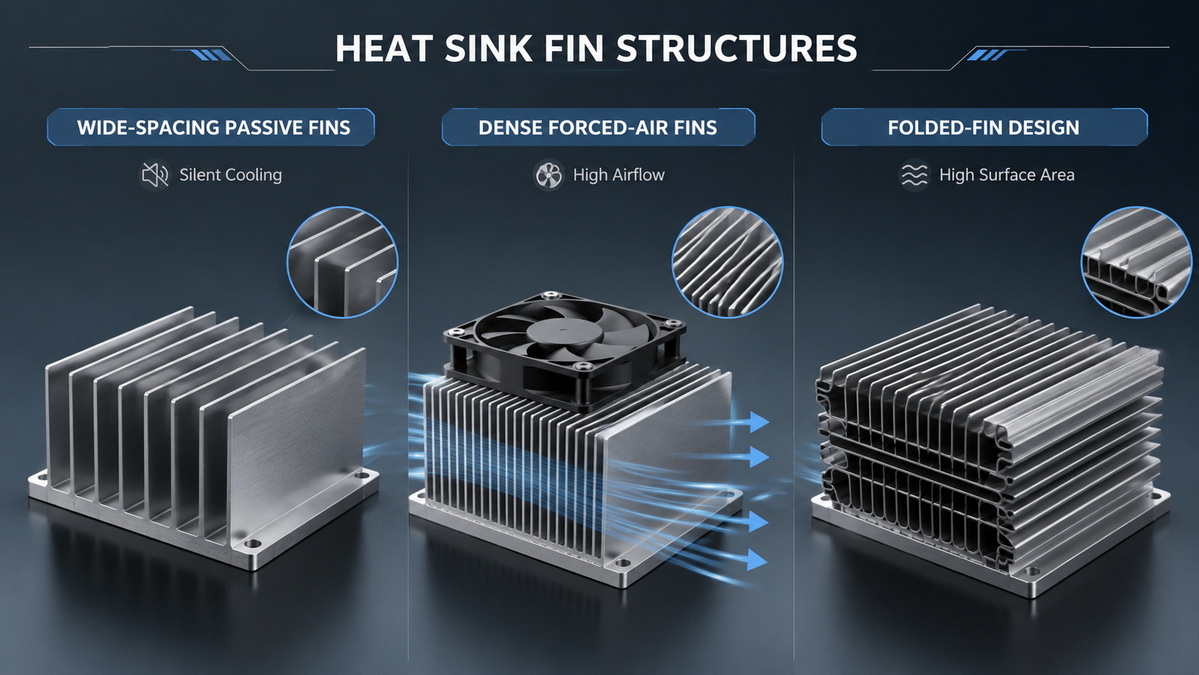
Passive heat sinks rely on natural air movement to remove heat. These designs usually have wider fin spacing and are best suited for applications where airflow is limited or no fan is available.
Active heat sinks use forced airflow, usually from a fan. They can support tighter fin spacing and higher fin density, which improves heat transfer when space is limited and stronger cooling is required.
When thermal performance is poor, electronic components can lose efficiency, age faster, or fail prematurely. Heat is often one of the main causes of reduced reliability in compact, high-power systems.
A strong heat sink design helps:
- Keep operating temperatures under control.
- Improve product reliability.
- Support stable performance over time.
- Reduce the risk of overheating-related failure.
- Make it easier to meet production and installation requirements.
In many projects, thermal problems are not caused by the heat sink alone. They come from a combination of material choice, airflow conditions, interface quality, and mechanical design.
The best heat sink designs are built around the full thermal path, not just the size of the fins. Every part of the system affects performance, from the heat source and interface material to the base, fins, and surrounding airflow.
Thermal resistance measures how difficult it is for heat to move from one point to another. Lower thermal resistance means better cooling performance.
In a real application, thermal resistance is influenced by several factors:
- Contact quality between the heat source and the heat sink.
- Conductivity of the base material.
- Shape and density of the fins.
- Airflow speed and direction.
- Mounting pressure and surface flatness.
The two most common heat sink materials are aluminum and copper.
Aluminum is widely used because it is lightweight, cost-effective, and easy to machine or extrude. It offers a strong balance of thermal performance and manufacturability.
Copper has higher thermal conductivity, so it is often used in applications that require greater heat transfer. However, it is heavier and more expensive, which makes it less practical for some projects.
Fin geometry has a major effect on how heat moves into the air. Important design factors include fin height, thickness, spacing, and orientation.
Tall fins increase surface area, but they may not perform well if the airflow is weak. Dense fins can improve heat transfer in forced-air systems, but they may restrict natural convection. The best fin shape depends on the cooling method and the available space.
Small design changes can lead to noticeable performance improvements. In many cases, the most effective choices are the simplest ones.
If the application uses natural convection, the design should support free upward airflow. Vertical fin orientation and wider spacing are usually more effective than narrow, tightly packed channels.
If the application uses forced convection, tighter fin spacing may work better because airflow is pushed through the channels by a fan. This allows for more surface area within the same footprint.
More fins do not always mean better cooling. If the fins are too close together, airflow can become restricted and performance may decline.
A more balanced design often works better than a highly dense one, especially in passive systems. The right spacing allows air to move through the sink without excessive resistance.
The connection between the heat source and the heat sink is just as important as the heat sink itself. A poor interface can reduce overall performance even if the sink is well designed.
To improve thermal contact:
- Use a suitable thermal interface material.
- Keep contact surfaces flat and clean.
- Apply proper mounting pressure.
- Avoid uneven installation that creates air gaps.
Surface finish can influence how heat is released into the surrounding air. In some applications, anodizing or other finishes may improve durability and appearance while also supporting thermal performance.
The right finish depends on the product environment, corrosion concerns, and production requirements.
Heat sink requirements vary depending on the product and operating environment. A design that works well for one application may be unsuitable for another.
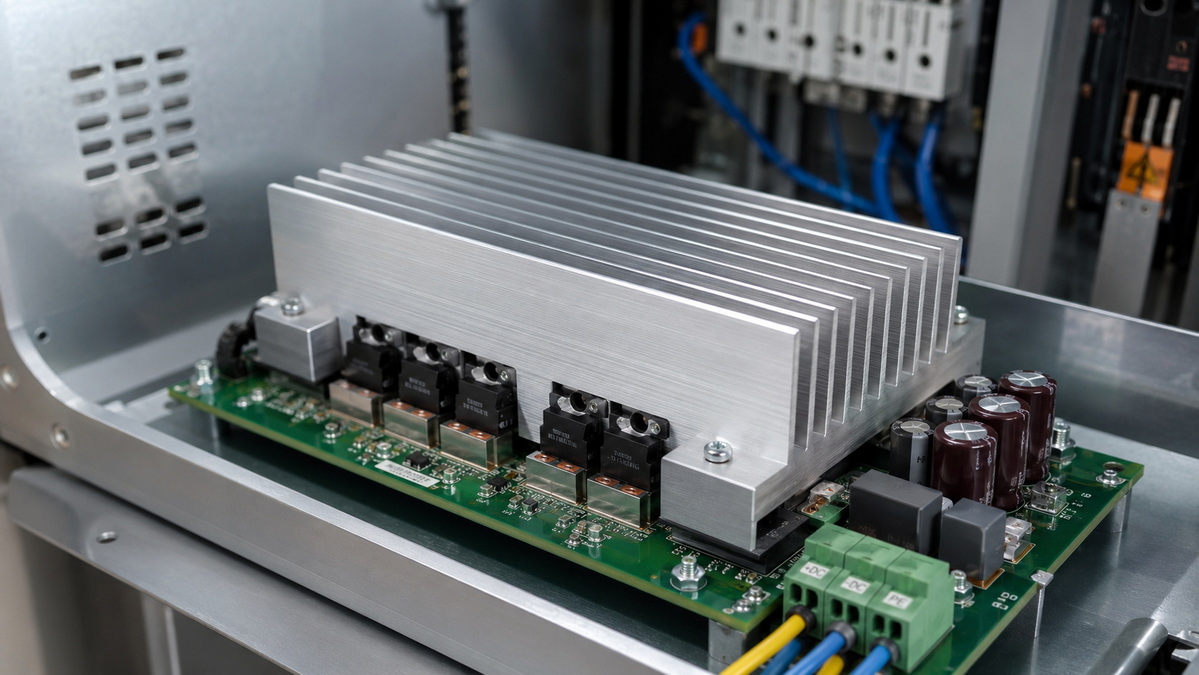
Power transistors, controllers, converters, and voltage regulators often generate concentrated heat in a small area. These applications usually need compact designs with efficient base conduction and controlled airflow.
LED systems depend on stable temperature control to maintain brightness, color stability, and lifespan. In these applications, heat sink design must support continuous operation and reliable long-term thermal management.
Industrial systems may be exposed to vibration, dust, moisture, or limited ventilation. Heat sink designs for these environments must account for mechanical durability as well as thermal efficiency.
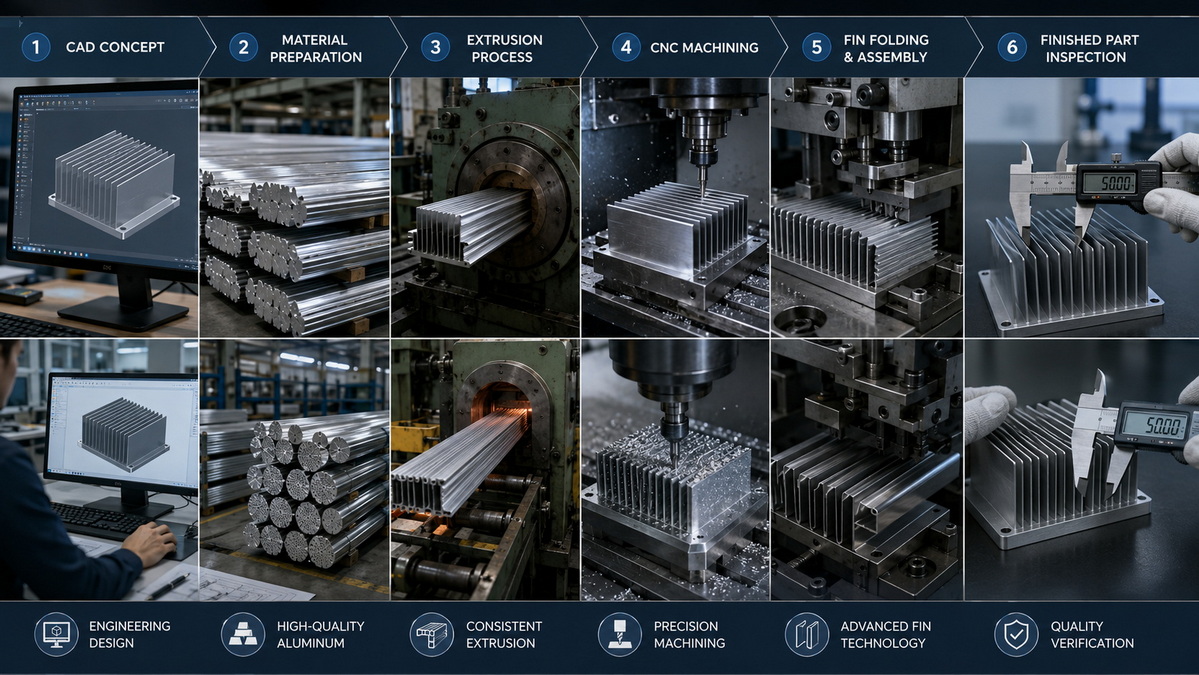
The production method plays a major role in what kind of heat sink can be built. A design that looks ideal in CAD may be difficult or expensive to produce at scale.
Extrusion is one of the most common methods for aluminum heat sinks. It is efficient for high-volume production and works well for standard profiles with consistent shapes.
CNC machining is useful for prototypes, complex geometries, and projects that require tight tolerances. It offers flexibility but is usually more expensive than extrusion for large volumes.
Stamping and sheet metal fabrication can support scalable, repeatable production. These methods are often suitable for custom thermal parts and structural components that need reliable batch consistency.
Folded fin and brazed heat sinks are often used when high fin density is needed in a compact space. These methods can deliver strong thermal performance, especially in demanding industrial and power applications.
Many heat sink problems come from design choices that overlook the real operating environment. These mistakes can lead to poor performance, unnecessary cost, or redesign work later in the project.
Common issues include:
- Choosing a fin arrangement that does not match the airflow.
- Ignoring the thermal interface between the source and the sink.
- Selecting a material based only on conductivity.
- Designing without considering production constraints.
- Creating a geometry that is difficult to mount or assemble.
- Assuming a larger heat sink always performs better.
A good design should be efficient, manufacturable, and suitable for the intended application.
Successful heat sink development usually follows a clear process. Starting with technical requirements and ending with production validation helps reduce risk and improve final results.
Before designing the heat sink, define the maximum allowable temperature, heat load, ambient conditions, and available installation space.
Decide whether the system will use passive cooling, forced air, or a liquid-based approach. This choice determines the most effective fin layout and material structure.
Use simulation, testing, and design iteration to adjust fin height, thickness, spacing, and base structure. The goal is to achieve the right balance of performance and manufacturability.
Prototype testing is essential before mass production. It helps confirm thermal behavior, mechanical fit, and repeatability in real operating conditions.
U-Need provides precision manufacturing support for custom thermal components and related industrial parts. With capabilities in custom precision machining, mold manufacturing, and sheet metal fabrication, U-Need can support projects that require practical, production-ready solutions.
For buyers who need a custom heat sink or supporting thermal structure, the most effective approach is to align the design with the manufacturing process from the beginning. This helps reduce development time, improve consistency, and support stable production at scale.
Heat sink design is both a thermal engineering task and a manufacturing decision. The best results come from combining material knowledge, airflow understanding, geometric optimization, and production planning.
For modern electronics and industrial systems, a well-designed heat sink can make the difference between unstable performance and dependable operation. When the design is aligned with the application, the cooling system becomes more efficient, more reliable, and easier to produce.
The most important factor is matching the design to the actual cooling environment. Material, fin spacing, airflow, and interface quality all work together.
Aluminum is usually better for cost, weight, and manufacturing efficiency. Copper is better when higher thermal conductivity is required and the added weight is acceptable.
The correct spacing depends on whether the system uses natural or forced convection. Wider spacing is usually better for passive cooling, while tighter spacing can work well with forced airflow.
A heat sink may underperform because of poor surface contact, weak airflow, incorrect mounting, or a design that does not match the real operating conditions.
A custom heat sink is better when the available space is fixed, the thermal load is high, or the standard product cannot meet the performance target.
Yes. Better interface materials, improved airflow, smarter fin geometry, and more suitable manufacturing methods can all improve performance without enlarging the part.
1.RapidDirect. "Optimize Your Heat Sink Design: Principles and Four Practical Tips."
https://www.rapiddirect.com/blog/heat-sink-design/
2.RapidDirect Chinese version.
https://www.rapiddirect.com/zh-TW/blog/heat-sink-design/
3.Lumileds. "Practical Heat Sink Design for Illumination."
https://lumileds.com/wp-content/uploads/files/WP31.pdf
4.ToffeeX case study. "Ricoh create a 31% more efficient heat sink design using..."
https://toffeex.com/casestudy/optimized-heat-sink-design-with-ricoh/
5.SSRN. "Liquid-Cooled Heat Sink Design Methodology with Technical and Commercial Viability Considerations."
https://papers.ssrn.com/sol3/papers.cfm?abstract_id=4685940
6.DRAmetal case study. "Heat Sink Case Study: 30,000 Folded Fin Aluminum Heat Sinks..."
https://drametal.com/case-studies/heat-sink-case-study/
7.DTIC. "Heat Sink Design and Optimization."
https://apps.dtic.mil/sti/tr/pdf/AD1000573.pdf
8.Digi-Key. "Heat Sink Design Facts & Guidelines for Thermal Analysis."
https://www.digikey.com/Site/Global/Layouts/DownloadPdf.ashx?pdfUrl=F51974C9A6D544F1A7D8F119514B67FF


