Views: 239 Author: U-Need Publish Time: 2026-11-26 Origin: Site
Content Menu
● CNC Prototype Machining vs Injection Molding at a Glance
● When CNC Prototype Machining Services Are the Better Choice
>> When the Design Is Still Changing
>> When the Test Depends on a Critical Dimension
>> When the Production Part Is Metal
● When Injection Molding Is Better for Early Product Development
>> When the Test Must Represent the Molded Part
>> When You Need a Pilot Batch, Not Another Design Iteration
● How to Choose: Match the Prototype to the Decision
● CNC Machining vs Injection Molding Cost: Calculate the Break-Even Quantity
● What to Send U-Need for a Useful Prototype Quote
● Request a Prototype Manufacturing Review
>> Is CNC machining faster than injection molding for prototypes?
>> Can CNC-machined plastic prototypes use the final production resin?
>> How many parts justify prototype injection molding?
>> Can I reuse the same CAD model for both processes?
>> Do I need a moldability review before ordering CNC prototypes?
>> What is the safest point to release an injection mold?
CNC prototype machining services are usually the better choice when you need a few functional parts, expect CAD revisions, or want to verify fit before paying for a mold. Injection molding is the better early choice when the test must capture how the final resin behaves during molding, or when a stable design calls for enough identical parts to justify tooling. The key question is not simply "Which process is cheaper?" It is "What does this batch need to prove?"
For global brands, distributors, and OEM teams sourcing custom parts from China, the choice also affects what goes into the request for quotation, when to release tooling, and which samples can support a production decision. This guide explains how to compare both routes before committing the budget.
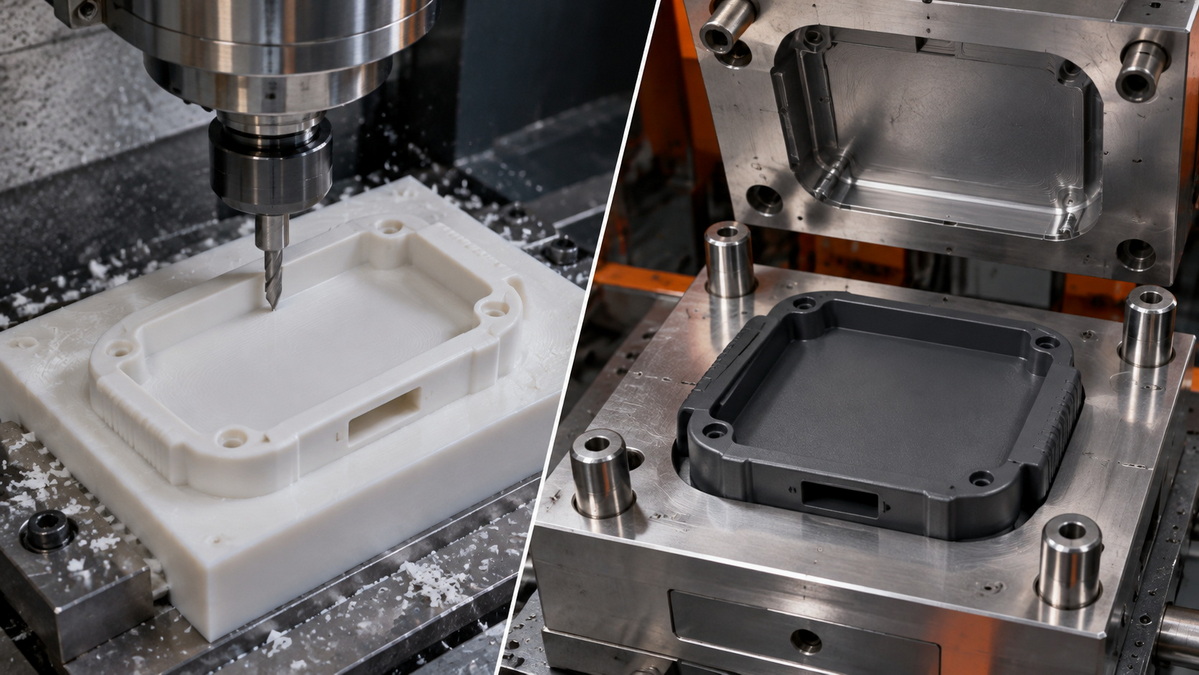
CNC machining uses computer-controlled cutting tools to remove material from a block, bar, or other stock. It can produce metal and plastic prototypes without a dedicated mold, although programming, setup, and fixturing may still be required. In plastic injection molding, molten resin fills a mold cavity, cools, and is ejected as a finished shape. The mold must be designed, built, and sampled before its output is approved.
| Decision factor | CNC prototype machining | Prototype injection molding |
|---|---|---|
| Best first use | Assembly fit, dimensional checks, and functional trials | Validating molded behavior and producing identical pilot parts |
| Upfront commitment | Programming, setup, and any required fixtures | Mold design, fabrication, and sampling |
| Design revisions | Often handled by updating CAD and machining instructions | May require insert changes, tool rework, or replacement |
| Material choice | Metals and plastics available as machinable stock | Injection-grade resins, including grades not readily available as stock |
| Geometry constraints | Cutter access, internal corner radii, and workholding | Draft, wall thickness, gates, parting lines, and ejection |
| Cost pattern | Lower initial commitment for many small batches | Higher initial commitment, with potential unit-cost savings as volume rises |
Lead time is also stage-dependent. Compare the date you will receive acceptable parts, not just the date machining starts or the first mold trial takes place. Finishing, inspection, sample approval, and shipping can change which route meets your deadline.
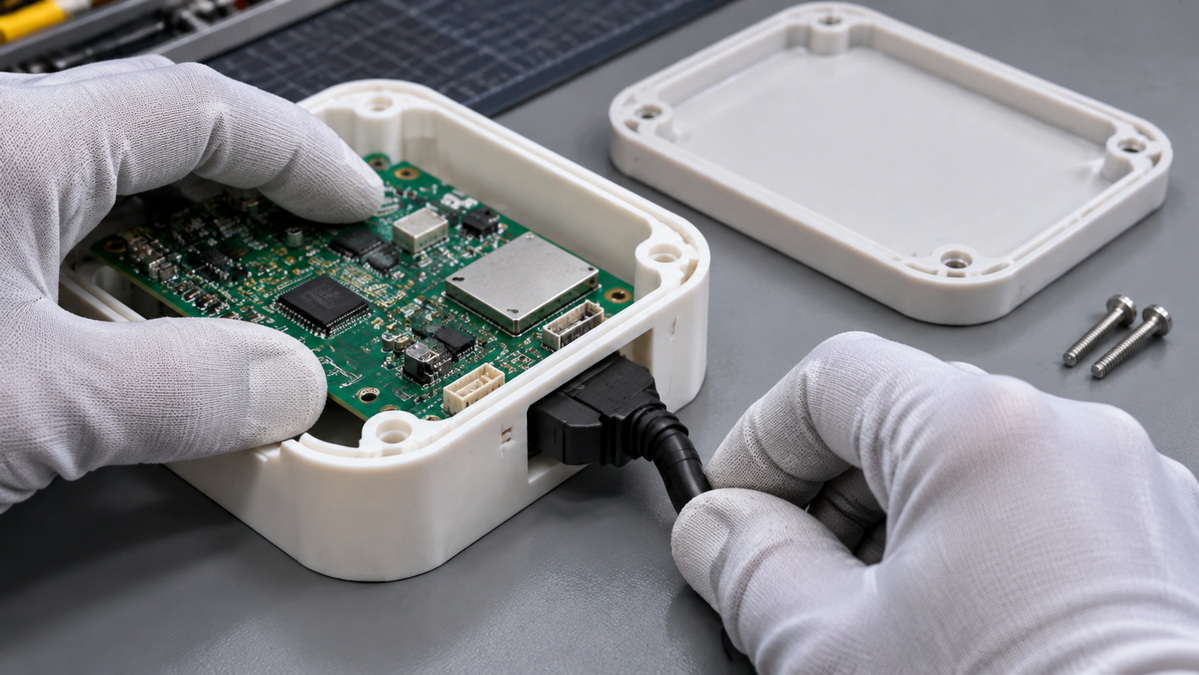
If engineers are still moving mounting holes, adjusting connector openings, or changing mating surfaces, machining lets them test a revision without first modifying a mold. This is particularly useful when the prototype must be assembled with real fasteners, a PCB, a gasket, or parts from another supplier.
A machined electronics enclosure, for example, can reveal that a connector fits the opening but leaves too little room for the cable to bend. Solving that interference before the tooling order is placed keeps the enclosure geometry open to change. The prototype has done its job even if it never matches the final part's appearance.
CNC machining is a strong option when the first build needs to verify a locating feature, bearing seat, sealing face, or hole pattern. But a drawing with tight tolerances everywhere can add cost without improving the test. Specify the surfaces that locate the part in assembly, identify the dimensions that affect function, and tell the supplier how those dimensions will be inspected.
Check machinability at the same time. A round milling cutter leaves a radius in an internal corner. Deep pockets with small corner radii can require smaller tools and longer cutting times. If the mating part needs corner clearance, an approved relief or a change to the mating geometry may be better than insisting on a sharp corner.
If the prototype is an aluminum heat sink, stainless steel shaft, or metal mounting bracket, conventional plastic injection molding is not a like-for-like alternative. The more useful comparison may be CNC machining versus sheet metal fabrication or another metal process. For a flat bracket with bends, for instance, a laser-cut and bent prototype can test the intended construction more directly than a bracket milled from solid stock.
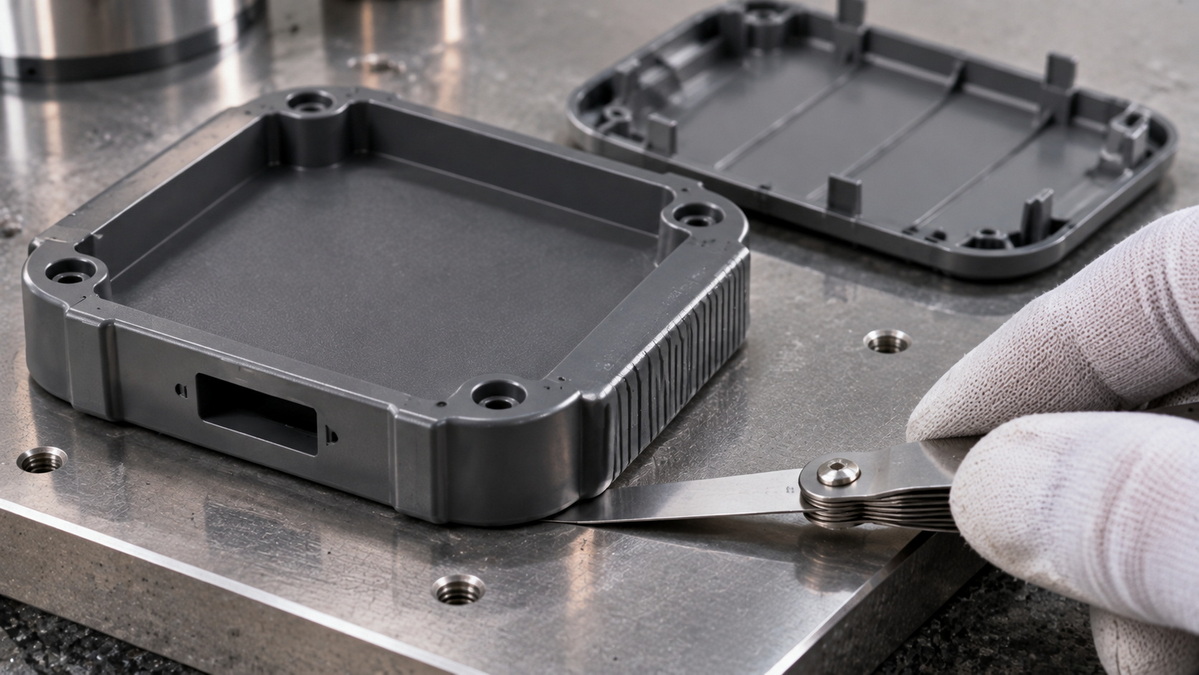
A CNC-machined plastic prototype can tell you whether parts fit, but it cannot reproduce how resin flows, cools, and shrinks in a mold. Even when stock and molding resin share a polymer name, the stock form, exact grade, and processing history can differ. A good result on a machined part is therefore not proof that the molded part will perform the same way.
Move to molded samples when your decision depends on:
- Whether shrinkage or warpage affects a seal, mounting interface, or assembly gap.
- Whether a weld line, where two fronts of molten resin meet, falls in a visible or stressed area.
- Whether a molded snap-fit, flexible feature, or filled resin meets its functional requirements.
- Whether texture, gate marks, or the mold parting line meet cosmetic expectations.
Uniform wall thickness helps control uneven cooling and shrinkage. Gate placement, resin choice, and geometry also affect the result. A moldability review can flag these risks before tooling, but it does not replace testing physical samples made under representative conditions.
Prototype injection molding can be the right choice before full production if the design is stable enough for tooling and the team needs identical parts for assembly trials, customer evaluation, or process validation. Bridge tooling is an intermediate option: it produces molded parts before the long-term production tool is ready or justified.
Ask what the bridge tool will and will not represent. A change in gate location, cooling layout, or cavity configuration between pilot and production tools can change the part. Define which pilot results will support release and which tests must be repeated when the production tool is sampled.
Before requesting a quote, write one sentence: "This batch will help us decide whether ______." Then choose the process that can produce credible evidence for that decision.
1. If the question is "Will it fit?", machine a few pieces and assemble them with the actual mating components. Record interference, clearances, and any changes needed to the drawing.
2. If the question is "Will it survive?", define the load, temperature, test duration, and acceptance criteria. Use machined parts for initial screening only when the material and manufacturing differences will not invalidate the result.
3. If the question is "Can we mold it consistently?", review draft—the taper that helps the part release—along with wall thickness, gates, and ejection. Use molded samples and an inspection plan to assess variation.
4. If the question is "Can we launch at the target cost?", quote both processes at the quantities you realistically expect to buy. Keep tooling, inspection, finish, shipping, and revision costs visible so they do not disappear into the unit price.
Consider a handheld enclosure with a gasket channel and two snap-fit latches. In this illustrative scenario, a machined prototype checks PCB clearance, connector access, and whether the gasket channel aligns with the mating cover. A molded pilot then checks whether the enclosure stays flat after cooling, whether the snaps withstand repeated assembly, and whether the seam meets the cosmetic standard. Each batch answers a different question, so neither is a duplicate of the other.
There is no universal quantity at which injection molding becomes cheaper than CNC machining. The crossover depends on tooling cost, machining time, resin, part geometry, and acceptable yield. Compare quotes using the same revision, functional requirements, finish, and inspection scope. Use landed costs if freight or import charges differ materially.
Suppose machining requires 300 in setup and costs 40 per accepted part, while molding requires 8,300 in tooling and setup and costs 8 per accepted part. All figures below are illustrative and use the same currency.
| Quantity | CNC total | Injection molding total |
|---|---|---|
| 100 | 4,300 | 9,100 |
| 250 | 10,300 | 10,300 |
| 500 | 20,300 | 12,300 |
In this example, the break-even quantity is 250 parts: divide the extra fixed cost of molding (8,000) by the per-part savings (32). This is a quote-comparison method, not a purchasing recommendation. If you expect to order 100 parts now and another 400 only after a redesign, pricing the job as 500 unchanged units could make tooling look more attractive than it is. Compare a stable-design scenario with a revision scenario before releasing the mold.
U-Need is a China-based manufacturing partner offering custom precision parts machining, mold manufacturing, and sheet metal fabrication. If your part could be machined now and molded later, make that intent clear in the first request. A machining quote can solve the immediate build, while a separate moldability review can identify features that should change before tooling.
Send the following information:
- A STEP model and a revision-controlled drawing that identifies critical dimensions, material, and finish.
- Prototype quantity, likely pilot quantity, expected production demand, and the required delivery date.
- The test objective, acceptance criteria, and any mating parts or assembly details that affect the design.
- Cosmetic surfaces, acceptable witness marks, and whether substitutions are allowed for the prototype only.
- Inspection and documentation requirements, plus the delivery destination for a comparable commercial quote.
For a tooling quote, ask who owns the mold, what sampling and revisions are included, and whether the tool is intended for pilot or recurring production. Clarify whether the quoted date covers the first trial, shipment of samples, or delivery of accepted parts.
Send U-Need your CAD files, target quantities, and the decision your next build needs to support. Ask for a CNC prototype quote, an injection mold review, or a comparison of both routes. Start with the process that answers your next engineering question, and commit to tooling when the design and test plan justify it.
Often for a first small batch, because there is no injection mold to build and sample. Complex machining, special material, or outsourced finishing can narrow that advantage. Compare delivery dates based on the same inspection and acceptance requirements.
Sometimes. The exact injection grade may not be available as machinable stock. Even when the material designation matches, a machined prototype does not capture the effects of mold filling and cooling. Confirm the material designation and use molded samples for decisions that depend on the production process.
There is no fixed cutoff. Compare the full cost of both routes at your expected order quantities. Molding can make sense below the financial crossover if the team needs molded behavior or pilot-run evidence that machining cannot provide.
Use it as a starting point, not an automatic release file. The machined version may need cutter access and workholding features, while the molded version may need draft, revised walls, and gate or ejector allowances. Track both revisions so a prototype-only change does not silently become a production requirement.
Not always. If the trial checks only basic fit, machining can proceed while the mold review is pending. If the fit depends on a feature that draft, shrinkage, or a parting line could change, review it early so the machined sample does not validate the wrong geometry.
Release tooling after the relevant fit and function checks, material selection, and moldability review are complete, and after the team agrees on sample acceptance criteria. If major interfaces are still changing, keep the next batch flexible unless you specifically need molded samples to resolve the remaining uncertainty.
1.Protolabs, *How to Select the Best Manufacturing Process for Your Part* ([process comparison]). Background on process selection, low-volume machining, pilot molding, and production scaling. [protolabs]
2.Autodesk, *Injection Molding Parts: Key Factors and Strategies for Minimizing Shrinkage* ([technical article]). Technical basis for the discussion of wall thickness, gating, cooling, shrinkage, and warpage. [autodesk]
3.Autodesk University, *Optimize Plastic Part Designs: Injection Molding Simulation in Fusion 360* ([class materials]). Background on using simulation to assess moldability before tooling. [autodesk]
4.Xometry, *CNC Machining Design Tip: Optimizing Internal Corner Radii* ([design guidance]). Technical basis for cutter-radius and machining-cost considerations. [xometry]
5.Xometry, *Design Guide: Injection Molding* ([PDF design guide]). Background on draft, wall thickness, tooling, and the cost implications of design changes. [cdn2.hubspot]


