Views: 265 Author: U-Need Publish Time: 2026-09-11 Origin: Site
Content Menu
● Why Choose CNC Machined PEEK Parts?
>> High-Temperature Performance
>> Wear and Friction Resistance
>> Lightweight Metal Replacement
>> Material Review and Grade Selection
>> Stress Relief and Material Stabilization
>> Deburring, Cleaning, and Inspection
● Design Guidelines for PEEK CNC Machining
>> Apply Tolerances Only Where Needed
>> Define Surface Finish by Function
>> Account for Metal-to-PEEK Assemblies
● Common PEEK Machining Challenges
● Applications of CNC Machined PEEK Parts
>> Medical and Laboratory Equipment
>> Semiconductor and Electronics
>> Oil, Gas, and Chemical Processing
>> Automotive and Electric Vehicles
>> Industrial Automation and Machinery
● How to Select a PEEK Machining Partner
● Summary
● FAQ
>> What is PEEK plastic CNC machining?
>> Can PEEK be machined with standard CNC equipment?
>> What tolerance can be achieved for machined PEEK parts?
>> Does PEEK need stress relief before machining?
>> Is PEEK stronger than nylon or acetal?
>> Can PEEK replace metal parts?
>> What industries use machined PEEK components?
PEEK plastic CNC machining is used to produce high-performance components for environments involving elevated temperatures, aggressive chemicals, repeated friction, electrical insulation requirements, and demanding mechanical loads. For global manufacturers, distributors, and product developers, PEEK offers a valuable combination of strength, dimensional stability, low weight, and long-term reliability.
U-Need is a trusted precision manufacturing partner in China, supporting global brands and industrial customers with custom precision parts machining, mold manufacturing, and sheet metal fabrication. From early-stage prototypes to repeat production programs, our team helps customers select appropriate materials, refine part designs, control tolerances, and manufacture parts that are ready for real-world use.
PEEK is not a standard engineering plastic. Its performance depends on choosing the right grade, designing the part correctly, and applying a controlled machining process. This guide explains how PEEK CNC machining works, where it delivers the most value, and what engineers should consider before production begins.
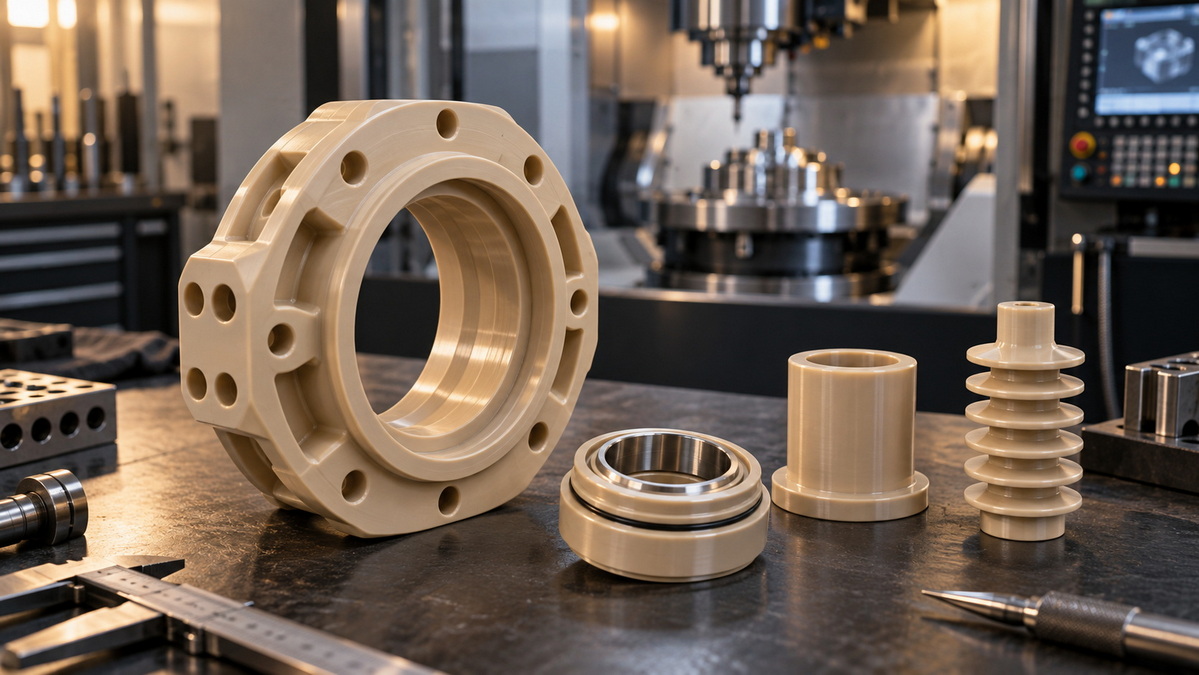
PEEK stands for polyether ether ketone, a high-performance semi-crystalline thermoplastic. It is widely used when common plastics such as nylon, acetal, ABS, polypropylene, or polycarbonate cannot meet the required operating conditions.
PEEK is often selected for parts that need to retain performance under heat, pressure, chemical exposure, or repeated mechanical movement. It is available in several forms, including rod, plate, sheet, tube, and near-net-shape stock. It can also be supplied in different grades to address specific performance requirements.
Common PEEK material grades include:
- Natural or unfilled PEEK
- Glass-fiber-reinforced PEEK
- Carbon-fiber-reinforced PEEK
- Wear-grade PEEK
- Bearing-grade PEEK
- Medical-grade PEEK
- High-purity PEEK for controlled environments
Each grade has different characteristics. Natural PEEK is often preferred where chemical resistance, electrical insulation, and material purity are important. Carbon-fiber-filled PEEK can provide greater stiffness and dimensional stability. Glass-filled PEEK may be selected for increased rigidity and improved thermal performance.
The material grade should always be selected based on the part's working environment, operating temperature, load condition, friction requirements, chemical exposure, and compliance needs.
PEEK is a premium engineering plastic, so it is generally used when its technical advantages create measurable value. It can replace metal in selected applications, reduce assembly weight, resist harsh chemicals, and support long service life in high-demand systems.
PEEK can maintain useful mechanical properties at temperatures that would cause many engineering plastics to soften, deform, or lose strength. This makes it suitable for components used near engines, heating systems, electrical equipment, industrial processing lines, and high-temperature fluid systems.
However, temperature performance should never be evaluated by material data alone. The final operating limit depends on the material grade, part geometry, continuous load, short-term load, thermal cycling, chemical exposure, and required safety factor.
Many PEEK grades offer strong resistance to oils, fuels, lubricants, cleaning agents, acids, bases, and process chemicals. This makes CNC-machined PEEK parts useful for pumps, valves, fluid-handling systems, laboratory equipment, chemical-processing machinery, and industrial automation equipment.
For critical projects, chemical compatibility should be evaluated against the exact fluid concentration, temperature, pressure, and duration of exposure.
PEEK is commonly used in moving assemblies because of its wear resistance and low-friction characteristics. It can be machined into bushings, washers, gears, bearing cages, guide rails, rollers, seals, and other components that experience repeated sliding or rotational movement.
Wear performance can be improved further by selecting a specialized grade, optimizing mating surfaces, applying suitable lubrication where allowed, and controlling surface finish during machining.
Low moisture absorption helps PEEK maintain dimensional stability in humid, wet, or steam-exposed environments. This is valuable for precision components used in fluid systems, medical equipment, marine environments, laboratory devices, and industrial machinery.
Dimensional stability is also influenced by residual material stress, machining heat, clamping force, wall thickness, and post-machining handling. A capable machining process addresses these factors before they become quality issues.
Natural PEEK is often used for electrical insulation applications because it combines dielectric properties with heat resistance and mechanical durability. It can be used for connector bodies, high-temperature insulators, semiconductor fixtures, electrical supports, cable-management components, and other non-conductive precision parts.
PEEK can provide substantial weight savings compared with steel, stainless steel, brass, bronze, and some aluminum components. This is especially valuable in aerospace, automotive, electric vehicle, robotics, portable equipment, and motion-control applications.
Replacing metal with PEEK is not always the right decision. Metal may still be required when a design needs extremely high stiffness, very high load capacity, electrical conductivity, or lower material cost. The best material choice should be made after evaluating the full operating environment.
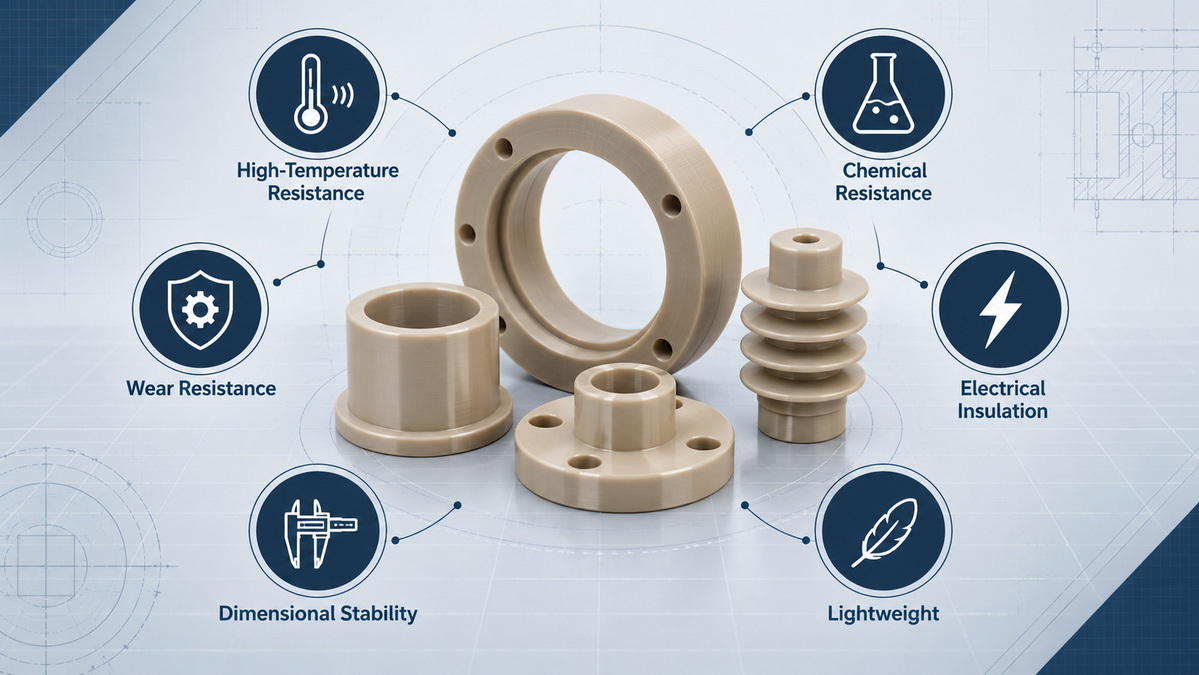
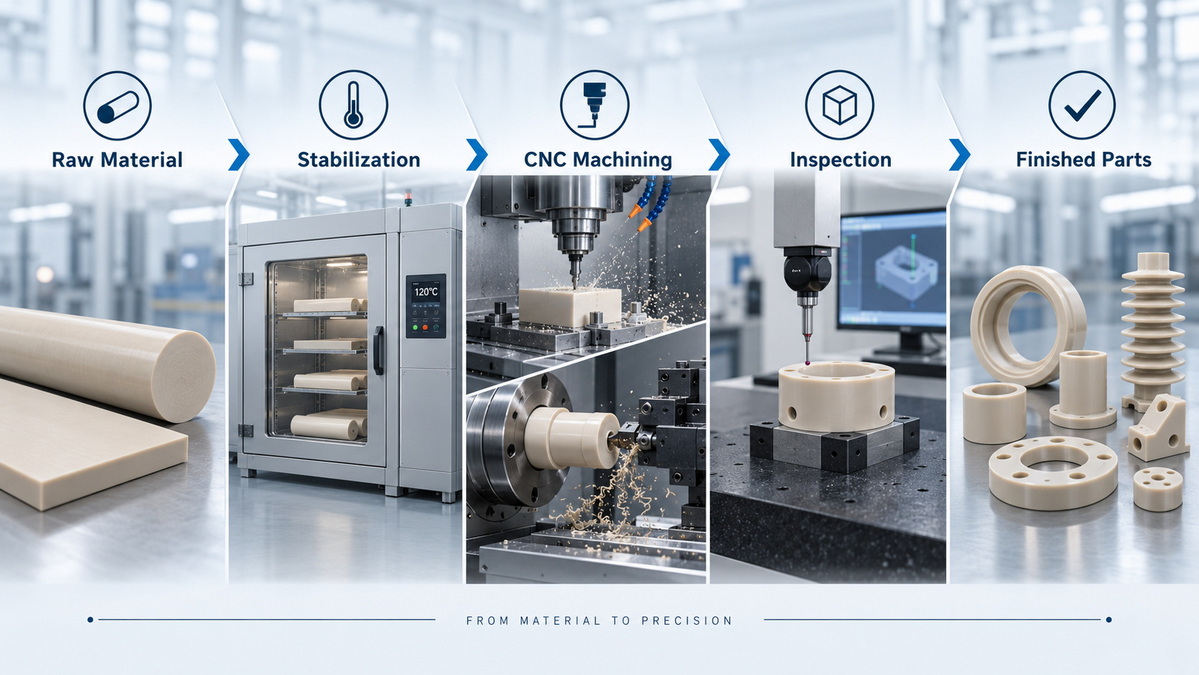
High-quality PEEK parts require a stable process from material selection through final inspection. PEEK can be milled, turned, drilled, tapped, bored, reamed, and machined on multi-axis CNC equipment, but it must be handled differently from metals and commodity plastics.
The manufacturing process begins with understanding the functional requirements of the part. Before machining starts, the production team should confirm:
- Operating temperature range
- Contact chemicals and fluids
- Mechanical loads and pressure levels
- Electrical insulation requirements
- Wear, friction, and sliding conditions
- Surface-finish requirements
- Tolerance and flatness requirements
- Regulatory or documentation requirements
- Prototype, low-volume, or production quantity
This step prevents costly problems later. A part intended for a chemical pump, for example, may need a different PEEK grade and surface finish than a part designed for a high-temperature electrical fixture.
PEEK stock is commonly supplied as rod, plate, tube, or sheet. The selected stock shape should match the part geometry whenever possible.
Using a round rod for a turned cylindrical component can reduce machining time and material waste. Using PEEK plate for a flat fixture or structural profile can improve process efficiency. For costly materials such as PEEK, intelligent stock selection can significantly affect final part cost.
For demanding programs, the material documentation may include:
- Material manufacturer and grade
- Batch or lot number
- Certificate of conformity
- Material test information
- Reinforcement specification
- Color and appearance requirements
- Compliance documentation
PEEK can contain internal stress from extrusion, molding, sawing, rough cutting, clamping, or previous machining steps. When material is removed, that stress may be released unevenly and cause the part to move, bow, twist, or lose flatness.
Stress-relief planning is especially important for:
- Thin-wall components
- Large flat parts
- Tight-tolerance assemblies
- Parts with deep pockets
- Complex asymmetrical shapes
- High-temperature applications
- Parts requiring stable flatness or concentricity
A controlled stabilization process may be applied before machining, after rough machining, or before final finishing. The correct process should be determined by the PEEK grade, part size, wall thickness, reinforcement type, and functional requirements.
Rough machining removes the majority of material and creates the basic part shape. During this stage, the machining strategy should minimize heat buildup and prevent excessive stress from being introduced into the part.
A well-planned roughing process may include:
- Sharp cutting tools with suitable geometry
- Stable fixturing that does not over-compress the part
- Effective chip evacuation
- Balanced stock removal from opposite sides
- Moderate cutting forces
- Allowances for later finishing operations
- Support for thin or unsupported areas
When machining PEEK, the goal is not simply to remove material quickly. The goal is to remove material in a way that preserves dimensional control for the final operation.
Finish machining creates the final dimensions, surface quality, and functional features. This stage may include CNC milling, turning, precision boring, drilling, reaming, thread milling, tapping, and multi-axis contour machining.
Critical PEEK features may include:
- Precision bores
- Bearing seats
- O-ring grooves
- Sealing faces
- Deep cavities
- Small threaded holes
- Thin cylindrical sections
- Tight flatness surfaces
- Complex fluid passages
- Mating features for metal assemblies
The final machining parameters should be adapted to the selected PEEK grade. Filled PEEK grades can be more abrasive to cutting tools, which may require more frequent tool monitoring. Natural PEEK requires careful heat management to maintain surface quality and avoid deformation.
After machining, parts are deburred and inspected to confirm that they meet drawing requirements. Depending on the project, quality checks may include:
- Dimensional verification with calipers and micrometers
- Pin-gauge and thread-gauge inspection
- Coordinate measuring machine inspection
- Bore and concentricity measurement
- Surface-finish verification
- Visual inspection for burrs, cracks, discoloration, or tool marks
- First article inspection reports
- In-process quality records
For cleanroom, semiconductor, laboratory, medical, food-contact, or vacuum-sensitive applications, cleaning and packaging requirements should be defined early. A basic industrial cleaning process may not be sufficient for high-purity applications.
A well-designed PEEK component is easier to manufacture, more stable in service, and more cost-effective. The following guidelines can help reduce production risk.
Tight tolerances should be applied to dimensions that directly affect fit, sealing, assembly, positioning, or functional performance. Applying extremely tight tolerances to non-critical features increases cost and may add unnecessary production risk.
For example, a bearing bore or sealing groove may need precise control. A non-functional outer surface may not require the same accuracy. Identifying critical dimensions early helps create a more efficient manufacturing plan.
Thin PEEK walls can deflect under machining force or move after unclamping. If the design permits, use ribs, support features, or a more balanced wall structure.
Helpful design practices include:
- Maintaining reasonable wall thickness
- Avoiding long unsupported sections
- Reducing abrupt material transitions
- Adding ribs where stiffness is needed
- Avoiding deep narrow pockets when possible
- Reviewing large flat surfaces for warpage risk
PEEK threads can be machined directly, but repeated assembly, high tightening torque, vibration, or frequent maintenance may require metal threaded inserts.
Inserts can improve long-term fastening performance for applications involving repeated disassembly. The insert design should be reviewed based on pull-out load, torque requirements, installation method, operating temperature, and part-wall thickness.
Not every PEEK surface needs a highly polished finish. Surface-finish requirements should match the function of the feature.
A sealing face may require a controlled finish. A sliding wear surface may need a different finish to manage friction. A cosmetic exterior may need to minimize visible tool marks. Defining finish requirements by function helps avoid unnecessary manufacturing cost.
Many PEEK parts are assembled with stainless steel, aluminum, titanium, brass, or other polymers. Designers should account for:
- Thermal expansion differences
- Fastener preload
- Assembly torque
- Contact pressure
- Friction and wear
- Sealing performance
- Long-term creep under load
- Operating temperature cycles
A PEEK part may perform well independently but behave differently when installed in a metal assembly. Reviewing the full assembly is essential.
PEEK machining can produce excellent results when the process is controlled. The following table outlines common issues and practical manufacturing responses.
| Common Challenge | Potential Cause | Manufacturing Response |
|---|---|---|
| Warping after machining | Internal stress released during material removal | Use staged machining, balanced stock removal, stabilization, and controlled fixturing |
| Poor surface finish | Excessive heat, dull tools, poor chip removal | Use sharp tooling, optimized cutting parameters, and proper chip evacuation |
| Burrs around holes | Tool wear, unsuitable drilling conditions, poor exit support | Use appropriate drills, controlled feeds, backing support, and careful deburring |
| Dimensional variation | Material movement, temperature changes, inconsistent stock | Stabilize the material and maintain consistent inspection conditions |
| Thread damage | Excessive torque or repeated assembly cycles | Consider threaded inserts or revised fastening geometry |
| Tool wear with filled PEEK | Carbon or glass reinforcement is abrasive | Use wear-resistant tools and establish a tool-monitoring plan |
| Flatness problems | Thin walls, uneven machining, residual stress | Machine both sides in a controlled sequence and support the part properly |
These challenges should be addressed before production begins. A detailed review of the drawing, material grade, machining approach, and inspection plan can prevent delays, scrap, and repeated revisions.
PEEK CNC machining supports a wide range of industries because it combines thermal stability, wear resistance, chemical resistance, insulation properties, and low weight.
PEEK may be used in lightweight brackets, cable-management components, wear parts, insulation components, fluid-system parts, and high-temperature assemblies. It can help reduce system weight while maintaining durability in demanding environments.
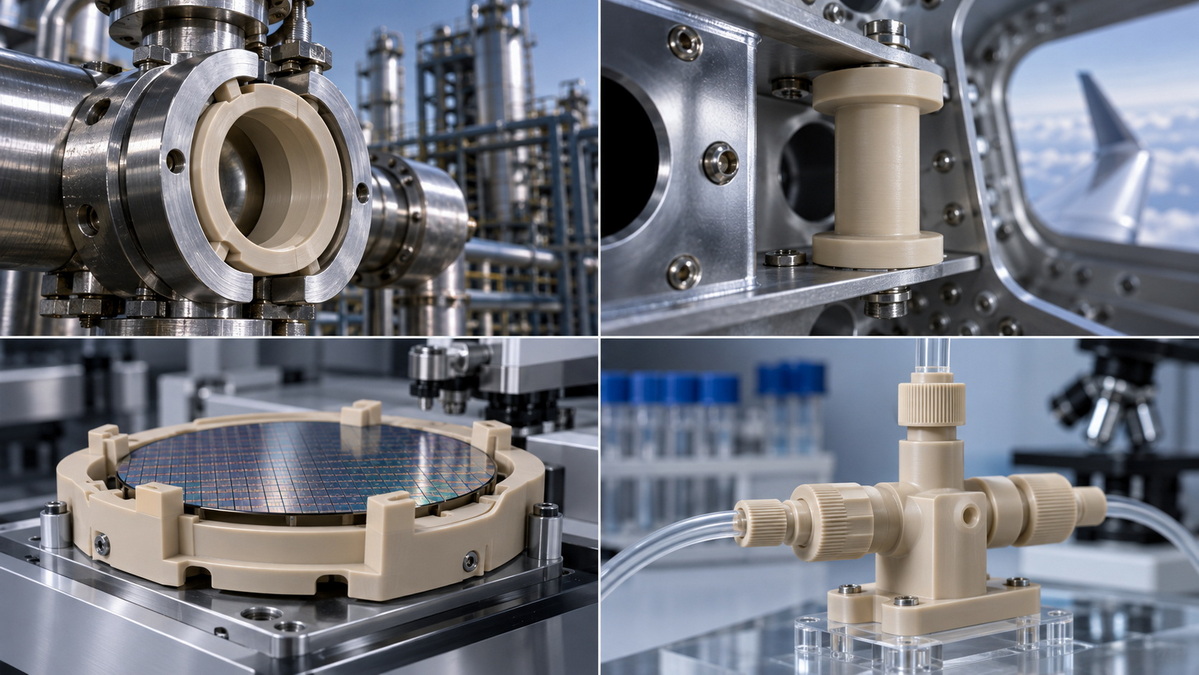
Machined PEEK is used in medical-device components, laboratory fixtures, fluid-handling equipment, analytical instruments, imaging-compatible parts, and specialized housings.
For medical applications, material grade, traceability, cleanliness, sterilization compatibility, biocompatibility requirements, and intended use should be clearly defined. A PEEK material grade alone does not confirm that the final component is suitable for every medical application.
PEEK is suitable for many controlled-environment and electrical applications. Typical uses include semiconductor fixtures, electrical insulators, test equipment, wafer-handling components, high-temperature connectors, and chemical-resistant support structures.
PEEK components can be used in valves, pumps, seals, back-up rings, compressor parts, instrumentation, and chemical-processing systems. Its combination of chemical resistance and mechanical durability makes it valuable in environments involving pressure, heat, and aggressive media.
Automotive and electric vehicle systems may use PEEK for high-temperature electrical insulation, sensor housings, wear components, fluid-system parts, pump components, lightweight structural parts, and assemblies near heat-generating systems.
Industrial equipment often uses machined PEEK for bushings, guide blocks, gears, rollers, bearing cages, wear pads, precision fixtures, valve components, and custom automation parts. These applications benefit from low friction, wear resistance, and long service life.
Choosing a manufacturing partner for PEEK parts requires more than comparing unit prices. The supplier should understand material behavior, production risks, quality documentation, and the functional needs of your final assembly.
Consider the following capabilities when evaluating a PEEK CNC machining supplier:
- Knowledge of unfilled, glass-filled, carbon-filled, wear-grade, and specialized PEEK materials
- Practical design-for-manufacturing support
- CNC milling, turning, drilling, boring, and multi-axis machining capability
- Material traceability and documentation support
- First article inspection and dimensional reporting
- Controlled production processes for prototype and repeat orders
- Experience with tight tolerances, thin-wall structures, and complex geometries
- Clear communication for international manufacturing programs
- Integrated capabilities for molds, stamped parts, forged components, and sheet metal assemblies
A capable supplier can identify manufacturability risks early, recommend practical improvements, and help prevent avoidable cost increases during prototyping or volume production.
PEEK plastic CNC machining is an effective manufacturing solution for components that must perform under heat, chemical exposure, friction, electrical stress, and demanding mechanical conditions. Its high-performance characteristics make it a strong choice for aerospace, medical, semiconductor, automotive, chemical-processing, and industrial equipment applications.
The best results come from combining the right PEEK grade with thoughtful part design, controlled machining parameters, material stabilization, appropriate inspection, and experienced production support. Tight tolerances, thin walls, threaded features, surface finishes, and metal-to-plastic interfaces should all be reviewed before machining begins.
U-Need provides custom precision machining support for PEEK and other engineering materials, along with mold manufacturing and sheet metal fabrication services. By coordinating material selection, manufacturability review, machining, inspection, and production planning, we help customers move from drawing to dependable finished components.
For a detailed PEEK machining evaluation, provide your 2D drawings, 3D CAD files, material requirements, quantity, tolerance information, surface-finish requirements, and operating conditions. U-Need can review the project and prepare a manufacturing solution that aligns with your performance and production needs.
PEEK plastic CNC machining is the use of computer-controlled milling, turning, drilling, boring, tapping, and finishing operations to manufacture precision parts from polyether ether ketone material. It is commonly used for components that require high heat resistance, chemical resistance, low friction, dimensional stability, or electrical insulation.
PEEK can be machined using CNC milling machines, CNC lathes, drilling equipment, and multi-axis machining centers. However, tooling, clamping, cutting parameters, chip control, and heat management should be adjusted for PEEK material behavior.
The achievable tolerance depends on part geometry, material grade, wall thickness, feature size, operating environment, machining sequence, and inspection requirements. Tight tolerances can be achieved for suitable features, but tolerances should be applied according to functional needs rather than as a general requirement for every dimension.
Not all PEEK components require stress relief. However, stabilization can be helpful for thin-wall parts, large flat components, tight-tolerance features, deep pockets, and applications involving high temperatures. The correct process depends on the specific material grade and component design.
PEEK generally offers higher heat resistance, chemical resistance, mechanical performance, and long-term dimensional stability than common plastics such as nylon or acetal. However, nylon or acetal may be more cost-effective for applications that do not require PEEK-level performance.
PEEK can replace metal in selected applications where weight reduction, chemical resistance, electrical insulation, wear performance, or thermal stability are important. It may not be suitable where the design requires extremely high stiffness, very high load capacity, electrical conductivity, or lower material cost.
Machined PEEK components are used in aerospace, defense, medical equipment, laboratory equipment, semiconductor manufacturing, electronics, oil and gas, chemical processing, automotive, electric vehicles, industrial automation, and high-performance machinery.
1. Victrex. "PEEK Materials Properties Guide." Available at: [https://www.victrex.com/en/material-properties]
2. Protolabs. "CNC Machining for PEEK Parts." Available at: [https://www.protolabs.com/services/cnc-machining/plastics/peek/]
3. Victrex. "VICTREX PEEK Finishing Operations Guide." Available at: [https://www.victrex.com/en/victrex-peek-finishing-operations-guide]
4. AIP Precision Machining. "Machining PEEK: A Plastics Guide." Available at: [https://aipprecision.com/machining-peek-a-plastics-guide/]
5. Xometry. "CNC Machining PEEK Services." Available at: [https://www.xometry.com/capabilities/cnc-machining-service/peek/]


