Views: 232 Author: U-Need Publish Time: 2026-07-18 Origin: Site
Content Menu
● Why Drilling on Angled or Curved Surfaces Is Difficult
● Method 1: End Milling + Spot Drilling + Standard Drilling
>> Key Benefits
>> Limitations
● Method 2: Flat Bottom Drill for Efficient Machining
>> Practical Machining Scenario
>> Recommended Cutting Strategy
● Why Flat Bottom Drills Improve Stability
● Limitations of Flat Bottom Drilling
● Choosing the Right Method for Your Application
>> When to Use the Traditional Method
>> When to Use Flat Bottom Drilling
● Advanced Machining Insights for Better Results
>> Improve Workholding Stability
>> Select Appropriate Cutting Parameters
>> Use High-Performance Tooling
● Integrated Manufacturing Capabilities for Complex Parts
● Practical Perspective from Shop Floor Experience
>> 1. What is the main cause of hole deviation on angled surfaces?
>> 2. How can drill walking be minimized?
>> 3. What is the typical depth limit for flat bottom drills?
>> 4. Are flat bottom drills suitable for all materials?
>> 5. Can both methods be combined in one process?
In precision machining, drilling on angled or curved surfaces is a frequent but technically sensitive task. Whether producing custom machined parts, molds, or complex sheet metal components, improper drilling techniques can lead to hole deviation, reduced dimensional accuracy, and increased rework rates. These issues not only affect product quality but also impact overall production efficiency.
In real workshop environments, operators often encounter situations where holes must be drilled on inclined planes, curved surfaces, or irregular geometries. If standard drilling methods are applied directly, the drill tip does not engage the material first. Instead, the cutting edges make initial contact, causing instability and leading to tool deflection.
This article explores two widely used machining methods, analyzes their advantages and limitations, and introduces practical insights based on real production experience to help improve both accuracy and efficiency.
The core challenge lies in the initial contact mechanics between the tool and the workpiece.
On a flat surface:
- The drill tip engages first.
- Cutting forces are evenly distributed.
- The hole position remains stable.
On an angled or curved surface:
- The drill edge touches first instead of the tip.
- This creates lateral force.
- The tool tends to slide before penetrating the material.
As a result:
- Hole positions shift from their intended coordinates.
- Surface finish may degrade.
- Tool wear increases.
Even minor deviations, such as 0.02 mm, can be unacceptable in high-precision applications like mold manufacturing or aerospace components.

This traditional method uses a multi-step approach to ensure positioning accuracy:
1. Surface Preparation
- A small flat area is created using an end mill on the angled surface.
2. Spot Drilling
- A center drill forms a precise starting point.
3. Final Drilling
- A standard twist drill completes the hole.
- High positional accuracy.
- Reliable for tight tolerance requirements.
- Suitable for a wide range of materials.
- Multiple tool changes increase cycle time.
- Programming complexity is higher.
- Less efficient for large production runs.
In practice, this method is often chosen when accuracy is prioritized over speed, particularly in small-batch or high-value component manufacturing.
A flat bottom drill simplifies the process by eliminating the need for pre-machining steps.
- The cutting edges contact the surface first in a controlled manner.
- This creates a stabilizing effect during entry.
- The tool effectively centers itself even on inclined or curved surfaces.
In a real machining test:
- Holes were drilled at angles of 5°, 10°, and 30°.
- Additional drilling was performed on:
- A curved dome surface
- An irregular geometry
- A deep angled section
- For shallow angles (e.g., 5°):
- Drill directly at full feed rate.
- For larger angles (10° and above):
- Reduce feed rate by approximately 30% during initial entry.
- Resume full feed once the drill is fully engaged.
This approach ensures stability during the most critical phase of cutting.
- Hole diameters remained consistent.
- Positional accuracy was maintained across all angles.
- Overall machining time was significantly reduced.
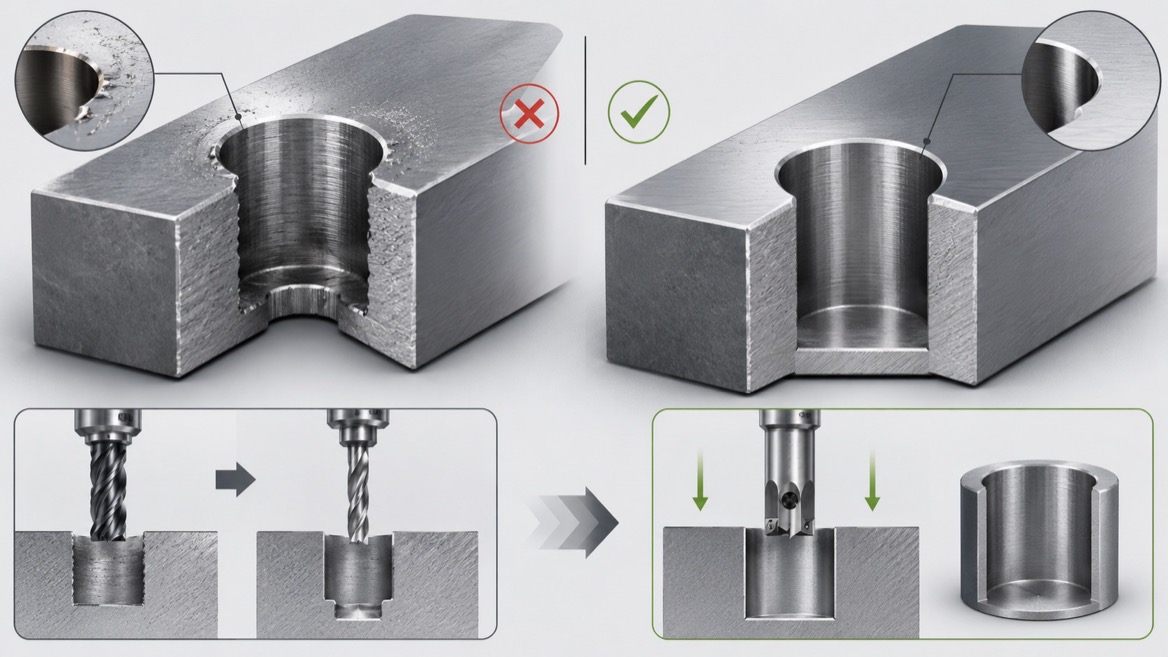
The improved performance comes from tool geometry and engagement behavior.
- The cutting edges create a stable contact zone.
- Lateral movement is minimized during entry.
- Cutting forces are distributed more evenly.
This makes flat bottom drills particularly effective for:
- Multi-angle drilling operations
- Complex part geometries
- Batch production environments
From a machining perspective, this method reduces variability and enhances repeatability.
Despite its efficiency, this method has certain constraints that must be considered.
- Requires high tool rigidity.
- Cutting edges are relatively short.
- Maximum drilling depth is typically limited to 3×D (three times the tool diameter).
For deeper holes:
- Use a flat bottom drill for initial positioning.
- Follow up with a standard twist drill to achieve full depth.
This hybrid approach balances accuracy and depth capability.
Selecting the appropriate drilling method depends on production requirements and part characteristics.
- Extremely tight tolerances are required.
- Working with hard or difficult-to-machine materials.
- Production volume is low.
- Efficiency and speed are priorities.
- Multiple angled holes are required.
- Production involves medium to large batch sizes.
In many real-world scenarios, combining both methods provides the best balance between precision and productivity.
- Avoid direct plunging on steep angles.
- Use controlled feed reduction during initial contact.
- Ensure rigid clamping to reduce vibration.
- Use custom fixtures for irregular shapes.
- Adjust spindle speed and feed rate based on material and angle.
- Monitor cutting forces to prevent tool deflection.
- Apply coated tools such as TiAlN or AlCrN.
- Improve heat resistance and extend tool life.
These refinements can significantly improve machining consistency and reduce operational risks.
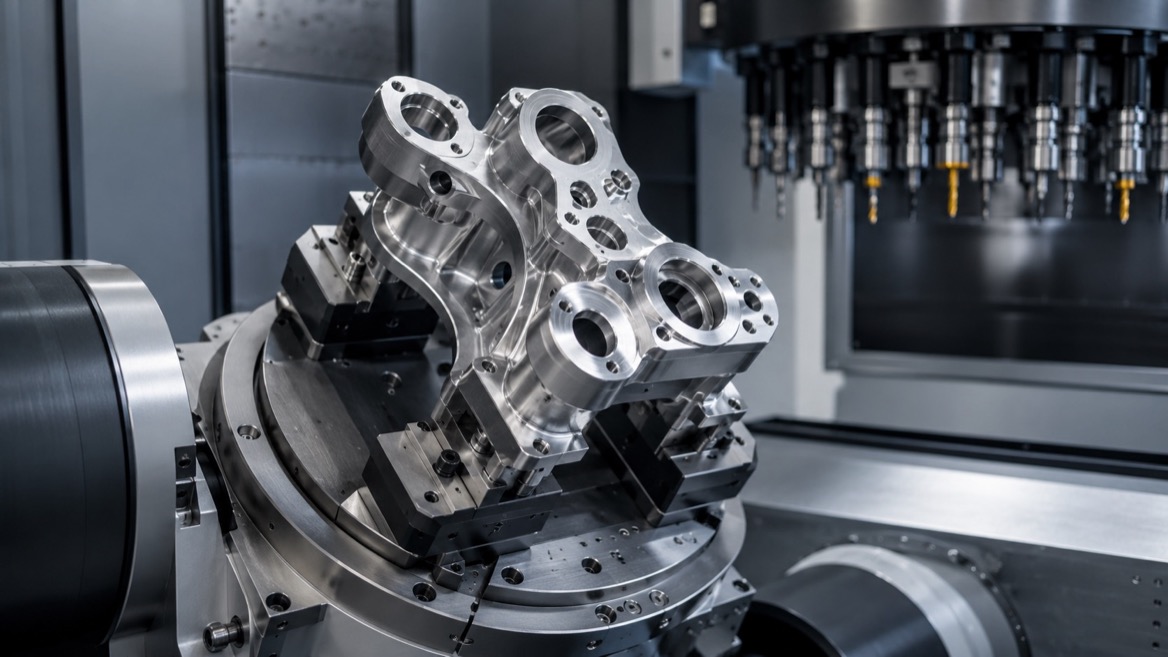
In modern manufacturing, drilling is rarely an isolated process. It is often part of a broader production workflow involving multiple machining and fabrication steps.
Comprehensive capabilities typically include:
- Custom precision parts machining using CNC milling and turning
- Mold manufacturing, including injection molds and stamping dies
- Sheet metal fabrication such as laser cutting, bending, and stamping
By integrating these processes, manufacturers can ensure better control over quality, lead time, and cost.
From a hands-on machining standpoint, the choice of drilling method often comes down to balancing three factors:
- Accuracy requirements
- Production efficiency
- Tooling limitations
Operators who frequently work with angled or curved surfaces tend to favor flat bottom drills for their simplicity and efficiency. However, for critical features where tolerance margins are extremely tight, the traditional multi-step method remains a dependable option.
Continuous testing and parameter optimization are essential to achieving consistent results across different materials and geometries.
Drilling on angled and curved surfaces requires a clear understanding of tool behavior, material interaction, and process strategy. While traditional methods provide high accuracy, modern tooling solutions such as flat bottom drills offer significant advantages in efficiency and versatility.
By selecting the appropriate method and optimizing cutting conditions, manufacturers can achieve stable, precise, and repeatable results across a wide range of applications.
Hole deviation is primarily caused by unstable initial contact between the drill and the workpiece, where the cutting edge engages before the drill tip.
Drill walking can be reduced by using spot drilling, lowering feed rates during entry, or using flat bottom drills for better stability.
The standard depth limit is approximately 3×D. For deeper holes, a secondary drilling process is recommended.
They are suitable for many materials, but performance depends on tool rigidity and proper parameter selection, especially in harder materials.
Yes, combining flat bottom drilling for positioning and standard drilling for depth is a common and effective approach.


