Views: 256 Author: U-Need Publish Time: 2026-07-11 Origin: Site
Content Menu
● What Is CNC Precision Machining – And Why It Matters Now
● How CNC Precision Machining Works: A Step-by-Step Expert View
>> 1. Design, DFM, and CAD Modeling (Where Precision Begins)
>> 2. CAM Programming and Digital Simulation
>> 3. Machine Setup, Tooling, and Workholding
>> 4. Machining: From Roughing to Finishing Passes
>> 5. Post-Processing and Final Finishing
● Core Precision CNC Machine Types Used in Modern Manufacturing
>> CNC Turning and Lathe Centers
>> CNC Drilling
>> EDM (Electrical Discharge Machining)
>> Plasma and Precision Grinding
● Materials Commonly Used in CNC Precision Machining
>> Metals
>> Plastics
● Where Precision CNC Parts Are Used: Key Industries and Applications
● Advantages of High-Precision CNC Machining for Global Buyers
>> Reduced Waste and Better Efficiency
>> Complex Geometries and Tight Tolerances
>> Material Versatility and Flexible Volumes
● How to Choose a CNC Precision Machining Partner in China
● 2026 Trends Shaping CNC Precision Machining
● Practical Checklist for Evaluating Your CNC Supplier
● FAQs on CNC Precision Machining and U-Need's Capabilities
U-Need is positioned to be more than a parts supplier—it can be the strategic precision manufacturing partner global brands rely on when tolerances, lead times, and scalability truly matter. This optimized article reframes CNC precision machining from an expert, practitioner perspective and connects it directly to U-Need's OEM/ODM capabilities in China. [blog.3ds]
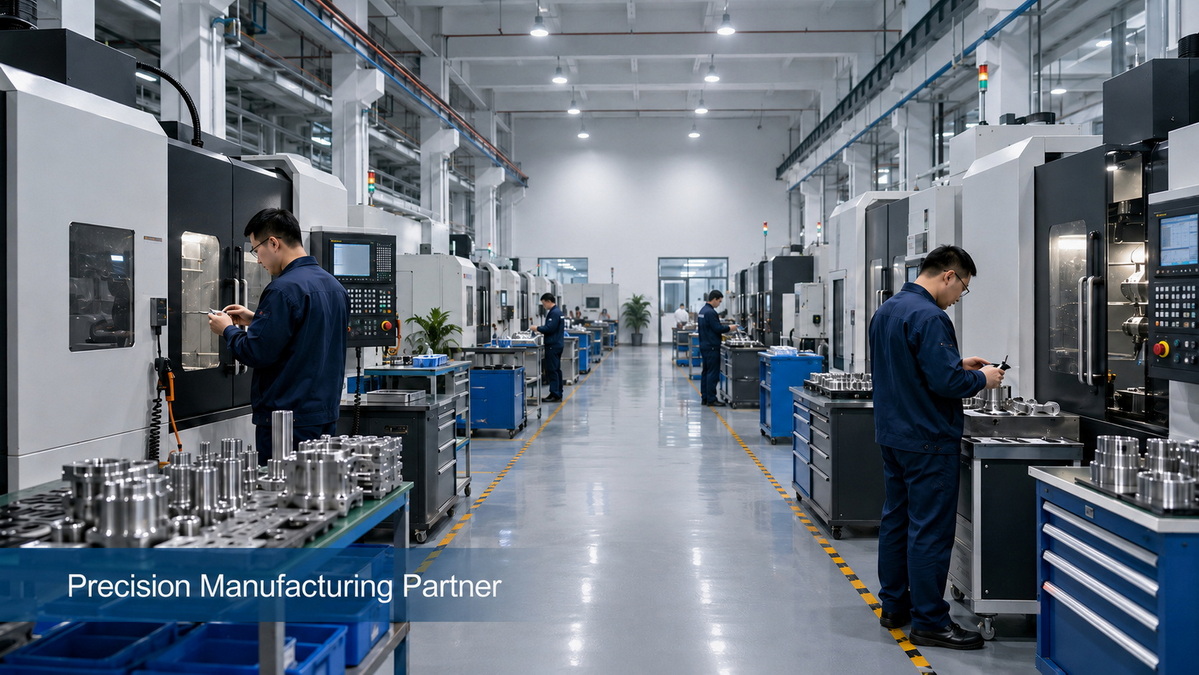
Automotive components, medical implants, EV battery systems, aerospace parts, and defense equipment all depend on ultra-tight tolerances—often down to ±0.001 inches—to function safely and reliably. Traditional machining cannot consistently reach this level, especially at scale, which is why CNC precision machining has become a foundational process for modern manufacturing. [dashnode]
At its core, CNC (Computer Numerical Control) machining uses computer-driven toolpaths to remove material from metals and engineering plastics, following a 3D CAD model and CAM-generated program. Precision machining adds stricter tolerances, optimized parameters, advanced tooling, and rigorous inspection to deliver parts that are dimensionally stable across entire production runs. [pans-cnc]
For global brands and distributors, this precision is not optional. It defines whether your design passes qualification, your product meets regulatory standards, and your supply chain can scale without spiraling quality costs. [steckermachine]
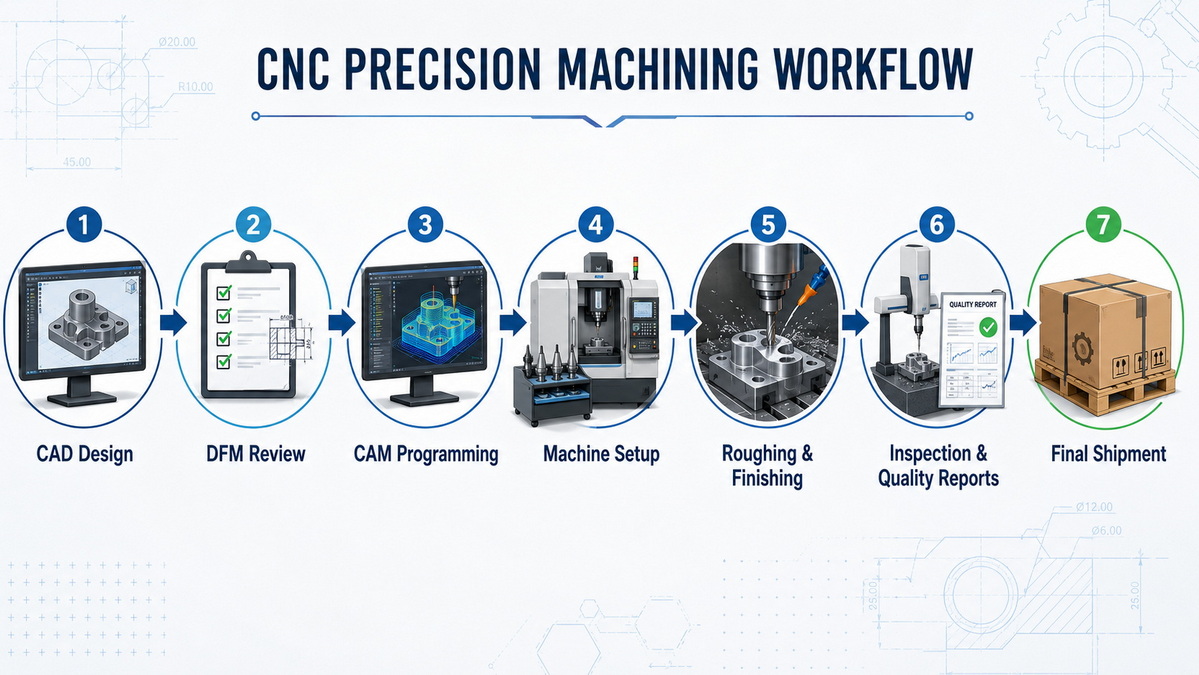
Every high-precision project starts with a robust 3D engineering design that clearly defines dimensions, tolerances, critical features, and surface finish requirements. Engineers typically use tools like SolidWorks or AutoCAD to build the model, and then apply Design for Manufacturability (DFM) principles to ensure the part is compatible with CNC machining capabilities. [zetwerk]
From an OEM/ODM partner's perspective, this is the phase where U-Need's engineering team should challenge unrealistic tolerances, suggest radius changes, and adjust wall thicknesses to avoid unnecessary cost and machining risk. Brands that involve their manufacturing partner early at this stage see fewer design iterations and faster validation cycles. [insights.made-in-china]
Once the CAD model is final, CAM software converts it into G-code and M-code—precise instructions that control spindle speeds, feed rates, toolpaths, and motion sequences in the CNC machine. Advanced CAM systems can simulate tool trajectories, detect collisions, and optimize tool engagement before any material is cut, significantly reducing scrap and setup time. [ymolding]
Leading precision shops now tie CAM data into digital twins of their machining cells, using simulation to validate cycle times and surface quality upfront. For U-Need, positioning CAM and simulation as part of its "end-to-end manufacturing" story immediately signals maturity to global buyers. [in-xmachineinc]
Precision is won or lost at the setup stage. Operators must select the right cutters (end mills, drills, reamers), install them in high-quality holders, and clamp the workpiece using fixtures or chucks that minimize vibration and deflection. Poor workholding or worn tooling is one of the most common causes of tolerance drift and poor surface finish in production. [blog.3ds]
Modern machine shops add automatic tool changers (ATC), probing systems, and standardized fixture libraries so that repeat setups become predictable and traceable. When U-Need highlights fixture repeatability and in-process probing in its marketing content, it signals to engineers that the shop understands real-world quality challenges, not just theoretical specs. [steckermachine]
During machining, CNC controllers synchronize spindle motion and tool movement along multiple axes to remove material in a controlled sequence. Typically, parts go through: [blog.3ds]
- Roughing passes to remove bulk material quickly
- Semi-finishing passes to approach final geometry
- Finishing passes to achieve final dimensions and surface tolerances
Experienced machinists fine-tune parameters like depth of cut and feed to prevent chatter and thermal distortion, which is critical for tight-tolerance pockets, thin walls, and complex geometries. Shops adopting AI-assisted monitoring now analyze spindle load and vibration data in real time to auto-adjust cuts, reducing scrap by double-digit percentages. [linkedin]
After machining, parts often show tool marks, burrs, or micro-chips that can interfere with fit or function. Precision shops rely on grinding, deburring, honing, and polishing to meet both dimensional accuracy and required surface roughness values (for example, Ra 0.8–3.2 µm for critical bearing surfaces). [in-xmachineinc]
Finishing processes such as sandblasting, anodizing, electroplating, and passivation not only improve corrosion resistance and aesthetics but also help meet industry-specific standards, from medical device regulations to aerospace specifications. When U-Need can offer integrated finishing and inspection under one roof, it simplifies vendor management for global buyers who otherwise must juggle multiple suppliers. [prototech-machining]
Different machine platforms address different geometries and tolerance requirements, and your choice of partner should reflect this diversity. [blog.3ds]
CNC milling machines use a rotating spindle and multi-axis movement to machine 2D and 3D features—from simple pockets to complex freeform surfaces. High-end mills now achieve tolerances down to ±0.0025 mm on rigid setups, especially when combined with thermal compensation and in-machine measuring probes. [rejincnc]
Turning centers rotate the workpiece while a stationary tool removes material, making them ideal for shafts, bushings, and symmetric components. Modern CNC lathes often integrate live tooling and Y-axis movement, allowing both turning and milling operations in a single setup to reduce stack-up errors. [rejincnc]
Drilling operations create holes with precise diameters and depths using rotating drill bits on a fixed workpiece. Techniques such as spot drilling and peck drilling are used to improve positional accuracy and manage heat and chip evacuation, especially in hard metals and deep holes. [pans-cnc]
EDM uses controlled electrical discharges between an electrode and the workpiece to erode material, making it ideal for hard alloys like titanium and tungsten and for intricate molds and dies. Because the process exerts minimal mechanical stress, EDM can achieve sharp internal corners and complex cavities that traditional cutting tools struggle to produce. [in-xmachineinc]
CNC plasma cutters employ an ionized gas jet at extremely high temperatures to cut conductive metals with tight tolerances and high speed. Precision grinding then refines surfaces and dimensions, delivering mirror-like finishes and extremely low roughness values for critical sliding or sealing surfaces. [insights.made-in-china]
A well-equipped precision partner like U-Need should present a clear machine list—multi-axis mills and lathes, EDM, grinding, and sheet metal lines—to reassure buyers that complex assemblies can be handled within a unified process chain. [insights.made-in-china]
High-precision CNC machining heavily relies on engineering metals and alloys that can withstand demanding operating environments. Common materials include aluminum (6061, 7075), carbon and alloy steels (1018, 4140), stainless steels (304, 316, 17-4 PH), titanium Ti-6Al-4V, copper, brass, bronze, and high-performance alloys like Inconel and Monel. [luyiss]
Selecting the right material is a balancing act between mechanical performance, machinability, and cost. For instance, aluminum offers high machinability and good strength-to-weight ratio, whereas titanium trades harder machining for superior fatigue and corrosion resistance. A partner with broad material capability and established parameter libraries, like U-Need, can help engineers choose the most cost-effective option that still meets functional requirements. [luyiss]
Plastics such as ABS, polycarbonate, POM (acetal), PEEK, PTFE, and various nylons are used for prototypes, housings, insulation parts, and components where weight and electrical properties matter. Because plastics are heat-sensitive, machining typically runs at lower speeds and lighter cuts to avoid warping or melting. [pans-cnc]
For early-stage product development, plastic CNC machining remains a valuable alternative to injection molding when quantities are low or designs are still evolving. U-Need can leverage this capability to help global clients bridge the gap between rapid prototyping and tooling investment. [dashnode]
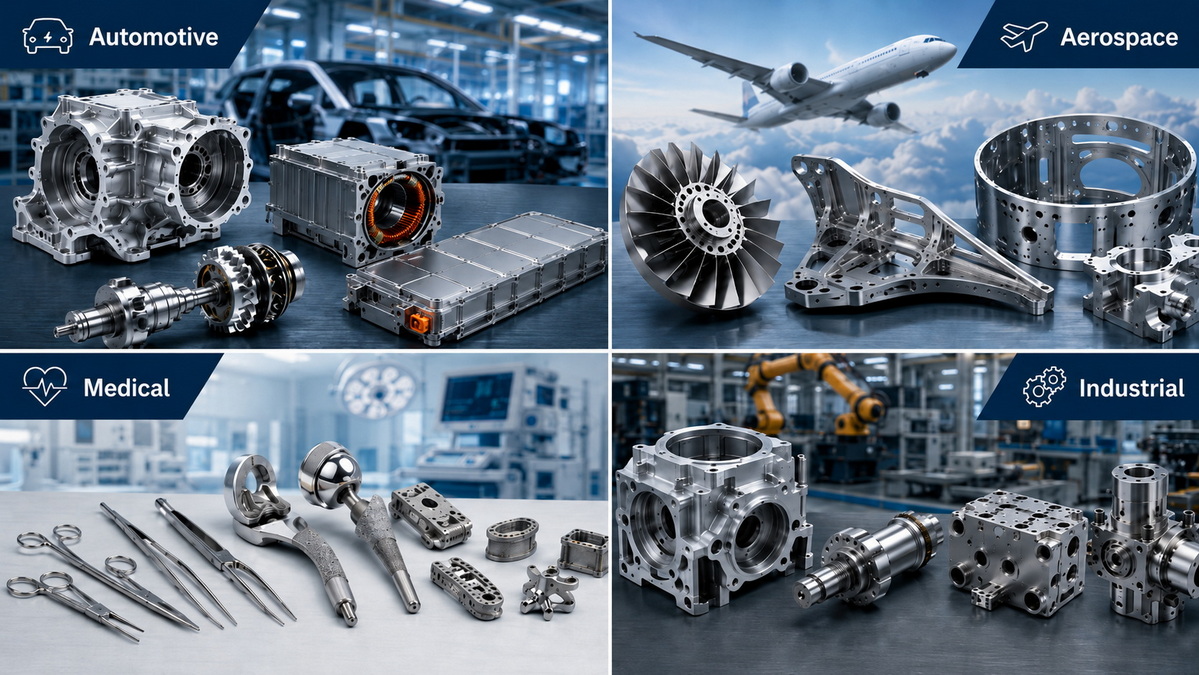
High-precision CNC parts show up wherever failure is unacceptable:
- Aerospace: structural components, engine parts, brackets, and hydraulic housings
- Automotive and EV: engine blocks, drivetrain parts, battery trays, precision brackets
- Medical: surgical instruments, implants, instrument housings, diagnostic equipment components
- Electronics: heat sinks, housings, precision connectors, mounting frames
- Industrial and energy: valve bodies, pump components, turbine parts, metering systems
In many of these sectors, tolerances are directly tied to regulatory standards and safety requirements, making the choice of machining partner a critical strategic decision. [linkedin]
Precision CNC machining can repeatedly hit tight tolerances across large batches by executing the same validated toolpath program and monitoring process drift over time. This stable repeatability allows global brands to consolidate part numbers, reduce incoming inspection, and trust that each shipment will meet the same dimensional baseline. [in-xmachineinc]
Optimized toolpaths, smart nesting, and robust process control reduce scrap and off-cuts, lowering material costs and environmental impact. When combined with lights-out automation and robotic loading, shops can maintain productivity even during off-shifts, shortening lead times for international customers. [linkedin]
Multi-axis CNC and EDM open up freedom for complex, high-integrity designs—turbine blades, lattice structures, conformal cooling channels, and custom orthopedic implants. Importantly, this complexity is achievable while still meeting tight dimensional requirements, meaning engineers no longer have to compromise between geometry and precision. [rejincnc]
Because CNC machining supports a broad range of metals and plastics and can scale from single-piece prototypes to full production runs, it is ideal for OEM/ODM projects where product lines evolve rapidly. U-Need can use this flexibility to offer zero-MOQ or low-MOQ options for development phases, while still being able to ramp into thousands of units once designs are validated. [linkedin]
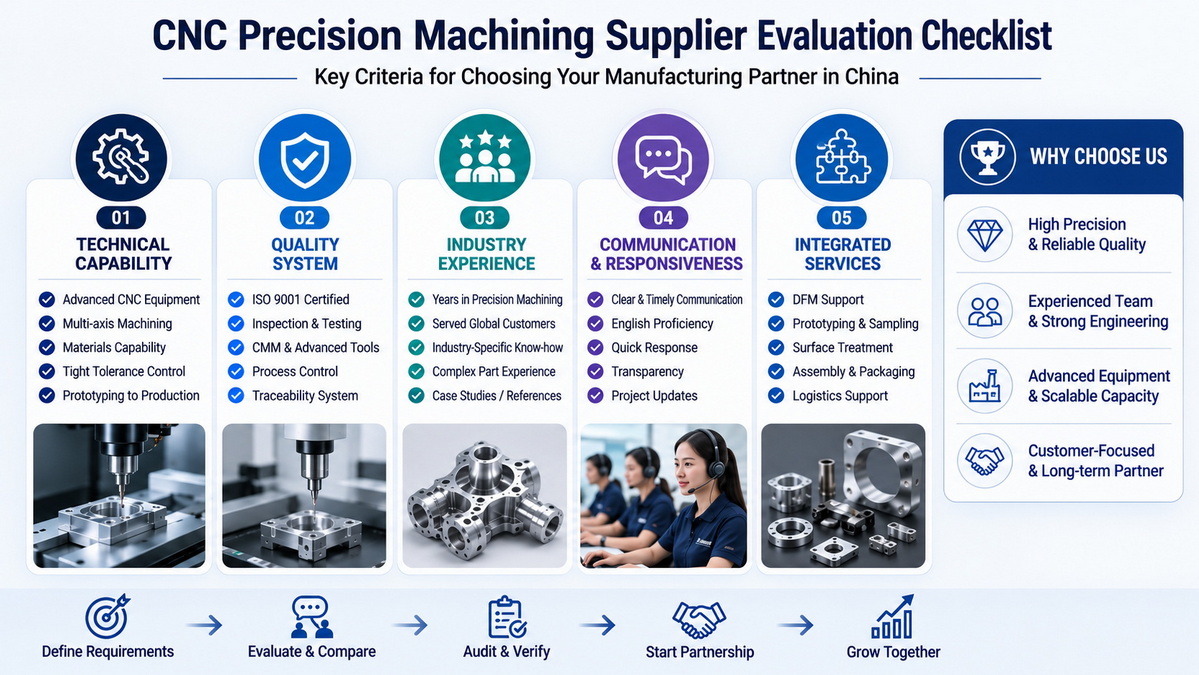
From a B2B buyer's perspective, choosing the right Chinese precision machining partner is less about chasing the lowest quote and more about de-risking your supply chain over the long term. Key factors include: [insights.made-in-china]
- Technical capability: Availability of 3-, 4-, and 5-axis machines, EDM, grinding, and sheet metal fabrication (laser cutting, bending, stamping) for full-system solutions. [rejincnc]
- Quality systems and certifications: ISO 9001, industry-specific standards, documented inspection processes, and use of CMMs and measuring equipment. [prototech-machining]
- Industry experience: Proven track record in your vertical—automotive, aerospace, medical, industrial equipment—plus familiarity with material and regulatory nuances. [linkedin]
- Communication and project management: Clear quoting, DFM feedback, proactive updates, and transparent lead-time commitments. [steckermachine]
U-Need can differentiate itself by positioning as a precision manufacturing partner rather than a job shop—integrating CNC machining, mold manufacturing (injection molds, stamping dies, cold-forging dies), sheet metal fabrication, and assembly into one end-to-end service stack. This integrated approach reduces hand-offs and tolerance stack-ups, which is a compelling message for global brands that struggle to coordinate multiple suppliers. [insights.made-in-china]
Recent industry data shows the global CNC machining market approaching USD 93 billion by 2026, driven by demand for precision engineering in EV, aerospace, medical, and high-performance industrial systems. Several powerful trends are reshaping how precision machining partners deliver value: [linkedin]
1. AI-Driven Adaptive Machining
AI-enabled CNC platforms now analyze vibration, temperature, and tool wear in real time to optimize cutting paths, reducing material waste and extending tool life. Partners that invest in these systems can offer more stable per-part pricing and fewer line-stopping defects. [linkedin]
2. Smart Manufacturing and Digital Connectivity
IoT sensors, MES platforms, and digital twins provide real-time visibility into machine health, energy usage, and part quality. For overseas buyers, this translates into traceable process data, better root-cause analysis, and stronger compliance documentation. [ymolding]
3. Sustainability and ESG-Driven Operations
Closed-loop coolant systems, scrap recycling, and renewable energy integration are increasingly standard expectations—not differentiators—for top-tier machining shops. Brands under ESG pressure will favor partners that can quantify their environmental performance with data. [ymolding]
4. Hyper-Flexible, Low-MOQ Production
Rapid prototyping, zero-MOQ options, and 24–48-hour prototype turnaround are becoming baseline expectations for innovation-driven sectors like medtech and robotics. U-Need's ability to combine CNC machining, mold design, and sheet metal work is ideal for these fast iteration cycles. [steckermachine]
Before you commit to a new precision machining partner, use this practical checklist to structure your technical and commercial evaluation:
- Request machining and inspection capability lists, including machine models, axis counts, and measurement tools
- Ask for 2–3 anonymized case studies that show how the shop handled tight tolerances, material challenges, and timeline pressure
- Review sample inspection reports (CMM, height gauge, surface roughness) to judge process discipline
- Confirm whether they can provide integrated mold manufacturing and sheet metal fabrication if your product involves housings or structural parts
- Verify communication channels, typical response times, and support for English-language technical documentation
U-Need can host these checklist points on its site as downloadable buyer guides, demonstrating thought leadership and making it easier for engineers to justify supplier selection internally.
1. What is CNC precision machining, in practical terms?
CNC precision machining uses computer-controlled tools, advanced fixtures, and strict process control to produce parts with tight, repeatable tolerances, typically in the ±0.001–0.002 inches range for critical features. [blog.3ds]
2. Why should global brands choose a China-based precision partner like U-Need?
China-based partners such as U-Need combine cost-effective machining, access to broad material supply chains, and integrated services (CNC, molds, sheet metal) to support fast product launches and competitive OEM/ODM programs. [blog.3ds]
3. Can U-Need support both prototypes and mass production?
Yes. U-Need's CNC, mold manufacturing, and sheet metal lines are designed to handle low-volume prototypes, pilot runs, and full-scale production, allowing customers to ramp from concept to market with the same trusted partner. [linkedin]
4. What industries does U-Need typically serve?
U-Need is well positioned to support automotive and EV suppliers, industrial equipment manufacturers, consumer electronics brands, and medical device companies that need reliable precision parts and tooling from a single source. [linkedin]
5. How does U-Need ensure quality and consistency across orders?
By combining CAM optimization, standardized fixtures, in-process inspection, and final CMM checks, U-Need can maintain stable tolerances and surface finishes across recurring batches, supported by documented quality systems and certifications. [prototech-machining]
1. RapidDirect. "Choosing A CNC Precision Machining Partner." [https://www.rapiddirect.com/blog/cnc-precision-machining/] [blog.3ds]
2. In-X Machine Inc. "2026 Advancements in Precision CNC Machining." [https://in-xmachineinc.com/blogs/2026-precision-cnc-machining-advancements/] [in-xmachineinc]
3. Taylor Yik. "2026 CNC Custom Machining Trends: Precision Reimagined for Agility & Sustainability." LinkedIn Article. [https://www.linkedin.com/pulse/2026-cnc-custom-machining-trends-precision-reimagined-taylor-yik-qq3zc] [linkedin]
4. Rejin CNC. "Top Precision CNC Machining Trends Shaping 2026 Revealed." [https://www.rejincnc.com/it/blog/top-precision-cnc-machining-trends-shaping-2026-revealed/] [rejincnc]
5. Made-in-China Insights. "2026 CNC Machining Trends: Precision, Speed & Intelligence." [https://insights.made-in-china.com/2026-CNC-Machining-Trends-Precision-Speed-Intelligence_sGeaZpDonxlF.html] [insights.made-in-china]
6. Stecker Machine. "6 CNC Machining Trends OEMs Must Watch in 2026." [https://www.steckermachine.com/blog/cnc-machining-trends] [steckermachine]
7. PANS CNC. "Practical CNC Machining Best Practices from Roughing to Finishing." [https://www.pans-cnc.com/news/practical-cnc-machining-best-practices-from-roughing-to-finishing/] [pans-cnc]
8. YMolding. "2026 CNC Industry Trends: Opportunities and Challenges in Smart Manufacturing." [https://www.ymolding.com/2026-cnc-industry-trends-opportunities-and-challenges-in-smart-manufacturing/] [ymolding]
9. Dashnode. "CNC Machining in 2026: What Everyone Should Know." [https://www.dashnode.ai/blog/cnc-machining-in-2026] [dashnode]
10. Luyiss. "CNC Machining in 2026: Trends in Precision Engineering." [https://www.luyiss.com/news/industrial/machining/CNC-Machining-in-2026--Trends-in-Precision-Engineering.html] [luyiss]
11. JLCCNC. "10 Valuable Tips for CNC Machining." [https://jlccnc.com/blog/cnc-tips-and-best-practices] [jlccnc]
12. LinkedIn. "High Precision CNC Machining Market Size, Trends, 2026–2033." [https://www.linkedin.com/pulse/high-precision-cnc-machining-market-size-trends-9udhf] [linkedin]
13. Zetwerk. "Improve CNC Machining Accuracy – 5 Tips for Efficiency." [https://www.zetwerk.com/en-us/resources/knowledge-base/cnc-machining/maximizing-efficiency-in-cnc-machining-tips-and-best-practices] [zetwerk]
14. Prototech Machining. "The Best CNC Machining Practices for Quality Production." [https://prototech-machining.com/blog/the-best-cnc-machining/] [prototech-machining]


