Views: 222 Author: U-Need Publish Time: 2026-05-12 Origin: Site
3D printing, also known as additive manufacturing, is a process that builds parts layer by layer from a digital 3D model, rather than cutting material away like traditional machining. [uptivemfg]
Unlike CNC machining, which removes material from a solid block, 3D printing deposits material only where needed, enabling complex geometries, lighter structures, and reduced material waste. [uptivemfg]
From a manufacturing engineer's perspective, 3D printing is no longer just a prototyping tool; it is an integrated production method that complements CNC machining, molding, and sheet metal fabrication within a broader precision manufacturing ecosystem. [flashforge]
Understanding the workflow helps both engineers and buyers judge whether 3D printing fits their project. [uptivemfg]
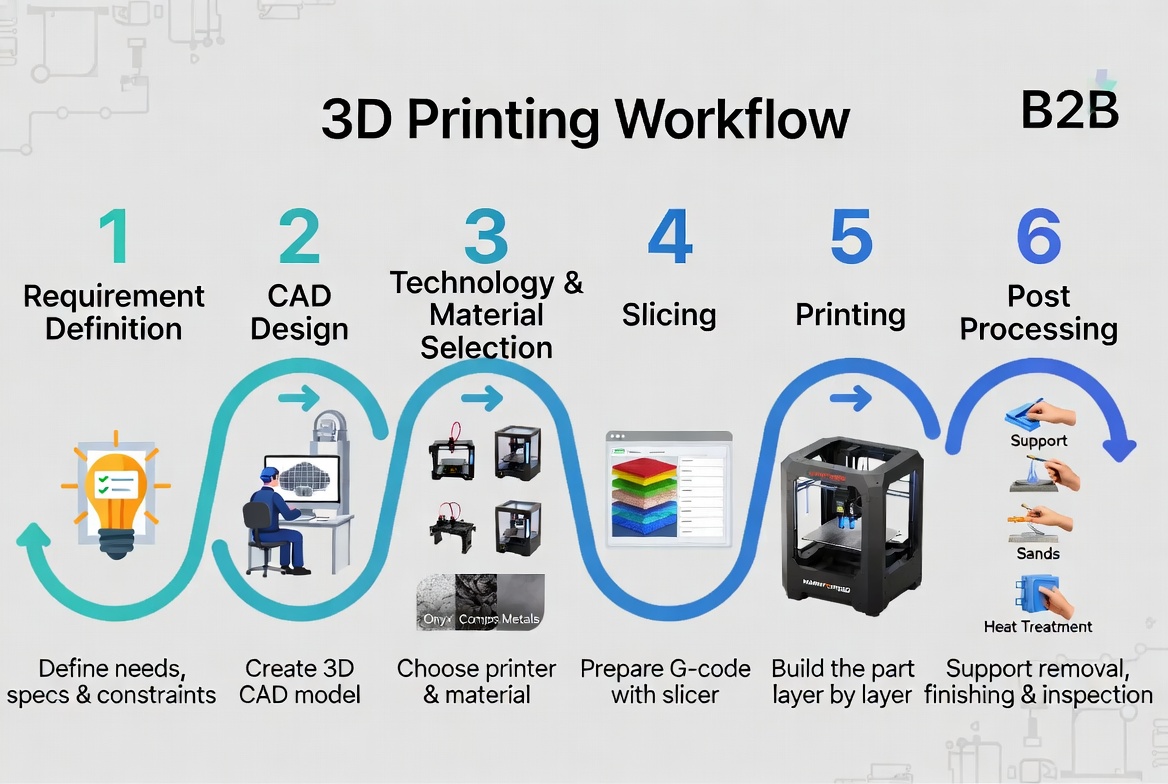
Typical 3D printing workflow:
1. Define requirements
- Functional requirements (load, temperature, environment)
- Dimensional accuracy and tolerances
- Volume: prototype, small batch, or end-use production. [ultimaker]
2. Create or import a 3D CAD model
- Design from scratch or reverse engineer an existing part.
- Apply DFAM (Design for Additive Manufacturing) practices, such as consolidating assemblies and optimizing internal channels. [stratasys]
3. Choose printing technology and material
- FDM, SLA, SLS, DMLS, etc. (explained below).
- Match materials to mechanical, thermal, and regulatory needs. [formlabs]
4. Slice the model
- Use slicing software to convert the model into layers and toolpaths.
- Set parameters like layer height, infill pattern, support structures, and print speed. [ultimaker]
5. Print and monitor
- Start the print and monitor for warping, layer adhesion issues, or nozzle clogs.
- For industrial parts, operators often implement process controls, such as temperature logs and in-process inspection. [stratasys]
6. Post-processing
- Remove supports, sand and polish surfaces, apply heat treatment or coating, and perform dimensional inspection.
- For high-precision parts, secondary machining (drilling, tapping, reaming) is often used to achieve tight tolerances. [uneedpm]
Different 3D printing technologies offer trade-offs in accuracy, strength, surface finish, and cost. [formlabs]
FDM extrudes melted thermoplastic filament through a nozzle, building parts layer by layer. [flashforge]
Recent advances in FDM have turned it from a prototype tool into a viable solution for high-mix, low-volume production, especially for fixtures, jigs, and end-use plastic parts. [flashforge]
Best for:
- Functional prototypes
- Low-volume plastic parts
- Large, less detail-critical components. [uptivemfg]
SLA uses UV light to cure liquid resin layer by layer, producing parts with very fine detail and smooth surfaces. [uptivemfg]
It's ideal when you need small features, intricate geometries, and cosmetic-quality surfaces, but it often requires more careful handling and post-curing. [ultimaker]
Best for:
- Highly detailed prototypes
- Dental, medical models, and small components
- Molds for low-pressure casting and silicone. [formlabs]
SLS uses a laser to sinter powdered materials (typically nylon or composites) into dense, functional parts. [uptivemfg]
Because the surrounding powder supports the part, SLS can create complex geometries without support structures, making it suitable for functional prototypes and end-use parts. [uptivemfg]
Best for:
- Functional prototypes under mechanical load
- Snap-fit features and living hinges
- Low-volume production of durable plastic parts. [uptivemfg]
Metal 3D printing technologies, such as DMLS (Direct Metal Laser Sintering) and SLM (Selective Laser Melting), use lasers or electron beams to fuse metal powder into dense, near-net-shape components. [stratasys]
These technologies are widely adopted in aerospace, automotive, and medical industries for lightweight structures and consolidated assemblies that are difficult or impossible to machine. [stratasys]
Best for:
- Lightweight lattice structures
- Complex internal channels (e.g., conformal cooling)
- High-value, low-volume metal components. [stratasys]
Material choices directly determine whether a 3D printed part is suitable for visual mockups, functional prototypes, or production use. [formlabs]
Common material categories:
- Standard plastics (PLA, ABS, PETG): Good for general prototypes and fixtures with moderate mechanical demands. [flashforge]
- Engineering thermoplastics (Nylon, PC, PEEK, PEI): Higher heat resistance and durability; suitable for automotive and industrial applications. [uptivemfg]
- Resins (standard, tough, high-temperature): SLA resins with tailored properties can achieve high detail and strong mechanical performance, especially the "tough" series designed for machining and load-bearing parts. [ultimaker]
- Metal alloys (stainless steel, aluminum, titanium): Used in critical components where weight, strength, and corrosion resistance matter. [formlabs]
Many industrial users adopt a hybrid approach, using 3D printing for design verification and rapid iteration, then switching to CNC machining, injection molding, or sheet metal fabrication for high-volume production. [uneedpm]
When you manage a precision manufacturing project, the real question is rarely "3D printing or nothing?"—it's how to balance 3D printing with CNC machining and mold-based processes. [uneedpm]
| Method | Process type | Strengths | Limitations |
|---|---|---|---|
| 3D printing | Additive | Complex shapes, fast iteration, low tooling cost | Slower per part, surface finish and tolerances may need post-processing (uptivemfg) |
| CNC machining | Subtractive | High precision, tight tolerances, broad materials | Higher material waste, less efficient for complex internal features (uneedpm) |
| Injection molding | Mold-based forming | Very low unit cost at volume, consistent quality | High upfront tooling cost, long lead time (uptivemfg) |
| Sheet metal fab | Forming / cutting | Excellent for enclosures, brackets, panels | Limited 3D geometry, may need welding/assembly (uneedpm) |
Industrial buyers often use 3D printing for prototypes and bridge production, then transition to CNC machining or molding once the design stabilizes and demand justifies tooling investment. [uptivemfg]
This fits naturally with a partner like U-Need, where CNC machining, mold manufacturing, and sheet metal fabrication can take validated 3D printed designs into long-term production with consistent quality. [uneedpm]
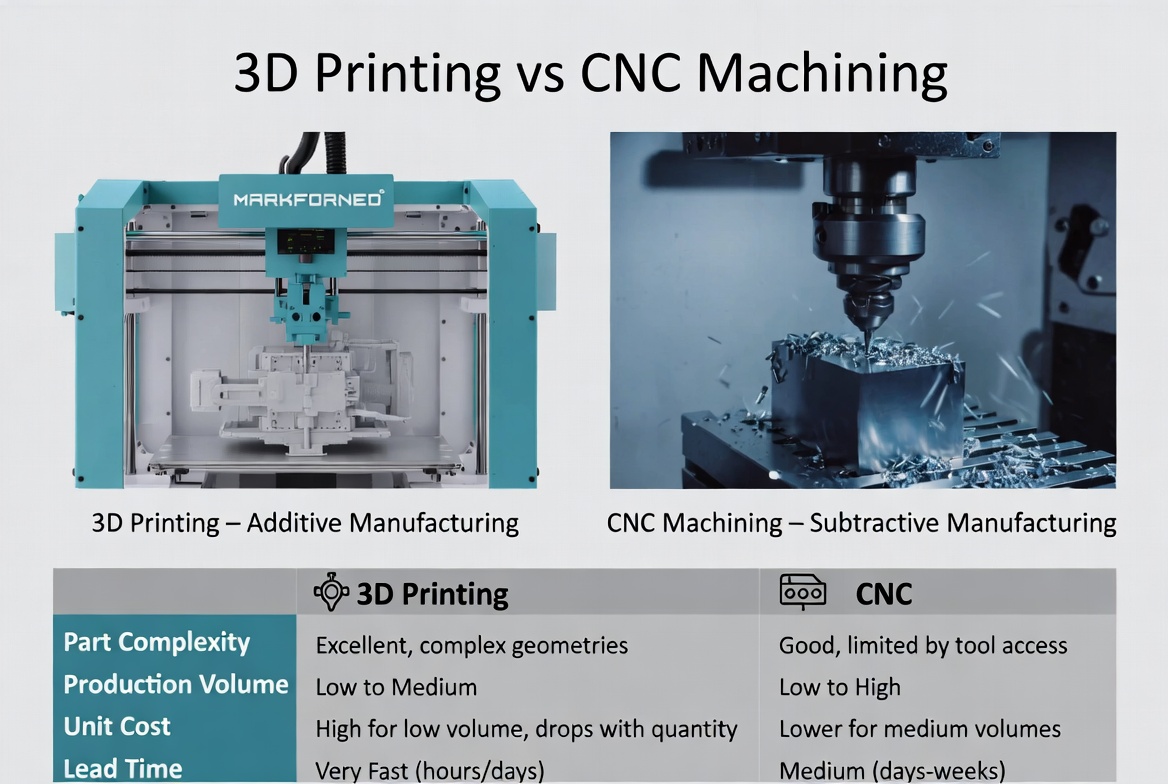
Choosing the right process begins with understanding your constraints and objectives. [uptivemfg]
3D printing is usually the best choice when:
- You need rapid prototypes to validate fit, function, or ergonomics.
- The design includes complex internal geometries, lattice structures, or topology-optimized shapes.
- You require custom, one-off, or low-volume parts where tooling costs are hard to justify.
- You want to shorten development cycles, iterating design changes multiple times per week.
- The part will later transition to CNC or molding, but you need an interim "bridge" solution. [uptivemfg]
From an engineer's standpoint, 3D printing shines in high-mix, low-volume environments, where flexible, fast production is often more valuable than the lowest possible unit cost. [flashforge]
Achieving consistent, high-quality 3D printed parts requires more than just pressing "print"—it demands disciplined process control and thoughtful design. [ultimaker]
Key factors that affect 3D printing quality:
- Printer calibration: Proper Z-offset, bed leveling, and nozzle condition strongly influence first-layer adhesion and dimensional accuracy. [ultimaker]
- Retraction and extrusion settings: Optimized retraction reduces stringing and surface defects, while precise extrusion avoids over- and under-extrusion. [ultimaker]
- Infill and shell configuration: Adjusting shells (perimeters) and infill patterns (e.g., gyroid, cubic) can improve strength without excessive material use. [ultimaker]
- Print orientation: Aligning layers perpendicular to primary load directions enhances mechanical performance and reduces weak planes. [formlabs]
As specialists in precision machining and mold manufacturing, U-Need engineers often combine printed and machined features, using post-machining to tighten critical tolerances or add threads and holes. [uneedpm]
Staying ahead means understanding where additive manufacturing is heading. [bgr]
Key trends shaping 3D printing today:
- FDM as a production tool: With higher-performance polymers and faster print speeds, FDM now supports end-use parts, especially in automotive, aerospace, and industrial equipment. [flashforge]
- Software and automation: Smarter slicing software, automatic parameter optimization, and better printer monitoring reduce trial-and-error and improve repeatability. [bgr]
- Hybrid manufacturing: Combining 3D printing with CNC machining and molding allows manufacturers to maximize flexibility while controlling cost and quality. [uptivemfg]
- Supply chain resilience: Companies increasingly use 3D printing for on-demand spare parts, reducing inventory and lead times in global supply chains. [bgr]
For a precision manufacturer like U-Need, these trends translate into more options for customers—ranging from printed prototypes and jigs to production-grade parts backed by established machining and molding capabilities. [uneedpm]
Practical examples help clarify how 3D printing adds value in real manufacturing scenarios. [uptivemfg]
Example 1: Custom tooling and fixtures
A manufacturer needs inspection jigs and assembly fixtures for a new product line. By 3D printing these tools first, engineers quickly test ergonomics and adjust designs, then either keep them as printed fixtures or transition to CNC-machined versions if higher stiffness is required. [uptivemfg]
Example 2: Automotive and industrial components
In the automotive sector, 3D printing is used for prototype housings, brackets, and airflow components, followed by low-volume runs of custom parts for motorsport or aftermarket applications. [uptivemfg]
Once demand stabilizes, these designs often shift to CNC machined aluminum or injection-molded plastic, using partners with strong precision manufacturing expertise. [uneedpm]
Example 3: Bridge production for new products
A startup developing a new device prints initial enclosures and functional parts to validate design and secure early customers. After confirming demand, they move into mold manufacturing and sheet metal fabrication, preserving key design features refined during the additive phase. [uneedpm]
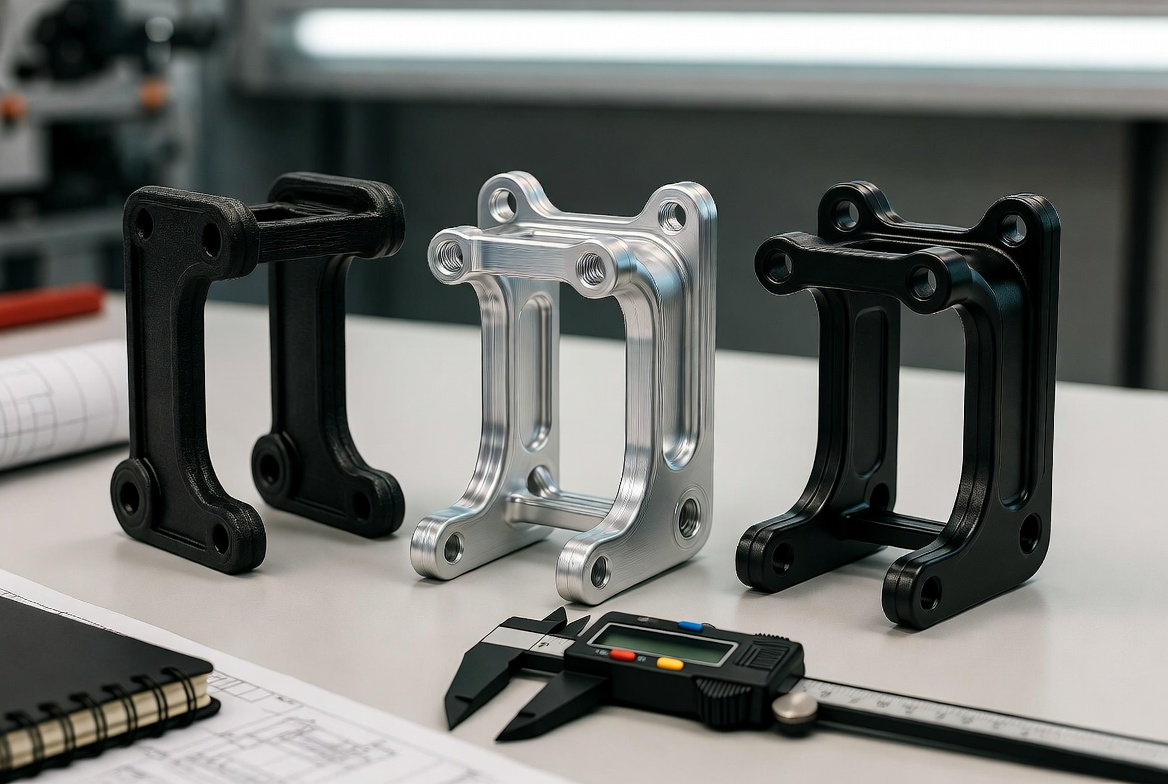
While U-Need's primary strengths are in custom precision parts machining, mold manufacturing, and sheet metal fabrication, we support customers who use 3D printing at various stages of their product lifecycle. [uneedpm]
U-Need's role in your 3D printing journey:
- Design for manufacturability review
- Our engineering team can review your 3D printed prototypes and CAD models, advising on tolerance schemes, machining allowances, and mold-ready features. [uneedpm]
- Transition from printed prototype to CNC or molds
- Once your printed design is validated, we help convert it into precision-machined parts, production tooling, or stamped / formed sheet metal components. [uneedpm]
- Precision machining for 3D printed parts
- For critical dimensions, we can post-machine printed parts, adding holes, threads, and fine features with tolerances down to ±0.001 mm for certain applications. [formlabs]
By combining 3D printing insights with U-Need's CNC machining, mold manufacturing, and sheet metal fabrication capabilities, you get a full end-to-end solution from concept to scaled production. [uneedpm]
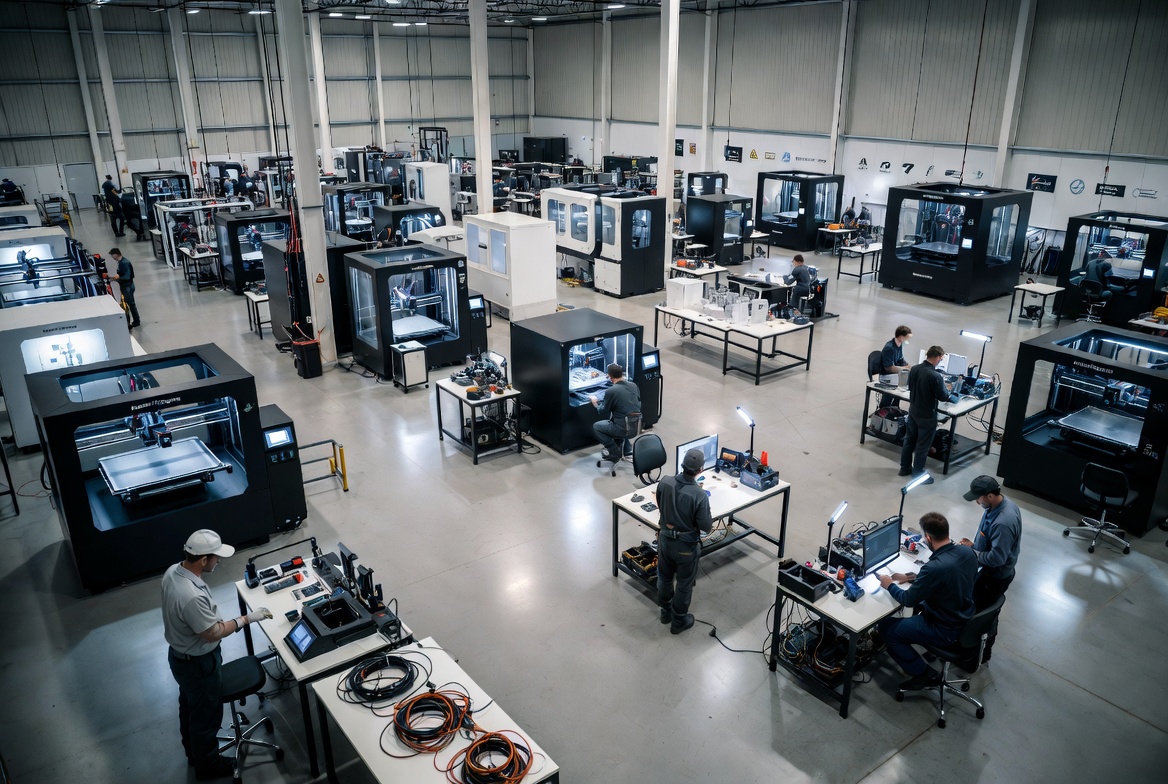
Use this quick checklist from a manufacturing engineer's perspective before committing to a process. [uptivemfg]
Ask yourself:
1. What is the expected annual volume (prototypes, tens, hundreds, thousands)?
2. How tight are the tolerance requirements, and on which features?
3. Does the design include complex internal geometries or lattice structures?
4. What are the operating conditions (temperature, load, environment)?
5. Will you eventually need molds or sheet metal tooling for mass production?
If you need fast iteration and low upfront cost, 3D printing is likely the best starting point.
If you already have a stable design and volume forecast, combining 3D printing (for fixtures and pre-production validation) with CNC, molds, or sheet metal may yield the best total cost of ownership. [uptivemfg]
Whether you are validating a new product with 3D printed prototypes or scaling a mature design into mass production, you need a partner who understands both additive and traditional manufacturing. [uneedpm]
At U-Need, we provide:
- Custom precision parts machining with strict tolerances and robust quality control
- Mold manufacturing for injection molds, stamping dies, and cold-forging dies
- Sheet metal fabrication including laser cutting, bending, and stamping
- Engineering support to help you migrate from 3D printed parts to production-ready components. [uneedpm]
Ready to take your 3D printed design to the next level?
Contact U-Need today to discuss your project, share your CAD files, and receive a tailored manufacturability review and quotation.
Modern industrial 3D printers can achieve impressive accuracy, but real-world precision depends on calibration, print parameters, and post-processing. For critical features, combining 3D printing with CNC machining or reaming/tapping often delivers the best balance of cost and precision. [formlabs]
You should consider transitioning when your design is stable, demand forecasts are clear, and the cost of tooling can be amortized over expected volumes. 3D printing remains valuable for fixtures, jigs, and engineering change updates even after production ramps up. [uptivemfg]
Yes, many companies now use FDM, SLS, and metal 3D printing for end-use parts, especially in low-volume or high-mix environments. The key is selecting the right material, validating performance, and implementing robust quality controls. [stratasys]
Start from your application: temperature, load, environment, and regulatory needs. From there, match properties such as strength, stiffness, heat resistance, and chemical resistance to available materials, and consider whether parts will later transition to machined metal or molded plastic. [flashforge]
U-Need supports your additive projects by reviewing designs for manufacturability, defining machining allowances, and providing precise CNC, mold, and sheet metal solutions for validated designs. We can also post-machine 3D printed parts to tighten tolerances and add critical features. [uneedpm]
1. UPTIVE Manufacturing – *The Ultimate Guide to 3D Printing* (accessed 2026). [uptivemfg]
2. Flashforge – *Exploring the Latest FDM 3D Printing Advancements 2026*. [flashforge]
3. Ultimaker – *3D Printing Quality Factors: Enhancing Accuracy and Resolution*. [ultimaker]
4. U-Need – *Our Values | Precision Manufacturing | U-Need*. [uneedpm]
5. UPTIVE Manufacturing – *Ultimate Guide to 3D Printing Automotive & Car Parts *. [uptivemfg]
6. Stratasys – *Five Key Additive Manufacturing 2026 Predictions*. [stratasys]
7. Formlabs – *Guide to 3D Printing Tolerances, Accuracy, and Precision*. [formlabs]
8. U-Need – *Machining Services*. [uneedpm]
9. UPTIVE Manufacturing – *CNC Machining vs. 3D Printing: A Comprehensive Guide*. [uptivemfg]
10. BGR – *5 Ways 3D Printers Could Change in 2026*. [bgr]


