Views: 222 Author: U-Need Publish Time: 2026-04-22 Origin: Site
As an engineer who has spent years on the factory floor watching tools chatter and parts fail tolerance by a few microns, I know that choosing the right precision manufacturing partner in China is not just a sourcing decision—it is a strategic engineering decision that directly impacts your product quality, cost, and brand reputation. When you are working with thin-wall aluminum parts, high-cavitation injection molds, or complex sheet metal fabrication, there is no room for guesswork. One wrong tool path or parameter can turn a production batch into scrap.
That is exactly why a partner like U-Need positions itself not only as a supplier, but as a process-focused, logic-driven machining expert that understands how to turn theoretical tolerances into stable, repeatable reality.

In real workshops, I have seen a common mindset: "I've done this for six months, so I must be doing it right." Yet, as we heard in the thin-wall aluminum machining conversation, experience without logic can quickly turn into bad habits.
A junior programmer notices vibration marks on a thin aluminum wall and dismisses feedback, insisting that his six months of programming are enough to qualify as "experienced." The senior engineer calmly points out the core issue: it is not about how long you have been doing the job; it is about whether your process logic and parameters are correct. When the process is wrong, repeating it only amplifies the error.
This is exactly the philosophy we bring into U-Need's custom precision parts machining:
- We challenge assumptions instead of protecting ego.
- We analyze tool paths, cutting parameters, and workholding step by step.
- We treat each part as an engineering problem, not just a machining order.
Thin-wall aluminum parts are notoriously difficult: they vibrate, deform, and show chatter marks easily. The conversation from the workshop points to a structured way of thinking that we also advocate when machining thin-wall aluminum components.
For thin-wall aluminum machining, toolpath strategy is the foundation. Instead of arbitrary programming, we rely on clearly defined steps:
- Roughing (Opening the cavity)
We use cavity milling combined with trochoidal (cycloidal) cutting for roughing.
This approach:
- Reduces radial engagement.
- Keeps cutting load consistent.
- Minimizes sudden tool deflection.
- Finishing (Depth contour milling)
For finishing, we shift to depth contour milling and keep the direction of cut consistent (for example, full climb milling for aluminum).
The goals are:
- Protect the cutting edge.
- Ensure dimensional stability.
- Achieve high surface quality on thin walls.
The key takeaway: thin-wall parts demand toolpaths that manage forces, not just fill the geometry as quickly as possible.
Another critical point from the workshop discussion is the explicit emphasis on aluminum-specific cutting parameters. Rather than "just using what worked last time," the senior engineer breaks down parameters by machining stage:
- Roughing parameters for aluminum thin walls
- Spindle speed: 7000–8000 rpm
- Feed rate: 2000–3000 mm/min
- Axial depth of cut per layer: 0.5–0.8 mm
- Semi-finishing parameters
- Spindle speed: 8000–12000 rpm
- Feed rate: 2000–2500 mm/min
- Stock to leave: 0.15 mm
- Finishing parameters
- Spindle speed: 10000–15000 rpm
- Feed rate: around 1500 mm/min
What matters is not the exact numbers for every machine, but the principle behind them: aluminum demands high-speed cutting with controlled engagement, and thin walls require finer step-downs and carefully managed cutting forces. At U-Need, we tune these to each machine-tool combination and part geometry instead of using fixed "one-size-fits-all" recipes.
One of the most insightful details from the expert in the workshop is the sequence: why we must finish the bottom before the side walls.
The logic is simple but powerful:
- When you machine and level the bottom surface first, you effectively create a rigid support for the side walls.
- During side-wall machining, we intentionally leave a very thin layer at the bottom (a small "skin") instead of breaking through completely.
- This means the thin wall is never left fully unsupported; it "leans" on a rigid base while the cut happens, which:
- Increases overall rigidity.
- Reduces vibration and deformation.
- Enhances surface finish quality.
If you reverse the sequence—finish side walls first, then open up the bottom—you end up with thin, unsupported walls vibrating freely. This is where you see chatter marks, dimensional drift, and poor surface brightness.
This is a good example of what we mean when we say: "Machining is a logic game, not a seniority game." At U-Need we design process routes specifically to preserve rigidity as long as possible.
Programming quality in UG/NX (or similar CAM systems) is often the difference between a stable process and a noisy, inconsistent one. The senior engineer in the video emphasizes three vital settings:
- Enable tool radius compensation
This allows for fine-tuning at the machine control, compensating tool wear and small dimensional deviations without regenerating the toolpath.
- Activate arc feed-rate optimization
When the tool moves through arcs, feed-rate optimization smooths changes in direction, minimizing sudden load spikes and reducing vibration.
- Finish bottom first, then generate wall toolpaths
This aligns CAM logic with the rigidity-first strategy described above.
At U-Need, our programming engineers treat these as process standards rather than optional tweaks, which is especially important for high-precision CNC machining of aluminum parts.

While thin-wall aluminum machining is a vivid case study of our process logic, U-Need's role as a precision manufacturing partner in China goes far beyond one material or process.
We provide custom precision machining services for:
- Aluminum alloys (e.g., 6061, 7075)
- Stainless steel and tool steel
- Copper and brass
- Engineering plastics
Key capabilities include:
- 3-axis, 4-axis and 5-axis CNC milling
- High-precision CNC turning
- Complex contour machining
- Tolerance control down to microns, based on project requirements
Throughout every project, we emphasize:
- Process design (toolpath strategy, workholding, parameter selection)
- Repeatability across batches
- Dimensional and surface-quality validation using appropriate metrology
As brands move from prototype to mass production, tooling quality determines how stable and economical their production will be.
U-Need supports:
- Injection molds for plastic components
- Multi-cavity molds for consumer products
- Precision molds for automotive or electronics parts
- Stamping dies
- Progressive dies for sheet metal
- Single-hit and compound dies for simpler parts
- Cold-forging dies
- Dies for fasteners and hardware
- Dies for automotive and industrial components
What sets us apart is the integration of machining logic from the start: the same thinking we apply to thin-wall aluminum toolpaths is applied to mold cores, cavities, inserts and die surfaces, ensuring long tool life and stable part quality.
Beyond machining and tooling, U-Need also provides sheet metal fabrication services:
- Laser cutting for accurate profiles in steel, aluminum and stainless.
- CNC bending for complex brackets and enclosures.
- Stamping for medium to high-volume sheet metal parts.
This makes U-Need a single-source partner for projects that combine machined parts, molded parts, and fabricated components, reducing the coordination burden on our customers.
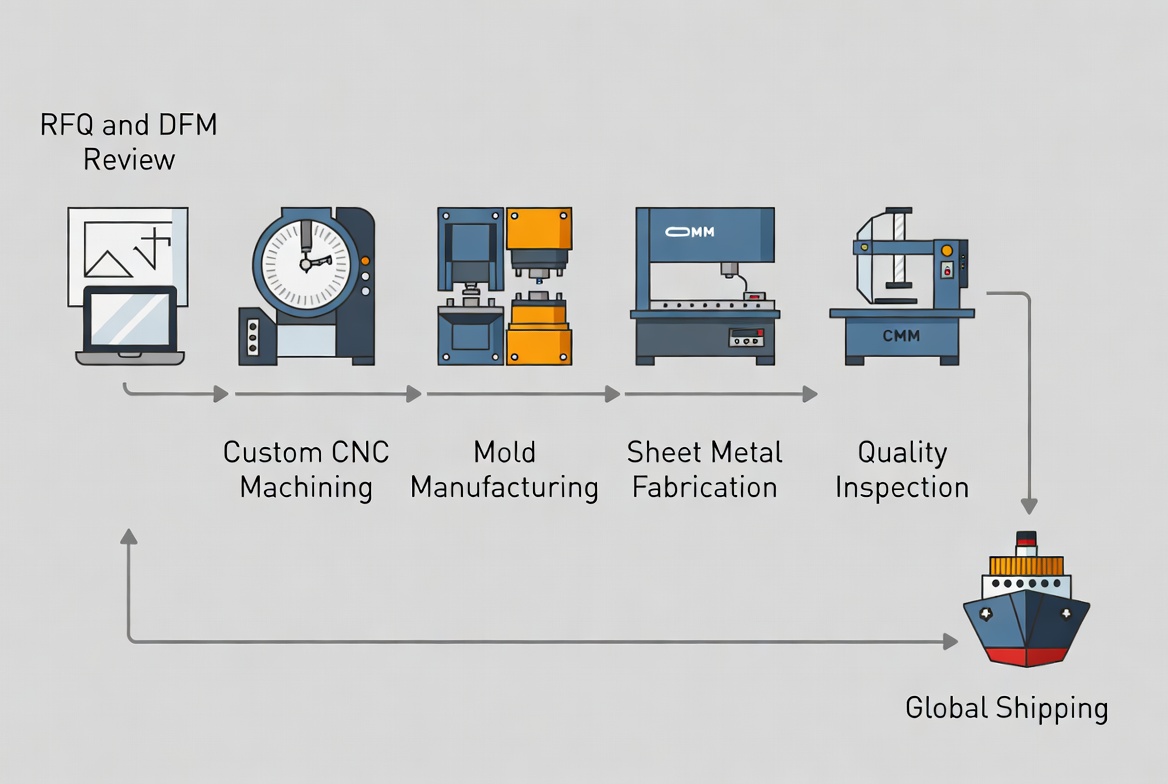
To illustrate how this all comes together, here is a simplified example workflow we might use when a customer sends a thin-wall aluminum housing:
1. DFM and risk review
- Analyze wall thickness, height-to-thickness ratio, and critical surfaces.
- Identify potential vibration-prone areas and tolerance hotspots.
2. Process planning
- Define toolpath strategies (cavity milling, trochoidal roughing, contour finishing).
- Decide on bottom-first, side-wall-later sequence.
- Select tool types (end mills, ball nose, corner radius tools).
3. CAM programming
- Program in UG/NX with:
- Radius compensation enabled.
- Arc feed-rate optimization turned on.
- Bottom surface toolpaths sequenced before wall finishing.
4. Parameter optimization
- Start from baseline:
- Roughing: 7000–8000 rpm, 2000–3000 mm/min, 0.5–0.8 mm step-down.
- Semi-finishing: 8000–12000 rpm, 2000–2500 mm/min, 0.15 mm stock.
- Finishing: 10000–15000 rpm, around 1500 mm/min feed.
- Adjust based on actual machine/tool/workholding feedback.
5. Trial production and measurement
- Run a pilot batch.
- Inspect key dimensions and surface roughness.
- Optimize if necessary.
6. Mass production with process control
- Lock in parameters and toolpaths.
- Monitor tool wear and adjust via tool radius compensation.
- Keep stable output across batches.
For buyers, engineers, and supply chain managers, here is a concise checklist you can use when evaluating a precision machining supplier in China:
- Do they explain how they machine thin-wall parts, or just say "we can do it"?
- Can they talk about:
- Toolpath strategy (roughing vs finishing)?
- Material-specific cutting parameters?
- CAM settings for stability and accuracy?
- Do they understand rigidity management (sequence of operations, support surfaces)?
- Can they provide:
- Both machining and mold/tooling services?
- Sheet metal fabrication if needed?
- Are they willing to:
- Review your design for manufacturability (DFM)?
- Share suggestions on risk areas and improvements?
A partner like U-Need, who talks in terms of logic, parameters, and process, is far more likely to deliver consistent quality than one who focuses only on price and lead time.
If you are developing a product that involves thin-wall aluminum parts, precision plastic components from injection molds, or sheet metal assemblies, you do not need to solve all the process challenges alone.
Share your drawings, 3D models, and technical requirements with U-Need, and our engineering team will:
- Review manufacturability and risk points.
- Propose machining and tooling strategies.
- Provide a clear quotation and lead-time plan.
By collaborating early in the design and development stage, we can turn complex precision requirements into stable, scalable production—and help you bring better products to market faster and more reliably.

You can include a table like this in the article to help readers quickly digest the technical content:
| Machining stage | Spindle speed (rpm) | Feed rate (mm/min) | Axial depth per pass (mm) | Stock to leave (mm) |
|---|---|---|---|---|
| Roughing | 7000–8000 | 2000–3000 | 0.5–0.8 | 0.3–0.5 |
| Semi-finishing | 8000–12000 | 2000–2500 | 0.3–0.5 | 0.15 |
| Finishing | 10000–15000 | ≈1500 | 0.1–0.2 | 0 |
U-Need stands out because we focus on process logic and parameter control, not just machine count or floor space. We combine CNC machining, mold manufacturing, and sheet metal fabrication under one roof, and we are willing to explain exactly how we plan to manufacture your parts, from toolpaths to inspection methods.
Yes. Our engineers design rigidity-first process routes, machine bottom surfaces before thin walls, use aluminum-specific cutting parameters, and optimize CAM settings to minimize vibration and distortion, enabling stable quality even on challenging thin-wall geometries.
For complex parts and tooling, we use professional CAM systems such as UG/NX (or equivalent), enabling advanced strategies like trochoidal roughing, depth contour finishing, and feed-rate optimization. This ensures smoother motion, better surface finish, and improved dimensional stability.
Yes. We support rapid prototyping, pilot runs, and full-scale mass production. The same process logic is applied at each stage, but we adapt fixtures, tool selection, and inspection plans to match volume and cost targets.
You can start by sending 2D drawings, 3D models (STEP/IGES), and key requirements (material, tolerance, surface finish, expected volume). Our engineering team will conduct a DFM review, provide technical feedback, and prepare a detailed quotation with lead times and recommended process routes.
1. U-Need official website – precision manufacturing partner in China for global brands and distributors.
Link: https://www.uneedprecisionmachine.com/
2. U-Need quality management system and operator training for process stability and defect prevention.
Link: https://www.uneedprecisionmachine.com/quality-assurance.html


