Views: 222 Author: U-Need Publish Time: 2026-04-22 Origin: Site
When you design a part with tight CNC machining tolerances, you are not just choosing numbers on a drawing—you are deciding how reliably your product will assemble, perform, and last in the field. Drawing on more than three decades in precision machining, I want to walk you through how tolerances really work on the shop floor, the trade‑offs between accuracy and cost, and how a partner like U‑Need helps you hit the sweet spot between performance and manufacturability. [protolabs]

In practical terms, CNC machining tolerance is the allowed difference between the nominal dimension on your drawing and the actual dimension of the finished part. It defines the window within which every part is still considered "good" and will function as intended in the assembly. [rapiddirect]
Engineers and buyers typically deal with three major types of tolerances:
- Dimensional tolerances – Control linear features like hole diameters, shaft diameters, and slot widths (for example, a hole specified as 10.00 mm ±0.01 mm).
- Form and position tolerances (GD&T) – Control flatness, roundness, perpendicularity, concentricity, and other geometric features (such as flatness ≤0.005 mm on a sealing surface).
- Surface roughness – Described by Ra values (for example Ra 0.8 μm); this impacts friction, sealing, wear, and even appearance.
From a user's perspective, tolerances are not abstract theory—they decide whether: [rapiddirect]
- A precision shaft slides smoothly but without play.
- An O‑ring seals under pressure without leakage.
- A camera housing holds optics at exactly the right focal distance.
When tolerances are too loose, your product fails in the field; when they are too tight, costs explode without adding real value.
To keep drawings consistent and interchangeable across countries and suppliers, engineers rely on established standards. [jlccnc]
Common frameworks include: [americanmicroinc]
- ISO 2768 – Used for general mechanical parts with medium accuracy; it allows practical tolerances for most non‑critical features.
- ASME Y14.5 – The backbone of GD&T, widely used in automotive, aerospace, and high‑reliability sectors.
- Internal enterprise standards – Many advanced manufacturers set their own internal limits, often targeting ±0.005 mm or better for critical features.
In real shop conditions, typical benchmark capabilities are: [modusadvanced]
- Standard CNC machining: about ±0.005" (±0.127 mm) for general work.
- Enhanced precision environments: down to ±0.001" (±0.0254 mm) for many critical applications.
- Ultra‑precision machining: leading providers can reach micrometer‑level control for demanding parts. [modusadvanced]
By contrast, U‑Need designs its processes around tolerances as tight as ±0.001 mm (1 μm) for selected applications, far beyond normal industry practice. For turning and milling, U‑Need routinely holds: [uneedpm]
- CNC turning: ±0.005 mm
- CNC milling: ±0.01 mm
- CNC grinding: ±0.002 mm
- Wire EDM: ±0.001 mm
These capabilities matter when you design parts for optical equipment, high‑frequency connectors, medical implants, or precision automation where even a few microns can change performance. [moseys]
Even on the best machines, tolerances are not just "machine capability"; they are the result of multiple interacting variables. In day‑to‑day manufacturing, I see five main drivers: [modusadvanced]
- Vibration, spindle deflection, and frame stiffness all change where the cutting edge actually ends up relative to the model.
- Temperature rise is critical: as a spindle heats up, it elongates; a 1 °C increase can cause roughly 12 μm of growth, which is already larger than many drawing tolerances.
Shops counter this by: [modusadvanced]
- Using mineral‑casting or heavily ribbed beds to minimize thermal deformation.
- Running constant‑temperature cooling systems and climate‑controlled workshops to hold ambient temperature within about ±1 °C for precision work.
If you are designing a long production run, tool wear will impact your tolerances far more than you might think. For example: [modusadvanced]
- Carbide tools machining aluminum may wear by ≈0.02 mm per 100 pieces, drifting dimensions if offsets are not updated.
Practical counter‑measures include: [protolabs]
- Optimizing feed rate and depth of cut (e.g., F ≈ 2000 mm/min, ap ≈ 0.2 mm for fine finishing of aluminum).
- Using coated tools (such as TiAlN) to extend tool life by about 30% and stabilize dimensional output.
Fixtures are often the silent killers of your tolerance stack. Common issues: [blog.epectec]
- Re‑clamping the part changes datum alignment; even high‑quality fixtures have repeatability in the ±0.003 mm range.
- Thin‑walled parts can deform by up to 0.1 mm under excessive clamping force.
Good practice includes: [blog.epectec]
- Using hydraulic or vacuum clamping to reduce concentrated stresses.
- Adding auxiliary supports under thin‑wall regions and designing parts with clamping in mind from the very first CAD iteration.
- Linear scales with micrometer‑level resolution and high‑quality servo feedback allow the control to see and correct small deviations.
- Advanced 5‑axis controls (such as the Heidenhain TNC family) offer real‑time compensation algorithms, reducing trajectory error and edge‑breaks on complex surfaces.
Materials move—they breathe, relax, and rebound. Consider aluminum alloy 6061‑T6: [modusadvanced]
- After machining, you may see spring‑back of about 0.05–0.1 mm, especially on thin sections.
Experienced shops mitigate this by: [modusadvanced]
- Pre‑aging or stress‑relief treatments before final machining.
- Adopting a rough‑then‑rest‑then‑finish approach, leaving a small finishing allowance (for instance, 0.1 mm) to be removed once the part has stabilized.

Modern precision shops rely on a combination of hardware, software, and process control to keep tolerances under control in production, not just on paper. [modusadvanced]
Using touch probes and on‑machine measurement, the process becomes a closed loop:
1. Measure critical features in‑cycle.
2. Feed dimensional data back to the CNC.
3. Automatically adjust tool offsets or compensate paths.
This kind of workflow can reduce tolerance fluctuation by up to 50% in volume production and is especially valuable for tight fits or multi‑op parts. [modusadvanced]
Rather than waiting for tools to fail, advanced shops: [modusadvanced]
- Track individual tools with RFID chips or digital tool management systems.
- Define predictive replacement rules (for example, trigger an alarm when 90% of the planned life is consumed).
This stabilizes surface finish and dimensional accuracy, while also preventing unscheduled downtime.
Combining processes on the same machine is one of the most effective ways to minimize cumulative errors. [blog.epectec]
Typical strategies:
- Mill‑turn centers reduce the number of re‑clamps, often improving overall accuracy by around 20%.
- 5‑axis machining completes multiple faces in a single setup, eliminating stack‑up from multiple datum transfers on complex parts. [blog.epectec]
Before a chip is cut, CAM and verification tools can predict where trouble will appear.
- Software like VERICUT simulates machining cycles to detect over‑cuts, collisions, or flex‑sensitive features.
- Finite Element Analysis (FEA) helps estimate how slender parts will deform, allowing engineers to adjust geometry or process strategies in advance.

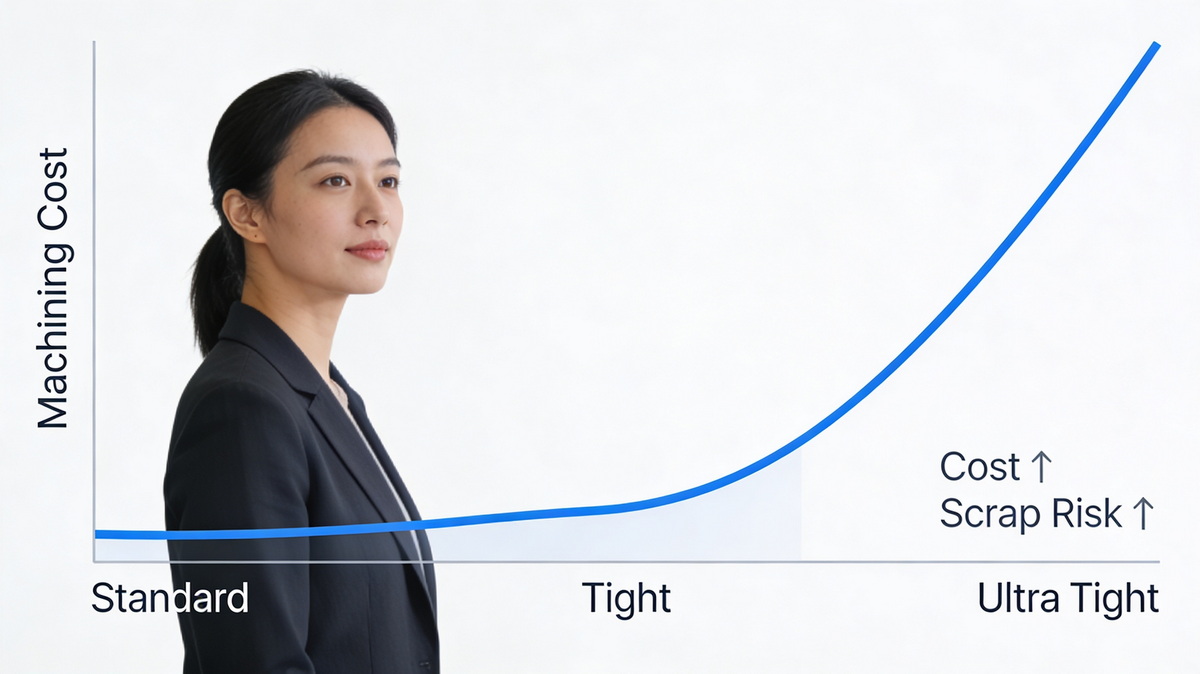
From an engineering manager's view, the crucial question is not "How tight can you go?" but "Where is tightness genuinely worth paying for?" [americanmicroinc]
Across many projects, the same pattern appears: [americanmicroinc]
- Moving from a "standard" tolerance (e.g., ±0.25 mm) to moderate precision (±0.125 mm) might increase cost by 25–50%.
- Pushing further to tight precision (around ±0.05 mm) can increase cost by 50–100%.
- Ultra‑tight tolerances (≤±0.0125 mm) often sit in the 100–200% cost premium range due to controlled environments, specialized tooling, and slower feeds. [modusadvanced]
Tighter tolerances also tend to: [blog.epectec]
- Reduce process capability (Cp, Cpk) unless the process is heavily optimized.
- Increase scrap and rework risk.
- Extend lead times due to more metrology steps and tighter process windows.
For this reason, experienced designers apply tight tolerances only on function‑critical features, leaving non‑critical surfaces at more generous "block" tolerances.
To make your next RFQ smoother and your production more stable, here is a practical, field‑tested approach to tolerance specification.
For each key feature, ask:
- Does it locate another component?
- Does it control sealing, alignment, or motion?
- Will it be subject to thermal expansion or dynamic loads?
Only features that truly affect function should carry tight or GD&T‑based tolerances; everything else can rely on standard blocks. [blog.epectec]
Most shops prefer general notes like: [blog.epectec]
- "Unless otherwise specified: ±0.1 mm" for machined dimensions.
- "Angular: ±0.5°" for non‑critical angles.
This lets machinists focus their attention—and your budget—on the features that matter.
When multiple dimensions combine (for example, a housing length, plus a shoulder height, plus a spacer), their tolerances add up. [blog.epectec]
In practice:
- Do a quick worst‑case stack‑up for your critical assembly paths.
- Allocate tighter tolerances only to the dimensions with the biggest impact on final deviation.
A seasoned CNC provider can often tell you within minutes whether your tolerance scheme is realistic, over‑specified, or under‑specified. At U‑Need, our team routinely reviews customer drawings before quotation to: [uneedpm]
- Flag dimensions that will drive cost out of proportion to their value.
- Suggest alternative geometries or datums to improve machinability.
- Propose process routes (e.g., grinding or honing) where ultra‑tight features are required.
Not every project needs micrometer‑level accuracy, but certain industries depend on it.
Typical scenarios include: [modusadvanced]
- Medical devices – Joint implants and surgical instruments often require surface roughness Ra ≤0.4 μm and tight dimensional control to ensure biocompatibility and wear resistance.
- Optical and photonics components – Lens mounts, sensor frames, and optical benches may demand flatness ≤0.001 mm to maintain alignment and focus.
- Aerospace and defense – Fuel system components, actuator housings, and safety‑critical mechanisms routinely call for sub‑0.01 mm tolerances and stringent verification.
- Semiconductor and high‑precision automation – Stages, guides, and fixtures require micrometer‑level repeatability and long‑term stability under thermal cycling. [modusadvanced]
These are the kinds of applications where U‑Need's ability to work down to ±0.001 mm can directly translate into measurable system performance gains. [uneedpm]
From an expert's standpoint, the true test of a machining partner is consistency rather than one‑off capability. U‑Need's value proposition combines equipment, process, and people: [americanmicroinc]
- 30+ years of machining experience enable production of high‑micromachined parts with extremely tight tolerances. [uneedpm]
- A precision factory certified to ISO 9001:2015 ensures that every step—from material receipt to final inspection—follows documented and auditable procedures, with a claimed pass rate of about 99.3%. [uneedpm]
- Advanced inspection equipment, such as CMMs, vision measuring machines, profile projectors, and micrometers, verifies dimensional, geometric, and positional tolerances on critical features. [uneedpm]
- A foreign trade and engineering team with more than 15 years of international experience helps reduce communication errors and align tolerance expectations across languages and standards. [uneedpm]
For many customers, a further advantage is flexibility: U‑Need services both small batches and larger runs, offers fast lead times (sometimes within three days for selected parts), and provides packaging solutions designed to preserve tight tolerances during global shipping. [uneedpm]
Below is a simplified comparison showing how typical industry ranges relate to U‑Need's in‑house capabilities. [americanmicroinc]
| Process / Scenario | Typical Industry Tolerance | U‑Need Typical Capability | Notes on Application |
|---|---|---|---|
| General CNC machining (standard shop) | ±0.005" (±0.127 mm) americanmicroinc | ±0.01 mm for milling uneedpm | Standard mechanical parts |
| Precision machining (controlled env.) | ±0.001" (±0.0254 mm) modusadvanced | ±0.005 mm turning uneedpm | Precision mechanical assemblies |
| Grinding of critical surfaces | ±0.01 mm typical modusadvanced | ±0.002 mm grinding uneedpm | Bearing seats, sealing surfaces |
| Wire EDM for intricate features | ±0.01 mm typical modusadvanced | ±0.001 mm wire EDM uneedpm | Die components, fine contours |
| Ultra‑precision applications | 1–3 μm in top vendors modusadvanced | Up to ±0.001 mm (1 μm) uneedpm | Optics, medical, semiconductor |
If you are currently wrestling with a drawing full of tight tolerances—or trying to understand why a legacy part is so expensive—share your 2D/3D files and tolerance requirements with U‑Need for a practical DFM review. [uneedpm]
You can:
1. Send your CAD (STEP/IGES) and PDF drawings.
2. Indicate which dimensions are truly functional and which can be relaxed.
3. Ask for alternative suggestions to reduce cost without sacrificing performance.
U‑Need's engineering team will respond with feasible tolerance schemes, suggested processes, and a clear quotation so you can make a data‑driven decision on precision vs budget. [uneedpm]
For non‑critical dimensions, many shops use around ±0.1–0.25 mm as a practical general tolerance, depending on part size, material, and process capability. Critical features then receive tighter, explicitly specified tolerances. [americanmicroinc]
With modern equipment, standard precision ranges around ±0.001–0.002" (±0.025–0.05 mm), while tight‑tolerance machining can reach ±0.0005" (±0.0125 mm) or better on selected features, especially with grinding or EDM. U‑Need pushes this further, offering capabilities down to ±0.001 mm for specific applications. [protolabs]
Every step of the process—machine selection, fixturing, tooling, cycle time, and inspection—becomes more demanding as tolerances shrink, which increases cost, scrap risk, and lead time. Applying tight tolerances only where they are functionally required is the best way to balance performance and budget. [blog.epectec]
Provide fully dimensioned drawings with tolerances, GD&T where applicable, material and heat‑treatment specs, expected quantities, and any special surface or inspection requirements. Highlight your function‑critical features; this allows your supplier to propose optimal processes and realistic tolerances. [americanmicroinc]
U‑Need combines ISO9001‑certified quality systems with advanced metrology (CMMs, vision machines, profile projectors) and in‑process checks to verify critical dimensions and geometries. Tool life management and controlled processes help maintain a reported pass rate above 99% on production batches. [uneedpm]
1. JLCCNC. "Understanding CNC Machine Tolerances and Their Impact on Part Accuracy."
<https://jlccnc.com/blog/understanding-cnc-machine-tolerances-and-impact-on-part-accuracy>
2. U‑Need Precision Machining – CNC Machining Services and Capabilities.
<https://www.uneedpm.com/cnc-machining/> [protolabs]
3. Protolabs. "Understanding CNC Machining Tolerances."
<https://www.protolabs.com/resources/design-tips/fine-tuning-tolerances-for-cnc-machined-parts/> [protolabs]
4. Modus Advanced. "The Complete Guide to Machining Tolerances."
<https://www.modusadvanced.com/the-complete-guide-to-machining-tolerances> [modusadvanced]
5. American Micro Industries. "Machining Tolerances 101: A Comprehensive Guide."
<https://www.americanmicroinc.com/resources/machining-tolerances/> [americanmicroinc]
6. RapidDirect. "Everything You Need to Know About CNC Machining Tolerances."
<https://www.rapiddirect.com/blog/cnc-machining-services-tolerances/> [rapiddirect]
7. Moseys. "Guide to CNC Machining Tolerance Standards."
<https://moseys.com/precision-machining-tolerances> [moseys]
8. Epec Engineered Technologies. "Design Practices for CNC Machined Parts with Tight Tolerances."
<https://blog.epectec.com/design-practices-for-cnc-machined-parts-with-tight-tolerances> [blog.epectec]


