Views: 222 Author: U-Need Publish Time: 2026-05-25 Origin: Site
When you are sourcing CNC parts, you are not just buying tolerances and materials—you are buying surface finish that your customer can see and feel. Over the past decade working with global brands and OEMs, I have seen more projects derailed by poor finishing than by machining accuracy. A part can measure perfectly in the CMM report and still be rejected on the assembly line because it looks "shop-made" instead of product-ready. [newayprecision]
For many of the engineers and buyers we support at U‑Need in China, bead blasting has become the go-to finish for aluminum housings, stainless-steel components, and cosmetic covers that must look consistent across large production runs. In this guide, I will walk you through how bead blasting works, where it shines, where it fails, and how to choose it intelligently as part of your overall CNC finishing strategy. [rapiddirect]
At its core, bead blasting is a mechanical surface finishing process where tiny spherical media—typically glass beads—are propelled at a part under controlled air pressure. Unlike grinding or polishing, the process does not cut deeply into the material; it "peens" the surface, smoothing tool marks and creating a uniform, satin-like texture. [uneedpm]
From a manufacturing engineer's perspective, bead blasting is most valuable when you need:
- A consistent, non-reflective matte surface
- Minimal material removal, suitable for tight-tolerance CNC parts
- Reliable prep before anodizing, painting, or powder coating [rapiddirect]
In real projects, we most often use bead blasting on:
- Aluminum housings and enclosures for consumer electronics and industrial equipment
- Stainless-steel components that must avoid glare or visible machining marks
- Precision parts that require stable adhesion before anodizing or other coatings [uneedpm]

From the outside, bead blasting looks simple: a technician aims a nozzle at a part and blasts it. In serious production, however, the process is highly controlled to protect tolerance and repeatability. [uneedpm]
1. Pre-cleaning and degreasing
Parts are cleaned to remove cutting fluids, chips, and fingerprints. Residue left on the surface can cause uneven texture and patchy appearance after blasting. [newayprecision]
2. Media selection and qualification
The shop selects bead size, hardness, and material (glass, ceramic, plastic) based on the base material and design requirements. For example, softer media for thin-walled aluminum, and harder media for aerospace or medical alloys. [etcnmachining]
3. Pressure and nozzle setup
Compressed air propels the beads at a controlled pressure. Too high and you risk rounding edges or altering dimensions; too low and you will not fully remove tool marks. [uneedpm]
4. Controlled coverage
Skilled operators or automated systems move the nozzle methodically across the surface, maintaining distance and angle so every feature receives uniform treatment. [uneedpm]
5. Post-blast cleaning and inspection
After blasting, parts are blown off, washed if required, and visually inspected under consistent lighting. For critical applications, surface roughness and adhesion tests may be performed. [uneedpm]
In one recent project, switching from hand-polishing to bead blasting on aluminum enclosures allowed production to scale from small batches to thousands of units per month, with visibly tighter color consistency after anodizing and fewer cosmetic rejects. [rapiddirect]
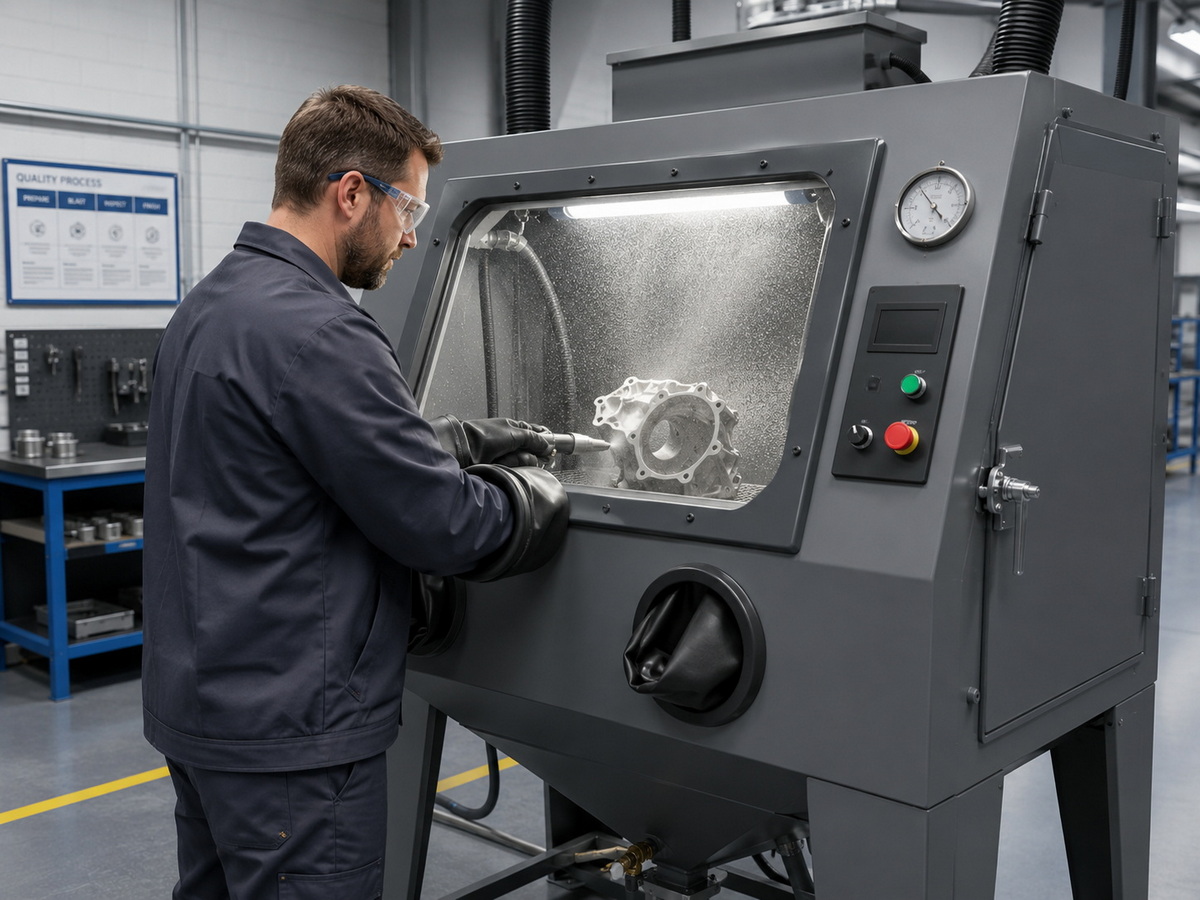
Engineers and buyers often use "sandblasting" as a catch‑all term, but bead blasting and sandblasting behave very differently on CNC parts. [uneedpm]
| Aspect | Bead blasting | Sandblasting |
|---|---|---|
| Media | Spherical glass or ceramic beads | Angular sand or abrasive grit |
| Surface texture | Smooth, satin, non-reflective finish | Rough, aggressive, more pitting |
| Material removal | Gentle, minimal base metal removal | More aggressive, higher erosion risk |
| Dimensional impact | Typically negligible on CNC parts | Can change dimensions on fine features |
| Best use cases | Cosmetic CNC parts, housings, pre-coating prep | Heavy rust removal, paint stripping, structural cleaning |
For CNC machined components, bead blasting is usually preferred because it produces a controlled satin finish without damaging tight-tolerance features. Sandblasting is better reserved for structural steel, heavy rust removal, or refurbishing large industrial equipment. [etcnmachining]
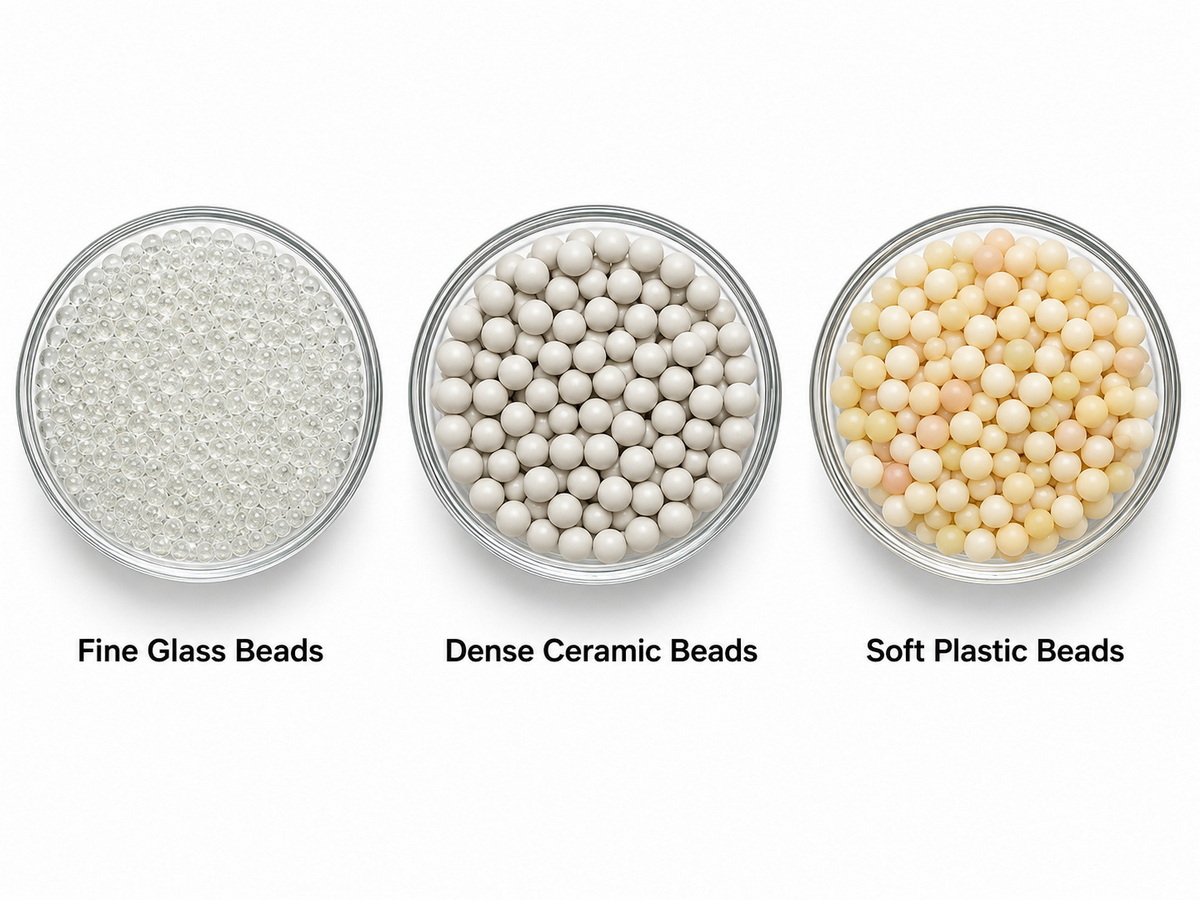
Different beads produce different textures, levels of aggression, and suitability for various materials. [uneedpm]
| Media type | Description | Best for | Why choose it |
|---|---|---|---|
| Glass beads | Lightweight, spherical glass particles | Aluminum and stainless-steel CNC parts | Balanced satin finish, ideal for cosmetic surfaces and pre-anodizing |
| Ceramic beads | Harder and denser than glass | Aerospace, medical, and high-strength alloys | Increased durability and wear resistance, more impact strength |
| Plastic beads | Soft polymer media | Soft metals and plastics | Gentle cleaning without notable dimensional change |
In typical CNC manufacturing, glass bead blasting is the default because it delivers the classic satin look customers expect on aluminum enclosures and faceplates. When a customer's design involves titanium medical parts or hardened alloys for aerospace, ceramic beads can achieve a more durable surface with controlled roughness that supports coating adhesion and fatigue performance. [etcnmachining]
From a procurement or engineering standpoint, bead blasting earns its place because it delivers both cosmetic and functional benefits in one step. [uneedpm]
- Highly uniform visual appearance
Bead blasting erases machining lines, tool marks, and minor burrs, leaving a consistent satin surface across large batches. [uneedpm]
- Improved coating adhesion and corrosion resistance
The process creates a controlled micro‑roughness that helps anodizing, powder coating, and paint anchor more tightly, improving long‑term corrosion and wear performance. [rapiddirect]
- Cost-effective alternative to polishing
Compared with hand or machine polishing, bead blasting achieves a professional finish at significantly lower labor cost, especially on complex geometries. [uneedpm]
- Suitable for intricate features
Thin walls, pockets, and internal corners can be treated uniformly without the risk of deep scratches or uneven cutting that comes with aggressive abrasive processes. [uneedpm]
Many manufacturing teams use bead blasting as the "baseline cosmetic finish" and then selectively polish or coat only customer-facing areas that must be reflective or branded.
Bead blasting is powerful, but it is not a universal solution. As an engineer or buyer, you should be aware of its limitations before locking in a finish on your drawing. [uneedpm]
- Dimensional tolerance impact
Although material removal is minimal, bead blasting can still slightly affect tight-tolerance features, especially on very small parts or precision fits. [uneedpm]
- Threads and sealing surfaces
Exposed threads, O‑ring grooves, and sealing faces often require masking to prevent media embedding or dimension changes that compromise sealing or assembly. [uneedpm]
- Gloss limitations
If your product spec calls for high-gloss or mirror-finished surfaces, bead blasting alone will not meet that requirement; you will need polishing, electropolishing, or other processes. [rapiddirect]
The practical takeaway: specify bead blasting strategically—apply it to cosmetic and non-critical areas, and clearly mark masked regions on the drawing to avoid surprises during sampling.
Bead blasting rarely exists in isolation. In modern CNC supply chains, it is one option among a toolbox of finishing methods. [rapiddirect]
| Finish | Typical appearance | Protection level | Ideal use cases |
|---|---|---|---|
| Bead blasting | Satin, matte, non-reflective | Preps surface for other coatings | Cosmetic parts, enclosures, pre‑anodizing or paint |
| Anodizing | Colored or clear, matte to semi‑gloss | High corrosion and wear resistance | Aluminum components for outdoor, aerospace, or electronics use |
| Polishing | Shiny or mirror‑like | Limited protection on its own | Decorative parts, medical tools, high-end consumer products |
| Powder coating | Thick, opaque, colorful | Excellent corrosion and impact resistance | Automotive, outdoor equipment, industrial housings |
| Electropolishing | Bright, smooth metallic finish | Strong corrosion resistance, cleanability | Stainless-steel parts for medical, food, and pharma applications uneedpm |
In many successful projects, we combine bead blasting + anodizing for aluminum or bead blasting + powder coating for robust housings, achieving both the desired look and field durability. [rapiddirect]
From an industry practitioner's point of view, these are the situations where bead blasting is usually the right call:
1. You need a professional cosmetic baseline
For front panels, visible housings, or consumer-facing components, a bead-blasted satin surface hides minor handling marks and looks premium out of the box. [uneedpm]
2. You are preparing for anodizing or painting
Bead blasting improves adhesion and helps coatings distribute more uniformly, particularly on aluminum and stainless steel. [rapiddirect]
3. Your part geometry is complex
Internal cavities, ribs, and pockets benefit from a process that can reach them without specialized polishing fixtures. [uneedpm]
4. You are sensitive to cost and lead time
Compared with mirror polishing or multi-step manual finishing, bead blasting is quicker to set up and more scalable for production volumes. [uneedpm]
If you are unsure, a practical approach is to request two sample sets: one with as‑machined finish plus coating, and one with bead-blast plus the same coating. Most teams end up favoring the bead‑blasted option once they see the actual parts side by side.
To put theory into context, here are typical application patterns we see across industries. [etcnmachining]
- Electronics and IoT devices
Aluminum enclosures for controllers, sensors, and gateways often use bead blasting before clear or black anodizing. The result is a clean, fingerprint-resistant surface that aligns with modern industrial design language.
- Automation and machinery
Control panels, brackets, and covers benefit from a bead blasted finish that hides minor wear, making equipment look "clean" even after long-term use.
- Medical and laboratory equipment
In combination with anodizing or electropolishing on stainless steel, bead blasting helps create a controlled surface texture that balances cleanability with low reflectivity, important in operating rooms and labs. [etcnmachining]
In each of these sectors, the recurring pattern is clear: bead blasting is less about decoration and more about consistency, perceived quality, and coating reliability.
To maximize success, use this short checklist when you add bead blasting to your drawing:
1. Define the base material and critical areas
Clearly mark surfaces that must be blasted and those that must be masked (threads, sealing faces, press-fit bores).
2. Specify finish in the title block or note
Use explicit language such as: "Surface finish: bead blasting, glass beads, satin finish on all visible surfaces unless otherwise noted."
3. Align roughness and appearance expectations
If your project has strict Ra requirements, discuss target roughness and sample photos with your manufacturer.
4. Confirm downstream processes
If parts will be anodized, powder coated, or plated, verify that your bead blasting spec is compatible with the chosen coating system. [rapiddirect]
5. Request samples or a finishing coupon
Before locking in mass production, approve a bead‑blasted sample or coupon to align internal stakeholders and avoid subjective debates later.
Following this structured approach helps you prevent miscommunication and reduces the risk of last‑minute cosmetic changes that delay shipment.
Bead blasting is most effective when it is integrated into a full manufacturing workflow, not treated as a disconnected outsource step. [uneedpm]
When machining and finishing happen under one roof:
- Process parameters can be tuned together to preserve tolerance while achieving the desired look.
- Quality control teams can inspect both dimensions and surface finish against the same specification set.
- Lead time drops, since parts do not have to move between multiple vendors.
Manufacturers like U‑Need, who offer custom precision machining, mold manufacturing, and sheet metal fabrication with in‑house surface finishing, are able to deliver more consistent cosmetic results with shorter feedback loops between design and production. [uneedprecisionmachine]
If you are designing or sourcing CNC parts that must ship assembly-ready—not just dimensionally correct but visually consistent—bead blasting should be on your finishing shortlist. Partner with a precision manufacturer that integrates machining, bead blasting, and downstream finishing so you can validate samples quickly and move to stable production without managing multiple vendors. [uneedpm]
Share your drawings and finishing requirements, and request a bead‑blasted sample along with a standard as‑machined version. Seeing them side by side will help your team make a confident, data-backed decision for your next project.
Yes, when parameters are controlled, bead blasting is safe for most precision parts because it uses relatively gentle spherical media and enclosed systems that protect operators and components. [uneedpm]
Bead blasting removes only a very thin surface layer, so dimensional impact is usually negligible, but extremely tight tolerances or micro-features should be reviewed and masked as needed. [uneedpm]
For CNC machined parts, bead blasting is generally preferable because it produces a smoother, satin finish and is less likely to erode edges or delicate geometries compared with sandblasting. [etcnmachining]
Bead blasting can remove light rust, oxidation, or thin coatings while smoothing the base material; heavily rusted or thickly coated surfaces often require more aggressive abrasive media. [etcnmachining]
Aluminum and stainless-steel CNC parts benefit the most, particularly when used for visible housings, panels, and components that will be anodized or painted afterward. [rapiddirect]
1. JLCCNC. "What is Bead Blasting Finish in CNC? A Complete Guide." (Accessed 2026). [Link] [uneedpm]
2. RapidDirect. "Surface Finishing Options for Custom Parts." (Accessed 2026). [Link] [rapiddirect]
3. ETCN Machining. (Accessed 2026). [Link] [etcnmachining]
4. Neway Precision. (Accessed 2026). [Link] [newayprecision]
5. U‑Need Precision Machining. "Our Values | Precision Manufacturing | U‑Need." (Accessed 2026). [Link] [uneedpm]
6. U‑Need Precision Machining. "Custom Precision Parts Machining Service As Your Design." (Accessed 2026). [Link] [uneedprecisionmachine]


