Views: 222 Author: Loretta Publish Time: 2025-12-22 Origin: Site
Content Menu
● Why CNC Fixtures Matter for Precision Machining
>> Drilling Fixtures and Drill Jigs
>> Tombstone and Trunnion Fixtures
>> Vacuum and Magnetic Fixtures
● Key Components of a CNC Fixture
● Design Principles for Reliable CNC Fixtures
● How CNC Fixtures Impact Cost and Lead Time
● Fixture-Friendly Design Tips for Engineers
● Advanced Trends in CNC Fixture Technology
● How U-NEED Uses CNC Fixtures to Support OEM Projects
● Take the Next Step With U-NEED
>> 1. What is the main difference between jigs and fixtures?
>> 2. When should I choose a dedicated fixture instead of a modular fixture?
>> 3. How do vacuum fixtures hold parts during CNC machining?
>> 4. Can one CNC fixture be used on multiple machines?
>> 5. What information should OEM buyers provide to help design better fixtures?
CNC fixtures are specialized workholding devices used to locate and clamp a workpiece securely on a CNC machine during cutting, drilling, milling, or grinding operations. They directly influence part accuracy, surface finish, cycle time, and overall process stability in precision manufacturing.[1][2][3]
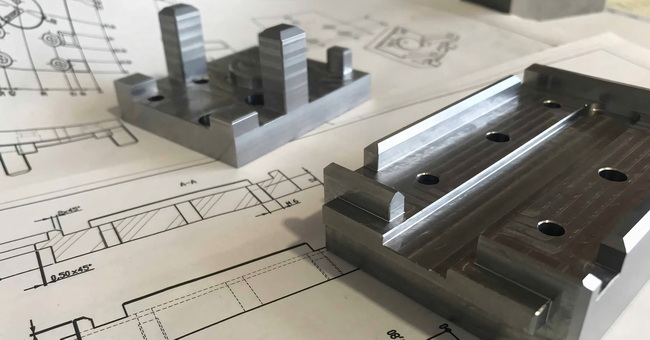
A CNC fixture is a custom or modular structure mounted on the machine table, pallet, or rotary axis to hold a workpiece in a fixed position while the tool moves according to the programmed path. Unlike jigs, which guide the cutting tool, fixtures focus on supporting, locating, and clamping the workpiece against machining forces.[4][5][2][1]
Key roles of CNC fixtures include:
- Providing repeatable positioning using defined datums and locators.
- Resisting cutting forces and vibration to maintain dimensional accuracy.
- Reducing setup time and manual adjustment between parts and batches.[3][1]
Accurate and rigid fixtures are critical to achieving tight geometric tolerances, stable surface finishes, and long tool life in CNC machining. Poor workholding can result in chatter, dimensional drift, burrs, and inconsistent quality across batches.[6][2]
For OEM buyers, fixture capability at a supplier affects:
- The achievable tolerances on key features and mating surfaces.
- The cycle time per part and long-term cost at volume.
- The risk of rework, scrap, and delivery delays due to unstable setups.[1][3]
Different machining operations and production scales require different fixture strategies. The following classification helps engineers and buyers select suitable solutions.
Milling fixtures are used on vertical and horizontal machining centers to clamp prismatic or complex parts for operations such as facing, slotting, pocketing, and contouring. They typically use a combination of base plates, locators, clamps, and supports to expose multiple faces of the workpiece in one setup.[2][3]
Well-designed milling fixtures:
- Provide good tool access around the part.
- Allow quick loading/unloading and repeatable positioning.
- Minimize deflection when milling heavy cuts or long tool overhangs.[3][1]
Turning fixtures are used on CNC lathes and mill-turn centers to hold round or symmetric parts. Common solutions include three-jaw and four-jaw chucks, collet chucks, expanding mandrels, and custom arbors.[7][8]
Their main goals are:
- Maintaining concentricity between OD, ID, and faces.
- Providing secure clamping at high spindle speeds.
- Allowing efficient chip evacuation and coolant flow during turning.[9][7]
Drilling fixtures and drill jigs support the part and guide the drill to the correct position and angle through hardened bushes. In CNC environments, traditional drill jigs are less common, but simple guiding or support features may still be used for critical multi-hole patterns.[10][11]
Advantages include:
- Accurate hole location and spacing over many cycles.
- Reduced need for manual layout and measurement.
- Improved safety and repeatability for complex drilling patterns.[11][10]
Grinding fixtures are used on surface, cylindrical, and tool grinders where micron-level accuracy and fine surface finish are required. They often feature hardened and ground reference surfaces, high stiffness, and balanced clamping to avoid distortion.[12][1]
Grinding fixtures help:
- Maintain parallelism, flatness, and roundness on critical features.
- Control heat generation and thermal distortion during fine finishing.
- Support delicate features without over-clamping.[12][1]
Modular fixtures use standardized bases, locators, clamps, and riser blocks that can be reconfigured for different parts. They are widely used in job shops and flexible CNC cells that handle many part numbers in small or medium batches.[6][3]
Benefits of modular fixtures:
- Lower initial investment compared with multiple dedicated fixtures.
- Fast reconfiguration between projects.
- Compatibility with pallet systems and zero-point clamping.[6][3]
Dedicated fixtures are application-specific solutions designed around a single part or small family of parts, optimised for productivity and repeatability.[1][6]
These fixtures are ideal when:
- The part design is stable over the long term.
- Production volumes are high enough to amortize fixture cost.
- There are stringent quality and cycle-time requirements.[1][6]
Tombstone fixtures are multi-face vertical blocks used on horizontal machining centers to mount many parts or multiple sides of a part at once. Trunnion fixtures are rotating assemblies used with 4-axis or 5-axis machines to tilt and rotate parts during machining.[3][6]
They provide:
- Multi-side machining in a single clamping.
- High spindle utilization with reduced idle time.
- Excellent suitability for automation and pallet pools.[6][3]
Vacuum fixtures use negative pressure to hold thin plates and large panels without mechanical clamps. Magnetic fixtures rely on permanent or electro-magnets to hold ferrous parts.[13][8]
Applications:
- Thin or delicate components that cannot tolerate clamp marks.
- Large sheet parts or covers where full-surface support is needed.
- Quick changeovers for flat workpieces in routers and mills.[8][13]
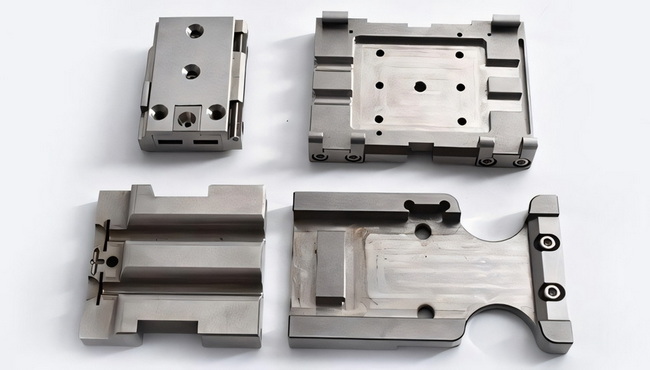
Although the geometry differs from one project to another, most CNC fixtures share several fundamental elements.[3][1]
Typical components:
- Base plate or body: The main structure that mounts to the machine table, pallet, or rotary axis.
- Locating elements: Pins, stops, angles, and reference surfaces that establish the part's position and orientation.
- Clamping elements: Manual clamps, toggle clamps, hydraulic or pneumatic clamps, screws, and wedges that hold the part securely.[6][3]
- Supports: Adjustable or fixed supports to prevent part bending and vibration.
- Fasteners and alignment devices: Bolts, T-nuts, keys, and dowel pins that ensure repeatable positioning on the machine.[1][3]
Good fixture design combines theory, experience, and knowledge of the specific CNC machines and cutting strategies used.[14][1]
Important principles include:
- Follow the datum scheme: Use the same primary, secondary, and tertiary datums that appear on the drawing or CAD model.[12][1]
- Use locators first, clamps second, and avoid over-clamping that could distort the part.
- Provide clearance for chips and coolant to prevent packing and heat build-up.[14][3]
- Minimize the number of setups by exposing as many surfaces as possible in one clamping.
- Ensure tool accessibility so cutters can reach all features with the correct approach angles.[14][6]
Fixture strategy has a strong influence on production economics. The right fixture can shorten cycle times, reduce scrap, and stabilize quality, while poor fixturing increases rework and delays.[1][6]
Key cost factors:
- Dedicated fixtures have higher upfront cost but lower cost per part at volume.
- Modular fixtures allow cheaper entry and better flexibility but may sacrifice some cycle-time efficiency.
- Well-designed fixtures reduce operator handling time, which is critical in high-labor-cost regions.[3][1]
For OEM buyers, it is important to clarify:
- Expected annual volume and batch sizes.
- Who owns the fixture and how costs are amortized in pricing.
- How fixture maintenance and life-cycle are managed by the supplier.[6][1]
Product design decisions strongly affect fixturing complexity and cost. Small changes often enable simpler fixtures and more stable machining.[14][12]
Practical tips:
- Provide flat clamping pads or bosses on non-functional areas for stable support.
- Avoid placing critical cosmetic surfaces directly under clamp forces.
- Use symmetric features where possible to simplify orientation and balancing.
- Keep pocket depths and internal radii compatible with standard tools to reduce special tooling and complex workholding.[12][14]
Early communication between design engineers and the CNC supplier's process engineers helps align part geometry with real-world fixturing and machining capabilities.
Modern CNC factories increasingly pair fixtures with automation, zero-point systems, and digital process monitoring.[3][6]
Current trends:
- Hydraulic, pneumatic, and electric clamping systems for consistent, fast clamping in automated cells.
- Zero-point and pallet systems that allow fixtures to be swapped quickly between machines.
- 3D-printed fixture inserts and soft jaws to conform to complex shapes and reduce weight.
- Integrated sensors to detect part presence and monitor clamping force in advanced manufacturing setups.[6][3]
These technologies improve throughput, repeatability, and safety, especially in lights-out and high-mix production environments.
U-NEED is a Chinese OEM manufacturer specializing in high-precision machined parts, plastic components, silicone products, and metal stamping for overseas brands, wholesalers, and manufacturers. Using robust CNC fixtures is central to ensuring stable quality and competitive pricing across these product lines.
By combining fixture design with process planning, U-NEED can:
- Develop dedicated fixtures for long-term OEM parts that require tight tolerances and reliable repeatability.
- Use modular fixtures and flexible workholding for prototypes, small batches, and multi-variant product families.
- Integrate CNC machining with stamping, plastic, and silicone processes so that all mating parts align correctly and assemble smoothly.
This approach helps international customers shorten development time, reduce quality risk, and maintain stable supply for demanding markets.
If your brand or factory needs reliable CNC machining with professional fixture design, U-NEED is ready to support your OEM projects from initial concept to mass production. Share your drawings, 3D models, expected volumes, and key tolerance requirements, and U-NEED's engineering team can recommend the most suitable fixture approach, machining strategy, and quality control plan for your parts. Contact U-NEED today to discuss your next batch of high-precision machined, plastic, silicone, or stamped components and build a stable, cost-effective supply chain for your global market.
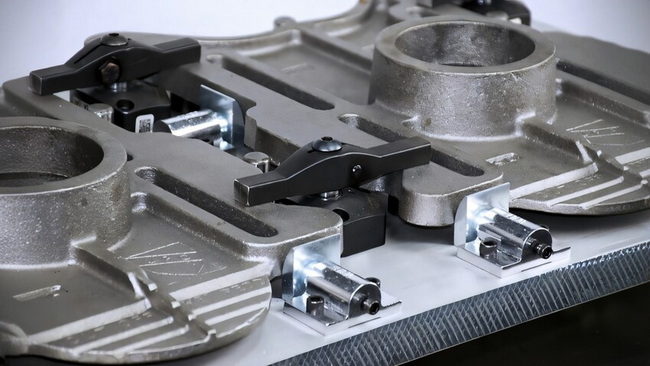
Jigs are primarily used to guide the cutting tool as well as support and locate the workpiece, while fixtures only secure, support, and locate the workpiece without guiding the tool. In modern CNC machining, fixtures are more common because the program controls the tool path electronically rather than relying on mechanical guides.[5][4]
Dedicated fixtures are best when part design is stable, production volumes are high, and aggressive cycle-time and quality targets must be met. Modular fixtures are better for prototypes, engineering changes, and low-to-medium volume projects where flexibility and lower upfront cost are more important.[1][6]
Vacuum fixtures use a sealed chamber and vacuum pump to pull the workpiece down onto a flat surface or grid, creating holding force through atmospheric pressure. They are particularly useful for thin plates, covers, and delicate components where mechanical clamps might distort the part or leave visible marks.[13][8]
Yes, many fixtures are designed with standardized mounting patterns, dowel pin locations, and zero-point interfaces so they can be transferred between machines or pallets with minimal alignment. This is common in automated cells and flexible manufacturing systems where parts move between roughing, semi-finishing, and finishing operations.[3][6]
OEM buyers should share detailed drawings or 3D models, tolerance requirements, datum definitions, material information, and expected production volumes. Indicating cosmetic surfaces, restricted clamping zones, and any potential future design changes also helps suppliers create fixtures that are stable, efficient, and adaptable over the product's life cycle.[14][1]
[1](https://www.steckermachine.com/blog/cnc-fixture-design)
[2](https://www.3erp.com/blog/cnc-fixtures/)
[3](https://blocktobox.com/blogs/articles/cnc-fixture-design-guide)
[4](https://www.rapiddirect.com/blog/jig-and-fixture/)
[5](https://www.rydtooling.com/difference-between-jigs-and-fixture/)
[6](https://www.fastems.com/blog/the-top-fixture-design-tips-for-automated-machining/)
[7](https://www.cnccookbook.com/cnc-jigs-fixtures-workholding-solutions-milling/)
[8](https://www.fictiv.com/articles/jigs-vs-fixtures-all-you-need-to-know)
[9](https://www.protolabs.com/resources/blog/the-difference-between-jigs-and-fixtures/)
[10](https://www.zintilon.com/blog/jigs-and-fixtures-in-cnc-machining/)
[11](https://testbook.com/mechanical-engineering/jigs-and-fixtures-definition-and-applications)
[12](https://www.allmetalsfab.com/designing-for-repeatability-fixtures-datums-and-process-control/)
[13](https://formlabs.com/blog/machining-fixtures-milling-cnc-workholding-jigs-3d-printing/)
[14](https://frigate.ai/cnc-machining/design-tips-for-reducing-cnc-lead-times/)
[15](https://www.zintilon.com/blog/jigs-and-fixtures/)
[16](https://www.richconn-cnc.com/jig-vs-fixture.html)
[17](https://leadrp.net/blog/everything-you-should-know-about-jigs-and-fixtures/)
[18](https://nixma.com/jig-vs-fixture-what-is-the-difference-between-the-jig-and-fixture/)
[19](https://www.reidsupply.com/en-us/industry-news/jig-vs-fixture-what-is-difference)
[20](https://www.runsom.com/blog/a-guide-to-cnc-fixtures-best-10-types-of-cnc-machine-fixtures/)


