Views: 290 Author: U-Need Publish Time: 2026-10-28 Origin: Site
Content Menu
● CNC Milling vs. CNC Cutting: What Are You Comparing?
>> What CNC Profile Cutting Does
● CNC Milling Cost vs. CNC Cutting Cost at a Glance
● What Actually Determines CNC Milling Cost?
>> Machining Time and Tool Access
● What Determines CNC Cutting Cost?
>> Cutting Length, Piercing, and Thickness
>> Nesting and Material Utilization
>> Edge Quality and Secondary Operations
● Why Hourly Rates Can Mislead Buyers
● Illustrative Cost Comparison: Milling vs. Cutting Plus Milling
>> Where Is the Break-Even Quantity?
● Seven Ways to Reduce CNC Milling and Cutting Costs
>> 1. Separate Critical and Noncritical Features
>> 2. Use Practical Internal Corner Radii
>> 3. Review Deep Pockets and Thin Walls
>> 4. Specify Finish by Surface
>> 5. Compare Complete Process Routes
>> 6. Consolidate Stable Demand Carefully
>> 7. Resolve Manufacturing Questions Before Production
● A Better RFQ Checklist for Overseas Buyers
● How U-Need Can Support Your Manufacturing Decision
>> Is CNC Cutting Always Cheaper Than CNC Milling?
>> How Much Does CNC Milling Cost Per Hour?
>> Can Laser-Cut Parts Replace Milled Parts?
>> Does Five-Axis Milling Always Cost More?
>> Why Are CNC Prototypes Expensive Per Part?
>> What Should I Send to Receive an Accurate Quote?
CNC milling cost and CNC cutting cost can differ substantially, even when suppliers quote the same material and production quantity. For global brands, distributors, and manufacturers, the challenge is not finding the lowest hourly rate. It is choosing the manufacturing route that delivers compliant parts at the lowest total cost.
The practical distinction is straightforward: profile cutting is often economical for flat components, while milling creates pockets, controlled depths, precision interfaces, and complex three-dimensional features. Some projects benefit from combining both.
This guide compares their cost drivers, explains how to evaluate quotations, and presents an illustrative calculation for sourcing custom precision parts from China.
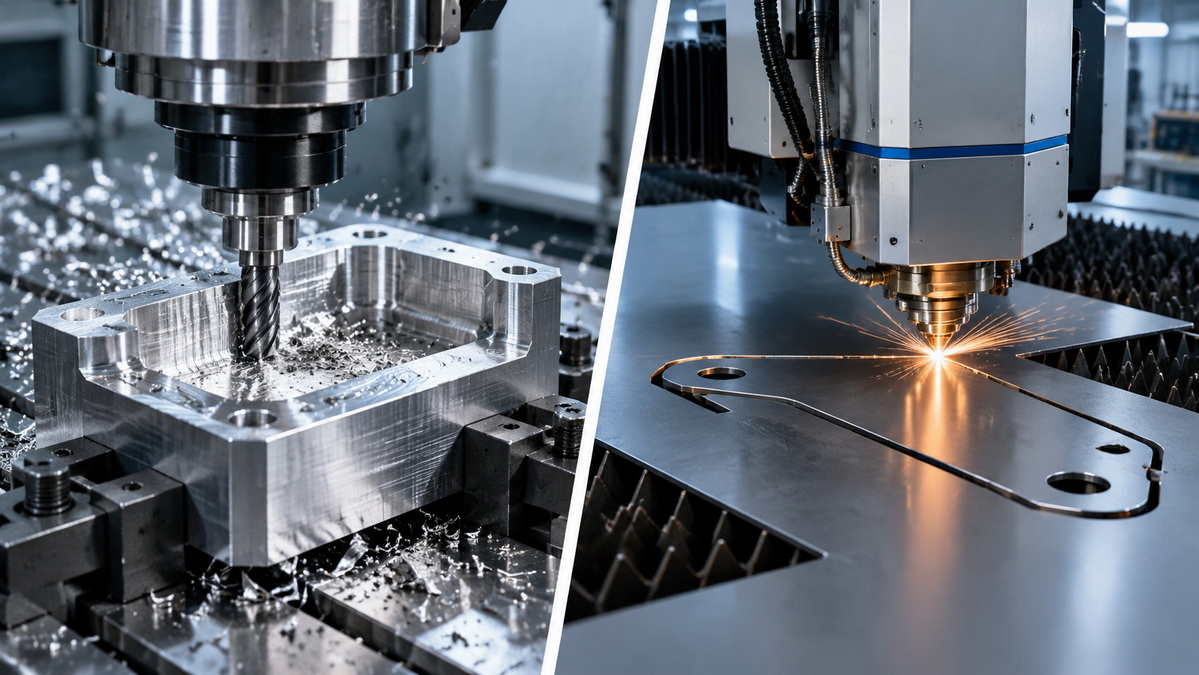
"CNC cutting" is an umbrella term that can include milling. To make the comparison useful, this article uses it specifically for laser, waterjet, and plasma profile cutting.
CNC milling uses rotating tools to remove material from a workpiece. It produces features such as:
- Pockets and stepped surfaces.
- Precision bores and threaded holes.
- Slots, mounting faces, and complex contours.
- Features positioned relative to specified reference surfaces.
Its cost depends heavily on machining time, tool access, workholding, and inspection requirements.
Profile cutting separates shapes from sheet or plate. Laser cutting uses concentrated thermal energy, waterjet cutting uses a high-pressure jet, and plasma cutting uses an electrically generated plasma arc.
These processes are not interchangeable. Material compatibility, thickness, edge requirements, and subsequent operations influence which route is suitable.
The comparison should therefore concern finished, acceptable components—not simply the cost of producing an outline.
| Comparison factor | CNC milling | CNC profile cutting |
|---|---|---|
| Typical geometry | Three-dimensional features and controlled depths | Primarily through-cut profiles |
| Starting material | Bar, billet, plate, or prepared blanks | Sheet or plate |
| Major cost drivers | Cycle time, setups, tooling, inspection | Cutting length, piercing, thickness, nesting |
| Internal features | Pockets, bores, threads, stepped surfaces | Through-holes and cutouts |
| Material efficiency | Depends on stock size and removal volume | Depends on nesting and sheet utilization |
| Secondary work | Deburring, finishing, possible grinding | Deburring, tapping, bending, possible milling |
| Strong application fit | Precision housings and functional interfaces | Panels, brackets, plates, and flat blanks |
Neither process is universally cheaper. Geometry and acceptance criteria determine the economic advantage.
Before production starts, a manufacturer must prepare toolpaths, select tools, establish workholding, and verify the process.
These activities create fixed costs. A prototype absorbs nearly all of them, while a production batch spreads them across multiple units.
Ask whether repeat orders can reuse programs and fixtures. Reuse may reduce preparation costs, but drawing revisions or changed quantities can require additional work.
Deep pockets, small internal radii, thin walls, and difficult-to-access surfaces can increase machining time.
For example, a narrow corner may require a smaller cutter and additional passes. A deep cavity may require longer tooling that limits stable cutting conditions.
When reviewing a drawing, my first cost question would be: "Which features force the supplier to slow down or change the setup?"
That question often reveals more than a comparison of machine rates.
Raw material price is only part of the calculation. Machinability, stock availability, cutting-tool consumption, and finishing requirements also affect cost.
Similarly, tight tolerances can require additional process control or secondary operations. Apply them where function demands them rather than across every dimension.
There is no universal "standard machining tolerance" shared by all suppliers. Confirm the applicable drawing requirements and the supplier's quoted capabilities.
Two parts with identical external dimensions can have different cutting costs.
A simple rectangular plate requires fewer toolpath movements than a perforated panel with numerous holes. Additional piercing operations, intricate contours, and greater thickness can increase processing time.
For meaningful comparisons, provide the actual geometry rather than requesting a price based only on overall dimensions.
Nesting means arranging multiple profiles within a sheet to reduce unused material.
Better utilization can reduce material cost per component. However, savings depend on sheet dimensions, required spacing, grain direction, part orientation, and the available order mix.
A larger batch does not automatically guarantee better utilization. Ask whether the quotation includes dedicated sheet purchases or shared-sheet production.
A cut profile is not necessarily a finished component.
Depending on the process and drawing, additional work may include:
- Removing burrs or dross.
- Improving edge condition.
- Machining precision holes.
- Adding threads or countersinks.
- Bending, coating, or surface treatment.
These operations can narrow—or reverse—the apparent price advantage of cutting.
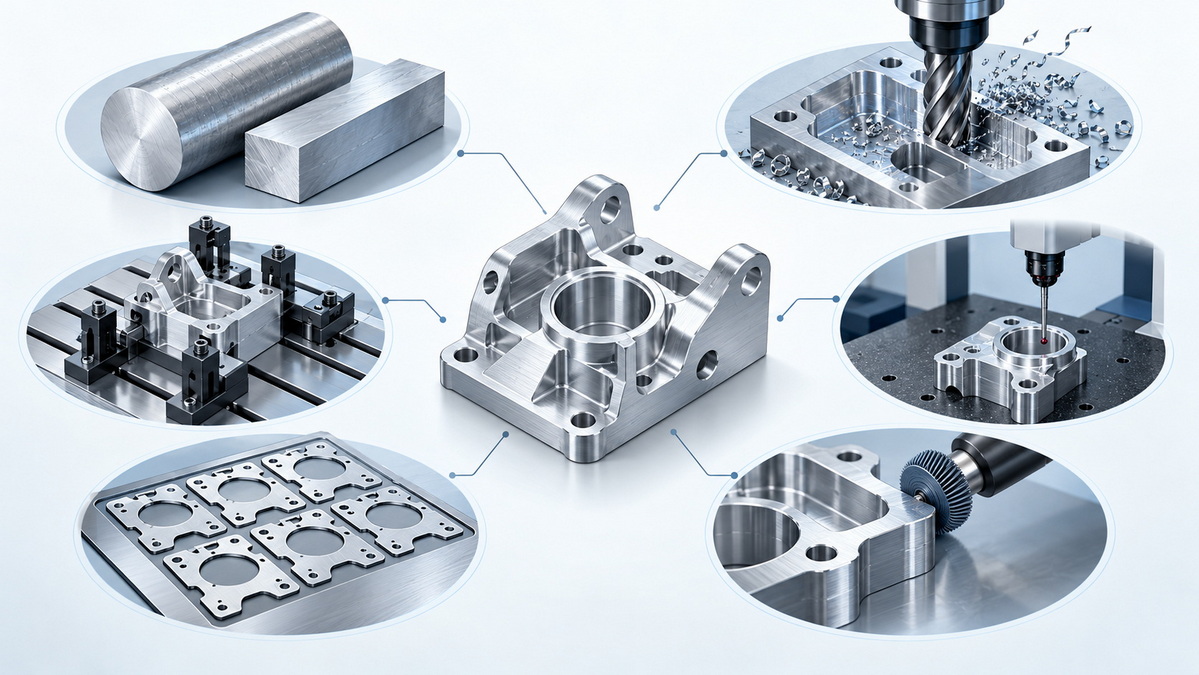
An hourly rate is not a finished-part price.
A higher-rate machine may complete a complex part with fewer setups. Conversely, a lower-rate machine may require repeated handling, additional fixtures, and longer processing time.
Indexed multi-axis machining illustrates this distinction. Reaching several faces without manually repositioning the workpiece can reduce setup requirements and alignment risks.
For international procurement, extend the calculation to include packaging, transport, applicable duties, and receiving activities.
Avoid double counting. Some suppliers include routine inspection or operator labor in their processing rates; others list them separately.
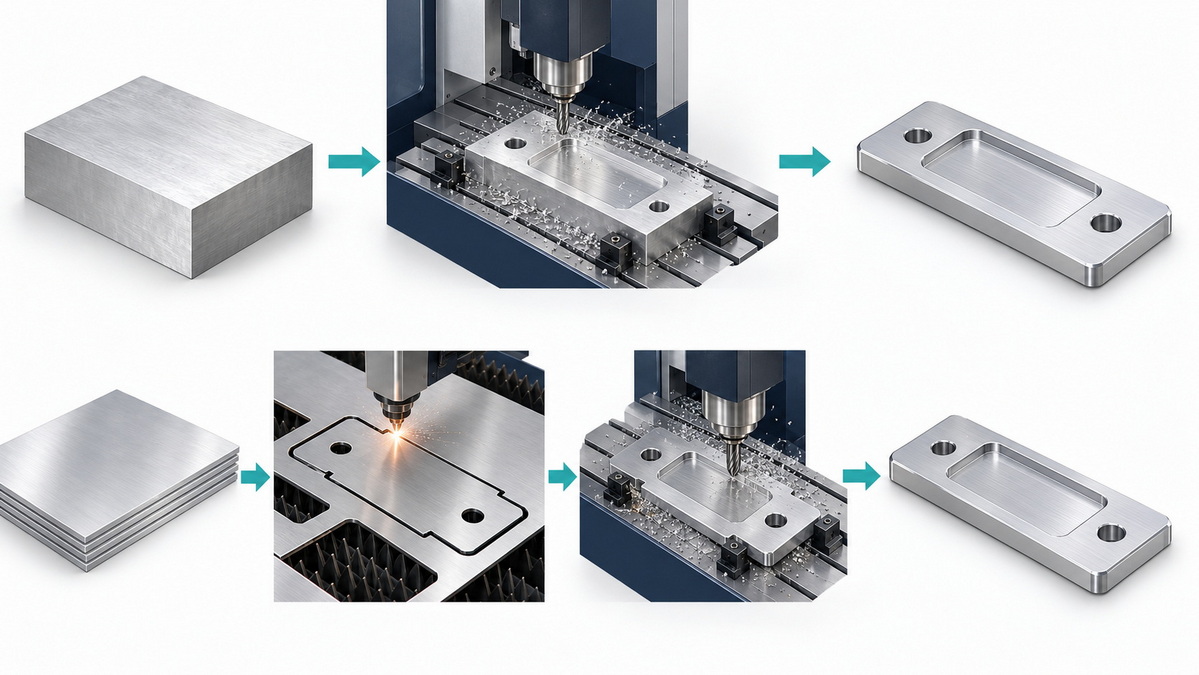
Consider an order for 100 aluminum mounting plates. Each plate has a through-cut outline, two precision locating holes, and a shallow seating pocket.
Two possible routes are:
1. Mill each component entirely from prepared stock.
2. Cut the blanks, then mill the locating holes and pocket.
The figures below are hypothetical planning assumptions—not market averages, customer results, or U-Need quotations. They assume both routes satisfy the same drawing requirements.
| Cost element | Milling only | Cutting plus milling |
|---|---|---|
| Fixed programming and setup | $240 | $360 |
| Material per part | $18 | $10 |
| Profile cutting per part | — | $6 |
| Milling per part | $28 | $8 |
| Deburring and inspection per part | $6 | $6 |
| Setup allocation at 100 parts | $2.40 | $3.60 |
| Total per part | $54.40 | $33.60 |
Under these assumptions, the hybrid route reduces manufacturing cost by approximately 38.2%.
The reason is not simply that cutting is cheaper. The hybrid route reduces material expenditure and milling time enough to offset its additional setup and cutting costs.
The hybrid route adds $120 in fixed preparation costs but saves $22 in variable cost per part.
It becomes less expensive from six parts onward within this simplified model.
Actual results depend on minimum charges, fixture requirements, cutting allowances, material purchasing, and inspection. The lesson is to request alternative process routes—not to assume this saving applies to every plate.
Identify which dimensions control assembly, sealing, alignment, or motion. Allow suitable flexibility elsewhere.
This helps the supplier concentrate precision work where it creates functional value.
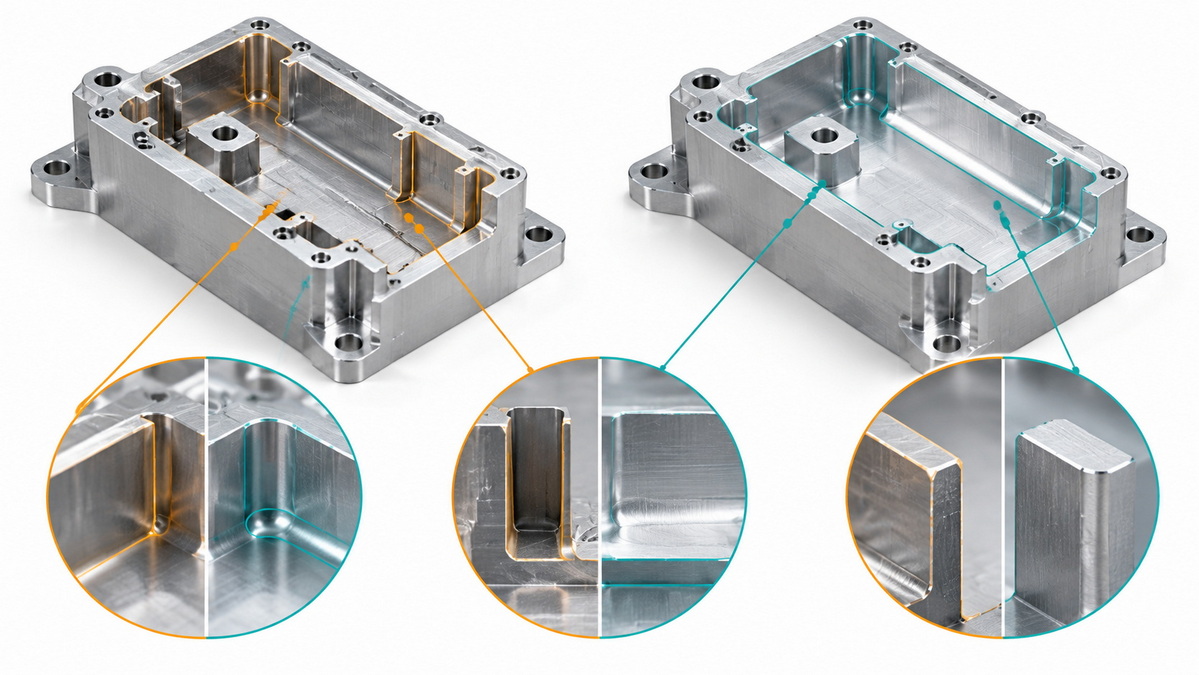
Milling tools naturally leave radiused internal corners. Where the design permits, larger radii can accommodate larger tools and more efficient material removal.
If a mating component requires clearance, discuss corner reliefs rather than automatically specifying square internal corners.
Ask whether cavity depth can decrease or whether a thin section can become thicker.
Any change must preserve strength, weight, heat transfer, and assembly performance.
A hidden mounting face may not need the same cosmetic treatment as an exposed cover.
Clearly identify appearance-critical surfaces and any areas requiring masking or controlled dimensions after coating.
For suitable components, request alternatives such as:
- Milling from solid stock.
- Cutting followed by localized milling.
- Cutting and bending instead of machining an entire shape.
- Dedicated tooling for stable, recurring demand.
Compare equivalent finished requirements, including assembly implications.
Larger batches can spread fixed costs. However, inventory carrying costs and potential design changes can offset lower unit prices.
Compare realistic purchasing quantities rather than ordering excess stock solely to obtain a discount.
Provide consistent models and drawings. Confirm material, critical dimensions, finish, inspection, and revision status before releasing the order.
Preventing one avoidable revision can be more valuable than negotiating a small reduction in processing rates.
A well-prepared request for quotation makes supplier comparisons more reliable.
Include:
- A 3D model and dimensioned drawing.
- Material grade and acceptable substitutions, if any.
- Prototype quantity and expected repeat demand.
- Critical tolerances and reference surfaces.
- Surface finish, coating, and cosmetic requirements.
- Inspection and material-documentation requirements.
- Packaging expectations and delivery destination.
- Required delivery terms and quotation currency.
- Permission to propose alternative manufacturing routes.
Ask suppliers to identify exclusions, one-time charges, minimum order charges, and assumptions.
For multi-operation components, clarify who coordinates the complete sequence. An inexpensive blank offers limited value if the buyer must manage avoidable handoffs between cutting, machining, finishing, and inspection.
U-Need is a precision manufacturing partner in China offering custom precision parts machining, mold manufacturing, and sheet metal fabrication, including laser cutting, bending, and stamping.
This service scope creates an opportunity to evaluate a component beyond a single manufacturing process.
For example, a flat bracket may warrant a cutting-and-bending assessment, while a component with precision interfaces may require milling or a hybrid route. Injection molds, stamping dies, and cold-forging dies introduce additional options when product geometry and recurring demand justify tooling.
The appropriate choice still requires a drawing review. Tooling investment, design stability, material requirements, and expected volume must support the decision.
Send U-Need your drawing, material specification, quantity, and critical requirements. Request a quotation that explains the proposed process route, secondary operations, inspection scope, and opportunities to reduce cost without compromising function.
No. Cutting can be economical for suitable flat profiles, but precision features, edge treatment, and secondary machining can change the total cost. Compare finished components that meet identical requirements.
There is no universally applicable rate. Machine capability, location, material, labor allocation, and quotation scope vary. For purchasing decisions, a drawing-based unit price is more useful than an isolated hourly figure.
Sometimes. A flat component may suit laser cutting, but pockets, controlled depths, precision bores, or demanding interfaces may still require machining. Confirm the complete drawing rather than judging only the outline.
Not necessarily per finished part. Although equipment and programming can cost more, fewer setups and improved access may reduce total processing effort. Simple components may remain more economical on three-axis equipment.
Programming, setup, workholding, and verification must occur even for one component. With few units available to absorb those fixed activities, the unit price can be substantially higher than a repeat production order.
Provide a model, drawing, material specification, quantities, finish requirements, critical tolerances, inspection needs, and destination. Also identify whether the supplier may recommend design changes or alternative manufacturing methods.
1.TOPS Precision, "How Much Does CNC Milling Cost? Factors, Examples, and …" Competitor article used to establish the topic and comparison context; its price ranges were not adopted as verified market benchmarks. [topsbest-precision]
2.Protolabs, "How to Reduce CNC Machining Costs." Supports the discussion of corner reliefs, tool access, and cost-conscious feature design. [protolabs]
3.Protolabs, "Understanding CNC Machining Tolerances." Supports selective tolerance specification and the potential cost of additional precision operations. [protolabs]
4.Protolabs, "CNC Machining: 3-Axis vs. 5-Axis Indexed vs. 5-Axis Continuous." Supports the relationship between multi-axis access, fewer setups, and manufacturing cost. [protolabs]
5.Xometry, "Custom CNC Cutting Service." Supports the distinction between the broad CNC-cutting category and specific processes, including milling and laser cutting. [xometry]
6.Xometry, "How to Reduce CNC Machining Costs." Supports machining-time analysis and the effects of internal radii and feature requirements. [xometry]


