Views: 255 Author: U-Need Publish Time: 2026-11-15 Origin: Site
Content Menu
● CNC Milling Machine vs CNC Router: The Main Differences
● What Is a CNC Milling Machine?
>> Are CNC Routers Limited to Three Axes?
● CNC Mill vs Router for Aluminum: Where the Choice Gets Difficult
>> When Routing May Be Appropriate
>> When Milling Is Usually the Stronger Choice
● CNC Milling vs Routing Accuracy: Specify the Feature, Not a Generic Number
>> Separate Accuracy, Repeatability, and Surface Finish
>> Ask for Feature-Based Verification
● Spindle Speed vs Production Speed: Why RPM Is Not Enough
● CNC Milling Machine vs CNC Router Cost: Compare Accepted Parts
>> Understand the Cost Drivers
● Three Practical Selection Scenarios
>> Scenario 1: Stainless Steel Bracket with Precision Bores
>> Scenario 2: Large Acrylic Equipment Panel
>> Scenario 3: Thin Aluminum Panel with Critical Interfaces
● A Five-Step Checklist for Selecting CNC Milling or Routing
● What to Send a Precision Manufacturing Supplier
● Discuss Your Custom Parts with U-Need
>> Can a CNC Router Cut Metal?
>> Is a CNC Milling Machine Always More Accurate?
>> Which Is Better for Plastic Parts?
>> Can a CNC Router Replace a Milling Machine?
>> Is CNC Routing Always Cheaper?
>> Should I Specify the Machine in My Inquiry?
Choosing between a CNC milling machine and a CNC router starts with your part, not the machine's name. Material, dimensions, tolerances, production quantity, and workholding determine which process makes commercial sense.
For global brands, distributors, and manufacturers sourcing custom components, this decision affects more than cutting speed. It influences inspection requirements, surface quality, tooling costs, and whether parts fit correctly during assembly.
This guide explains the practical differences between CNC milling and routing, challenges common assumptions, and provides a framework for selecting a manufacturing process.
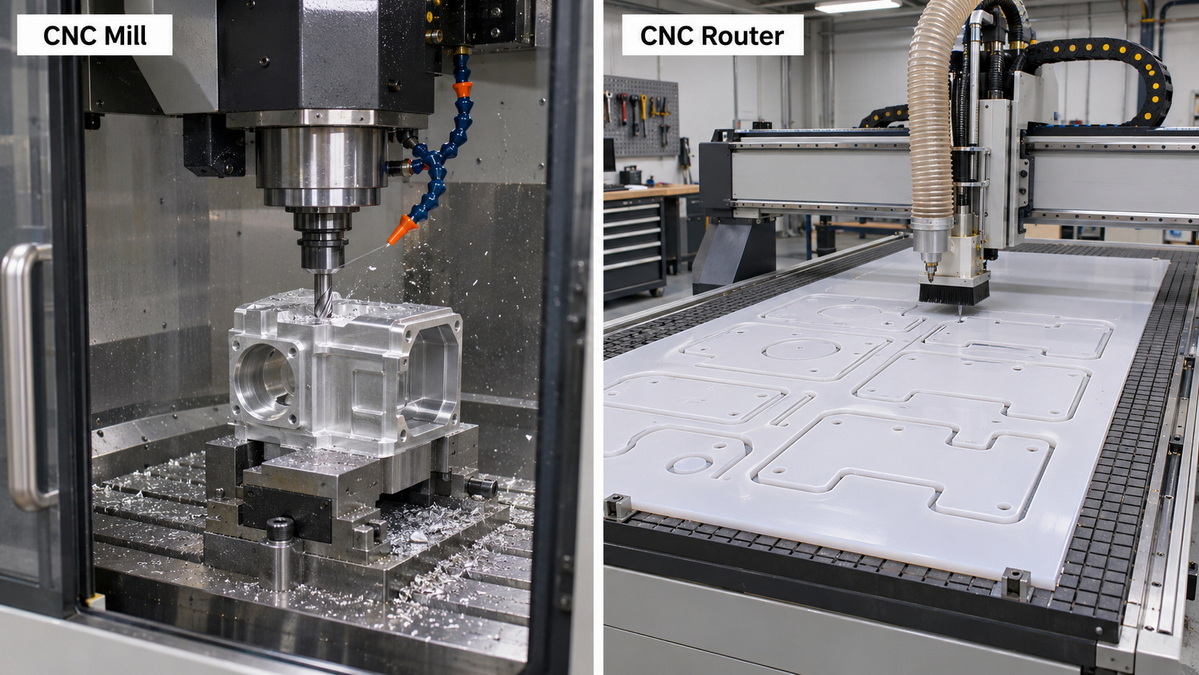
Both machines remove material with rotating cutting tools controlled by programmed toolpaths. Their capabilities overlap, but their construction and intended applications often differ.
| Comparison | CNC milling machine | CNC router |
|---|---|---|
| Typical applications | Precision components, tooling, metal housings | Panels, signage, furniture, patterns |
| Common materials | Steel, aluminum, brass, titanium, engineering plastics | Wood, plastics, foam, composites, suitable aluminum |
| Structural emphasis | Rigidity under demanding cutting loads | Large working area and efficient sheet processing |
| Workholding | Vises, fixtures, clamps, dedicated pallets | Vacuum tables, fixtures, mechanical clamps |
| Geometry | Pockets, bores, threads, multi-face features | Profiles, nested parts, engraving, sculpted surfaces |
| Main buying consideration | Feature accuracy and machining capability | Working envelope and material-handling efficiency |
These are tendencies, not universal limits. Industrial routers can machine aluminum, while milling machines can process plastics and large components. Always evaluate the actual machine and proposed setup.
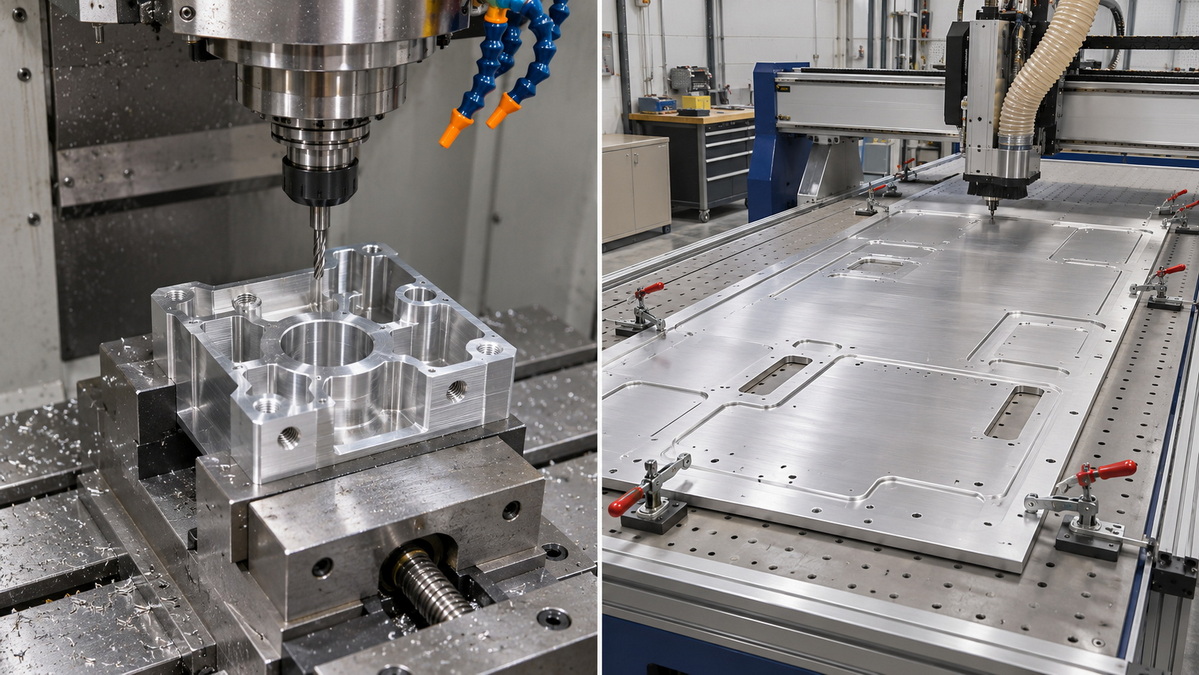
A CNC milling machine uses a rotating cutter to remove material from a securely held workpiece. Depending on its configuration, the spindle, table, or both move along programmed axes.
Milling machines commonly produce:
- Precision brackets and mounting plates.
- Housings with pockets and threaded holes.
- Mold components and die inserts.
- Fixtures and production tooling.
- Components with closely controlled mating features.
Their suitability for demanding metal cutting comes from the complete system: frame stiffness, spindle characteristics, bearings, toolholding, workholding, and process control.
Cutting generates forces that can deflect the tool, workpiece, or machine structure. Excessive movement can cause chatter, poor surface finish, dimensional errors, and premature tool wear.
A rigid setup helps maintain the intended tool position under load. However, even a capable mill can struggle when machining a thin wall with an unnecessarily long cutter.
The practical lesson is straightforward: assess the entire machining arrangement, not just the machine specification.
A CNC router also follows programmed toolpaths with a rotating cutter. Many use a gantry structure that moves above a broad worktable.
This arrangement is useful for processing sheets and large-format workpieces, including:
- Furniture panels and cabinet components.
- Plastic guards and equipment covers.
- Signs and decorative panels.
- Foam patterns and prototypes.
- Composite profiles and selected aluminum parts.
Vacuum workholding can support efficient nesting, where multiple components are arranged within one sheet to improve material utilization.
No. Three-axis routers are common, but multi-axis equipment also exists.
Similarly, gantry construction does not automatically identify a lightweight router. Industrial gantry machines can support substantial metal machining and complex five-axis work.
Axis count describes movement capability. It does not independently establish accuracy, cutting strength, or suitability for your component.
Aluminum is where simple "metal versus wood" comparisons become misleading. Both processes may be suitable, depending on the part.
Consider routing for aluminum panels, large profiles, and relatively shallow features when the equipment is designed for metal cutting.
Before selecting this route, confirm:
1. The spindle and tooling suit the alloy and cutter diameter.
2. The fixture prevents lifting, slipping, and vibration.
3. Chips can be removed effectively.
4. Lubrication is appropriate for the operation.
5. Required dimensions remain achievable across the workpiece.
A machine that can cut aluminum occasionally is not necessarily suitable for repeat production of precision aluminum components.
Milling is generally the more defensible starting point for aluminum parts with deep pockets, precision bores, substantial material removal, or several closely related features.
For example, a housing with bearing seats and mounting faces needs more than an accurate external outline. The relationship between those features may determine assembly performance.
Start with the functional drawing, then select the process capable of controlling those relationships.
A blanket comparison such as "mills achieve ±0.01 mm and routers achieve ±0.1 mm" can mislead buyers.
Actual results depend on:
- Feature size and geometry.
- Material stability.
- Tool wear and cutter deflection.
- Machine condition and thermal behavior.
- Clamping and unclamping effects.
- Inspection method and measurement uncertainty.
Machine positioning specifications are not the same as guaranteed finished-part tolerances.
Accuracy describes closeness to the intended value. Repeatability describes consistency across repeated results. Surface finish describes the texture left on the machined surface.
These characteristics are related, but they are not interchangeable.
A smooth-looking bore can still be oversized. A repeatable process can consistently produce the wrong dimension if its offsets are incorrect.
Identify the characteristics that affect function:
- Bore diameter and position.
- Flatness of mounting surfaces.
- Perpendicularity between mating faces.
- Thread specification.
- Surface texture on sealing areas.
Then ask how those characteristics will be measured. For thin components, clarify whether acceptance applies while clamped or in the free state.
This creates a more meaningful quality agreement than requesting "high precision" without defining it.

Higher spindle speed does not automatically mean a shorter production cycle.
Feed rate depends on spindle speed, the number of cutting edges, and feed per tooth. Material removal also depends on cutting depth and width.
A high-speed spindle taking shallow passes may remove less material per minute than a suitable milling setup taking a heavier cut.
For purchasing decisions, consider:
- Loading and unloading.
- Tool changes.
- Roughing and finishing.
- Repositioning between operations.
- Deburring and cleaning.
- Inspection.
A short cutting cycle offers limited value if the part requires several difficult manual setups afterward.
Likewise, a router may deliver excellent productivity when nesting many panel components in one sheet. The relevant comparison is finished, acceptable parts per production period.
Machine purchase prices vary widely with size, construction, automation, spindle options, and regional conditions. Broad price brackets are therefore poor substitutes for current, configuration-specific quotations.
For outsourced manufacturing, equipment price is even less useful than total delivered part cost.
| Cost driver | What the buyer should clarify |
|---|---|
| Programming and setup | Whether charges are separate or included |
| Workholding | Whether a dedicated fixture is required |
| Machining | Which features drive cycle time |
| Tooling | Whether special cutters are necessary |
| Finishing | Whether deburring and coatings are included |
| Inspection | Which reports and checks are included |
| Rework and scrap | How nonconforming parts are handled |
A lower hourly rate can become more expensive if the process requires additional setups, excessive finishing, or repeated correction.
Compare quotations for the same drawing revision, material, quantity, finish, and inspection scope.
Then assess total spending against the number of accepted parts, rather than comparing machining rates alone.
This approach makes hidden differences visible and helps procurement teams distinguish a genuinely efficient process from an incomplete quotation.
The following examples illustrate process-selection logic. They are not customer case studies or claims of measured production results.
The component includes threaded holes, precision bores, and a mounting face.
A milling machine is generally the better starting point because the job combines demanding material removal with controlled feature relationships.
The supplier should still review tool access, clamping, and inspection before confirming feasibility.
The component consists mainly of an external profile, cutouts, and mounting holes.
A router may offer an efficient solution because of its working area and suitability for sheet nesting.
Review edge quality, protective film handling, support beneath the sheet, and crack-sensitive features before production.
The component has a large outline but also includes closely controlled locating features.
Do not assume that one process must handle every operation.
A supplier might propose routing, milling, or a combined sequence. Compare the complete plan, including distortion control and inspection after unclamping.
Use this sequence before requesting a production quotation.
1. Define function. Identify which features control fit, sealing, alignment, or movement.
2. Specify material. Include alloy or polymer grade, condition, and thickness.
3. Classify geometry. Separate sheet profiles from deep pockets, precision bores, and multi-face features.
4. Confirm acceptance. State tolerances, finish, inspection requirements, and critical dimensions.
5. Compare process plans. Review setup count, workholding, secondary operations, and total cost.
My recommendation is to avoid choosing equipment first and forcing the component into its limitations. Define the acceptance criteria, then evaluate how each supplier intends to meet them.
A useful inquiry should contain:
- A 3D model and dimensioned drawing.
- Material grade and any permitted alternatives.
- Prototype, initial order, and expected repeat quantities.
- Critical tolerances and surface requirements.
- Finishing and marking instructions.
- Inspection and documentation requirements.
- Delivery destination and required schedule.
If the design remains flexible, identify which dimensions or features may change. This gives the manufacturer room to suggest simpler tooling, fewer setups, or more economical geometry.
Keep drawing revisions clearly identified so quotations and inspection plans refer to the same requirements.
U-Need is a precision manufacturing partner in China serving global brands, distributors, and manufacturers.
Its end-to-end solutions include custom precision parts machining, mold manufacturing—including injection molds, stamping dies, and cold-forging dies—and sheet metal fabrication, including laser cutting, bending, and stamping.
Send your drawings, material requirements, quantities, and critical features to U-Need for a project-specific discussion. Request a quotation that identifies the proposed process, finishing scope, and inspection requirements.
The objective is not simply to choose milling over routing. It is to establish a practical manufacturing route that delivers the parts your application requires.
Yes. Suitable industrial routers can machine aluminum and certain other metals. Capability depends on machine construction, spindle characteristics, tooling, workholding, and chip management. Metal-cutting suitability should be verified for the specific component.
No universal rule applies. Milling machines are commonly selected for demanding precision work, but finished-part accuracy depends on the complete process. Compare demonstrated capability against your drawing rather than relying on equipment labels.
Routers often suit large plastic sheets and profiles. Mills may be preferable for compact components with precision bores, deep pockets, or closely related features. Material behavior and clamping distortion also matter.
It can replace some milling operations when its capabilities match the job. It should not be treated as an automatic substitute for heavy metal removal, difficult materials, or demanding precision features.
No. Routing may be economical for nested sheet components, but total cost also includes setup, tooling, finishing, inspection, and rejected parts. Compare quotations using identical specifications and acceptance criteria.
Usually, specify the component requirements first. Ask the supplier to explain the proposed process. Specify equipment only when a contractual, qualification, or technical requirement makes it necessary.
1. TOPS Precision. "A Complete Guide to CNC Milling Machine vs CNC Router." Original comparison article, reviewed for topic coverage and technical limitations; unsupported numerical ranges were not carried into this rewrite. [topsbest-precision]
2. Haas Automation. "CNC Routers for …" GR/GM equipment brochure. Manufacturer documentation illustrating the overlap between industrial routers, gantry equipment, and metal-cutting capability. [haascnc]
3. Haas Automation. "GM-2-5AX | 5-Axis Gantry CNC Milling Machine." Product documentation covering five-axis gantry construction and large-part applications. [haascnc]
4. Haas Automation. "Gantry-Style CNC Machines for Milling." Manufacturer brochure covering aluminum and other metals, light materials, and high-speed gantry configurations. [haascnc]
5. Haas Automation. "Modular Drill, Feeds and Speeds, Metric." Technical reference containing relationships between spindle speed, feed per tooth, feed rate, and material removal rate. [haascnc]
6. Haas Automation. "UMC-750SS | 5-Axis Mill." Manufacturer documentation explaining multi-sided machining, reduced setups, and work-envelope considerations. [legacy-aem.haascnc]


