Views: 253 Author: U-Need Publish Time: 2026-11-05 Origin: Site
Content Menu
>> CNC Machine Tending vs. Robotic Machining
● Why Manufacturers Are Investing in CNC Automation
>> More Predictable Machine Utilization
>> Better Use of Skilled Labor
● Which Parts Are Suitable for Robotic CNC Machine Tending?
>> Evaluate Part Families, Not Only Annual Volume
● Designing Precision Parts for Reliable Automation
>> Specify Functional Tolerances
>> Plan Gripping and Location Features
>> Include Cleaning in the Process Plan
● How to Implement CNC Robotics: A Six-Step Framework
>> 1. Establish a Measured Baseline
>> 2. Stabilize the Machining Process
>> 3. Select the Robot and End-of-Arm Tooling
>> 4. Define Machine Communication
>> 5. Validate Safety and Quality
>> 6. Run Representative Acceptance Trials
● Quality Control for Automated CNC Production
● CNC Robotics ROI: Calculate the Whole Cell
>> An Illustrative Payback Calculation
● A Real CNC Machine-Tending Example
● Safety Requirements Buyers Should Not Overlook
● How U-Need Supports Precision Manufacturing Projects
>> What to Include in Your Request for Quotation
>> What is the difference between CNC automation and CNC robotics?
>> Can CNC robotics improve machining accuracy?
>> Are collaborative robots always safe without fencing?
>> Is robotic machine tending suitable for small batches?
>> Can one robot serve multiple CNC machines?
>> What should buyers verify before choosing a supplier?
CNC robotics connects computer-controlled machining with robotic handling to create more consistent production workflows. For manufacturers buying precision components, the real value is not simply a robot beside a machine. It is a controlled process that delivers reliable parts, predictable capacity, and fewer interruptions.
At U-Need, our focus is helping global brands, distributors, and manufacturers source custom precision parts and related manufacturing solutions in China. This guide explains how CNC robotics works, where it adds value, and what buyers should evaluate before committing to an automated production route.
The central principle is consistency: automation should stabilize a capable process, not conceal an unstable one.
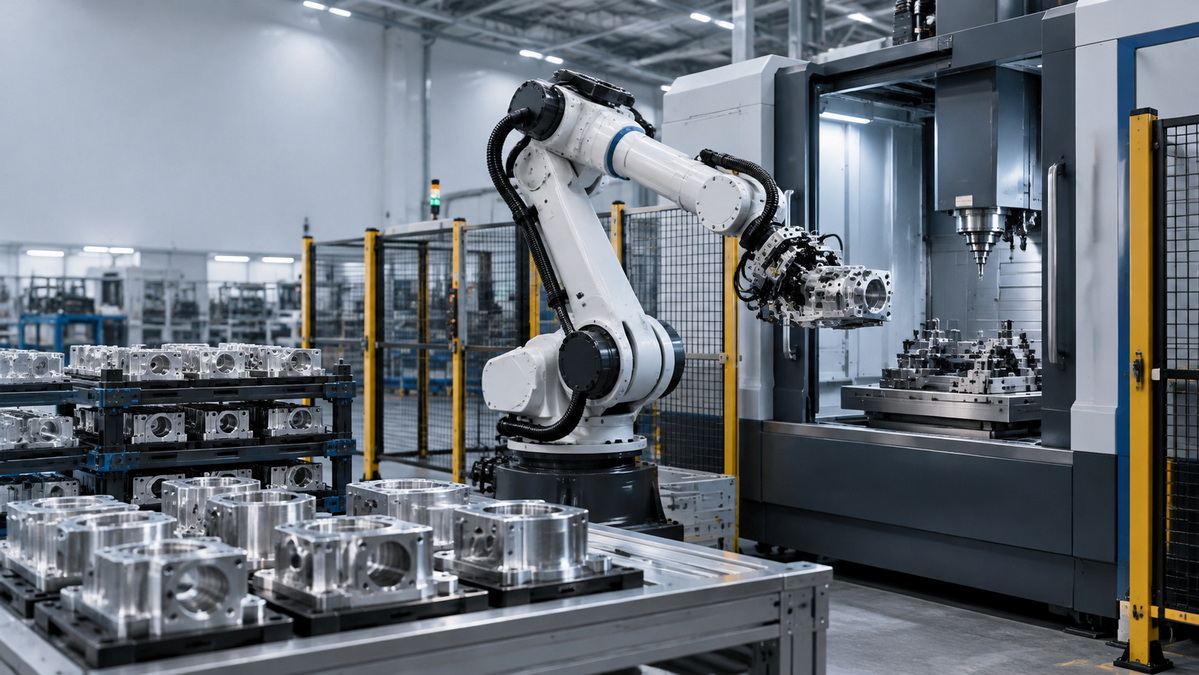
CNC robotics typically combines a CNC machine with a programmable robot that handles supporting tasks. The machine performs milling, turning, drilling, or other programmed operations. The robot moves workpieces between defined locations.
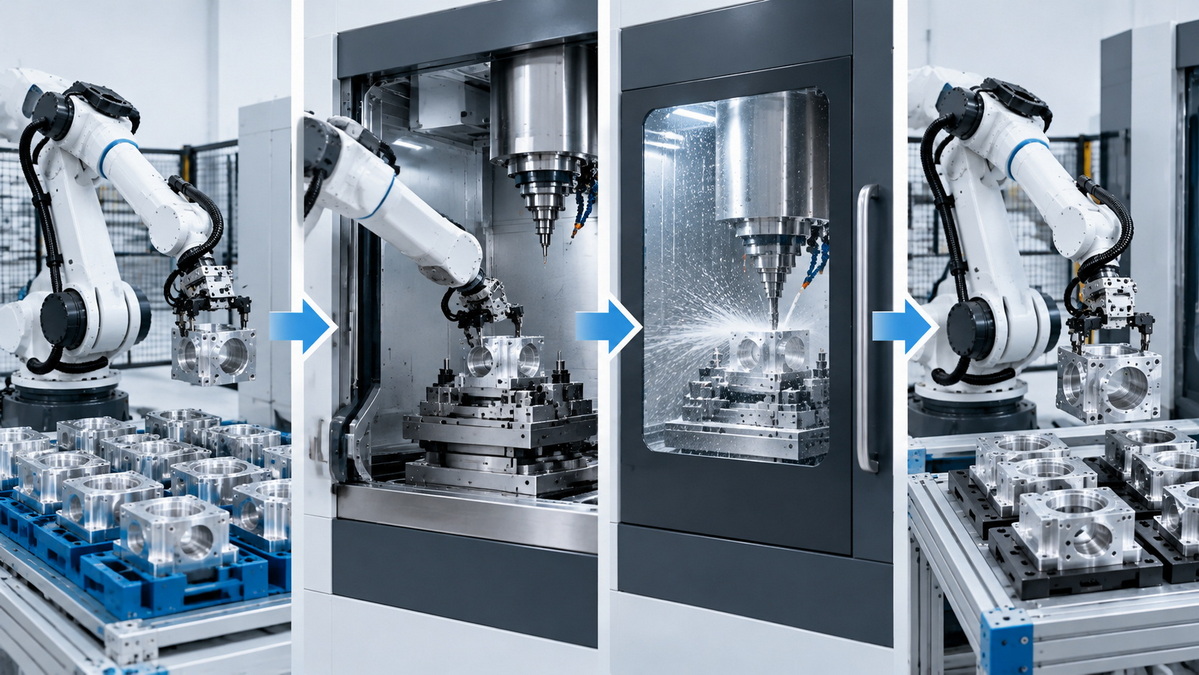
A typical robotic CNC machine-tending cycle includes:
1. Picking a blank from a tray or feeder.
2. Positioning it in a chuck or fixture.
3. Confirming that loading and clamping are complete.
4. Starting the approved machining cycle.
5. Unloading the finished component.
6. Transferring it to inspection, cleaning, or storage.
Some cells also include vision systems, part identification, washing equipment, and automated measurement.
These terms describe different arrangements.
| Approach | What the robot does | Main evaluation priority |
|---|---|---|
| CNC machine tending | Loads and unloads a separate machine tool | Reliable handling and machine communication |
| Robotic machining | Carries a spindle or machining tool | Stiffness, accuracy, cutting forces, and calibration |
| Robotic finishing | Guides deburring, polishing, or similar tools | Contact control and finish consistency |
| Robotic inspection handling | Presents parts to measuring equipment | Orientation, traceability, and measurement reliability |
For precision-part buyers, identifying the arrangement prevents a common misunderstanding: robot positioning performance does not automatically establish finished-part machining accuracy.
The International Federation of Robotics reported in September 2026 that approximately five million industrial robots were operating in factories worldwide in 2025. Annual installations exceeded 600,000 units.
These figures cover industrial robotics broadly, not CNC applications alone. Nevertheless, they show the scale of investment in automated manufacturing.
For machining operations, the practical attraction is straightforward: expensive equipment produces value when it makes acceptable parts, not when it waits for loading.
Robotic loading can reduce variation between cycles, particularly when operators must also inspect parts, replenish materials, or support other machines.
The benefit depends on the bottleneck. Automating loading will not resolve excessive tool changes, unstable cutting conditions, or an overloaded inspection station.
Automation can move employees away from repetitive handling and toward setup, process improvement, inspection, and troubleshooting.
It does not remove the need for expertise. Someone must maintain the cell, manage tooling, interpret quality results, and recover safely from faults.
Automated cells can extend production beyond continuously attended hours. However, unattended operation requires sufficient raw material, tool-life control, chip management, and defined responses to abnormal conditions.
A robot alone does not create a lights-out factory.
The strongest candidates combine stable demand with repeatable handling and a proven machining process.
Useful screening questions include:
- Can the robot grip the blank and finished part securely?
- Is the part orientation predictable?
- Can the fixture locate the component consistently?
- Does the machining cycle leave enough time for supporting tasks?
- Can chips and coolant be managed without frequent intervention?
- Are changeovers manageable across the expected product mix?
High-volume components are obvious candidates, but smaller batches may also work when parts share common gripping surfaces, fixtures, and loading logic.
Conversely, a high-volume part can be difficult to automate if blanks vary significantly or fragile surfaces restrict gripping.
The practical question is not just "How many parts?" It is "How much engineering and changeover effort does each production family require?"
A useful procurement perspective is to treat automation readiness as part of manufacturability.
The drawing defines the finished component. The production system must also accommodate how that component is gripped, located, cleaned, and inspected.
Avoid assigning tight tolerances everywhere without a functional reason.
Identify:
- Critical mating dimensions.
- Datum features.
- Bearing or sealing surfaces.
- Thread requirements.
- Surface-finish requirements.
- Cosmetic areas that must remain unmarked.
This helps the supplier concentrate process controls where they matter.
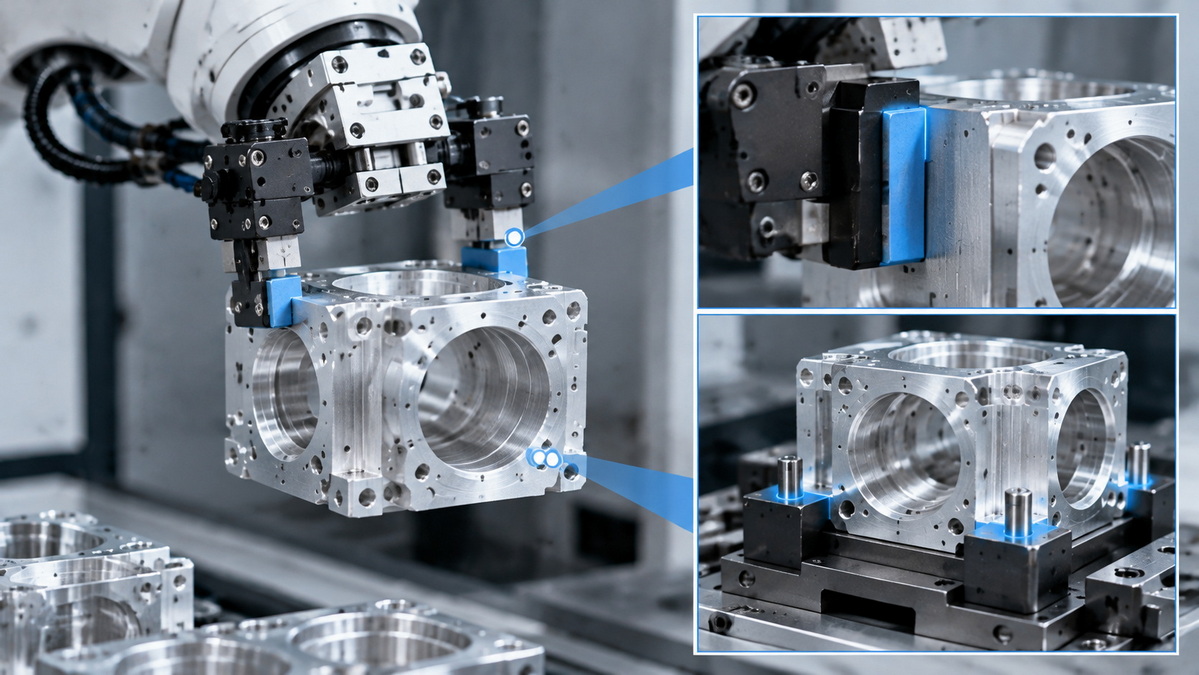
Where the design permits, accessible gripping surfaces and clear locating features can simplify handling.
For delicate or finished surfaces, discuss protective jaw materials, contact locations, and acceptable witness marks before production.
Also distinguish robot repeatability from overall process capability. Final dimensional results depend on the machine, fixture, tool condition, material behavior, thermal effects, and measurement method.
A chip trapped against a locating surface can prevent correct seating. Residual coolant can complicate handling or downstream inspection.
Cleaning should therefore be considered a process requirement, not an optional housekeeping task.
Record cycle time, loading time, scrap, downtime, staffing requirements, and actual output.
Separate machining time from waiting time. Without this distinction, projected improvements can target the wrong constraint.
Resolve recurring dimensional drift, tool breakage, poor chip evacuation, and inconsistent blank quality before automating.
Otherwise, the cell may reproduce defects more consistently rather than prevent them.
Evaluate payload, reach, access, gripping force, and environmental exposure.
Payload calculations must include the gripper, adapters, accessories, and workpiece—not just the component weight.
Check whether the robot can reach the fixture without collisions or awkward configurations.
The robot and machine need an agreed sequence for loading permission, door movement, clamping, cycle completion, and fault handling.
Document what happens when a signal is missing or a part fails to seat. Recovery behavior matters as much as the normal cycle.
Assess the complete application, including the robot, gripper, workpiece, CNC machine, and surrounding equipment.
A collaborative robot does not automatically make every application safe for unrestricted human access.
Test normal production and realistic disruptions:
- Empty or incorrectly loaded trays.
- Misaligned blanks.
- Tool-life limits.
- Gripper faults.
- Inspection failures.
- Restart after an interruption.
Agree on acceptance criteria before approval, including output, quality, changeover time, and operator intervention.
Automation strengthens repeatability only when the underlying controls are appropriate.
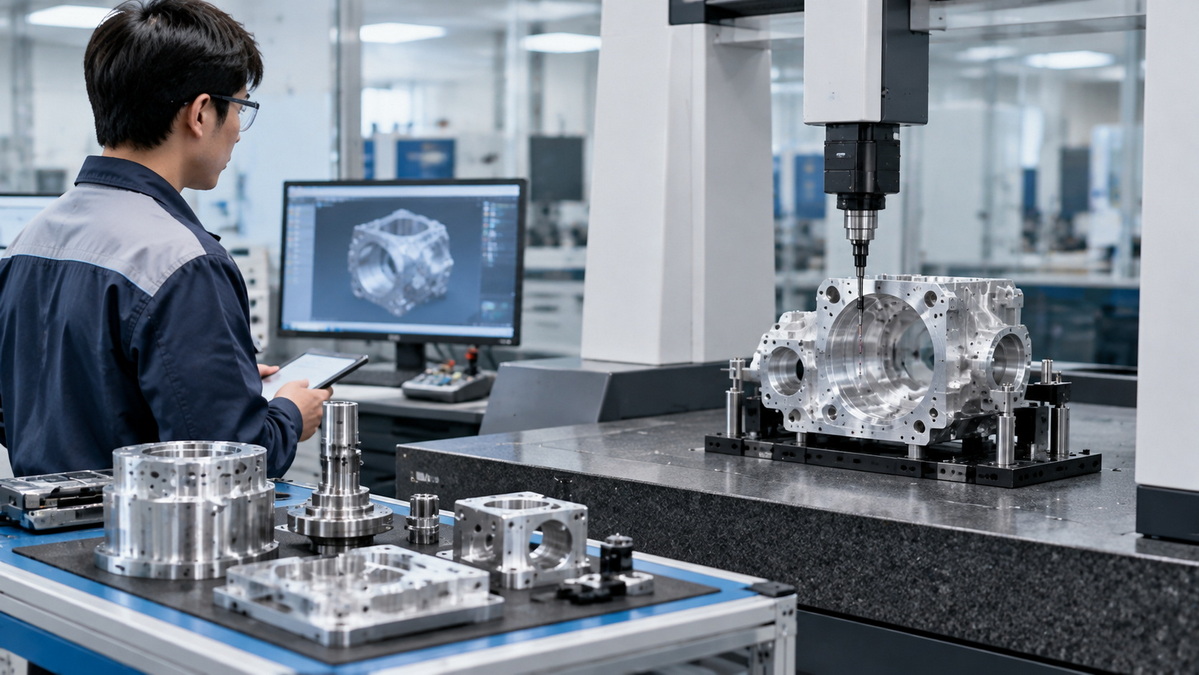
A useful quality plan connects drawing requirements to inspection methods, sampling frequency, and corrective action.
| Control area | What buyers should request |
|---|---|
| Material identity | Agreed material specification and traceability requirements |
| Initial approval | First-article results against identified drawing features |
| Process monitoring | Checks for tool wear, seating, and dimensional drift |
| Measurement | Suitable equipment and defined inspection methods |
| Nonconformance | Segregation, notification, and corrective-action procedures |
| Shipment | Agreed reports, identification, and packaging |
An automated inspection station is not inherently more trustworthy than a well-controlled manual method. Its measurement process still needs validation.
For recurring orders, discuss how the supplier maintains continuity between batches, including fixture condition, program revisions, and inspection records.
Investment decisions should include more than the robot purchase price.
Relevant costs can include:
- Integration and programming.
- Grippers and fixtures.
- Machine-interface modifications.
- Safety equipment.
- Installation and training.
- Maintenance and spare parts.
- Production disruption during commissioning.
Benefits may include reduced handling effort, increased usable capacity, lower scrap, or avoided overtime. Count each benefit once and avoid treating redeployed labor as an automatic cash saving.
Assume an installed cell costs $120,000 and produces $60,000 in annual net benefit after additional operating expenses.
This is an illustrative calculation, not a U-Need quotation or performance promise.
Test a conservative scenario too. Lower demand, slower changeovers, and unexpected intervention can materially extend payback. Additional capacity creates financial value only when it supports a genuine business need.
In a published Universal Robots case study, RCM Industries used collaborative robots to tend CNC lathes.
The application included pre-positioning parts, loading successive chucks, and transferring completed components. Force-torque sensing supported alignment and detection of loading problems.
RCM's engineering and technology director reported an immediate throughput increase of approximately 15%.
The useful lesson is not that every installation will achieve that result. It is that consistent handling can improve output when variable loading interrupts an otherwise productive process.
Because this is a robot supplier's published case study, buyers should treat it as application evidence—not an independent benchmark or guaranteed return.
Robotic automation introduces hazards as well as reducing exposure to repetitive tasks.
Potential risks include crushing, trapping, unexpected motion, dropped workpieces, and contact with sharp components.
Safety evaluation should cover production, setup, cleaning, maintenance, and fault recovery.
Ask the responsible integrator or supplier to explain:
- Who conducts the application risk assessment.
- How access and hazardous motion are controlled.
- How emergency stops and machine interlocks function.
- Which tasks require energy isolation.
- How employees are trained and authorized.
- How modifications trigger reassessment.
Never bypass safeguards to recover production faster. Follow applicable regulations, validated procedures, and equipment-specific instructions.
U-Need is a precision manufacturing partner in China serving global brands, distributors, and manufacturers.
Our end-to-end manufacturing offering includes:
- Custom precision parts machining.
- Injection mold manufacturing.
- Stamping dies and cold-forging dies.
- Sheet metal laser cutting, bending, and stamping.
These capabilities support sourcing discussions across machined components, tooling, and fabricated parts.
Manufacturing capability should not be confused with robotic-cell integration. Any project requiring automation engineering, particular equipment, or specific inspection documentation should have that scope confirmed individually.
Send your drawings and available 3D models with:
- Material grade and finish.
- Critical dimensions and functional requirements.
- Prototype quantity and expected repeat demand.
- Inspection and traceability expectations.
- Delivery requirements.
- Any automated assembly or handling constraints.
Contact U-Need with this information to request a project-specific quotation and clarify the proposed manufacturing route, quality documentation, and delivery scope before ordering.
CNC automation is the broader category. It includes bar feeders, pallet systems, automated measurement, and robotic handling. CNC robotics specifically involves a programmable robot within the manufacturing workflow.
It can improve handling consistency and reduce some loading-related errors. It does not automatically improve the machine tool's cutting accuracy. Fixtures, tooling, thermal conditions, and process controls remain essential.
No. Safeguarding depends on the complete application and its risk assessment. The gripper, component geometry, machine hazards, and operating conditions can require additional protective measures.
Sometimes. Shared fixtures, reusable programs, standardized blanks, and fast changeovers can make smaller batches practical. Frequent redesigns and complex handling may weaken the business case.
Yes, where reach, layout, loading sequences, and cycle timing permit. Evaluate whether the robot becomes a bottleneck and how one machine's interruption affects the others.
Verify the proposed process, inspection approach, capacity assumptions, change-management procedures, and commercial scope. Request evidence relevant to your component rather than relying on general automation claims.
1. [Topsbest Precision — "CNC Robotics and Automated Machining."] Original topic reference; indexed material was available, but the complete page could not be retrieved for a detailed textual audit. [topsbest-precision]
2. [International Federation of Robotics — "World Robotics 2026 Report" announcement, September 24, 2026.] Source for approximately five million operating industrial robots and more than 600,000 installations in 2025. These figures describe industrial robotics overall. [ifr]
3. [Universal Robots — "Machine Tending."] Application overview covering CNC loading, unloading, end-of-arm tooling, and integration considerations. [universal-robots]
4. [Universal Robots — RCM Industries: "Precise and cost-effective UR cobots enable increased output."] Manufacturer-published customer case supporting the described workflow and reported 15% throughput improvement. [universal-robots]
5. [Occupational Safety and Health Administration — OSHA Technical Manual, Section IV, Chapter 4: "Industrial Robot Systems and Industrial Robot System Safety."] Technical guidance covering integrated robot systems, risk assessment, safeguards, and employee training. [osha]
6. [Occupational Safety and Health Administration — "Robotics: Overview."] Background on robotic applications and hazards during programming, maintenance, testing, setup, and adjustment. [osha]


