Views: 249 Author: U-Need Publish Time: 2026-07-12 Origin: Site
Content Menu
● What Is CNC Robotics in Modern Manufacturing?
● Why CNC Machining Is Ideal for Robotic Parts
>> 2. Dimensional Accuracy and Repeatability
>> 3. Material Compatibility for High‑Performance Robots
>> 4. Controlled Surface Finish
● Common Robotic Components Produced via CNC Machining
>> Jigs, Fixtures, and Workholding
>> Sensor Housings and Controller Components
● Key Robotics Types Used Around CNC Machines
>> Articulated Industrial Robots
>> SCARA Robots
>> Delta Robots
● Advantages of Robotics in CNC Machining Cells
>> Fast and Consistent Production
>> Enhanced Surface Quality and Process Control
>> Multi‑Tasking and Lights‑Out Operation
● CNC Machines vs. CNC Robotics: Capabilities and Limits
● 2026 Trends in CNC Robotics and Precision Machining
>> AI‑Driven CNC Automation and Digital Twins
>> Market Growth for CNC Machines
>> Cobots, Vision Systems, and Remote Service
● Practical Roadmap: How Manufacturers Can Implement CNC Robotics
>> Step 1 – Connect Machines and Collect Data
>> Step 2 – Introduce Robot‑Assisted Loading and Unloading
>> Step 3 – Optimize Fixtures and End Effectors via CNC
>> Step 4 – Integrate Vision and In‑Cell Quality Control
>> Step 5 – Expand Toward Lights‑Out Manufacturing
● How a Precision Partner in China (U‑Need) Adds Value
CNC robotics is no longer a niche innovation – it is the backbone of modern precision manufacturing, enabling global brands to scale production, stabilize quality, and unlock true lights‑out factories. For OEMs, distributors, and engineering teams, the real advantage now lies in how strategically you combine CNC machining, industrial robotics, and expert suppliers in China like U‑Need to build robust, automated production cells. [cnccode]
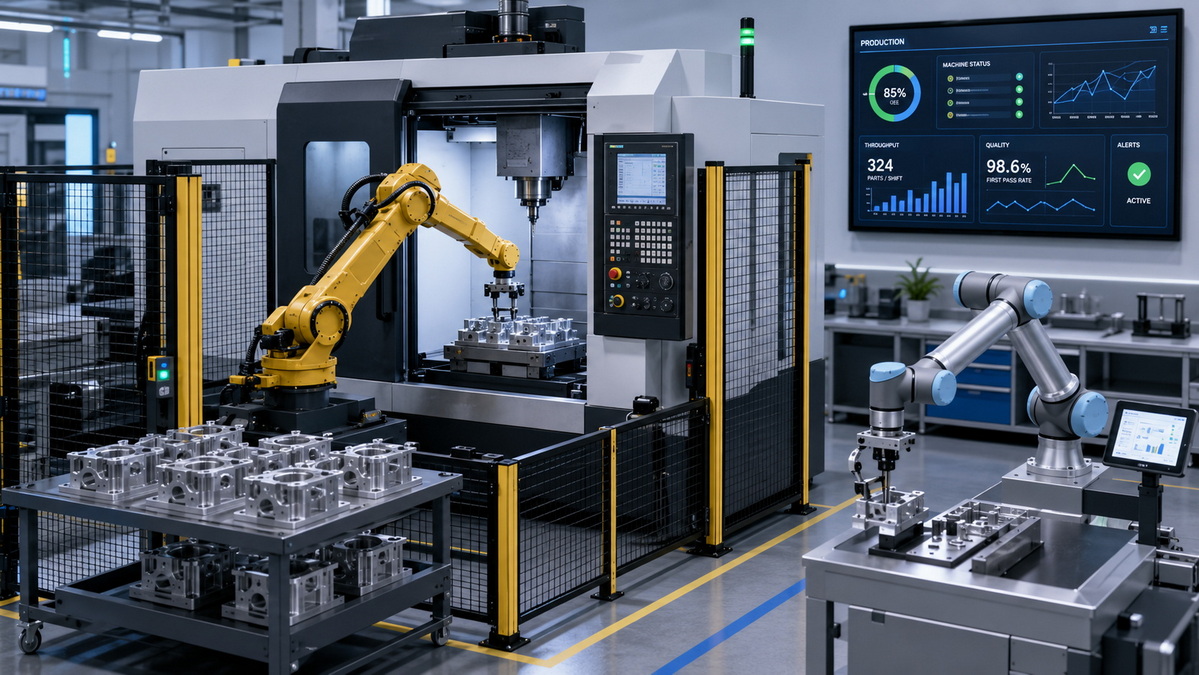
CNC robotics refers to the integration of industrial robots and collaborative robots (cobots) with CNC machines to automate tasks such as loading, unloading, part transfer, inspection, and post‑processing. In practice, a CNC robot is any programmable robotic system dedicated to machining workflows, executing tasks autonomously based on pre‑defined protocols and sensor feedback. [sdmsrobotics]
In 2025–2026, CNC robotics sits at the core of Industry 4.0: connected CNC machines, robots, and software platforms work together as a single cyber‑physical system, communicating with MES/ERP, digital twins, and AI analytics. This shift is driving a new generation of factories that move from operator‑driven machining to self‑regulating, data‑driven production ecosystems. [taikanmachine]
CNC machining is one of the fastest ways to produce custom robotic components, from prototype to low‑volume production. Well‑optimized CNC cells routinely deliver robotic parts within 1–3 days, depending on part complexity and material. [in-xmachineinc]
Key speed advantages include:
- Rapid iterations for design changes and functional testing. [cnccode]
- Stable cycle times suitable for automated robot tending. [easyrobotics]
- Seamless scaling from prototype to bridge production without switching processes. [tuofamachining]
Robotics demands tight tolerances to ensure precise, repeatable motion, especially in joints, bearings, and linear guides. High‑end CNC precision machining can routinely achieve tolerances of around ±0.0002 inches, enabling smooth, backlash‑controlled movement in critical robotic assemblies. [in-xmachineinc]
This level of precision:
- Stabilizes kinematic performance over long duty cycles. [cnccode]
- Reduces wear on joints and sliding surfaces. [cnccode]
- Minimizes rework and scrap in downstream assembly. [coherentmarketinsights]
Robots increasingly rely on high‑strength, lightweight materials such as aluminum alloys, titanium, hardened steels, engineering plastics, and composites. CNC machining excels at processing these materials, maintaining tight tolerances and consistent surface finishes even on difficult‑to‑cut alloys. [tuofamachining]
Typical material choices for robotic parts include:
- Aluminum alloys for structural arms and brackets (excellent strength‑to‑weight). [in-xmachineinc]
- Tool steels and stainless steels for wear‑critical interfaces and grippers. [cnccode]
- Engineering plastics (e.g., POM, PA, PEEK) for low‑friction bushings and covers. [in-xmachineinc]
Interacting robot components need low friction, predictable surface roughness, and corrosion resistance. CNC machining can achieve surface roughness values around Ra 0.8 µm or lower, which is suitable for sliding surfaces, precision guides, and sealing interfaces. [in-xmachineinc]
Additional surface finishing operations, such as anodizing, hardening, bead blasting, and coating, further enhance durability and aesthetic appearance. [tuofamachining]
Robotics and CNC machining intersect in two directions: CNC machines make robotic parts, and robots automate CNC machining cells. [piprecision-cnc]
Robotic arms function as the primary motion structure for industrial robots and cobots, mirroring human arm movements to perform tasks such as loading, welding, or assembly. These arms are typically machined from: [easyrobotics]
- High‑strength aluminum for lightweight yet rigid structures. [cnccode]
- Steel or stainless steel for heavy‑duty applications and harsh environments. [cnccode]
Precision CNC machining ensures reliable reach, rigidity, and repeatable motion with minimal deflection under load. [in-xmachineinc]
End effectors attach to the ends of robotic arms to perform specific tasks – gripping, clamping, suction, or specialized tooling. Most modern grippers, grabbers, and vacuum devices rely on CNC‑machined housings, jaws, fingers, and mounting plates to achieve high stiffness and long‑term durability. [sdmsrobotics]
CNC machining allows:
- Custom finger geometries for unique part shapes. [cnccode]
- Integrated channels for pneumatics or vacuum. [cnccode]
- Fast adaptation to new product lines without full redesign of the robot. [sdmsrobotics]
Robot‑assisted CNC cells require custom jigs and fixtures to locate and secure workpieces consistently. CNC machining is the most cost‑effective method to produce these fixtures, because: [cnccode]
- Tolerances directly influence accuracy of automated loading. [cnccode]
- Design changes can be quickly implemented and tested. [tuofamachining]
- Robust materials ensure fixture stability over long production runs. [cnccode]
Robotic sensors, controllers, and PCB‑based modules often need CNC‑machined enclosures, mounting brackets, and heat‑dissipating structures. While PCB traces are historically produced via chemical etching, CNC machining now helps manufacture precision PCB outlines, slots, and cutouts without relying on hazardous chemicals. [tuofamachining]
CNC robotics is not just about the parts – it's about the robots that work with CNC machines to build fully automated cells. [easyrobotics]
Articulated robots feature multiple rotary joints (axes) and are the most widespread in industrial environments. Depending on the configuration, they range from simple two‑axis arms to complex systems with 10+ axes for extensive flexibility. [cnccode]
Typical CNC‑related applications:
- Machine loading and unloading. [cnccode]
- Material handling and part transfer. [cnccode]
- Packaging and palletizing downstream of machining cells. [easyrobotics]
SCARA (Selective Compliance Articulated Robot Arm) robots provide high‑speed, four‑axis motion tailored for repetitive, light‑payload operations. They combine fast horizontal motion with limited vertical compliance, making them ideal for: [cnccode]
- Assembly and micro‑assembly near CNC lines. [cnccode]
- Pick‑and‑place tasks with short cycle times. [cnccode]
- High‑speed packaging and inspection. [sdmsrobotics]
Delta robots are parallel‑kinematic robots with a characteristic inverted triangular frame mounted above conveyor lines. Their lightweight design allows extremely fast pick‑and‑place operations, particularly for: [cnccode]
- Sorting small machined parts. [cnccode]
- Packaging components leaving CNC cells. [easyrobotics]
- High‑speed assembly in consumer goods and electronics. [sdmsrobotics]
Gantry (Cartesian) robots move along three linear axes (X, Y, Z), often spanning large work envelopes above CNC machines or production lines. They are ideal for: [cnccode]
- Heavy workpiece handling and pallet transfer. [cnccode]
- Large‑format machining support and cutting systems (laser, waterjet). [v-techsro]
- Flexible automation with adjustable stroke length, precision, and speed. [cnccode]
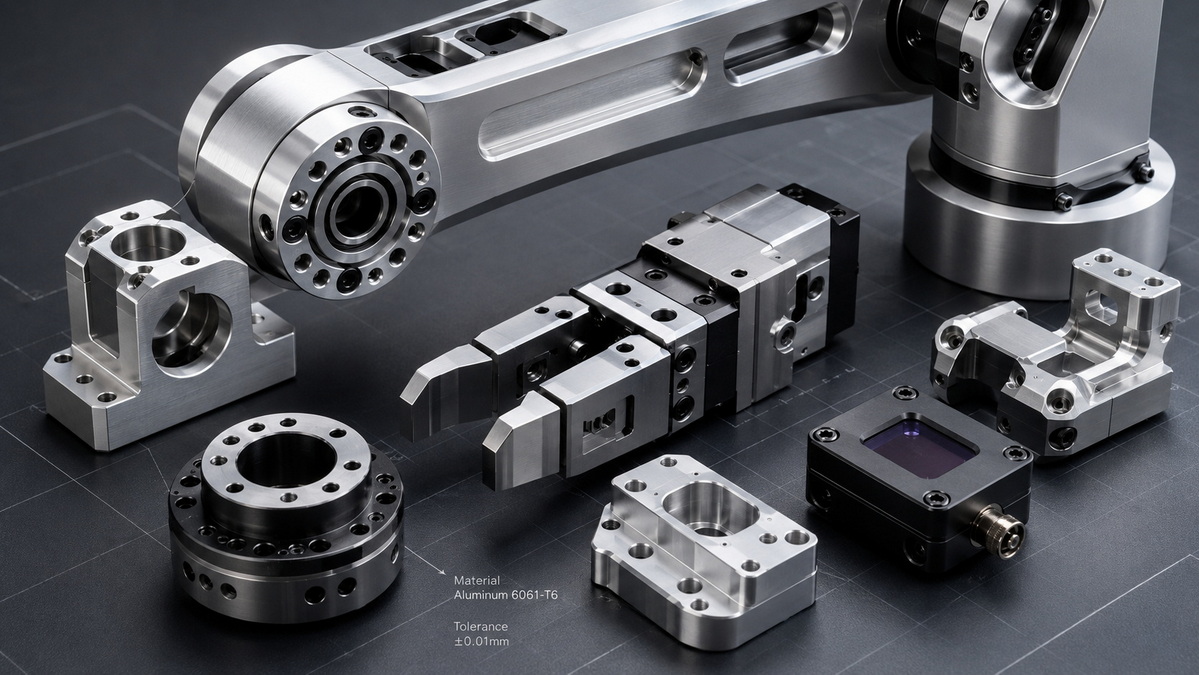
When robots are integrated with CNC machines, manufacturers gain four major performance advantages. [easyrobotics]
Robots maintain highly consistent cycle times, grabbing, loading, and unloading workpieces at the same speed hour after hour. This removes bottlenecks caused by human fatigue or operator availability and accelerates time‑to‑market. [easyrobotics]
Robotic loaders can reach ±1 mm positioning accuracy for loading and unloading routines, which is enough for most CNC workholding systems when paired with properly designed fixtures. This accuracy stabilizes machining results and reduces human‑induced variability. [piprecision-cnc]
Robots ensure consistent handling pressures, motions, and timing, which contributes to more predictable surface finishes when combined with finely tuned CNC parameters. Automated deburring, polishing, and cleaning operations can also be performed robotically for uniform surface quality. [piprecision-cnc]
While CNC machines cut, drill, or turn, robotic arms can simultaneously:
- Load the next job into a queue. [cnccode]
- Pack finished parts. [cnccode]
- Perform in‑cell quality checks using vision systems or probes. [sdmsrobotics]
This multi‑tasking capability is key for lights‑out machining, where entire shifts run with minimal human presence. [easyrobotics]
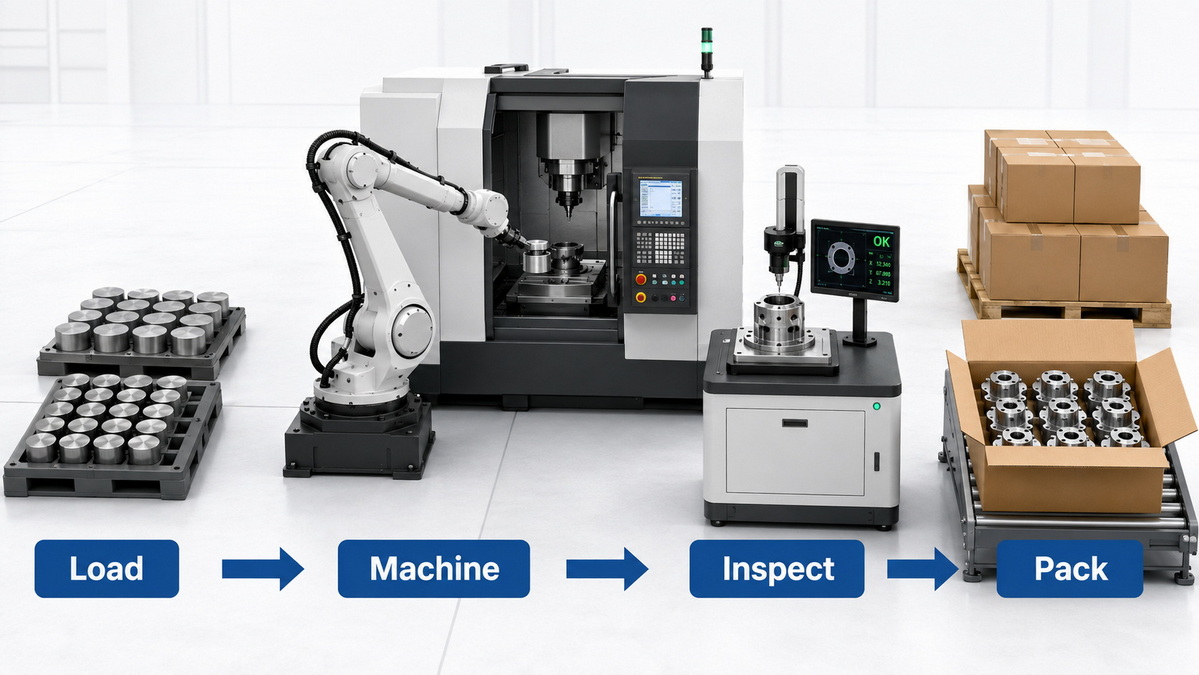
It is tempting to ask whether robots will simply replace CNC machines, but reality is more nuanced. [cnccode]
Industrial robots have improved significantly, achieving 0.1–0.2 mm precision under optimal conditions. However, high‑end CNC machines still deliver 0.02–0.05 mm accuracy, and specialized Swiss‑type lathes reach ±0.0002 mm, far beyond typical robot capabilities. [sdmsrobotics]
The underlying reason is rigidity:
- Robot stiffness is typically below 1 Newton per micrometer, which limits performance on hard metals. [cnccode]
- CNC machine tools exceed 50 Newtons per micrometer, enabling aggressive cutting strategies with high accuracy on difficult materials. [tuofamachining]
Robots are inherently versatile, offering multiple degrees of freedom, sometimes more than six axes, and large workspaces up to 7 cubic meters or more. CNC machines, by contrast, specialize in cutting operations with fewer axes but much higher rigidity and precision. [taikanmachine]
Both robots and CNC machines represent significant capital investments. However, robots can deliver greater value per unit cost when used to automate multiple tasks, handle varied part families, and cover large work envelopes. CNC machines still dominate high‑precision cutting, making the combination of both technologies the most effective strategy. [easyrobotics]
Conclusion: robots will not replace CNC machines; instead, CNC machines + robotics form a complementary system where each plays to its strengths. [cnccode]
To go beyond the original article and meet Google E‑E‑A‑T expectations, it's crucial to connect CNC robotics to current industry trends and data. [taikanmachine]
Between 2025 and 2026, CNC automation has entered a phase where AI‑controlled machining and real‑time digital twins are becoming mainstream in advanced factories. [tuofamachining]
Key developments:
- AI models adjust spindle speed, toolpaths, and coolant pressure in real time based on chip load and vibration. [cnccode]
- Digital twins mirror live CNC states – spindle loads, vibration, power usage – enabling predictive optimization with micron‑level accuracy. [taikanmachine]
- Predictive maintenance uses IIoT sensors to reduce unexpected downtime on expensive multi‑axis machines. [tuofamachining]
The global CNC machine market is estimated to reach around USD 96–93 billion in 2026, with a steady CAGR driven by demand for precision manufacturing in aerospace, medical, and advanced mobility sectors. This growth aligns with increased investment in robot‑tended CNC cells, not just standalone machines. [coherentmarketinsights]
Collaborative robots are becoming more flexible due to clearer international safety standards, allowing entire production cells to be classified as collaborative workspaces. At the same time: [sdmsrobotics]
- AI‑based vision systems can now identify and handle diverse part families, not just single product types. [automate]
- Remote robot support allows integrators to diagnose and fix integration issues without visiting the facility physically. [sdmsrobotics]
These trends make CNC robotics more accessible to mid‑size manufacturers, not just large OEMs. [easyrobotics]

To create unique value beyond competitors, it helps to translate theory into a step‑by‑step adoption roadmap for CNC robotics in precision manufacturing. [tuofamachining]
Start by connecting CNC machines to basic monitoring platforms to track:
- Spindle utilization. [cnccode]
- Tool wear and breakage events. [tuofamachining]
- Job queue performance and changeover times. [cnccode]
This single step exposes bottlenecks and reveals where robotics can deliver the highest ROI.
Implement articulated robots or cobots for:
- Loading raw materials or blanks into CNC machines. [easyrobotics]
- Unloading finished parts onto conveyors or inspection stations. [cnccode]
Focus on stable, repeatable tasks first, ensuring safe interaction between humans, robots, and machines.
Use CNC machining to produce custom fixtures and end effectors that:
- Locate parts precisely for robotic loading. [cnccode]
- Handle different shapes and materials with minimal changeover. [sdmsrobotics]
Well‑designed fixtures and grippers are often the difference between successful and unreliable automation.
Add vision systems and probing routines to allow robots to:
- Verify part orientation and presence before loading. [piprecision-cnc]
- Perform basic dimensional checks or surface inspections. [sdmsrobotics]
Closed‑loop inspection reduces scrap and prevents defective parts from leaving the cell. [cnccode]
Once basic tasks are automated and data flows are stable, extend automation to:
- Night shifts with minimal human oversight. [cnccode]
- Automated palletizing and packaging for downstream logistics. [easyrobotics]
- Predictive maintenance scheduling based on machine health data. [tuofamachining]
At this point, CNC robotics becomes a strategic advantage, not just an operational improvement.
For global brands, distributors, and manufacturers, working with a trusted precision partner in China is crucial to executing CNC robotics strategies effectively. A supplier like U‑Need, offering custom precision parts machining, mold manufacturing, and sheet metal fabrication, can support: [in-xmachineinc]
- CNC‑machined robotic parts (arms, brackets, grippers, fixtures) with tight tolerances. [in-xmachineinc]
- Injection molds, stamping dies, and cold‑forging dies that underpin high‑volume component production for robot systems. [tuofamachining]
- Sheet metal laser cutting, bending, and stamping for robot frames, cabinets, safety enclosures, and machine guarding. [v-techsro]
With a vetted engineering team, robust QC/QA workflows, and digital DFM feedback, such partners reduce risk, shorten lead times, and align production with global quality standards. [in-xmachineinc]
Q1: Will CNC robots ever fully replace CNC machines?
No. Robots excel at handling, flexibility, and workspace coverage, but modern CNC machines still offer much higher rigidity and cutting accuracy. The most competitive factories combine both technologies in integrated cells. [tuofamachining]
Q2: Which robot type is best for CNC machine tending?
Articulated robots and cobots are most common for CNC machine tending because they provide sufficient reach, multiple degrees of freedom, and safe human‑robot collaboration. Gantry robots are ideal when payloads are heavy or work envelopes are large. [easyrobotics]
Q3: How tight do tolerances need to be for robotic joints?
Critical joints and linear guides typically require tolerances down to tens of microns. CNC precision machining can deliver tolerances around ±0.0002 inches, which is suitable for high‑performance robotic assemblies and smooth motion. [in-xmachineinc]
Q4: Is CNC robotics only relevant for large manufacturers?
No. Falling robot costs, cobot platforms, and modular automation cells make CNC robotics accessible to mid‑size and even smaller shops. Starting with simple machine tending can deliver clear ROI without full factory redesign. [sdmsrobotics]
Q5: How can I evaluate a CNC robotics supplier in China?
Assess their machining tolerances, materials expertise, certifications, DFM support, and ability to provide end‑to‑end solutions (precision parts, molds, sheet metal, and surface finishing). Ask for sample quality reports and case studies in robotics or automation industries. [in-xmachineinc]
1. RapidDirect. "CNC Robotics: CNC Machining and Automated Robots."
https://www.rapiddirect.com/blog/cnc-robotics/ [cnccode]
2. CNC Automation & Industry 4.0 Trends (2025–2026).
https://cnccode.com/2025/12/03/how-cnc-automation-and-industry-4-0-will-transform-manufacturing-by-2026-real-data-machine-trends [cnccode]
3. SDMS Robotics. "The State of CNC‑Robotics Integration in 2026."
https://sdmsrobotics.com/cnc-robotics-industry-trends-2026/ [sdmsrobotics]
4. Coherent Market Insights. "Computer Numerical Control Machine Market."
https://www.coherentmarketinsights.com/market-insight/computer-numerical-control-machine-market-6072 [coherentmarketinsights]
5. In‑X Machine Inc. "2026 Advancements in Precision CNC Machining."
https://in-xmachineinc.com/blogs/2026-precision-cnc-machining-advancements/ [in-xmachineinc]
6. Tuofa Machining. "Top CNC Machining Trends for 2026."
https://www.tuofamachining.com/news/future-of-manufacturing-top-cnc-machining-trends-for-2026-283693.html [tuofamachining]
7. EasyRobotics. "Industrial Robotics Trends 2026: How Cobot Automation Changes Manufacturing."
https://easyrobotics.biz/blogs/industrial-robotics-trends [easyrobotics]
8. Automate.org. "Tech Papers: Robotics Trends and Predictions for 2026."
https://www.automate.org/robotics/tech-papers/predictions-that-are-reshaping-robotics-in-2026 [automate]
9. PiPrecision CNC. "CNC Machining for Robotics: Materials, Tolerances, DFM Tips."
https://piprecision-cnc.com/blogs/cnc-machining-for-robotics [piprecision-cnc]
10. V‑Tech SRO. "Smart Clamping Systems and CNC Technology Trends 2026."
https://v-techsro.cz/news/trends-cnc-technlogy-2026 [v-techsro]


