Views: 246 Author: U-Need Publish Time: 2026-07-14 Origin: Site
Content Menu
● What Is a Die Casting Mold and Why It Matters
● Core Components of a Die Casting Mold
● Types of Die Casting Molds and When to Use Each
● How Experts Design a Die Casting Mold: Step‑by‑Step
>> 1. Manufacturability and preliminary assessment
>> 2. Defining cavities and projection area
>> 3. Sizing volume, injection channels, and overflows
>> 4. Simulation and iterative refinement
>> 5. Tool build, trials, and validation
● Key Design Factors That Make or Break Die Casting Molds
● Industry Trends: Smarter, Greener Die Casting Molds
● How U‑Need Supports High‑Precision Die Casting Molds
>> Integrated capabilities for complex programs
>> Precision, lead times, and quality control
● Practical Steps to Source Die Casting Molds from China
● FAQs About Die Casting Molds and Precision Manufacturing
U-Need is uniquely positioned to help international buyers design and source high‑performance die casting molds and precision metal parts from China, combining expert tooling design with ultra‑tight tolerances and fast, reliable production. This guide reframes die casting mold tooling from a practitioner's perspective, showing how to go from concept to qualified tooling while minimizing risk, cost, and lead time. [heli-mould]
In high‑pressure die casting, the mold (or "die") defines not only the shape of your part, but also its dimensional stability, mechanical performance, and surface finish over the entire life of the program. A well‑engineered die casting mold can deliver consistent, repeatable parts across tens or hundreds of thousands of shots, while a poorly designed mold will drive up scrap, downtime, and corrective tooling costs. [gmmoldtech]
From an engineering and sourcing perspective, the mold is best viewed as a precision machine tool: a multi‑component assembly that must control molten metal flow, venting, cooling, and ejection in a tightly coordinated way. This is why experienced OEMs no longer treat die casting molds as a one‑time purchase, but as a strategic asset that deserves the same level of design review and lifecycle planning as any critical piece of production equipment. [moldiecasting]
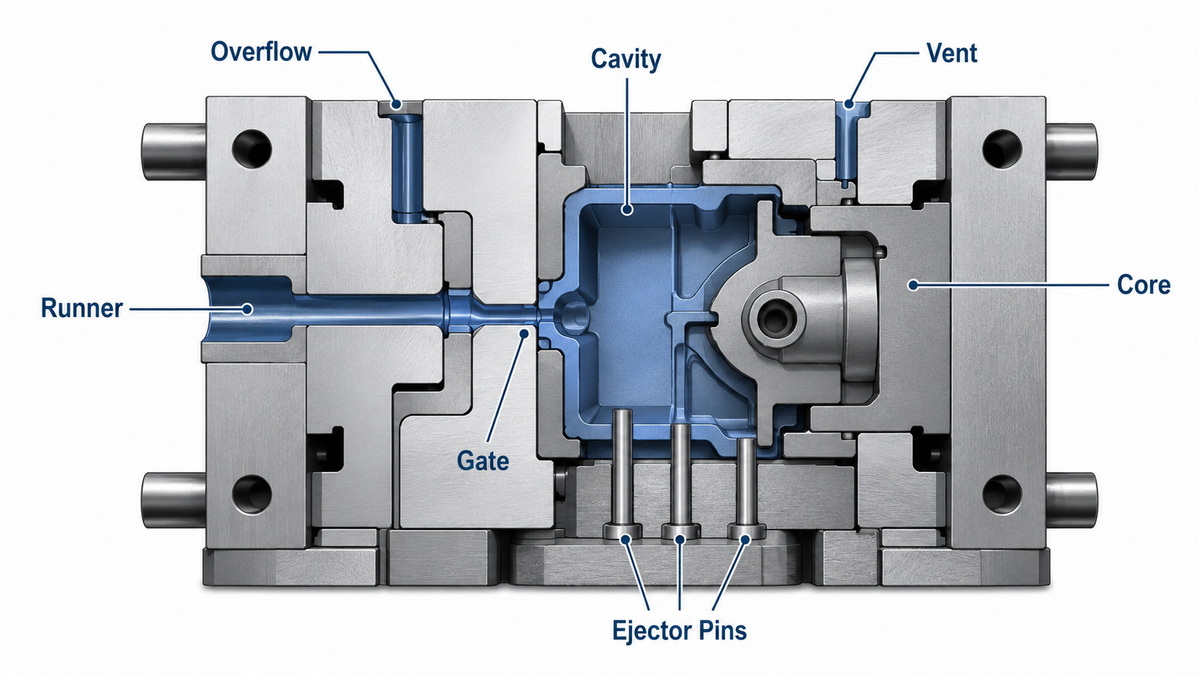
A modern die casting mold is more than just a cavity cut into steel; it is a complete tooling system designed around your part and your process. Understanding its key components will make design reviews and supplier discussions far more productive. [heli-mould]
- Molding system – Includes the cavity, core, inserts, sliders, and core pins that create the actual part geometry. These elements must be designed for uniform metal flow, controlled shrinkage, and reliable ejection without galling or flash. [gmmoldtech]
- Mold base system – Steel plates and frames that hold all working inserts and allow accurate mounting on the die casting machine, often with standardized sizes for easier maintenance and replacement. [moldiecasting]
- Ejection system – Ejector pins, return pins, and guide elements that push the solidified casting out of the die while protecting critical surfaces from deformation. [heli-mould]
- Runner system – Sprue, runner, and gate network that delivers molten metal into the cavity at controlled speed and pressure, heavily influencing porosity, cold shuts, and surface finish. [amfasinternational]
- Overflow and venting system – Overflow pockets and vent slots that capture the first, colder metal and expel trapped air and gases, which is crucial for both strength and cosmetic quality. [gmmoldtech]
- Ancillary elements – Positioning components, fasteners, slide mechanisms, and cooling channels that ensure repeatable alignment, heat extraction, and long‑term durability. [moldiecasting]
Experienced tooling engineers, including U‑Need's in‑house team, treat these subsystems as levers they can tune to support different priorities such as cycle time, cosmetic appearance, or fatigue life. [zintilon]
Choosing the right type of die casting tooling is one of the earliest decisions that will shape your project budget and schedule. Below are the most common categories and where they fit in a typical product lifecycle. [heli-mould]
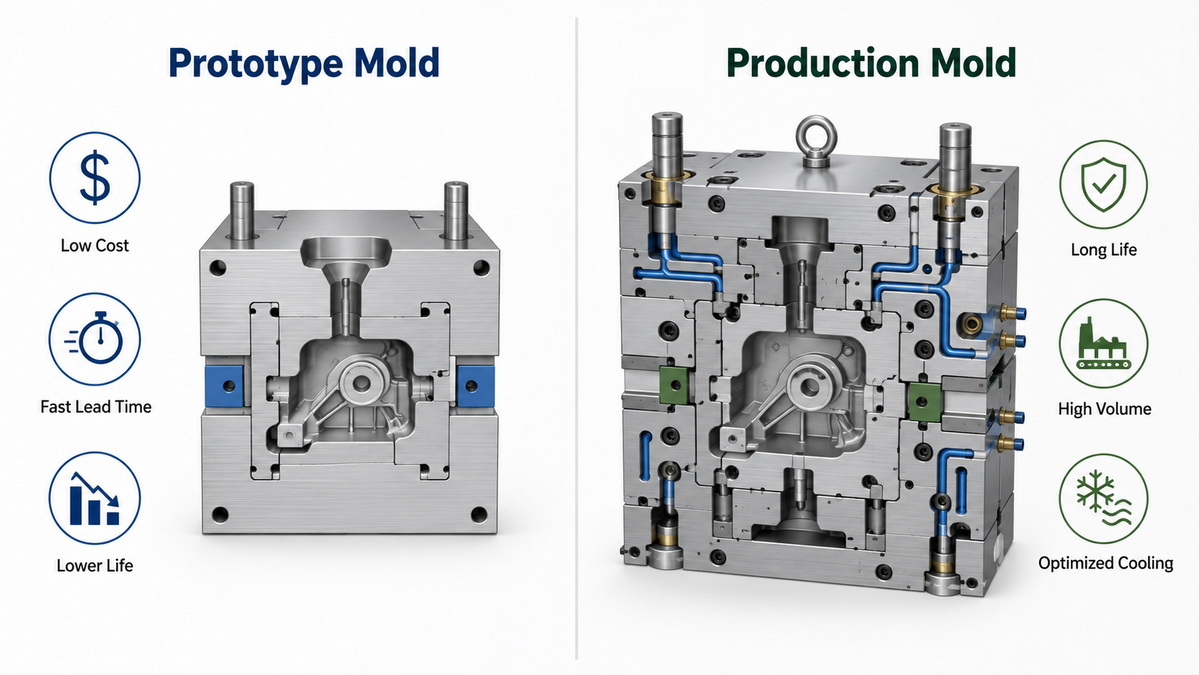
Prototype dies are used to validate form, fit, and function using the same or similar alloy and process conditions as mass production, but with simplified construction and shorter life. They often use pre‑hardened, uncoated tool steels and less optimized ejection or cooling, trading ultimate durability for shorter lead time and lower upfront investment. [heli-mould]
For engineering teams, prototype dies are ideal when you need a few hundred to a few thousand parts to validate assembly interfaces, thermal behavior, or mechanical performance before committing to a full production tool. [amfasinternational]
Rapid tooling refers to dies or inserts produced with processes like selective laser sintering or direct metal deposition, which dramatically shorten lead time compared with traditional machining only. These tools can serve as bridge solutions between 3D‑printed prototypes and long‑life production tools, especially when your design is still evolving but you need production‑like parts quickly. [kbrbuild]
Production dies are the workhorses of high‑volume die casting, designed for long life, tight tolerance control, and reliable automation. They are typically made from high‑grade tool steels with optimized cooling circuits, robust slide mechanisms, and refined gating and venting layouts. [moldiecasting]
Common variants include single‑cavity dies for larger parts and multi‑cavity dies for smaller components where output per shot is critical. As a rule of thumb, the more cavities you add, the more attention you must pay to balance filling, ejection, and maintenance accessibility. [gmmoldtech]
Unit dies are modular cavity blocks that fit into a common holder, making them suitable for low‑volume, less complex parts where tooling cost control matters more than ultimate productivity. Trim dies, in contrast, are complementary tools used to remove flash, runners, and overflows from castings, and are essential for automated high‑volume operations. [moldiecasting]
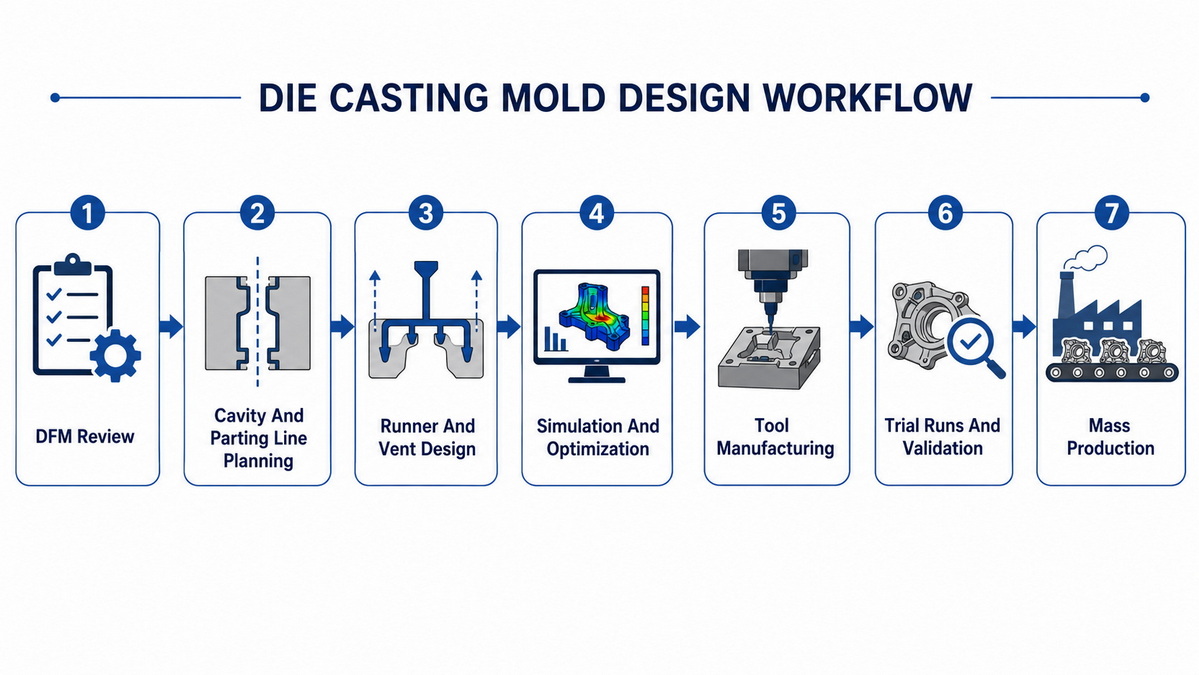
From a tooling engineer's standpoint, a "good" die is not an accident; it is the result of a disciplined design process. When I review or commission die casting molds for OEM programs, the workflow typically follows the steps below. [heli-mould]
Design starts with assessing whether the part is truly die‑castable: wall thickness distribution, draft angles, undercuts, and tolerance stack‑ups all need to be evaluated against the realities of molten metal flow and solidification. This phase also includes checking required annual volumes, alloy selection, and cosmetic requirements so the tooling concept matches business goals. [amfasinternational]
The number of cavities is determined by required output, target cycle time, and machine capacity, with projection area used to estimate clamping force and prevent flash. Under‑estimating this step is a common reason why lower‑cost dies later struggle with burrs, leakage, or premature wear on parting lines. [gmmoldtech]
Tool designers then optimize the die volume and runner system, sizing gates and channels to manage metal velocity, turbulence, and temperature gradients. Strategically placed overflows and vents capture colder first metal and drive trapped air out of critical sections, which strongly affects porosity and fatigue life. [amfasinternational]
Today, best‑in‑class suppliers use flow and solidification simulation to predict filling behavior, hot spots, and potential defects before cutting steel. By adjusting gate locations, fill times, and cooling circuits in simulation, they can often reduce trial‑and‑error loops on the shop floor and shorten the time to stable production. [kbrbuild]
Once design is frozen, the die is manufactured, assembled, and run through a series of trials, from first shot to capability studies on critical dimensions. At this stage, collaboration between the toolmaker and your engineering team is essential to align on acceptable deviations, necessary engineering changes, and final process windows. [zintilon]
U‑Need's advantage is that it combines precision CNC machining, mold making, and sheet metal fabrication under one roof, so these steps can be coordinated quickly and directly rather than via multiple subcontractors. [gmmoldtech]
Beyond the high‑level process, several specific design details have an outsized impact on mold performance and part quality. When we audit tools or supplier proposals, we look closely at the following factors. [moldiecasting]
- Draft angles – Adequate draft on walls and cores is essential for reliable ejection and low wear, with inner walls typically needing more draft than outer ones due to shrinkage behavior. [heli-mould]
- Fillets and radii – Smooth transitions reduce stress concentrations in both the tool and the part, improving fatigue life and limiting hot spots and crack initiation. [gmmoldtech]
- Parting lines – Correct placement and robust support at parting surfaces prevent flash and maintain dimensional integrity across tool life. [heli-mould]
- Bosses and ribs – Used to achieve stiffness and mounting functionality without excessive wall thickness, which helps control weight and avoid sink marks and porosity. [heli-mould]
- Holes, windows, and symbols – These features strongly influence metal flow and venting paths, so they must be integrated into gating and overflow strategy rather than treated as afterthoughts. [heli-mould]
- Wall thickness uniformity – Consistent wall thickness supports predictable solidification, lowers internal stresses, and reduces the risk of cold shuts and distortion. [amfasinternational]
When a partner like U‑Need reviews your 2D drawings and 3D models, much of their DFM feedback will revolve around these areas, often suggesting small geometry changes that dramatically improve tooling robustness. [gmmoldtech]
The die casting industry is evolving rapidly under the combined pressures of cost, sustainability, and labor constraints. For buyers, understanding these trends can help you specify molds that remain competitive over the full life of your program. [jonesandwilkinson.co]
- Automation and smart manufacturing – Many mold shops now integrate sensors and machine‑learning‑driven maintenance planning, reducing downtime and improving consistency over long production runs. [kbrbuild]
- Advanced materials and coatings – High‑performance tool steels and surface treatments improve thermal conductivity and wear resistance, extending mold life by up to 30% in some applications. [kbrbuild]
- 3D‑printed inserts and conformal cooling – Additive manufacturing of localized inserts enables conformal cooling channels and faster heat extraction, which can reduce cycle time and improve dimensional stability. [kbrbuild]
- Sustainability focus – Regulatory and customer pressure push manufacturers toward lower energy consumption, better scrap recycling, and more eco‑efficient processes throughout the die casting value chain. [kbrbuild]
Forward‑looking suppliers in China and globally are already investing in these capabilities, and engaging them early allows you to bake innovation into the mold design rather than retrofit it later. [jonesandwilkinson.co]
From the perspective of a sourcing and engineering professional, the real value of a partner like U‑Need lies in how they translate design requirements into repeatable, measurable outcomes on the shop floor. U‑Need focuses on non‑standard, custom projects that demand close collaboration rather than off‑the‑shelf components. [gmmoldtech]
U‑Need combines precision CNC machining, mold manufacturing (including injection molds, stamping dies, and cold‑forging dies), and sheet metal fabrication (laser cutting, bending, stamping) under one roof. This integration shortens iteration cycles during DFM and tool trials, reduces miscommunication between separate vendors, and simplifies project management for global OEMs, brands, and distributors. [gmmoldtech]
Typical capabilities include high‑accuracy 3–5‑axis milling, turning of shafts and bushings, machining of aluminum, steels, stainless steels, and engineering plastics, and flexible low‑volume production suitable for prototypes and pilot runs. For die casting projects, that means critical mold inserts, cores, and replacement components can be produced quickly with consistent dimensional control. [gmmoldtech]
According to U‑Need's published information, the company emphasizes minimal tolerances down to ±0.001 mm on selected critical features, supported by calibrated equipment and disciplined fixturing and process control. They also highlight urgent machining lead times as short as 3–5 days for some projects, which is particularly valuable for engineering builds and time‑sensitive tooling modifications. [gmmoldtech]
On the quality side, customers can expect measured inspection data such as CMM reports and first‑article inspections for critical parts, aligning with best practices in global sourcing. Combined with experience across automotive, industrial equipment, consumer electronics, and automation components, this gives international buyers a credible basis for long‑term cooperation. [gmmoldtech]

For engineering and sourcing teams, working with a precision manufacturing partner in China follows a structured workflow that can be optimized to reduce risk. Based on typical best practice and U‑Need's stated process, a streamlined approach looks like this: [moldiecasting]
1. Project scoping and RFQ – Prepare clear 2D drawings, 3D models, annual volume projections, and material and tolerance requirements, including any special test or certification needs. [gmmoldtech]
2. DFM review and quotation – Engage the supplier's engineers in manufacturability analysis; use their feedback to refine geometry, consolidate parts where feasible, and choose the appropriate tooling tier (prototype vs. production). [gmmoldtech]
3. Prototype or pilot tooling – Start with a prototype die or rapid tooling where appropriate to validate design, process window, and functionality before committing to a long‑life production mold. [heli-mould]
4. Tooling trials and PPAP/FAI – Run defined trials, collect dimensional and process data, and align on acceptance criteria; this is where robust communication and transparent reporting are essential. [amfasinternational]
5. Ramp‑up and lifecycle management – Plan for preventive maintenance, periodic re‑qualification, and potential engineering changes, treating the mold as an asset that needs a lifecycle strategy, not just a one‑time purchase. [kbrbuild]
Approaching your die casting mold sourcing this way helps de‑risk cross‑border outsourcing while making the most of your partner's technical strengths. [gmmoldtech]
1. Is die casting the same as permanent mold casting?
No. In traditional permanent mold casting, molten metal flows by gravity into the mold cavity, while in high‑pressure die casting, metal is injected under high pressure, enabling thinner walls and finer details. [heli-mould]
2. How are molds for die casting actually made?
Die casting molds are produced from hardened tool steels using high‑precision CNC machining, EDM, grinding, and subsequent heat treatment, followed by assembly and try‑out on a die casting machine. [moldiecasting]
3. How long does a die casting mold last?
Tool life depends on alloy, process parameters, steel grade, and maintenance, but with proper design and care, production dies can often deliver tens of thousands to hundreds of thousands of shots before major refurbishment. [moldiecasting]
4. What tolerances are realistic for die cast parts?
Compared with machining, die casting has tighter limits on achievable tolerances, but with optimized tooling and process control, critical dimensions can be held very consistently, and post‑machining is usually reserved for the most demanding interfaces. [heli-mould]
5. Why work with an integrated partner like U‑Need instead of multiple vendors?
Consolidating precision machining, mold making, and sheet metal fabrication under one roof reduces coordination overhead, shortens DFM and trial loops, and improves accountability for quality and delivery across the entire value chain. [zintilon]
1. RapidDirect – "A Detailed Die Cast Mold Tooling Guide". Available at: [https://www.rapiddirect.com/blog/die-casting-mold/] [heli-mould]
2. U‑Need Precision Machinery Co., Ltd. – "Waarom U‑Need uw vertrouwde partner voor precisieproductie in China is". Available at: [https://www.uneedprecisionmachine.com/nl/why-u-need-is-your-trusted-precision-manufacturing-partner-in-china.html] [gmmoldtech]
3. Global Mold and Die Casting Industry Trends 2026 – Representative market and technology outlook sources. [jonesandwilkinson.co]
4. Industry best practices in die casting production and maintenance. [moldiecasting]
5. Selected Chinese and international precision machining and mold manufacturing case references and capability statements. [zintilon]


