Views: 222 Author: U-Need Publish Time: 2026-06-27 Origin: Site
Automotive die casting is one of the most important manufacturing processes behind today's lighter, stronger, and more efficient vehicles. For OEMs, Tier 1 suppliers, and engineering teams, it offers a rare combination of high dimensional accuracy, repeatability, and production efficiency.
As electrification and lightweighting continue to reshape the industry, die casting has moved from a back-end production method to a strategic design decision. The right casting process can reduce part count, improve thermal performance, and lower total assembly cost.

Automotive die casting is a metal-forming process in which molten alloy is injected into a precision steel mold under high pressure. Once the metal solidifies, the mold opens and the finished part is ejected.
This process is widely used because it produces parts with:
- Excellent dimensional consistency
- Smooth surface quality
- Thin-wall capability
- High-volume manufacturing efficiency
- Strong repeatability across long production runs
In automotive production, these advantages matter because many parts must meet tight tolerances while surviving vibration, heat, corrosion, and mechanical stress.
The automotive industry has changed quickly. Electric vehicles, advanced driver-assistance systems, and stricter emissions goals have increased demand for lighter parts with more complex geometry.
Die casting supports this shift in several ways:
- It helps reduce vehicle weight without sacrificing strength.
- It enables consolidation of multiple components into one part.
- It supports thermal management in EV battery and powertrain systems.
- It can improve production efficiency for medium- to high-volume programs.
In other words, die casting is not just a manufacturing choice. It is part of a broader product strategy.
Different alloys bring different strengths. The alloy choice affects weight, strength, corrosion resistance, machinability, and cost.
| Alloy Type | Main Strengths | Typical Automotive Use |
|---|---|---|
| Aluminum | Lightweight, corrosion resistance, good thermal conductivity | Housings, brackets, engine and EV components |
| Zinc | Excellent detail, strong surface finish, good dimensional stability | Small precision parts, connectors, internal hardware |
| Magnesium | Very light, good strength-to-weight ratio | Lightweight structural or interior parts |
For most automotive applications, aluminum die casting is the most widely used option because it offers a strong balance of weight, performance, and manufacturability.
Not all casting methods serve the same purpose. In automotive programs, the process should match the part's geometry, material needs, and volume target.
| Process | Best For | Tradeoff |
|---|---|---|
| High-pressure die casting | Complex parts, tight tolerances, high volume | Higher tooling cost |
| Gravity casting | Larger parts, lower pressure fill | Lower productivity |
| Sand casting | Prototypes and very large parts | Rougher finish, less precision |
| Investment casting | Complex detail, smaller volume | Slower and more expensive |
For large-scale automotive production, high-pressure die casting is usually preferred because it combines speed with repeatability.
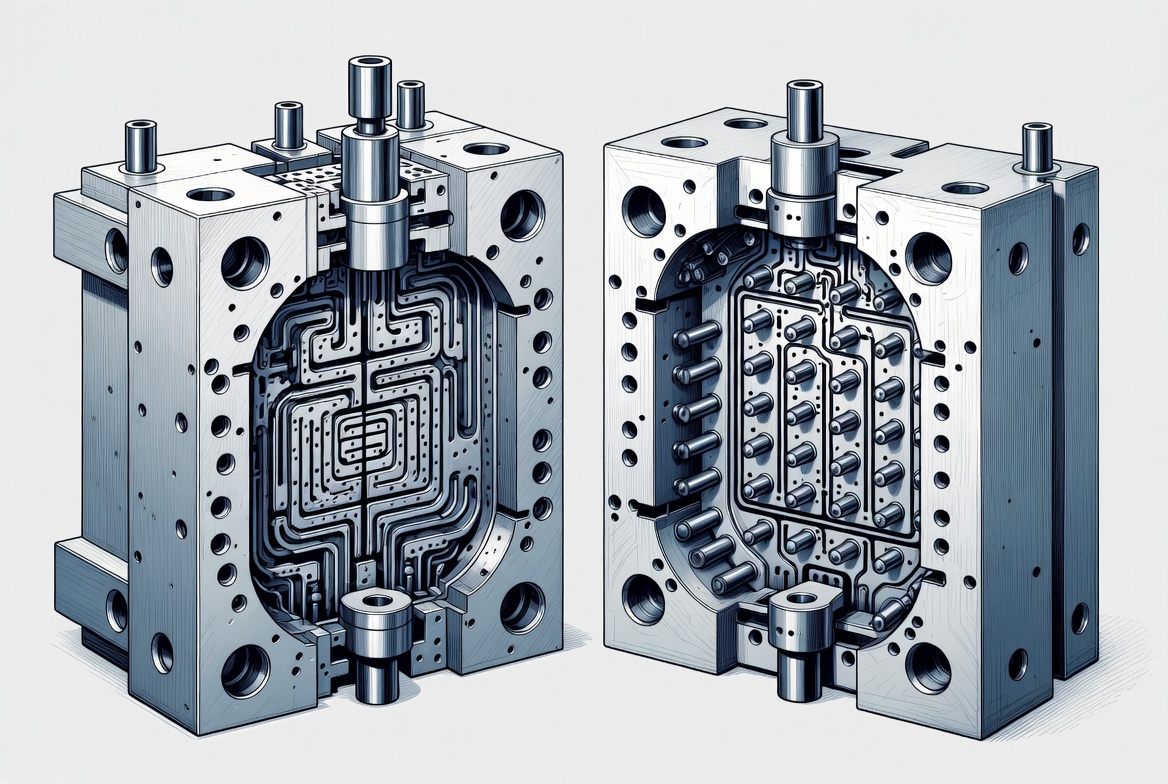
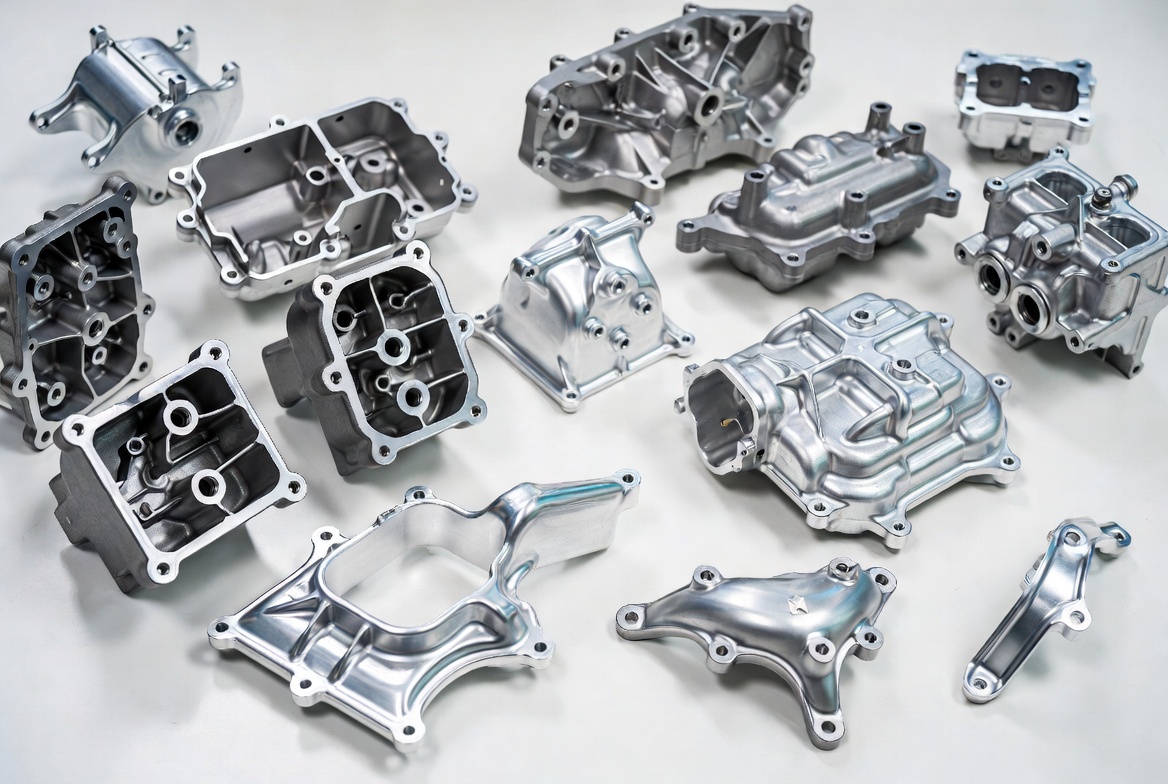
Automotive die casting is used across nearly every vehicle system. Common applications include:
- Engine and transmission housings
- Battery enclosures and EV structural parts
- Motor housings and inverter components
- Gearbox covers
- Brackets and support frames
- Heat sinks and thermal control parts
- Interior and electronic housings
A useful example is an EV motor housing. It must be light, thermally efficient, and stable under vibration. Die casting can meet all three requirements in one part.
A good casting starts with a good design. Many quality problems can be avoided early by designing for manufacturability.
Keep wall thickness as uniform as possible to reduce shrinkage, porosity, and warping.
Draft helps the part release cleanly from the mold and reduces wear.
Ribs can strengthen a part without adding too much weight, but overly thick ribs may create sink marks.
Critical surfaces should be identified early so the casting can be machined where needed.
Poor metal flow can trap air, which leads to porosity and weak spots.
These design choices directly affect cost, quality, and lead time.
Quality expectations in automotive manufacturing are high because a small defect can affect safety, performance, or assembly fit.
A strong quality system should include:
- Incoming material inspection
- Tooling verification
- In-process dimensional checks
- X-ray or internal defect inspection where required
- Final dimensional measurement
- Surface and functional testing
For safety-critical or performance-sensitive components, documentation matters as much as the part itself. Traceability, process control, and repeatable inspection standards are essential.
Die casting creates the greatest value when a part must balance several competing goals:
- Low weight
- High repeatability
- Complex geometry
- Cost efficiency at scale
- Good thermal performance
This is why it is especially relevant in electric vehicles. EV platforms place more emphasis on battery cooling, motor efficiency, and packaging density than many legacy vehicle systems did.
The automotive die casting market is being influenced by electrification, lightweighting, and greater demand for integrated components. Recent industry coverage also points to continued growth in die casting demand and a shift toward high-performance alloys and advanced production methods. [lvma-cnc]
A few trends stand out:
- Larger structural castings are replacing multiple welded parts.
- EV-specific components are creating new demand for thermal and housing parts.
- More automation is improving consistency and throughput.
- Design integration is helping reduce assembly steps.
For manufacturers, this means casting is no longer just about metal shaping. It is about system-level efficiency.
Choosing the right supplier matters as much as choosing the right process. A strong partner should offer technical guidance, stable quality, and flexible production support.
Look for a supplier that can provide:
- Engineering review before tooling
- Clear DFM feedback
- Tight tolerance capability
- Reliable inspection and documentation
- Experience with automotive applications
- Support from prototype to mass production
For companies sourcing from China, U-Need positions itself as a precision manufacturing partner offering end-to-end services in custom precision parts machining, mold manufacturing, and sheet metal fabrication, which can help streamline the full supply chain. [uneedprecisionmachine]
From a sourcing perspective, one of the biggest advantages of working with a full-service partner is coordination. When machining, molds, and fabrication are handled in a connected workflow, communication gaps shrink and lead times often become easier to control.
U-Need highlights its precision machining capability, long industry experience, and quality-focused operations as part of its positioning for global customers. [uneedpm]
For automotive buyers, that matters because supplier performance is not only about unit price. It is also about:
- Tooling reliability
- Process consistency
- Responsiveness during engineering changes
- Stable delivery schedules
- After-sales support
Before starting an automotive die casting project, use this checklist:
1. Define the functional requirements.
2. Confirm annual volume and launch timing.
3. Choose the right alloy for strength, weight, and cost.
4. Review geometry for manufacturability.
5. Identify critical dimensions and tolerances.
6. Plan inspection methods before tooling begins.
7. Confirm post-processing needs such as machining or finishing.
8. Evaluate supplier engineering support and response speed.
This simple sequence reduces risk and improves the odds of first-pass success.
Automotive die casting remains a core technology for modern vehicle manufacturing because it combines precision, speed, and scalability. As the industry moves toward lighter, more integrated, and more thermal-efficient designs, the process is becoming even more valuable.
For OEMs and suppliers, the best results come from pairing the right alloy, the right design, and the right manufacturing partner. That is where technical review, process control, and supplier expertise make the biggest difference.
Call to action: If you are developing automotive die casting parts, start with a design-for-manufacturability review and compare suppliers on engineering support, quality control, and production stability, not price alone.
Automotive die casting is used to produce precision metal parts such as housings, brackets, engine components, battery enclosures, and thermal management parts.
EVs need lightweight parts, compact packaging, and efficient heat management. Die casting helps meet all three requirements.
Aluminum is the most common choice because it offers a strong balance of weight, strength, corrosion resistance, and thermal conductivity.
It offers excellent repeatability, fast cycle times, good surface finish, and the ability to produce complex shapes at scale.
Use uniform wall thickness, proper draft, good gating and venting design, stable process control, and thorough inspection.
1. RapidDirect blog: Automotive die casting — https://www.rapiddirect.com/blog/automotive-die-casting/
2. LVMA CNC: Top Trends in Automotive Die Casting Industry in 2026 — https://www.lvma-cnc.com/news/top-trends-in-automotive-die-casting-industry-in-2026/
3. Mordor Intelligence: Die Casting Market Report — https://www.mordorintelligence.com/industry-reports/die-casting-market
4. Mordor Intelligence: High-Pressure Die Casting Market — https://www.mordorintelligence.com/industry-reports/high-pressure-die-casting-market
5. GII Research: Die Casting Auto Parts Global Market Report 2026 — https://www.giiresearch.com/report/tbrc1932443-die-casting-auto-parts-global-market-report.html
6. U-Need Precision Machining: CNC Machining Services — https://www.uneedpm.com/cnc-machining/
7. U-Need Precision Machining: CNC Turning Services — https://www.uneedpm.com/cnc-turning/
8. U-Need company profile page — https://www.uneedprecisionmachine.com/cs/why-u-need-is-your-trusted-precision-manufacturing-partner-in-china.html


