Views: 229 Author: U-Need Publish Time: 2026-08-08 Origin: Site
Content Menu
● Die Casting vs Injection Molding: Quick Comparison
>> Common Die Casting Materials
>> Typical Die Casting Applications
>> How Injection Molding Works
>> Common Injection Molding Materials
>> Typical Injection Molding Applications
● How to Choose the Right Process
>> Choose die casting if your part needs:
>> Choose injection molding if your part needs:
● Strength, Precision, and Quality
>> Common quality issues in die casting
>> Common quality issues in injection molding
>> What matters most in both processes
● Industry Trends Affecting Both Processes
● Real-World Selection Scenarios
>> Die casting is usually the better fit when:
>> Injection molding is usually the better fit when:
● Design Tips That Improve Results
● Summary
● FAQ
>> 1. What is the main difference between die casting and injection molding?
>> 2. Which process is stronger?
>> 3. Which process is cheaper?
>> 4. Which process is better for complex parts?
>> 5. Can die casting replace injection molding?
>> 6. Which process is better for mass production?
When comparing die casting vs injection molding, the most important factor is not which process is superior in general, but which one fits the part, material, and production goal. Die casting is typically used for metal parts, while injection molding is used for plastic parts; that basic difference shapes everything from tooling and cost to strength, weight, and design flexibility.
For engineers, procurement teams, and product developers, choosing correctly at the start can reduce tooling risk, shorten lead time, and improve product quality. The sections below provide a practical, decision-oriented comparison that can be used for early-stage planning or supplier discussions.
| Factor | Die Casting | Injection Molding |
|---|---|---|
| Material type | Non-ferrous metals such as aluminum, zinc, and magnesium | Thermoplastics and engineering resins such as ABS, PP, PC, and nylon |
| Typical output | Strong metal components | Lightweight plastic components |
| Best suited for | Structural parts, housings, heat-resistant components | Enclosures, consumer products, medical parts, packaging, and functional plastic parts |
| Tooling | Hardened steel dies, usually higher cost | Molds vary by application, often lower entry cost for plastic parts |
| Part strength | High mechanical strength and rigidity | Good performance depends on resin selection and part design |
| Weight | Heavier than plastic | Lightweight |
| Surface finish | Excellent metal finish, often with secondary finishing options | Excellent cosmetic quality and texture options |
| Production volume | Very efficient at scale | Very efficient at scale |
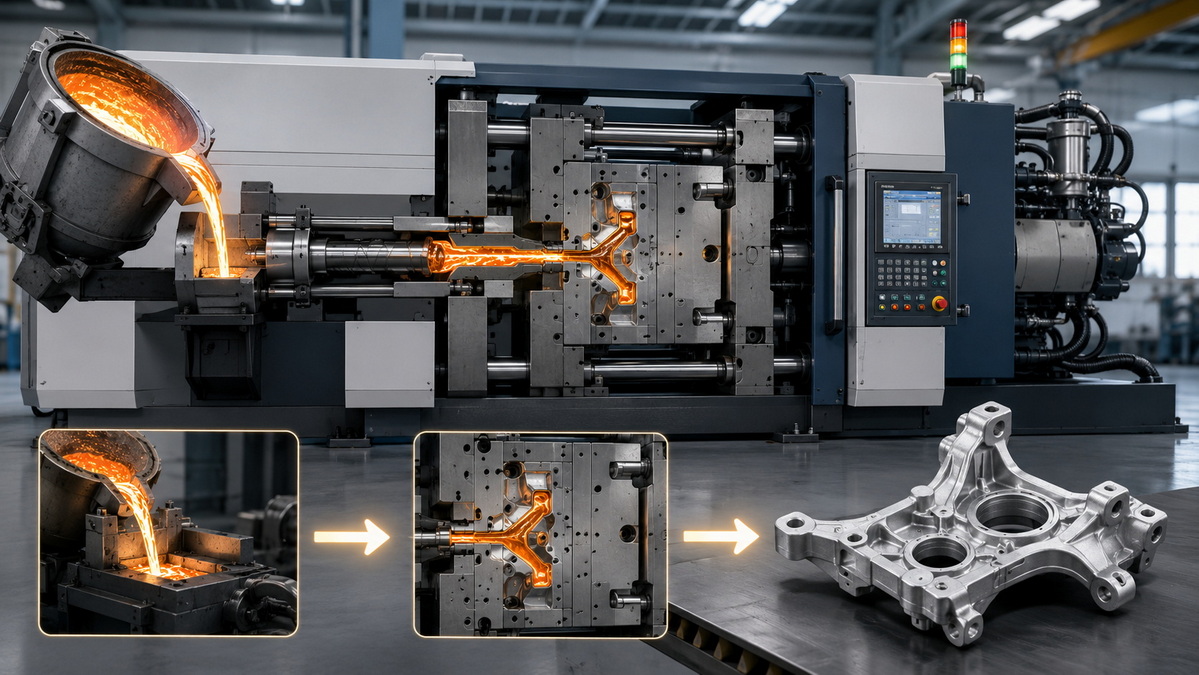
Die casting is a metal manufacturing process in which molten non-ferrous metal is injected into a mold cavity under high pressure. The metal rapidly solidifies inside the die, producing a dense, repeatable part with good dimensional consistency. It is widely used where strength, heat resistance, and metallic performance are important.
1. A steel die is prepared and lubricated.
2. Molten metal is forced into the mold cavity under pressure.
3. The metal cools and solidifies quickly.
4. The part is ejected, trimmed, and inspected.
- Aluminum alloys.
- Zinc alloys.
- Magnesium alloys.
- Automotive housings.
- Industrial equipment parts.
- Electronic enclosures.
- Heat sinks.
- Hardware and structural components.
- High strength and rigidity.
- Fast cycle times at production scale.
- Good dimensional repeatability.
- Smooth surface quality.
- Limited to non-ferrous metals.
- Higher tooling investment.
- Potential porosity issues.
- Less suitable for very large parts.
Injection molding is a process in which molten plastic resin is injected into a mold cavity, cooled, and ejected as a finished part. It is one of the most efficient ways to mass-produce lightweight, detailed, and cost-effective plastic parts. Because of its versatility, it is used across consumer, industrial, and medical markets.
1. Plastic pellets are heated until molten.
2. The resin is injected into the mold under pressure.
3. The material cools and solidifies.
4. The finished part is ejected and post-processed if needed.
- ABS.
- Polypropylene.
- Polycarbonate.
- Nylon.
- TPU.
- POM.
- Consumer product housings.
- Packaging components.
- Medical device parts.
- Electrical enclosures.
- Automotive plastic components.
- Wide material choice.
- Lightweight output.
- High production efficiency.
- Strong design freedom for plastic parts.
- Good cosmetic finish.
- Mechanical strength is lower than metal.
- Shrinkage and warpage must be controlled.
- Resin selection strongly affects performance.
- Mold design quality is critical.

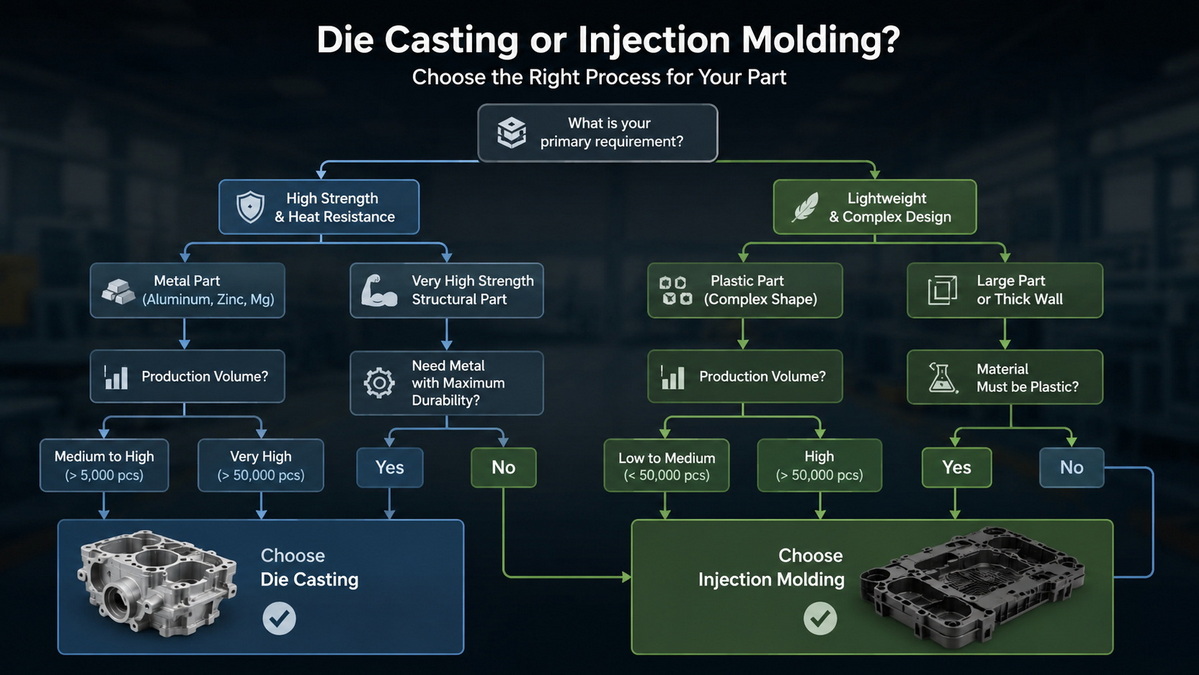
The simplest way to decide is to start with the material requirement.
- Metal strength and rigidity.
- Better heat resistance.
- A metallic structure or appearance.
- Thin walls with high repeatability.
- Performance in demanding industrial or automotive use.
- Low weight.
- Electrical insulation.
- Complex plastic features.
- Lower-cost plastic mass production.
- Broad options for color, texture, and transparency.
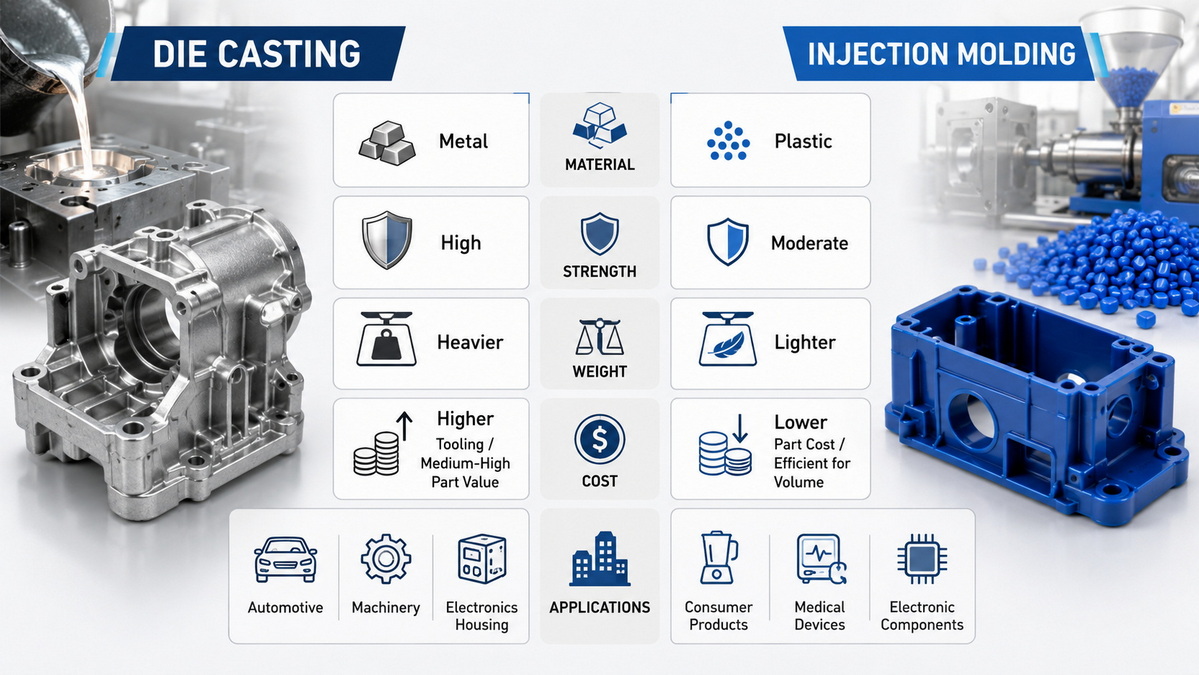
Cost is not just about tooling. It also includes material cost, cycle time, scrap, finishing, and production stability. Die casting often has a higher initial tooling burden, but it can be highly economical for large-volume metal production. Injection molding often offers lower-cost entry for plastic parts, especially when part geometry and resin choice are well controlled.
- Part size and complexity.
- Production quantity.
- Material selection.
- Tooling design.
- Secondary processing.
- Quality requirements.
- Scrap and rework rates.
- For metal parts, die casting is often the better long-term value at scale.
- For plastic parts, injection molding is often the more cost-effective choice.
- For low-volume validation, prototype tooling or alternative methods may be more practical.
Both processes can produce high-quality parts, but they fail in different ways. Die casting offers strong metal components with excellent repeatability, but engineers must manage porosity, flash, and thermal stress. Injection molding offers precise plastic components, but poor flow design can cause sink marks, warpage, or incomplete filling.
- Porosity.
- Flash.
- Incomplete fill.
- Die wear.
- Trapped air.
- Warpage.
- Sink marks.
- Short shots.
- Weld lines.
- Burn marks.
- Wall-thickness consistency.
- Gate placement.
- Cooling design.
- Draft angle.
- Material flow behavior.
- Ejection strategy.
Manufacturing is changing fast, and both die casting and injection molding are benefiting from digital control, automation, and sustainability improvements. In injection molding, current industry direction includes IoT integration, AI-driven optimization, and greater use of sustainable materials. In die casting, automation, robotics, process monitoring, and energy efficiency are improving consistency and reducing waste.
This shift is important because modern buyers increasingly care about total efficiency, not only unit price. A process that reduces scrap, improves traceability, and stabilizes production can create more value over the life of the program than a lower-cost process with more quality risk.
- The part must carry load.
- Heat dissipation matters.
- The product needs a metal housing or frame.
- The application is industrial, automotive, or power-related.
- The part must be lightweight.
- Electrical insulation is needed.
- Cosmetic appearance is important.
- The part includes snap-fits, clips, ribs, or internal plastic features.
A good design can reduce manufacturing cost and improve reliability. In both processes, design for manufacturability should be considered before tooling begins.
- Keep wall thickness as uniform as possible.
- Avoid sharp corners.
- Add draft angles for ejection.
- Reduce unnecessary mass.
- Plan for trimming and finishing if needed.
- Keep wall thickness consistent.
- Use ribs instead of thick walls.
- Add proper draft.
- Position gates carefully.
- Select resin based on use environment, not only price.
Die casting and injection molding are both powerful production methods, but they serve different purposes. Die casting is the better choice for many metal parts that require strength, heat resistance, and durability. Injection molding is the better choice for many plastic parts that require low weight, flexibility in design, and efficient mass production.
If you are still deciding between the two, the safest next step is to evaluate the part with a manufacturing partner that can review material, structure, and volume requirements before tooling starts.
Die casting uses metal, while injection molding uses plastic or polymer resin.
Die casting is generally stronger because it produces metal parts.
Injection molding is often cheaper for plastic parts, while die casting can be more economical for high-volume metal parts.
Both can handle complexity, but injection molding is usually better for complex plastic features, while die casting is better for complex metal parts.
Not directly, because they use different materials and serve different product requirements.
Both are suitable for mass production. The better choice depends on whether the part should be metal or plastic.
1. RapidDirect. "Die Casting vs Injection Molding: A Detailed Comparison." [https://www.rapiddirect.com/blog/die-casting-vs-injection-molding/]
2. The Business Research Company. "Die Casting Market Size, Trends and YoY Growth Rate, 2033." [https://www.thebusinessresearchcompany.com/report/die-casting-market]
3. Fictiv. "The Biggest Injection Molding Trends for 2025." [https://www.fictiv.com/articles/the-biggest-injection-molding-trends-for-2025]
4. Protolabs. "The Future of Injection Molding | 7 Trends to Watch in 2025." [https://www.protolabs.com/resources/blog/the-future-of-injection-molding-7-trends-to-watch-in-2025/]
5. Industry research result on injection molding market size and growth, 2025–2033. [https://www.grandviewresearch.com/industry-analysis/injection-molding-market]
6. Industry research result on aluminum die casting market size and growth, 2026–2033. [https://www.grandviewresearch.com/industry-analysis/aluminum-die-casting-market]


