Views: 251 Author: U-Need Publish Time: 2026-07-27 Origin: Site
Content Menu
● What Is Hot Chamber Die Casting?
● How the Hot Chamber Die Casting Process Works
● Best Materials for Hot Chamber Die Casting
>> Zinc Alloys
>> Why Aluminum Is Usually Excluded
● Advantages of Hot Chamber Die Casting
>> Suitable for Thin and Detailed Parts
>> Not Ideal for Very Large Parts
● Hot Chamber vs Cold Chamber Die Casting
● Design Tips for Better Results
● Why This Process Matters in Modern Manufacturing
>> What metals are used in hot chamber die casting?
>> What is the main advantage of hot chamber die casting?
>> Can aluminum be hot chamber die cast?
>> Why does hot chamber die casting sometimes have porosity?
>> Is hot chamber die casting good for small production runs?
>> What products are best suited to this process?
Hot chamber die casting is a high-pressure metal casting process used for low-melting-point alloys such as zinc, magnesium, tin, and lead. It is designed for fast, repeatable production of metal parts with consistent dimensions and smooth surfaces.
The process is especially suitable for small to medium-sized parts that require fine detail and stable output at high volume. Because the injection system is immersed in molten metal, the cycle is faster than many alternative casting methods.
In practical manufacturing, hot chamber die casting is valued for its efficiency, productivity, and ability to support complex part geometries. It is a common choice when speed and consistency matter more than material flexibility.
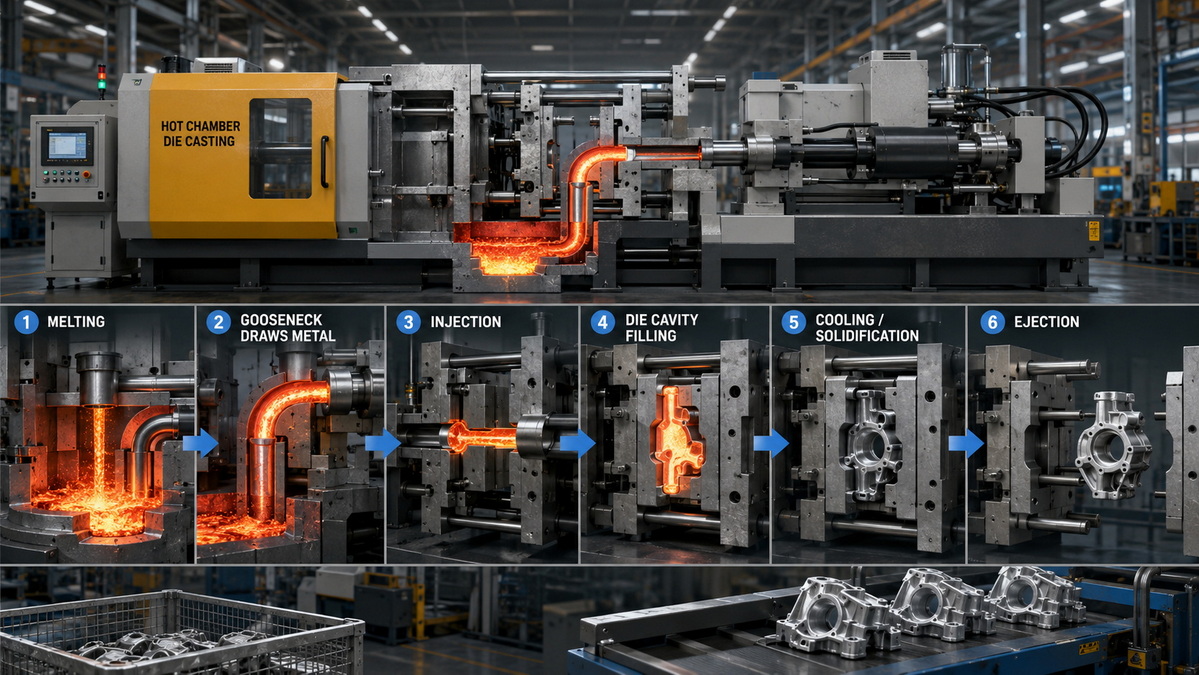
Hot chamber die casting follows a short and efficient production cycle. The process begins with molten metal held in an integrated furnace that is connected to the injection system.
First, the plunger rises and allows molten metal to enter the chamber through an opening. Then the plunger moves downward and forces the metal through the gooseneck and nozzle into the die cavity under high pressure.
Once the cavity is filled, pressure is maintained during solidification to help improve dimensional stability. After the metal cools, the die opens and the finished part is ejected.
This cycle repeats quickly, which is one reason the process is so productive. For high-volume manufacturing, the short cycle time can create strong advantages in both output and cost efficiency.
A hot chamber die casting machine has several core components that work together to form the part. Each part of the machine affects speed, precision, and consistency.
- Furnace: Keeps the alloy molten at a stable temperature.
- Gooseneck: Transfers molten metal from the chamber to the die.
- Nozzle: Directs the flow of metal into the cavity.
- Plunger: Generates the pressure needed for injection.
- Die and ejector system: Shapes the part and releases it after solidification.
The integrated structure makes the machine compact and efficient. It also reduces the distance molten metal must travel before injection, which helps support fast cycles.
Hot chamber die casting is mainly used for alloys with relatively low melting points. Zinc and magnesium are the most common choices, while tin and lead are used in more specialized applications.
Zinc is the most widely used hot chamber alloy. It offers excellent fluidity, good surface finish, and strong dimensional stability.
It is often selected for precision housings, connectors, decorative parts, and mechanical components. Zinc also supports thin-wall designs and detailed features very well.
Magnesium is often chosen when weight reduction is a major requirement. It is one of the lightest structural metals used in casting.
This makes it attractive for lightweight housings, automotive parts, handheld devices, and performance-driven applications. Magnesium parts can deliver a useful balance of strength and low mass.
Tin and lead alloys are used in certain specialized parts, but their industrial use is narrower. Their lower melting temperatures make them technically suitable for hot chamber systems.
However, material selection must also consider safety, compliance, and product requirements. In many modern projects, zinc and magnesium remain the most practical choices.
Aluminum is generally not used in hot chamber die casting because its melting temperature is too high for the immersed injection design. It is usually processed through cold chamber die casting instead.
This distinction is important when selecting the right method for a new part. The wrong alloy-process match can lead to production issues and higher tooling risk.

Hot chamber die casting offers several important benefits for mass production. These advantages make it a preferred method for many zinc and magnesium parts.
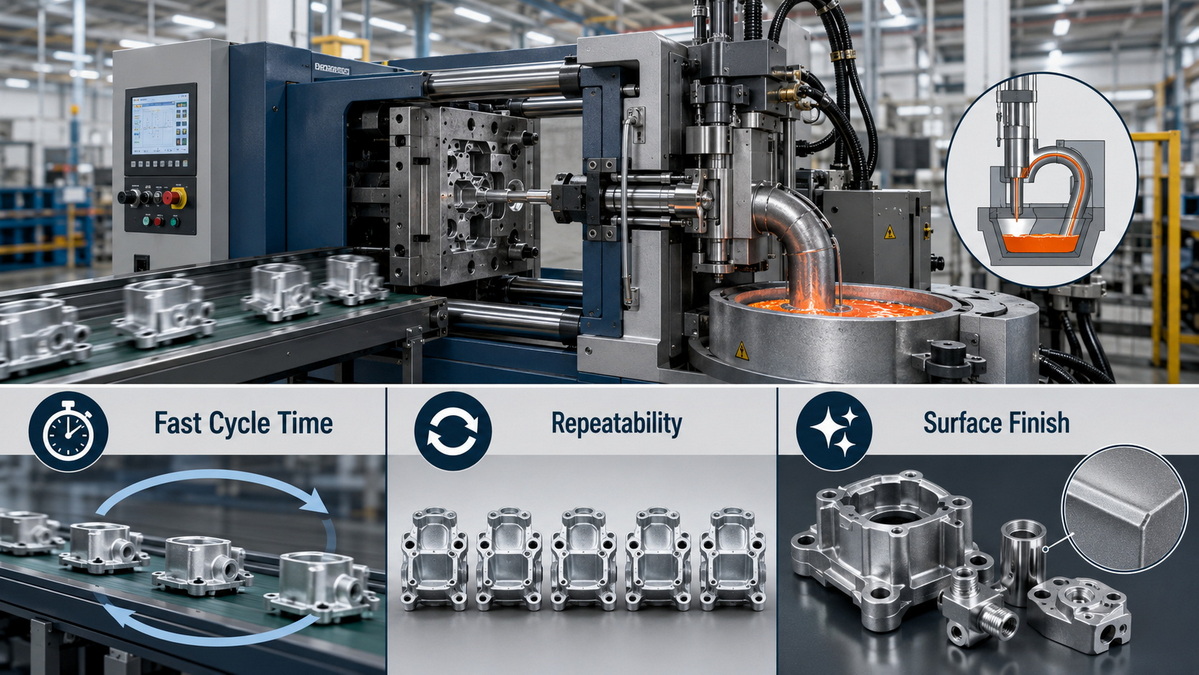
The most obvious advantage is speed. Because the injection system is directly connected to molten metal, each casting cycle can be completed quickly.
This helps manufacturers produce large quantities in less time. For projects with steady demand, high throughput can improve overall efficiency.
Hot chamber die casting is known for strong repeatability and stable part dimensions. This is especially useful when parts must fit together precisely in assemblies.
The process can also produce smooth surfaces and fine details. In many cases, this reduces the need for extensive secondary finishing.
The integrated furnace and injection system reduce handling steps. That means less metal transfer, less waste, and fewer interruptions in production.
This efficiency can support lower operating costs in high-volume runs. It also contributes to consistent output across long production campaigns.
The process is well suited to thin-walled and intricate designs. High-pressure filling helps the molten metal reach narrow features and complex geometry.
This makes hot chamber die casting a strong fit for precision components that need both detail and repeatability. It is particularly effective for compact parts that would be difficult to make with less controlled methods.
Hot chamber die casting is not the right choice for every project. Its benefits come with certain design and material limitations.
The process is mainly restricted to low-melting-point metals. That means it cannot be used for many higher-temperature alloys, including aluminum.
This makes material selection one of the first and most important decisions in process planning. A mismatch between alloy and process can create unnecessary cost and delay.
Like many high-pressure casting methods, hot chamber die casting can produce porosity if gases become trapped in the cavity. This may affect strength, sealing, or surface integrity in some parts.
For this reason, venting, pressure control, and part design all matter. Careful process setup can reduce risk, but it cannot always eliminate it completely.
The process is generally best suited to small and medium-sized components. Larger parts may require a different casting method, especially if structural demands are high.
This is another reason design review matters early in the project. The right process choice can save time and improve manufacturability.
Although the process is efficient in production, tooling cost can be significant. That means hot chamber die casting is usually more attractive when the production volume is high enough to justify the investment.
For short runs, other methods may be more practical. The best choice depends on quantity, tolerance requirements, and part complexity.
These two processes are often compared because they serve different materials and production goals. The best choice depends mainly on alloy type and part requirements.
| Factor | Hot Chamber Die Casting | Cold Chamber Die Casting |
|---|---|---|
| Furnace setup | Integrated with the machine | Separate from the injection system |
| Cycle speed | Faster | Slower |
| Best alloys | Zinc, magnesium, tin, lead | Aluminum and higher-temperature alloys |
| Thermal stress | Lower for compatible alloys | Higher |
| Typical use | High-volume precision parts | Larger parts and hotter alloys |
In simple terms, hot chamber die casting is the better option for speed and low-melting alloys. Cold chamber die casting is usually used when the material requires a different thermal setup.
Good part design can make a major difference in casting quality and cost. The more manufacturable the design, the easier it is to produce stable results.
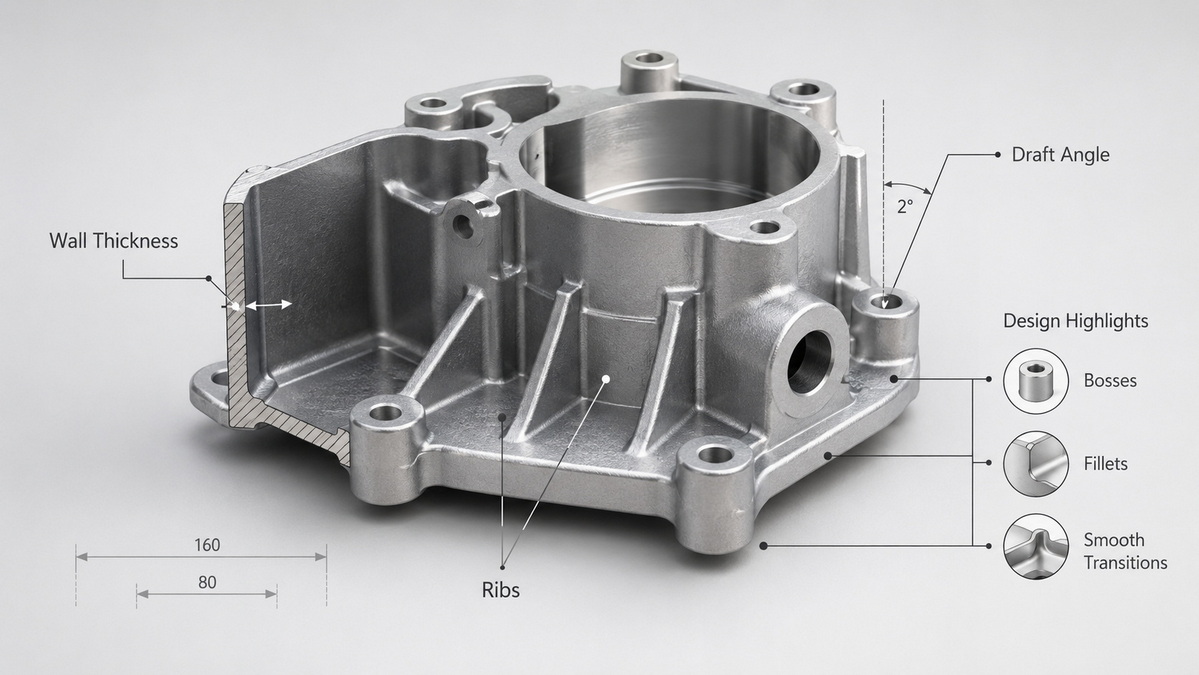
1. Keep wall thickness as uniform as possible.
2. Avoid unnecessary undercuts unless the design truly needs them.
3. Use ribs for stiffness instead of making walls excessively thick.
4. Add draft angles to support clean part release.
5. Specify tolerances only where they are functionally required.
These principles help improve filling, reduce distortion, and simplify tooling. They also support lower reject rates during production.
A design review before tooling approval is often the smartest step in the process. It helps identify risk early and prevents expensive changes later.
Hot chamber die casting is widely used in industries that need precision metal parts at scale. It is particularly common where consistent shape, surface finish, and repeatability are important.
- Automotive components such as brackets, trim parts, and housings.
- Electronics parts such as connectors, shields, and compact enclosures.
- Consumer products such as handles, locks, and appliance components.
- Industrial hardware that requires durable, repeatable metal parts.
These applications often share the same requirements: stable dimensions, clean surface quality, and efficient large-scale production. That is why hot chamber die casting continues to be relevant across many sectors.
As manufacturing becomes more focused on efficiency and lightweight design, hot chamber die casting remains a practical solution for many product categories. Zinc and magnesium parts continue to play an important role in industrial and consumer applications.
The process is especially useful when a project needs speed, detail, and controlled production costs. It offers a strong balance between performance and manufacturability.
For companies developing new products, the key advantage is reliability. Once the tooling and process are well set, hot chamber die casting can support stable repeat production with consistent quality.
Hot chamber die casting is mainly used for zinc and magnesium alloys. Tin and lead can also be used in some specialized cases.
The biggest advantage is speed. The integrated furnace and injection system allow fast cycle times and efficient production.
No. Aluminum usually requires cold chamber die casting because its melting temperature is too high for hot chamber equipment.
Porosity can occur when gas becomes trapped during the high-speed filling process. Proper venting and part design can help reduce this issue.
It is usually better for high-volume production. Tooling costs make it less economical for short runs.
It is best for small to medium precision parts such as housings, connectors, brackets, and decorative components.
1. RapidDirect. "What Is How Chamber Die Casting [Basic Guide]." [https://www.rapiddirect.com/blog/hot-chamber-die-casting/]
2. Dynacast UK. "Hot Chamber Die Casting Process." [https://www.dynacast.com/en-gb/specialty-die-casting/die-cast-process/hot-chamber-die-casting]
3. NADCA video. "Hot Chamber Die Casting Process." [https://www.youtube.com/watch?v=lZY4bcDjC_U]
4. DieCastingCompany. "The Advantages Of Hot Chamber Die Casting Machine." [https://www.diecastingcompany.com/helpful-articles/the-advantages-and-disadvantages-of-hot-chamber-die-casting-machine]
5. DieCastor. "Hot Chamber Die Casting: Pros and Cons." [https://diecastor.com/the-advantages-and-disadvantages-of-hot-chamber-die-casting/]
6. Oeform. "Hot Chamber Die Casting: Process, Advantages & Applications." [https://oeform.com/hot-chamber-die-casting/]
7. RT Prototype. "Advantages and Disadvantages of Hot Chamber Die Casting." [https://www.rtprototype.com/news/advantages-and-disadvantages-of-hot-chamber-die-casting.html]
8. NADCA Design. "Alloy Selection." [https://www.diecastingdesign.org/alloy-selection/]
9. Scribd-hosted NADCA-related design text snippet. [https://www.scribd.com/document/376905410/Die-Casting-Prod-Design-NADCA]
10. Mordor Intelligence. "Die Casting Market Size & Share Analysis." [https://www.mordorintelligence.com/industry-reports/die-casting-market]
11. GII Research. "High-Pressure Die Casting - Market Share Analysis..." [https://www.giiresearch.com/report/moi2066519-high-pressure-die-casting-market-share-analysis.html]
12. Jones & Wilkinson. "Top trends in the Die Casting industry in 2026." [https://www.jonesandwilkinson.co.uk/top-trends-in-the-die-casting-industry-in-2026/]
13. Yizumi. "Why Hot Chamber Die Casting Machines Are Ideal for Zinc..." [https://www.yizumi.com/en/news/product/industry-trend/hot-chamber-die-casting-machines]
14. Metal.com. "H1 2026 Die-Casting Zinc Alloy Market Review." [https://news.metal.com/newscontent/103999517-how-chinese-die-casting-zinc-alloy-producers-navigate-persistent-oversupply-in-h2-2]
15. EUROGUSS. "EUROGUSS 2026 showcases die casting as an enabler..." [https://www.euroguss.de/en/press/press-releases/2026/01/euroguss-closing-report-2026]


