Views: 296 Author: U-Need Publish Time: 2026-10-11 Origin: Site
Content Menu
● What Is the Best Nylon Grade for CNC Machining?
● Nylon Grades for CNC Machining: A Practical Comparison
>> PA6: A Versatile Starting Point
>> PA66: Useful Rigidity, but Not Moisture Immunity
>> PA12 and PA612: Options for Moisture-Sensitive Parts
>> Modified Nylon: Match the Filler to the Function
● Why Nylon Property Tables Can Be Misleading
● Moisture and Tolerances: Design for the Service Condition
>> Define When the Dimension Must Be Correct
>> Build Conditioning into the Production Plan
● How to Machine Nylon Without Losing Dimensional Control
>> Use Sharp Tools and Grade-Appropriate Tooling
>> Control Clamping and Material Removal
>> Remove Chips and Manage Heat
● An Illustrative Case: Selecting Nylon for a Conveyor Bushing
● Nylon CNC Machining vs. Molding and Additive Manufacturing
● What to Include in Your Nylon Machining RFQ
>> What is the best nylon grade for CNC machining?
>> Is nylon 6 or nylon 66 better for machined parts?
>> Can nylon parts hold tight tolerances?
>> Is glass-filled nylon suitable for bearings?
>> Does nylon need conditioning before machining?
>> What information should I send for a nylon machining quotation?
Choosing the best nylon grade for CNC machining means matching material behavior to your part's actual operating conditions. Strength matters, but moisture absorption, friction, temperature, manufacturing history, and dimensional stability can be equally important.
For global brands, distributors, and manufacturers, the right choice can reduce assembly problems, premature wear, and unnecessary production costs. The wrong choice may produce a component that passes inspection but changes dimensions after installation.
U-Need is your precision manufacturing partner in China, supporting custom precision parts machining, mold manufacturing, and sheet metal fabrication. This guide explains how to evaluate nylon grades, prepare a practical specification, and move from material selection to reliable production.
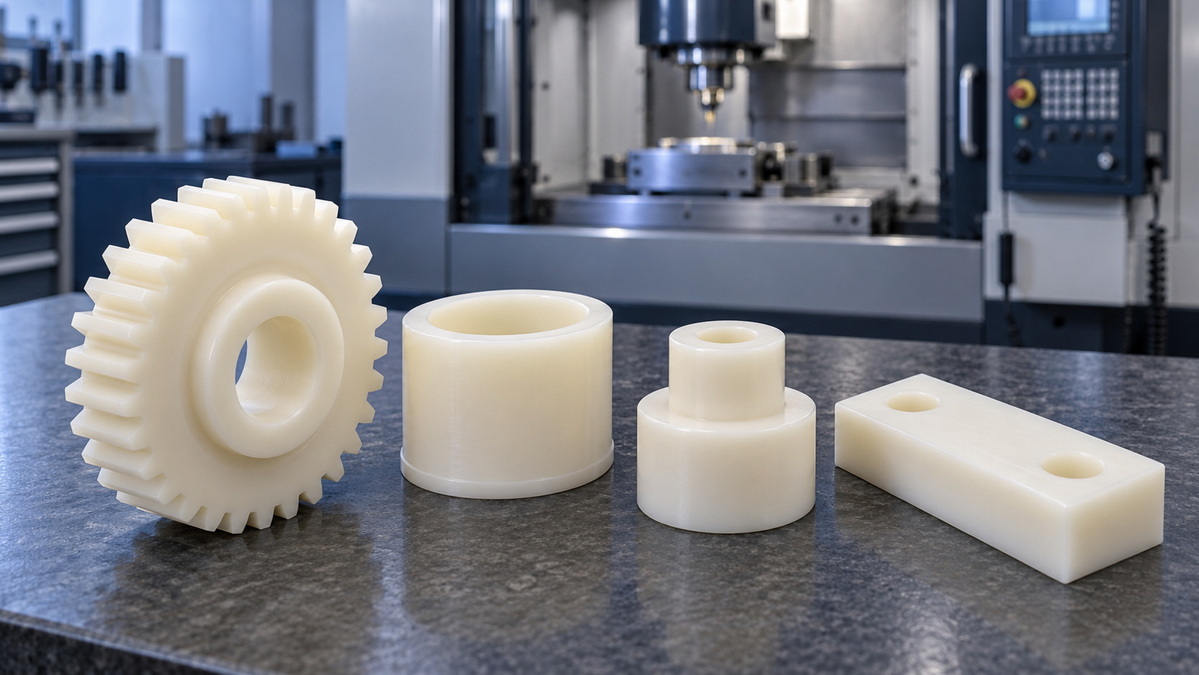
There is no universal winner. A useful starting point is:
- PA6 for general-purpose wear components.
- PA66 for applications requiring rigidity and thermal dimensional stability.
- PA12 for applications where moisture-related dimensional changes are a major concern.
- PA612 for a balance of mechanical performance and reduced moisture absorption.
- Lubricated or MoS2-filled nylon for selected sliding and bearing applications.
- Glass-filled nylon for increased stiffness, subject to tooling and mating-surface requirements.
The most important selection principle is application fit. Choose a specific commercial grade and stock form, not simply a polymer name.
Two products labeled "nylon" can behave differently because of fillers, processing methods, conditioning, and test conditions.
Use this table to shortlist materials. Final selection should follow the supplier's current technical data and application testing.
| Nylon grade | Main advantage | Typical candidate applications | Main consideration |
|---|---|---|---|
| PA6, including cast nylon | Toughness and wear performance | Rollers, gears, bushings, wear pads | Moisture uptake and machining stress |
| PA66 | Rigidity, hardness, and thermal dimensional stability | Spacers, mechanical supports, wear components | Moisture-related dimensional change |
| PA12 | Low moisture absorption and high toughness | Humidity-sensitive components and precision spacers | Confirm stiffness and load capability |
| PA612 | Lower moisture absorption than PA66 | Components needing improved dimensional stability | Verify availability and exact grade data |
| Lubricated or MoS2-filled nylon | Grade-specific friction and wear benefits | Bearings, sliding pads, thrust washers | Validate pressure, speed, and counterface |
| Glass-filled nylon | Increased stiffness | Structural supports and loaded components | Abrasive machining and directional properties |
PA6 is a practical candidate for gears, rollers, bushings, and other mechanical components requiring toughness and wear resistance.
However, distinguish cast PA6 from extruded PA6. Cast and extruded stock are not interchangeable specifications. Their processing history and commercial formulations can influence performance and machining behavior.
For larger components, investigate suitable cast stock dimensions before committing to a design. Stock availability can affect material utilization, machining time, and procurement.
PA66 offers good rigidity, hardness, abrasion resistance, and thermal dimensional stability.
Nevertheless, choosing PA66 does not eliminate moisture-related dimensional changes. A part machined and measured in one condition may behave differently after exposure to humid air or water.
Specify the inspection condition alongside the material. "PA66 with a tight tolerance" is incomplete unless the required environmental state is also defined.
PA12 has low moisture absorption compared with commonly used PA6 and PA66 grades. This makes it worth evaluating when humidity could interfere with a close fit.
PA612 also offers lower moisture absorption than PA66 and can provide a useful compromise.
Neither material is completely unaffected by temperature, loading, or moisture. Evaluate the complete application rather than treating lower water absorption as a guarantee of dimensional accuracy.
Oil-filled and MoS2-modified nylons are designed for particular friction and wear requirements. Some commercial grades combine additives.
Glass reinforcement serves a different purpose: increasing stiffness and altering mechanical behavior. It does not automatically make a material the best bearing grade.
For sliding applications, consider the mating surface, contact pressure, speed, lubrication, and allowable wear together.
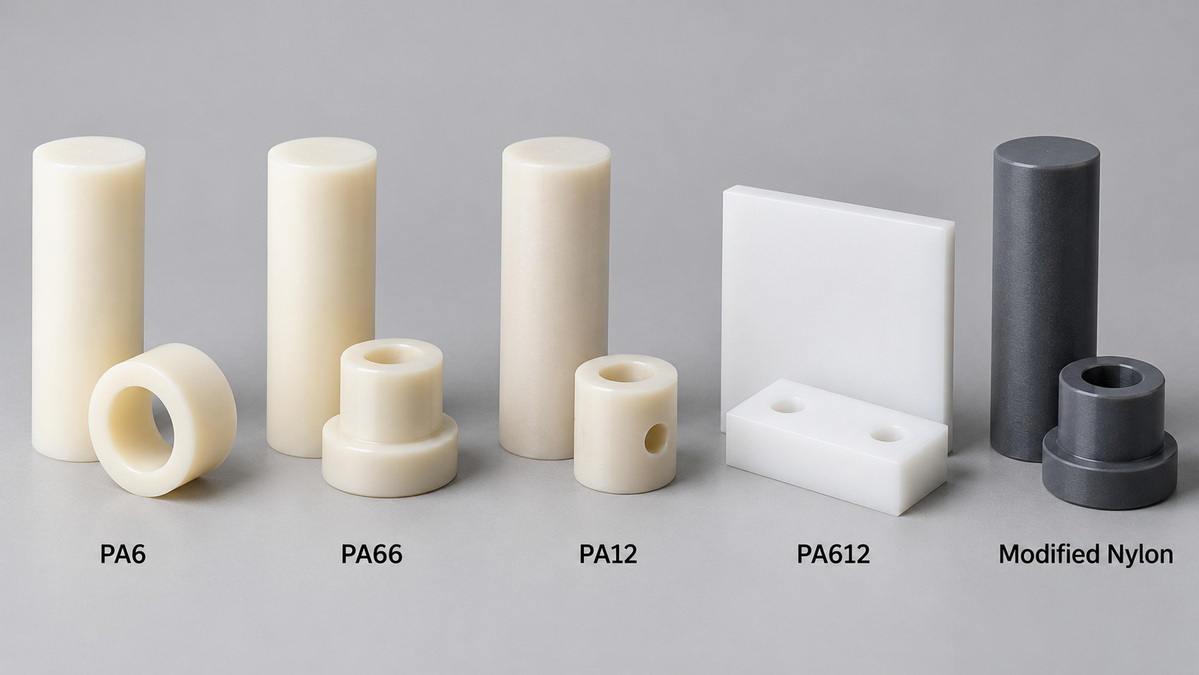
A single tensile-strength or water-absorption value rarely describes every nylon product.
Before comparing supplier data, check:
1. The exact commercial grade.
2. Whether the specimen was dry or conditioned.
3. The test standard and exposure duration.
4. Test temperature and specimen geometry.
5. Whether the data describe resin, molded specimens, or machining stock.
For example, Ensinger reports moisture absorption of 0.15% after 24 hours and 3.0% at saturation for TECAMID 612 under the stated ASTM D570 conditions. These figures describe different exposure states, not conflicting results.
Its TECAMID 12 data report water absorption of 0.04% after 24 hours and 0.07% after 96 hours under DIN EN ISO 62 at 23°C.
These examples demonstrate why "nylon absorbs X% water" is an incomplete specification. Values from different grades and methods should not be ranked without checking their basis.
Similarly, a temperature rating is not automatically a permitted operating temperature for a loaded bearing. Time, load, geometry, and environment matter.
Nylon can absorb moisture and change dimensions. This creates a practical distinction between machining accuracy and in-service dimensional stability.
A component may meet its drawing immediately after machining yet develop an unacceptable fit after environmental exposure.
For each critical feature, establish whether acceptance applies:
- Immediately after machining.
- After an agreed conditioning procedure.
- At a specified inspection temperature and humidity.
- After representative service exposure.
This is especially important for bearing bores, press fits, locating features, and thin-walled components.
Do not use a water-absorption percentage as a dimensional-growth percentage. Mass uptake and dimensional expansion are different measurements.
For moisture-sensitive parts, consider this sequence:
1. Select the exact stock grade and material condition.
2. Rough-machine the component.
3. Apply any supplier-recommended stress-relief procedure.
4. Condition the material when required by the application.
5. Finish-machine critical features.
6. Inspect under the agreed conditions.
The sequence is not universal. It should be validated for the selected grade, wall thickness, and required fit.
Conditioning should be specified as a controlled process, not simply "leave the part in the workshop."
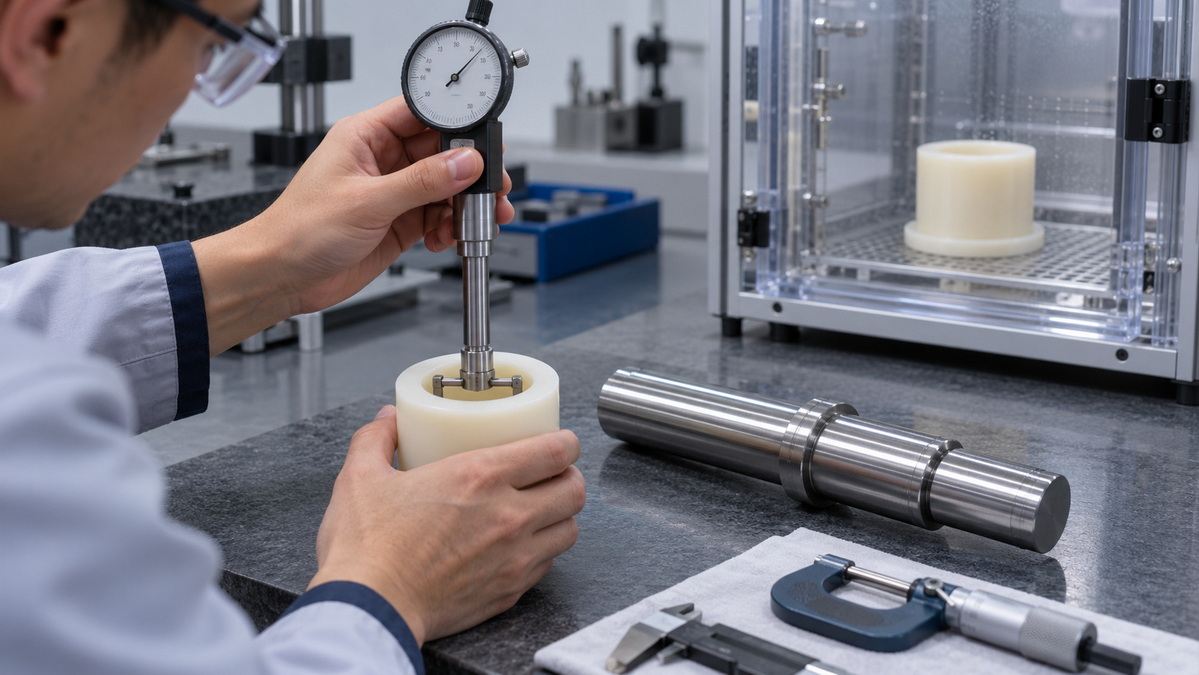
Nylon CNC machining requires control of heat, clamping forces, chips, and residual stress.
A productive process is not necessarily the one with the highest spindle speed. It is the one that delivers repeatable geometry after the part cools and the fixture releases it.
Sharp cutting edges help reduce rubbing and unnecessary heat.
Unfilled thermoplastics can be machined with suitable high-speed steel tools. Reinforced grades require wear-resistant tooling, such as carbide, because fillers increase abrasion.
Select tool geometry and cutting conditions for the actual material and operation. A universal speed-and-feed chart cannot account for every cutter, stock size, or reinforced grade.
Excessive clamping can distort nylon, particularly around thin walls or unsupported features.
Use fixtures that support the component without forcing it into shape. Where possible, distribute clamping loads and separate roughing from precision finishing.
For substantial stock removal, consider a balanced machining sequence. Removing material aggressively from one side may release internal stress unevenly.
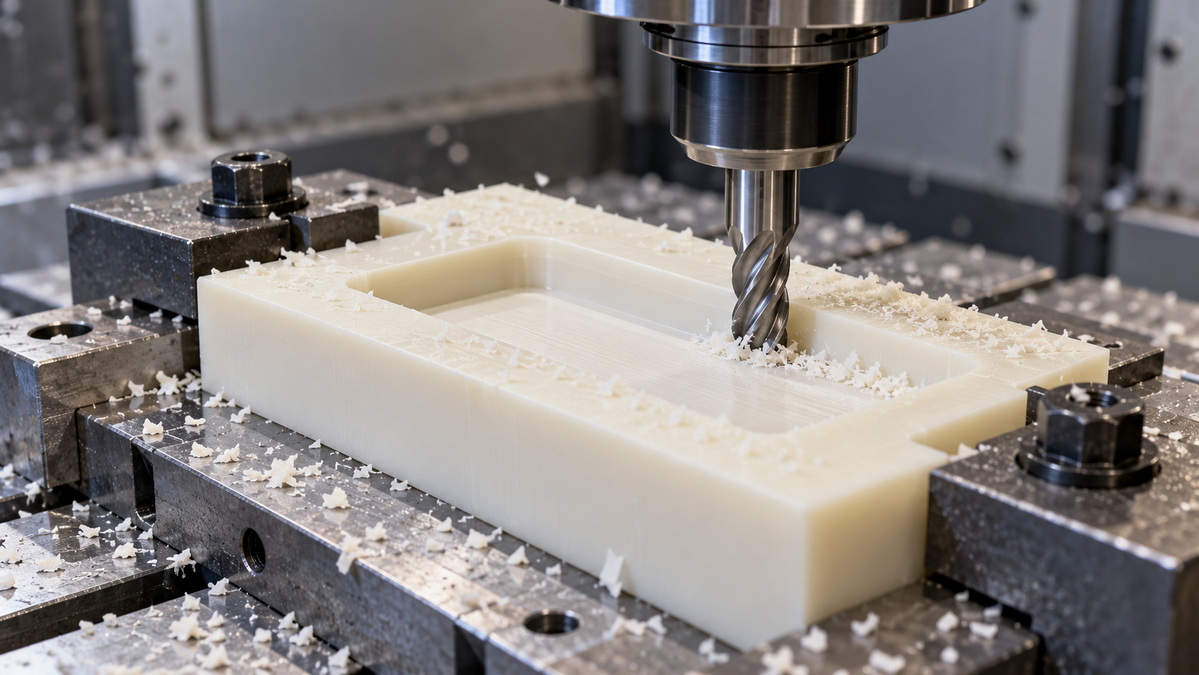
Poor heat dissipation can undermine surface quality and dimensional control.
Maintain effective chip evacuation, particularly in deep holes and enclosed pockets. Chips left in the cutting zone can be recut or interfere with the tool.
Where coolant is used, verify compatibility with the exact plastic grade. Do not assume a fluid developed for metal machining is suitable for nylon.
Measure critical dimensions after the component reaches the agreed inspection temperature, rather than while it remains warm.
Consider a conveyor bushing exposed to intermittent washdown, sustained loading, and sliding contact with a steel shaft.
This is an illustrative selection exercise, not a documented customer project.
A general-purpose PA6 grade may be a reasonable starting candidate. However, moisture uptake could affect shaft clearance, while load and sliding speed could determine wear performance.
The evaluation should answer:
- What is the contact pressure?
- How fast does the shaft move?
- Is lubrication available?
- What cleaning chemicals are used?
- How much clearance change is acceptable?
- What wear level triggers replacement?
A lubricated cast nylon may merit testing for friction and wear. PA12 or PA612 may merit consideration if moisture-related fit changes dominate.
The final decision should follow representative testing. Choosing the material with the highest tensile strength would not resolve every failure mechanism.
Manufacturing method affects both economics and material behavior.
| Process | Useful when | Main evaluation point |
|---|---|---|
| CNC machining | Designs change, quantities are limited, or machining stock is suitable | Material removal, accessibility, and dimensional control |
| Injection molding | Repeat production can justify dedicated tooling | Tooling investment, shrinkage, reinforcement orientation, and geometry |
| Additive manufacturing | Complex geometry or rapid design iteration is important | Process-specific strength, surface finish, porosity, and dimensional behavior |
Do not assume an injection-molded or printed nylon part will perform identically to a machined component with the same general polymer designation.
Changing production methods requires renewed review of material condition, geometry, and acceptance criteria.
U-Need's custom machining and injection mold manufacturing capabilities support planning across these stages. Select the production route around validated requirements rather than volume alone.
A complete request helps a manufacturing partner evaluate material choice and process feasibility.
Provide:
- A 3D model and dimensioned drawing.
- The preferred grade or application requirements.
- Quantity and expected repeat demand.
- Critical dimensions and functional fits.
- Operating temperature and humidity.
- Loads, movement, and lubrication conditions.
- Chemical exposure, including cleaning fluids.
- Required inspection and conditioning procedures.
- Applicable food-contact or other compliance requirements.
For regulated applications, request documentation for the exact grade, additives, and intended conditions of use. A generic description such as "food-safe nylon" is insufficient.
Send U-Need your drawing, quantity, operating environment, and critical tolerances to request a nylon machining feasibility review and quotation. Include mating-part details so material selection can address assembly performance, not only the finished drawing.
The best grade depends on operating conditions. PA6 suits many general wear applications, PA66 offers useful rigidity, and PA12 or PA612 may be preferable when moisture-related dimensional changes are important.
Neither is universally better. Compare the exact commercial grades, stock forms, moisture behavior, temperature requirements, and loading conditions. Avoid choosing from polymer names alone.
Nylon can be machined accurately, but maintaining dimensions requires control of temperature, moisture, clamping, and residual stress. Define the condition in which each critical tolerance must be met.
Not automatically. Greater stiffness does not guarantee better sliding performance. Evaluate counterface wear, friction, loading, and speed against suitable bearing-grade alternatives.
Some moisture-sensitive applications require conditioning before or between machining stages. The appropriate sequence depends on the grade, component dimensions, and intended service environment.
Send drawings, models, quantity, critical tolerances, operating conditions, and any material or compliance requirements. If the grade is undecided, describe the function and likely failure risks.
1. TOPS Precision — "How to Choose the Best Nylon Grade for CNC Machining Projects." Original article used as the restructuring baseline; its general property ranges were not treated as universal specifications. [topsbest-precision]
2. Ensinger — "Frequently Asked Questions: Machinable Plastics." Supports guidance on moisture-related swelling, conditioning, stress, machining, and dimensional control. [ensingerplastics]
3. Ensinger — "PA 66: TECAMID 66 Natural." Supports the discussion of rigidity, wear properties, machinability, and moisture-related limitations. [ensingerplastics]
4. Ensinger — "Low Moisture Nylon: TECAMID 612 Natural." Source of the cited ASTM D570 moisture-absorption figures and PA612 selection context. [ensingerplastics]
5. Ensinger — "PA 12: TECAMID 12 Natural," with its stock-shape technical datasheet. Supports PA12 properties and the stated DIN EN ISO 62 water-absorption values. [ensingerplastics]
6. Mitsubishi Chemical Advanced Materials — "Ertalon and Nylatron: Wear-Resistant Nylon Grades." Supports discussion of commercial wear grades and combined oil/MoS2 formulations. [mcam]
7. Ensinger — "Guidelines for Machining Engineering Plastics." Supports tooling, heat management, stress-relief, conditioning, and cutting-fluid compatibility guidance. [engineeredplasticsblog]
8. Ensinger — "Extruded Nylon" and "PA Plate." Supports the distinction between commercially supplied extruded and cast nylon stock. [ensingerplastics]


