Views: 216 Author: U-Need Publish Time: 2026-07-21 Origin: Site
Content Menu
● Understanding the Complexity of Thin-Wall Aluminum Machining
● Process Logic as the Foundation of Quality
● Optimized Machining Sequence for Thin-Wall Structures
>> Bottom Surface First: Establishing Structural Stability
>> Consequences of Incorrect Sequencing
● Maintaining Structural Support During Sidewall Machining
● Recommended Cutting Parameters for Aluminum CNC Machining
>> Finishing
● CAM Programming Optimization for Better Results
>> Critical Settings to Configure
● Common Industry Mistakes and How to Avoid Them
● Real-World Application: Improving Aluminum Component Quality
● Integrated Manufacturing Capabilities for Complex Projects
● Practical Design and Sourcing Recommendations
● Final Perspective on Precision Machining
● FAQs
>> 1. Why are thin-wall aluminum parts difficult to machine?
>> 2. What is the correct machining sequence for thin-wall parts?
>> 3. How can deformation be minimized during machining?
>> 4. What role does CAM software play in machining quality?
>> 5. What industries commonly use thin-wall aluminum components?
Precision CNC machining in China has become a critical capability for global manufacturers seeking reliable quality and scalable production. From custom precision parts machining to mold manufacturing and sheet metal fabrication, experienced partners such as U-Need provide integrated solutions that support demanding industrial applications.
Among all machining challenges, thin-wall aluminum components stand out due to their sensitivity to deformation, vibration, and surface defects. Achieving consistent quality requires more than machine capability—it depends on process logic, correct sequencing, and disciplined parameter control. This article reconstructs real workshop insights into a structured, professional guide for engineers, buyers, and manufacturing decision-makers.

Thin-wall aluminum parts are widely used in aerospace structures, robotic arms, automotive housings, and industrial enclosures. Their advantages include lightweight properties, corrosion resistance, and excellent machinability. However, these same characteristics introduce instability during machining.
- Low rigidity leads to deformation under cutting force
- Thermal expansion affects dimensional accuracy
- Vibration and chatter degrade surface quality
- Tool engagement instability increases defect risks
In many workshops, inconsistent results stem from an overreliance on habit rather than structured methodology. Repeating incorrect methods—even over long periods—does not improve outcomes. Precision machining depends on correct logic, not accumulated time.
Successful machining of thin-wall aluminum parts begins with a clear understanding of process sequencing and structural behavior.
- Machining strategy must prioritize rigidity preservation at every stage
Operators who rely solely on experience often overlook how material removal order affects part stability. In contrast, well-defined process planning ensures predictable and repeatable results.
The most critical step in machining thin-wall parts is the initial preparation of the bottom surface.
1. Machine the bottom surface first
2. Ensure it is flat, fully seated, and dimensionally stable
3. Use it as a support base for subsequent operations
- Provides rigid backing for sidewalls
- Minimizes deflection during cutting
- Improves dimensional consistency
- Enhances surface finish quality
Machining sidewalls before establishing a stable base results in:
- Unsupported, flexible structures
- Increased vibration and tool instability
- Poor surface finish and visible marks
- Higher scrap rates
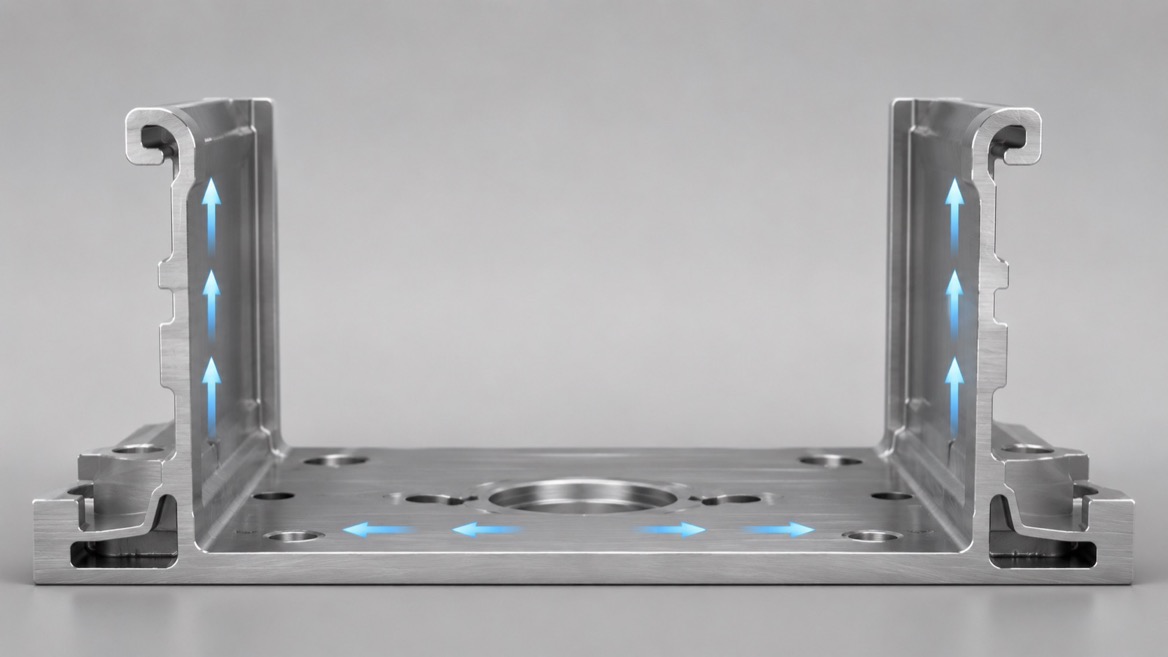
Even after establishing a stable base, improper sidewall machining can still cause deformation.
- Avoid cutting through the wall in early stages
- Retain a thin support layer during roughing
- Remove remaining material during finishing
- Maintains continuous structural integrity
- Reduces vibration and tool chatter
- Ensures smoother finishing passes
This approach is especially important for high-aspect-ratio geometries, where wall height significantly exceeds thickness.
Correct parameter selection plays a decisive role in achieving stable machining performance.
- Spindle speed: 7,000–8,000 RPM
- Feed rate: 2,000–3,000 mm/min
- Depth per pass: 0.5–0.8 mm
- Spindle speed: 8,000–12,000 RPM
- Feed rate: 2,000–2,500 mm/min
- Controlled stock removal
- Spindle speed: 10,000–15,000 RPM
- Feed rate: approximately 1,500 mm/min
- Final allowance: around 0.15 mm
- Reduced deformation risk
- Improved surface smoothness
- Enhanced tool life and stability
Parameter consistency is essential. Deviations without analysis often lead to unpredictable results.
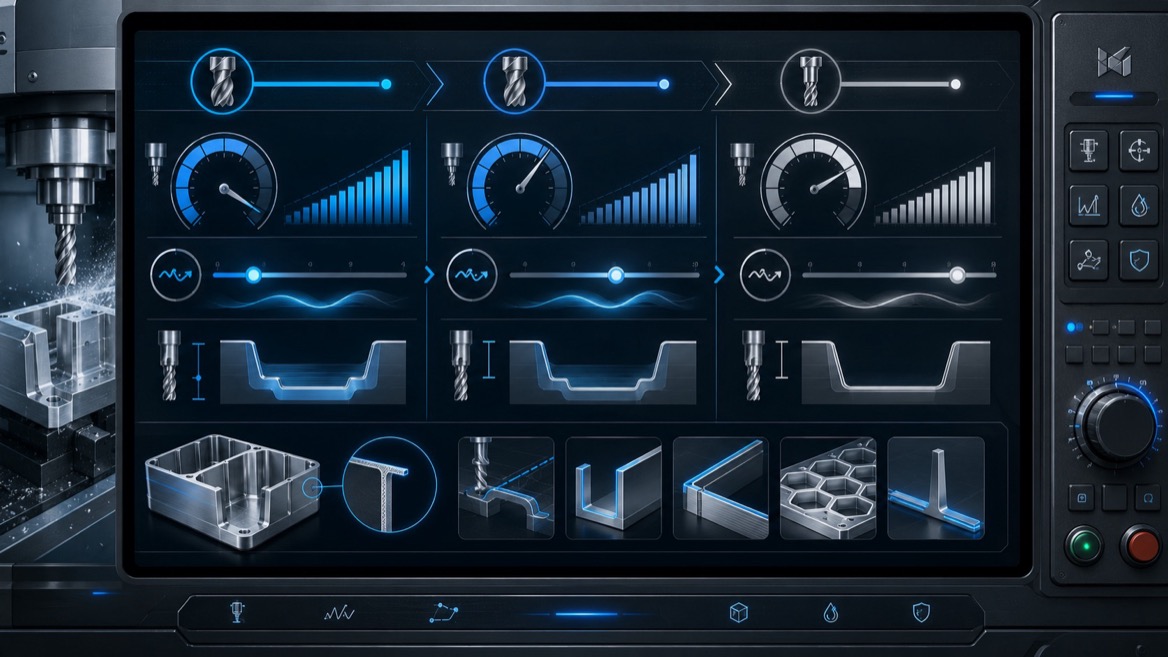
Advanced CAM systems such as Siemens NX play a crucial role in modern machining workflows.
- Enable tool radius compensation
- Activate arc feed rate optimization
- Sequence toolpaths to finish internal features before external walls
- Smoother tool motion
- Reduced tool load fluctuations
- Better dimensional accuracy
- Lower post-processing requirements
CAM programming is not just a technical step—it is a core component of process control.
Despite access to advanced machines, many manufacturers struggle with consistency due to process gaps.
- Lack of standardized machining procedures
- Overdependence on operator habits
- Poor fixture design and clamping strategy
- Incorrect toolpath planning
- Establish documented machining workflows
- Use simulation to validate toolpaths
- Implement material-specific parameter libraries
- Design fixtures that maximize part stability
Organizations that adopt structured systems consistently outperform those relying on informal practices.
A manufacturing project involving thin-wall aluminum housings highlighted the importance of process optimization.
- Surface irregularities on thin sections
- High rejection rates
- Inconsistent dimensional accuracy
- Reordered machining sequence to prioritize base stability
- Applied controlled parameter ranges
- Maintained support material during intermediate stages
- Significant reduction in defect rates
- Noticeable improvement in surface quality
- Increased production efficiency
This example demonstrates that systematic refinement of process logic leads to measurable gains.
Modern production increasingly requires suppliers capable of delivering multiple processes under one system.
- Custom precision parts machining
- Injection mold and die manufacturing (including stamping and cold-forging dies)
- Sheet metal fabrication such as laser cutting, bending, and stamping
- Reduced lead times
- Improved communication across processes
- Consistent quality control
- Streamlined project management
A unified manufacturing approach supports both prototyping and large-scale production.
For engineers and procurement teams working with thin-wall aluminum components, several practical considerations can improve outcomes.
- Maintain uniform wall thickness
- Avoid abrupt geometry transitions
- Use rounded internal corners where possible
- Define achievable tolerances
- Evaluate technical expertise, not just pricing
- Confirm process documentation and control systems
- Review past project experience with similar geometries
Early collaboration between design and manufacturing teams reduces risk and improves efficiency.
Precision machining is fundamentally a discipline of structured thinking and controlled execution. Equipment capability alone does not guarantee results. Instead, quality is achieved through the alignment of process logic, parameter accuracy, and engineering consistency.
Organizations that prioritize these elements are better positioned to deliver reliable, high-performance components in demanding industrial environments.
Thin walls lack rigidity, making them prone to deformation, vibration, and dimensional instability during cutting.
The bottom surface should be machined first to create a stable base, followed by controlled sidewall machining.
Maintain structural support, use appropriate cutting parameters, and avoid premature full-depth cuts.
CAM software ensures optimized toolpaths, stable cutting conditions, and improved dimensional accuracy.
Aerospace, automotive, robotics, and industrial equipment manufacturing frequently rely on such components.
1. Siemens NX CAM https://www.sw.siemens.com/en-US/nx/cam/
2. ASM International – Machining of Aluminum Alloys https://www.asminternational.org
3. Sandvik Coromant – CNC Machining Guidelines https://www.sandvik.coromant.com
4. Modern Machine Shop – Thin Wall Machining Practices https://www.mmsonline.com
5. U-Need Precision Manufacturing https://www.uneedprecisionmachine.com/


