Views: 265 Author: U-Need Publish Time: 2026-09-18 Origin: Site
Content Menu
● Why Rapid Prototyping Is Important in Medical Development
● What Is Medical Rapid Prototyping?
● Patient-Specific Anatomical Models for Surgical Planning
● Surgical Guides and Patient-Matched Instrument Concepts
● Custom Prosthetic and Reconstructive Development
● Cardiovascular Models and Soft-Tissue Prototypes
● Choosing the Right Manufacturing Process
>> 3D Printing for Speed and Complex Geometry
>> CNC Machining for Precision and Functional Testing
>> Injection Molding for Pilot Production and Scale-Up
>> Sheet Metal Fabrication for Enclosures and Structural Parts
● A Practical Medical Prototyping Workflow
>> 1. Define What the Prototype Must Prove
>> 2. Prepare Accurate Digital Data
>> 3. Select Materials Based on the Real Use Case
>> 4. Build, Inspect, and Record Results
>> 5. Turn Prototype Learning Into Production Improvements
● Quality and Risk Considerations
● Why U-Need Supports Prototype-to-Production Projects
● Summary
>> What is rapid prototyping in the medical field?
>> Can rapid prototyping be used for patient-specific anatomical models?
>> Is a 3D-printed medical prototype suitable for implantation?
>> When should a medical-device company choose CNC machining instead of 3D printing?
>> Can prototype injection molds be used for medical-device development?
>> What files are needed to request a medical prototype quotation?
>> What should be checked before moving from a prototype to production?
Rapid prototyping in the medical field helps healthcare innovators turn complex ideas, digital scans, and engineering drawings into physical models and functional components faster. From patient-specific anatomical models and surgical planning tools to precision-machined device parts, prototype molds, and sheet metal enclosures, rapid prototyping supports a more efficient path from concept development to manufacturing.
Medical product development involves more than creating a visually impressive prototype. A useful prototype must answer an important question. It may need to verify anatomical fit, demonstrate a surgical workflow, test a mechanical feature, confirm assembly clearance, evaluate material performance, or prepare a product for production tooling.
For global medical-device brands, distributors, and manufacturers, the strongest development process combines digital design, engineering review, physical prototyping, testing, inspection, and production planning. U-Need supports this process with custom precision parts machining, mold manufacturing, sheet metal fabrication, and prototype-to-production engineering services.
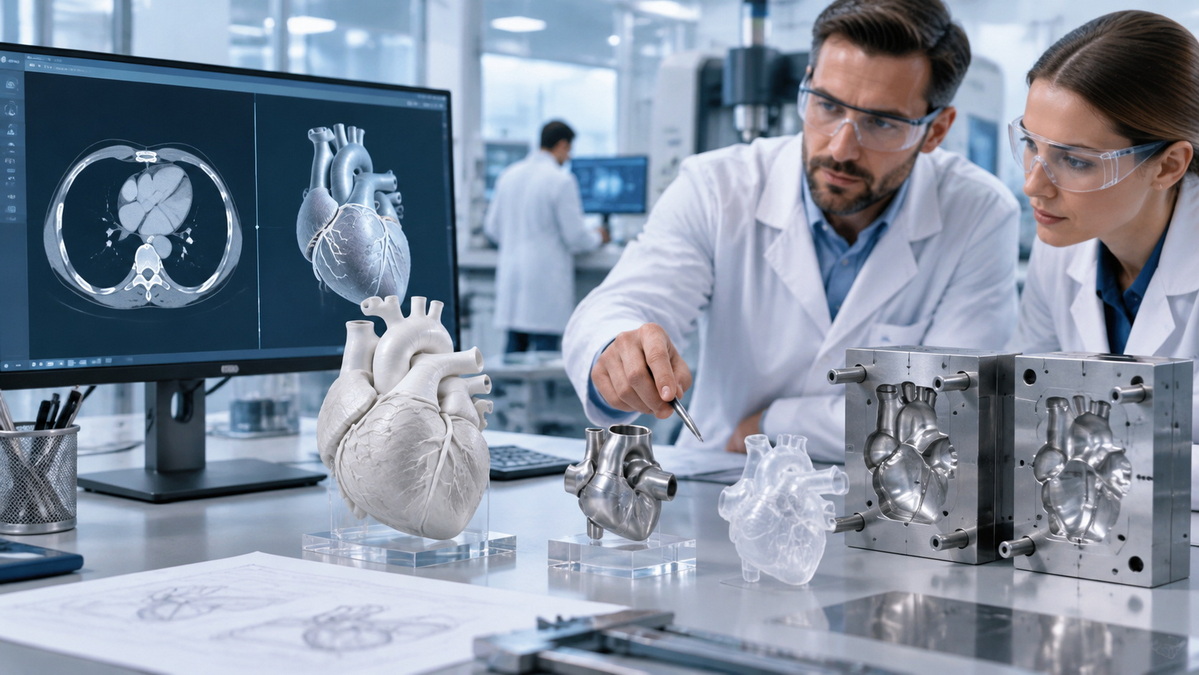
Medical products often involve complicated requirements. A component may need to fit a specific anatomy, connect with a surgical instrument, withstand repeated movement, resist chemicals, support a sterile workflow, or meet strict dimensional tolerances.
Traditional development methods can make design changes slow and expensive. When a design error is discovered after production tooling has been made, the cost of modifying a mold, die, fixture, or assembly can be significant.
Rapid prototyping reduces this risk by allowing teams to create and evaluate physical parts earlier in the development cycle.
Key advantages include:
- Faster design iteration during early-stage product development
- Better communication between clinicians, engineers, product managers, and manufacturing teams
- Earlier fit and function checks for components, housings, handles, and surgical tools
- Improved visualization of patient anatomy and complex internal structures
- Lower tooling risk before investing in injection molds or stamping dies
- More informed material selection before pilot production
- Better manufacturability planning for mass production
The value of rapid prototyping is not limited to speed. It gives teams the opportunity to learn before costly production decisions are made.
For example, a medical-device company developing a handheld diagnostic device may initially produce a 3D-printed housing to evaluate size and ergonomics. The next stage may require a CNC-machined prototype to test threads, snap features, assembly tolerances, and internal component clearances. Before full production, the company may use prototype injection molding to evaluate the final polymer, cosmetic appearance, shrinkage, and repeatability.
Each stage answers a different question. Using the correct manufacturing method at the correct time can reduce unnecessary redesign and shorten the path to production.
Medical rapid prototyping is the process of creating physical models, parts, tools, or product samples from digital data. The digital data may be created from medical imaging, engineering drawings, CAD models, reverse engineering, or product-development specifications.
Typical data sources include:
- CT scans
- MRI scans
- DICOM medical imaging files
- CAD models
- STEP files
- IGES files
- 2D engineering drawings
- Reverse-engineered product data
- Clinical workflow requirements
Medical rapid prototyping includes more than additive manufacturing. Depending on the purpose of the project, a development team may use 3D printing, CNC machining, silicone casting, injection molding, laser cutting, sheet metal bending, stamping, or cold forging.
The right process depends on the part's intended use, material requirement, geometry, tolerance, quantity, surface finish, mechanical load, and production goal.
| Development Need | Recommended Process | Typical Purpose |
|---|---|---|
| Early anatomical model | 3D printing | Surgical planning, education, visualization |
| Concept model | SLA printing, FDM printing, silicone casting | Appearance, ergonomics, form review |
| Functional medical-device prototype | CNC machining, SLS printing, metal fabrication | Mechanical testing, assembly checks, functional evaluation |
| Low-volume polymer parts | Prototype injection molding | Material validation, fit testing, pilot production |
| Metal brackets and enclosures | Laser cutting, bending, stamping | Device housings, internal supports, structural components |
| High-volume production preparation | Injection molds, stamping dies, cold-forging dies | Repeatable manufacturing and scale-up |
One of the most important uses of rapid prototyping in the medical field is the production of patient-specific anatomical models.
Medical imaging data from CT or MRI scans can be converted into three-dimensional digital models. Engineers and clinicians can isolate specific structures such as bone, blood vessels, organs, tumors, or damaged tissue. The model can then be printed or manufactured for physical review.
Patient-specific models can support planning in many specialties:
- Orthopedic surgery
- Craniofacial surgery
- Maxillofacial reconstruction
- Dental and oral surgery
- Neurosurgery
- Cardiovascular surgery
- Congenital heart treatment
- Trauma surgery
- Oncology-related surgical planning
- Reconstructive surgery
A physical model can help a medical team understand complex anatomical relationships more clearly. It may be easier to examine the orientation of a fracture, bone defect, vessel pathway, or tumor location when holding a three-dimensional model instead of relying only on two-dimensional images.
For example, a surgeon preparing for mandibular reconstruction may use a patient-specific jaw model to examine the extent of a defect and plan the shape of a reconstruction plate. A prototype can also help teams review screw positions, plate contours, instrument access, and potential interference points before surgery.
Rapid prototyping can also support the development of surgical guide concepts and patient-matched instruments.
These products may include:
- Drill guides
- Cutting guides
- Alignment guides
- Positioning fixtures
- Implant trial components
- Patient-matched instrument handles
- Surgical navigation accessories
- Alignment jigs
- Test fixtures for surgical tools
A development team can use prototypes to evaluate the geometry of a guide, the usability of a handle, the location of a drilling path, or the interface between a new component and an existing medical instrument.
However, a prototype guide should not be treated as a finished clinical product without proper evaluation. Accuracy, material behavior, dimensional stability, cleaning requirements, sterilization compatibility, mechanical performance, and product documentation must be considered before a product is used in a clinical setting.
A practical development approach includes the following stages:
1. Define the clinical or engineering problem.
2. Create a digital model from medical imaging or CAD data.
3. Review the design with clinicians and engineers.
4. Produce an early prototype for visual and fit evaluation.
5. Create a functional prototype for mechanical testing.
6. Inspect critical dimensions and assembly interfaces.
7. Update the design based on test results.
8. Prepare the product for prototype tooling or volume manufacturing.
This process helps teams identify potential issues before they become expensive production problems.
Rapid prototyping is also valuable in the development of custom prosthetic forms, reconstructive components, facial prostheses, and patient-specific external devices.
A common example is a custom ear prosthesis. A healthy ear can be scanned and converted into a digital model. The model can then be mirrored, adjusted, refined, and prepared for mold manufacturing or silicone casting.
This process may include:
1. Scanning the healthy anatomical feature.
2. Creating a detailed digital 3D model.
3. Mirroring or modifying the model to match the affected side.
4. Refining the surface texture and shape.
5. Producing a master pattern or prototype.
6. Manufacturing a mold.
7. Casting silicone or another suitable material.
8. Evaluating fit, appearance, texture, and comfort.
The same approach can support the development of facial prosthetic components, orthopedic support products, assistive devices, hearing-related accessories, and customized rehabilitation products.
For these projects, the prototype must often balance multiple requirements. It may need to look realistic, feel comfortable, fit accurately, resist wear, and be produced in a repeatable way.
Cardiovascular models are another important application of medical rapid prototyping. Heart models, vascular pathways, and soft-tissue structures can be created from imaging data to support visualization, training, product development, and procedural planning.
These models may require different properties depending on the application.
A rigid transparent model may be useful for visualizing vessel pathways. A flexible model may better simulate soft tissue, blood vessels, or catheter interaction. A colored model may help distinguish between chambers, arteries, veins, valves, and other structures.
Before selecting a process, teams should define what the model needs to achieve.
Important questions include:
- Does the model need to be visual, functional, or both?
- Does it need to be transparent?
- Does it need to simulate soft tissue?
- Will it be used with fluid or pressure?
- Does it need to tolerate repeated handling?
- Will medical instruments interact with the model?
- Does the model need to be full scale?
- Which anatomical features are most important?
A visual demonstration model and a functional training model may look similar but require different manufacturing processes, materials, wall thicknesses, and finishing methods.
3D printing is often the first option considered for medical rapid prototyping because it can create complex geometry directly from digital files.
It is particularly suitable for:
- Anatomical models
- Early-stage surgical guide concepts
- Complex internal structures
- Visual presentation models
- Low-volume prototype parts
- Design verification models
- Product-development samples
- Educational models
Different 3D-printing processes offer different benefits.
SLA printing can produce fine details and smooth surfaces. It is often suitable for detailed medical models, appearance prototypes, and concept components.
SLS printing can produce more durable polymer parts and is useful for functional prototypes, assemblies, clips, housings, and mechanical components.
FDM printing is often a cost-effective choice for larger concept models, simple fixtures, and early-stage development samples.
Metal additive manufacturing can produce complex metal structures, but it may require additional post-processing, machining, finishing, inspection, and mechanical testing.
The main limitation of 3D printing is that a printed part may not fully represent the behavior of a production part. Layer direction, porosity, surface finish, material properties, and post-processing can all affect performance.
CNC machining is often the preferred choice when a medical prototype requires close tolerances, production-like material performance, threaded features, high strength, or improved surface finish.
CNC machining can be used for:
- Precision metal components
- Surgical instrument prototypes
- Medical-device housings
- Test fixtures
- Assembly fixtures
- Threaded parts
- Mechanical components
- Transparent plastic parts
- Small-batch production components
Common materials may include aluminum, stainless steel, titanium, PEEK, acetal, polycarbonate, ABS, and other engineering-grade materials.
For a device that requires tight assembly tolerances, a CNC-machined prototype can provide more meaningful feedback than a basic printed model. It can help engineers evaluate fit, sealing, screw engagement, moving parts, load-bearing performance, and component alignment.
If the final product will be injection molded, it is important to consider mold design early in the development process.
Prototype injection molds and bridge tools can help manufacturers evaluate:
- Material selection
- Shrinkage
- Warpage
- Surface finish
- Parting lines
- Gate locations
- Snap fits
- Living hinges
- Cosmetic appearance
- Assembly fit
- Repeatability
A prototype mold can produce multiple parts in the intended material. This is valuable when a team needs to evaluate the product under realistic conditions before committing to high-volume tooling.
Mold manufacturing is especially useful for medical-device housings, disposable components, diagnostic-device parts, fluid-management components, protective covers, and assembly parts that will eventually require repeatable production.
Many medical products include sheet metal components. These may include device enclosures, panels, trays, brackets, carts, shields, mounting hardware, and internal structural supports.
Sheet metal fabrication methods can include:
- Laser cutting
- Bending
- Welding
- Riveting
- Deburring
- Powder coating
- Brushing
- Stamping
Laser-cut and bent sheet metal is often suitable for low-volume prototypes and early functional assemblies. For higher volumes, stamping dies may improve repeatability and reduce unit cost.
The right process depends on annual production volume, part geometry, material type, dimensional tolerance, finish requirements, and expected product lifecycle.

A structured workflow helps ensure that prototypes provide useful information instead of becoming isolated samples.
Before selecting a manufacturing process, define the purpose of the prototype.
A prototype may be used to:
- Confirm anatomical fit
- Test a mechanism
- Review ergonomics
- Demonstrate a product concept
- Validate an enclosure assembly
- Check material behavior
- Evaluate a production process
- Prepare for pilot production
- Support internal design review
A visual prototype, functional prototype, and production-validation sample should not be treated as the same type of part.
Digital data should be clear, controlled, and ready for manufacturing.
For device components, this may include:
- 3D CAD models
- 2D drawings
- Tolerances
- Critical dimensions
- Material requirements
- Surface finish requirements
- Assembly information
- Revision numbers
- Inspection requirements
For patient-specific models, the workflow may include image segmentation, smoothing, artifact correction, scaling checks, and clinical review.
An STL file may be enough for a simple printed model, but a STEP file or native CAD model is often more suitable for precision machining, mold design, and production planning.
Material selection should be based on the intended test or application.
Important factors include:
- Mechanical strength
- Flexibility
- Fatigue resistance
- Chemical resistance
- Temperature resistance
- Transparency
- Surface finish
- Sterilization compatibility
- Cleaning requirements
- Wear resistance
- Biocompatibility requirements
- Production material equivalency
For example, a clear visual model may only require a transparent resin. A mechanical device prototype may require PEEK, polycarbonate, stainless steel, aluminum, or another engineering material. A silicone prosthetic development project may require a precision mold and controlled casting process.
Inspection should be part of the prototype process, not an afterthought.
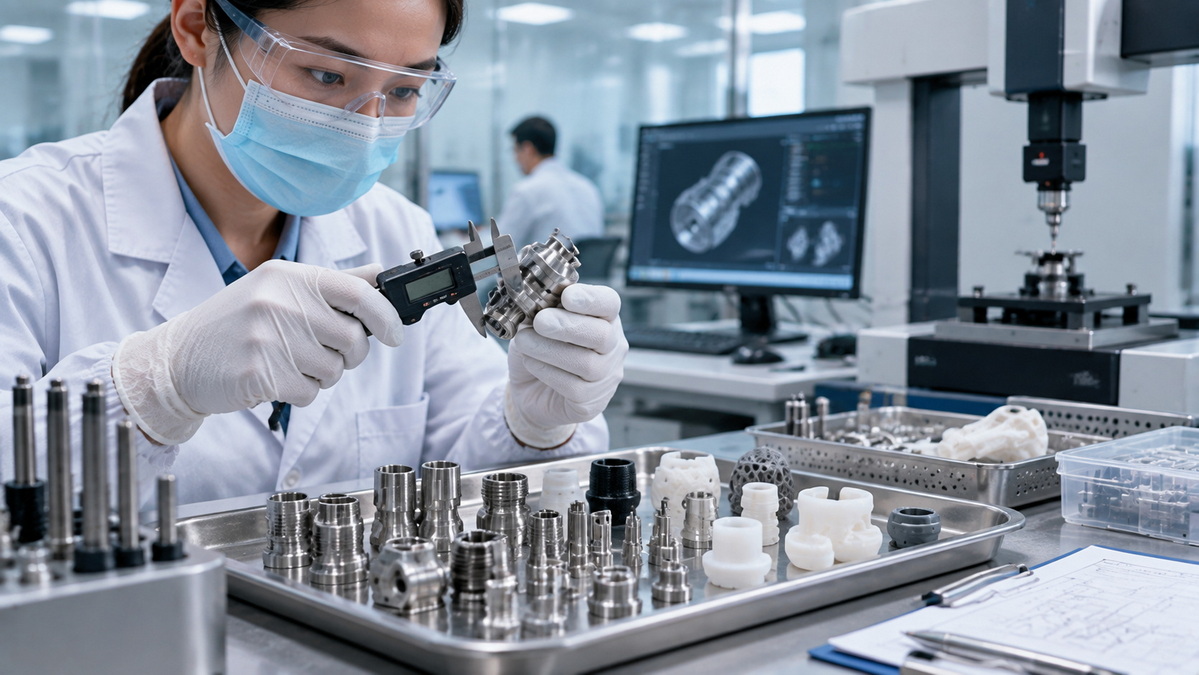
Critical features should be measured and compared with the approved design. For assemblies, mating parts should be tested together to identify tolerance stack-up and interference issues.
A practical inspection plan may include:
- Critical-to-quality dimensions
- Hole diameter and position
- Flatness
- Parallelism
- Perpendicularity
- Thread engagement
- Surface roughness
- Assembly fit
- Material verification
- First-article inspection reporting
The inspection results should be used to guide the next design revision or manufacturing step.
The purpose of a prototype is to improve the final product.
After testing, the design may need changes such as:
- Adding draft angles
- Adjusting wall thickness
- Improving rib design
- Modifying snap features
- Changing material selection
- Revising tolerances
- Improving assembly features
- Changing the manufacturing process
- Updating surface finish requirements
The prototype phase should connect directly to production decisions. Design feedback should be transferred into mold design, machining programs, sheet metal processes, quality plans, and assembly instructions.
Medical-related projects require careful planning. Not every prototype is suitable for patient contact, and not every material is suitable for every medical application.
Before moving forward, manufacturers and product teams should consider:
| Area | Key Questions |
|---|---|
| Intended Use | Is the part a visual model, functional prototype, accessory, instrument, implant concept, or finished device? |
| Materials | Is the material appropriate for the real application and test conditions? |
| Biocompatibility | Is evidence required for the specific type and duration of patient contact? |
| Sterilization | Can the material and design tolerate the intended sterilization process? |
| Traceability | Can design revisions, materials, processes, and inspection results be tracked? |
| Mechanical Performance | Can the part meet strength, fatigue, and assembly requirements? |
| Dimensional Accuracy | Are critical features measured and verified? |
| Data Security | Is patient imaging data handled securely and responsibly? |
| Production Readiness | Can the design be manufactured consistently at the required volume? |
A successful medical prototype is not only visually accurate. It must also be connected to a controlled engineering and manufacturing process.
U-Need provides integrated manufacturing support for companies developing medical-related components, equipment, accessories, and precision assemblies.
Rather than limiting a project to a single prototype process, U-Need can help customers evaluate the most practical route from early development to production.
Core capabilities include:
- Custom precision parts machining for plastic and metal components
- Mold manufacturing for injection molds, stamping dies, and cold-forging dies
- Sheet metal fabrication including laser cutting, bending, welding, and stamping
- Prototype-to-production support for functional testing, pilot builds, and scalable manufacturing
- Manufacturability review to identify design risks before tooling investment
- Engineering communication for tolerances, materials, finishes, assembly requirements, and inspection needs
A strong project begins with complete technical information. The more clearly a customer defines the intended use, material, quantity, tolerances, finish requirements, and testing needs, the more effectively the manufacturing process can be planned.
Rapid prototyping in the medical field supports faster, more informed product development. It can help healthcare innovators visualize anatomy, test device concepts, evaluate mechanical performance, improve surgical planning, create custom prosthetic forms, and prepare products for production.
The most effective projects do not rely on a single process. They combine digital modeling, 3D printing, CNC machining, mold manufacturing, sheet metal fabrication, inspection, testing, and production planning according to the needs of each development stage.
For medical-device brands, distributors, and manufacturers, the goal is not simply to create a prototype quickly. The goal is to create a prototype that provides meaningful information, reduces development risk, and supports a practical transition to repeatable manufacturing.
U-Need helps global customers move from concepts and CAD files to precision-machined components, prototype molds, sheet metal parts, and production-ready tooling. By combining engineering communication with flexible manufacturing capabilities, U-Need can support a more efficient path from prototype development to scalable production.
Rapid prototyping in the medical field is the fast development of physical anatomical models, medical-device components, surgical tool concepts, prosthetic forms, fixtures, and manufacturing samples from digital data. It can involve 3D printing, CNC machining, injection molding, silicone casting, sheet metal fabrication, and other processes.
Yes. CT or MRI data can be converted into three-dimensional models that represent a patient's anatomy. These models can support surgical planning, clinical education, engineering review, and communication between healthcare professionals and patients.
Not automatically. A 3D-printed prototype is not inherently sterile, biocompatible, implantable, or suitable for patient contact. Implantable or patient-contact applications require careful evaluation of material properties, manufacturing controls, testing methods, cleaning, sterilization, and applicable product requirements.
CNC machining is often preferred when a prototype needs close tolerances, production-like material properties, threaded holes, strong mechanical performance, improved surface finish, or accurate assembly testing. 3D printing is often more suitable for fast concept models, complex geometry, and low-volume anatomical models.
Yes. Prototype injection molds can produce multiple parts in the intended polymer. This allows teams to evaluate material behavior, shrinkage, warpage, cosmetic finish, assembly fit, snap features, and repeatability before investing in high-volume production tooling.
A complete request usually includes a 3D CAD file such as STEP, IGES, or a native format; 2D drawings with tolerances; material requirements; surface finish requirements; quantity; intended application; inspection requirements; and target delivery date.
Before production, teams should confirm the final design, material, tolerance strategy, manufacturing process, inspection plan, assembly requirements, surface finish, packaging needs, expected production volume, and any documentation requirements related to the final application.
1. U.S. Food and Drug Administration. [Technical Considerations for Additive Manufactured Medical Devices]
2. U.S. Food and Drug Administration. [3D Printing Medical Devices at the Point of Care: Discussion Paper]
3. U.S. Food and Drug Administration. [3D Printing of Medical Devices]
4. Chepelev, L. et al. [Radiological Society of North America 3D Printing Special Interest Group Guidelines for Medical 3D Printing and Appropriateness for Clinical Scenarios]
5. RPPROTO. [Application of Rapid Prototyping in the Medical Field]
6. U.S. Food and Drug Administration. [FDA's Role in 3D Printing]


