Views: 222 Author: U-Need Publish Time: 2026-04-14 Origin: Site
When engineers, buyers, and startup founders come to U-Need, the first question they usually ask me is simple: "Should we use sheet metal or CNC machining for this part?" From my experience helping global brands and distributors bring complex products to market, the right answer depends on geometry, tolerance, volume, and lifecycle cost—not just unit price. [geomiq]
By the end of this guide, you will clearly understand sheet metal vs CNC machining, including how each process works, where they shine, typical costs, and how I personally evaluate real projects before recommending a method. I will also share practical selection checklists and real-world scenarios that reflect how professional buyers and engineers actually decide. [gtrmfg]

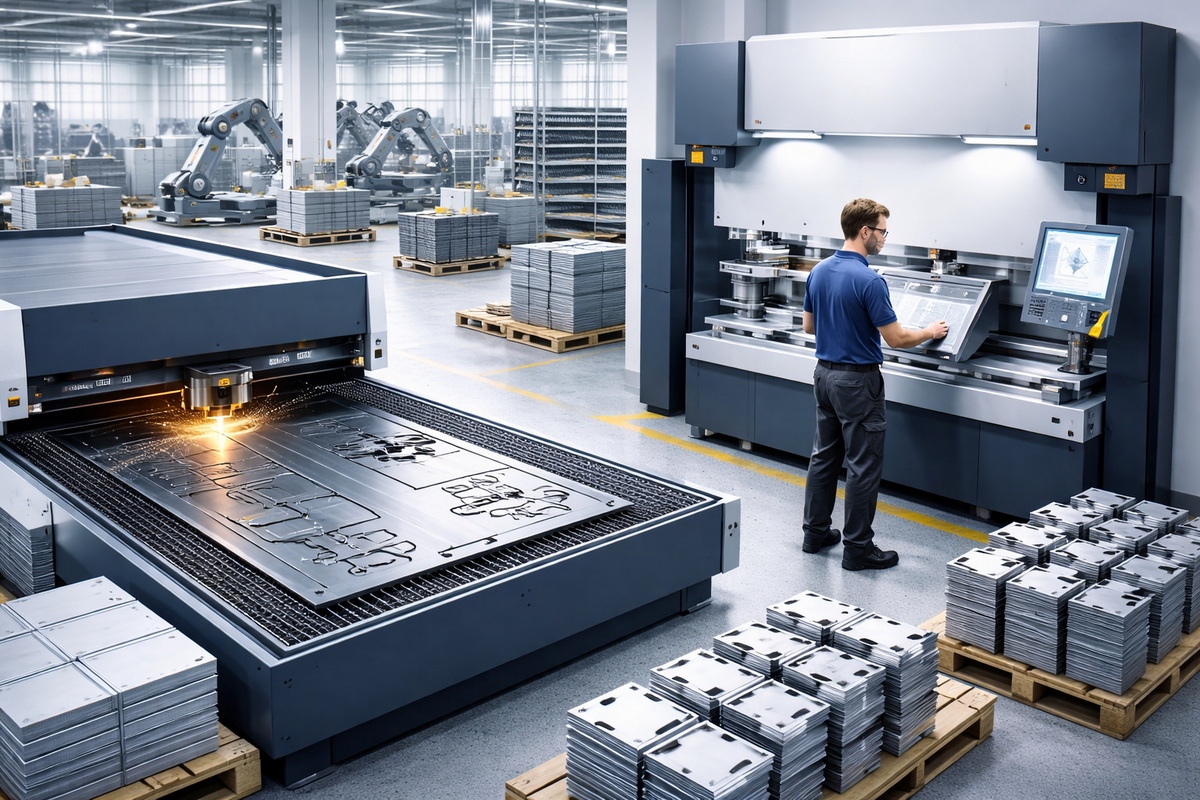
Sheet metal fabrication is a form‑and‑assemble process that turns flat metal sheets into three‑dimensional parts by cutting, bending, forming, and joining. [gtrmfg]
Typical steps in a modern sheet metal shop include: [gtrmfg]
1. Cutting – Laser cutting, shearing, or CNC plasma cutting to get blanks with the required outline.
2. Bending – Press brakes bend flanges, channels, and brackets to precise angles.
3. Forming – Stamping, embossing, and rolling create beads, ribs, louvers, and radii.
4. Joining – Welding, riveting, clinching, or fasteners assemble multiple pieces into one structure.
5. Finishing – Powder coating, painting, passivation, or plating improve corrosion resistance and appearance. [gtrmfg]
Because most operations work from sheet stock, this method is perfect for: [protocase]
- Enclosures and housings
- Brackets, racks, and frames
- Panels and cabinets
- Chassis for electronics and appliances
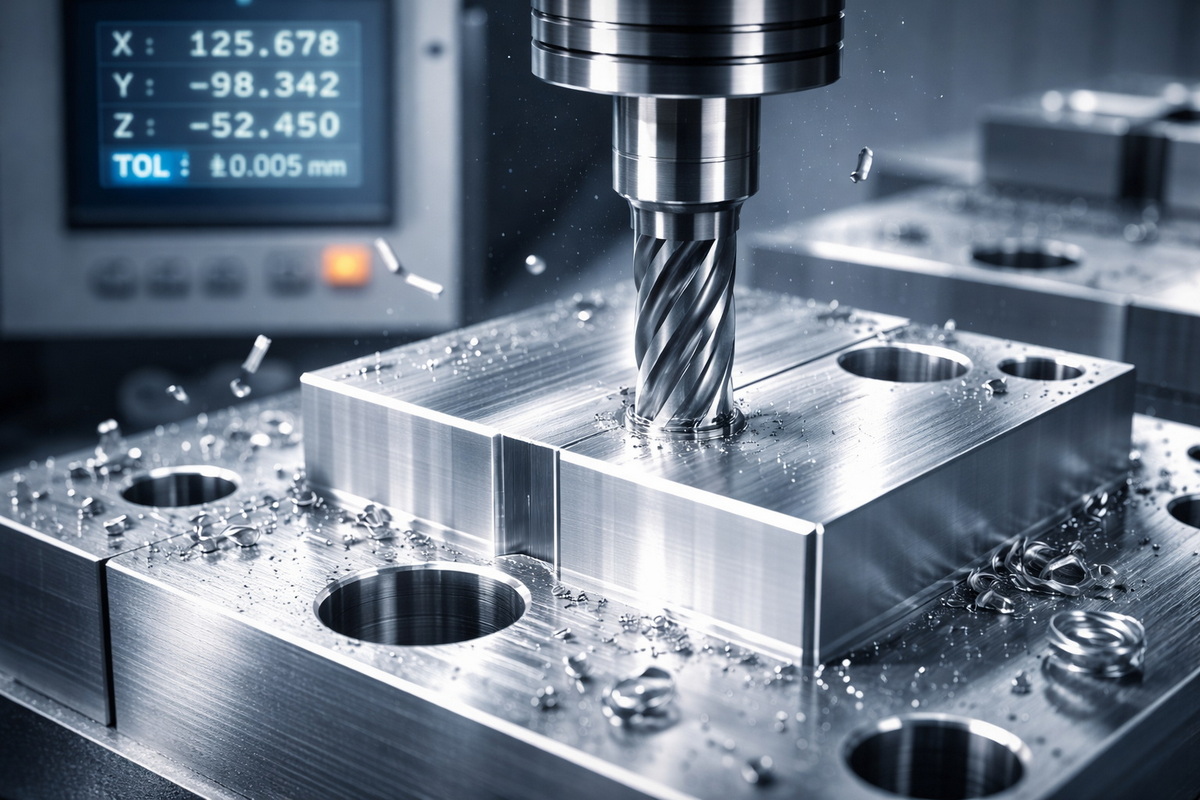
CNC machining is a subtractive process: we start from a solid block, bar, or billet and precisely remove material using computer‑controlled tools. Programmed via CAD/CAM, the machine follows a toolpath to achieve exact geometries and tolerances. [geomiq]
In our own CNC machining shop at U-Need, we routinely work with: [uneedpm]
- CNC turning for rotational parts (shafts, bushings, sleeves)
- CNC milling for prismatic parts, pockets, slots, and complex 3D surfaces
- CNC grinding when ultra‑tight tolerances and surface quality are critical
- EDM and wire EDM for hard materials and very intricate profiles
Compared with general industry standards, we maintain tolerances as tight as ±0.001 mm, significantly better than typical ±0.01–0.05 mm ranges in many factories. That capability is crucial when customers design components for high‑precision motion control, optics, and medical devices. [achrnews]
From a buyer's perspective, the real question is not "What is it?" but "Which process fits this part best?" The table below summarizes the key differences I walk through with clients during early RFQ discussions. [protocase]
| Aspect | Sheet Metal Fabrication | CNC Machining |
|---|---|---|
| Geometry | Flat, folded, box‑like shapes, moderate 3D features gtrmfg | Solid blocks, complex 3D contours, pockets, channels gtrmfg |
| Precision | Good dimensional control, but not micron‑level gtrmfg | Excellent accuracy; U-Need reaches ±0.001 mm in some cases geomiq |
| Wall Thickness | Thin walls and lightweight structures gtrmfg | Thick sections, ribs, local thin features in one block geomiq |
| Volume & Cost | Highly cost‑effective for medium–high volumes of simpler parts gtrmfg | Better for low–medium volumes, complex or high‑value parts gtrmfg |
| Setup & Lead Time | Fast setup, short lead times for standard geometries gtrmfg | More programming and fixturing; slightly longer initial lead time gtrmfg |
| Materials | Mainly steel, stainless, aluminum sheet gtrmfg | Wide range: metals, plastics, composites, high‑performance alloys gtrmfg |
| Typical Uses | Enclosures, brackets, racks, cabinets gtrmfg | Housings, manifolds, precision bases, tooling, molds geomiq |
Based on hundreds of quotes I have reviewed, sheet metal wins when customers need lightweight structures and cost efficiency at scale. [view-well]
You should strongly consider sheet metal if: [protocase]
- The part is mainly flat panels with bends (like cabinets, boxes, or frames).
- Structural stiffness can come from bends and ribs instead of thick solid walls.
- You require hundreds to thousands of pieces per year.
- Aesthetic surfaces can be handled with powder coating or painting.
- Tolerances are important but do not require micron‑level control.
Example from my work: a European EV charger startup initially asked for solid milled aluminum housings. After reviewing their design, we redesigned to a sheet metal enclosure with local CNC‑machined inserts, cutting their total cost by more than 30% while still meeting IP rating and thermal requirements. [view-well]
CNC machining becomes the preferred method when the part must be monolithic, highly precise, or heavily loaded. [geomiq]
Typical indicators that you need CNC machining include: [achrnews]
- Complex 3D forms: pockets, channels, mating surfaces on multiple faces.
- Very tight tolerances on critical features, such as bearing seats or sealing faces.
- Demanding materials (high‑strength alloys, engineering plastics, composites).
- Low to medium production volume where tooling for casting or stamping is not justified.
- Parts that must maintain alignment over time under dynamic loads.
With our precision gap advantage—for example, ±0.005 mm on turning and ±0.01 mm on milling vs typical ±0.02–0.05 mm industry standards—we often step in as a problem‑solver when customers are struggling with tolerance stack‑ups or fit issues from other suppliers. [tramarindustries]
When we review a new drawing or 3D model, my team and I run through a structured checklist before recommending sheet metal vs CNC machining. [jlccnc]
- Simple to moderately complex, mainly 2.5D → usually sheet metal if strength and stiffness allow. [jlccnc]
- Intricate geometry, deep cavities, compound surfaces → CNC machining.
- If you specify tight tolerances on many dimensions, CNC machining is almost always required. [tramarindustries]
- Sheet metal is usually more economical for larger batches of simpler parts, because cutting and bending processes scale very well. [view-well]
- CNC machining tends to have higher per‑part cost but excels for low volume, prototypes, and complex high‑value parts. [geomiq]
- For standard brackets, panels, and enclosures, sheet metal can often be produced very quickly after design freeze. [protocase]
- CNC machining requires programming and fixturing, but for critical prototypes and engineer‑to‑order projects, it gives unmatched flexibility to adjust designs between iterations. [geomiq]
- If your design is clearly based on sheet stock such as 1.5–3.0 mm steel or aluminum, sheet metal is a natural choice. [gtrmfg]
- If you need engineering plastics (POM, PEEK, PC, PA) or specialized alloys, CNC machining is generally the better route. [geomiq]
In real projects, the best solution is often not either/or, but both. [view-well]
For example, we frequently help customers by: [jlccnc]
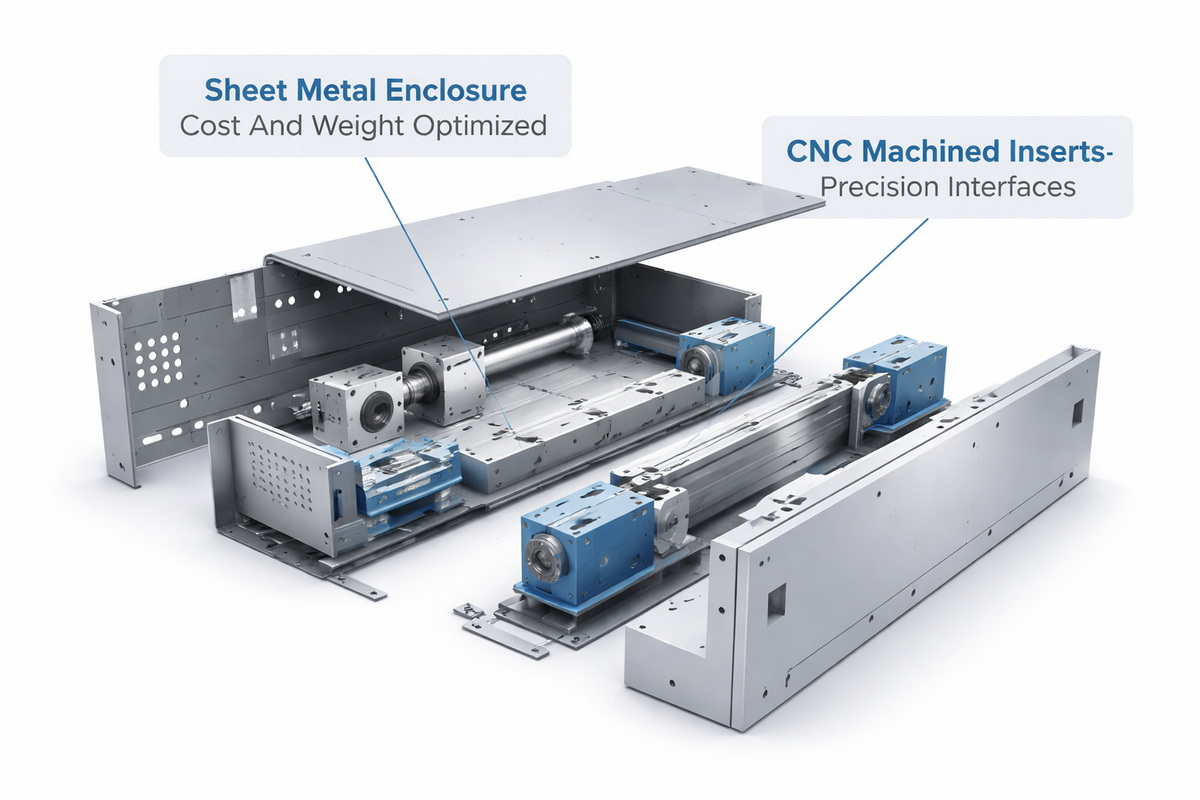
- Using sheet metal for the primary housing to reduce cost and weight.
- Integrating CNC‑machined inserts where precise alignment or sealing is critical (bearing blocks, sealing flanges, heat‑spreader plates).
- Designing assemblies so that machined parts can be easily aligned and fastened to sheet structures, simplifying installation and maintenance.
This hybrid strategy leverages the speed and cost‑efficiency of sheet metal together with the precision and material flexibility of CNC machining. As a manufacturing partner, we can manage both processes internally, ensuring tolerance compatibility across the entire build. [uneedpm]
From an E‑E‑A‑T standpoint, it is important that you understand who is giving you this advice and how it is applied in practice. [wgcontent]
At U-Need, our process selection typically follows these expert steps: [uneedpm]
1. Application analysis – We clarify how and where the part will be used: mechanical loads, operating environment, regulatory constraints.
2. Design for manufacturability (DFM) review – We review your CAD, identify potential tolerance risks, and suggest modifications to simplify forming or machining.
3. Process‑capability mapping – We compare your requirements against what sheet metal and CNC machining can realistically achieve, including our own precision benchmarks. [pmc.ncbi.nlm.nih]
4. Cost‑benefit analysis – We estimate tooling, processing, and finishing costs for relevant options and explain the trade‑offs.
5. Prototyping plan – For new designs, we often start with CNC machining or a hybrid approach, then migrate parts to sheet metal or other processes once the design stabilizes. [protocase]
This structured approach is consistent with best practices in manufacturing benchmarking and process selection documented in industry and academic literature. [snicsolutions]
Here is a simple decision framework I often share with engineering and sourcing teams. [jlccnc]
Rank these factors for your project:
- Precision and tolerance
- Unit cost at target volume
- Lead time and speed to market
- Weight and space constraints
- Material compliance (e.g., RoHS, REACH, medical)
- If precision and complex geometry are your top priorities → lean toward CNC machining.
- If cost per unit at volume is critical and geometry is mostly flat and bent → consider sheet metal.
- If your design is still evolving, start with CNC machining, then evaluate whether parts can be converted to sheet metal later.
- For mission‑critical interfaces, consider hybrid designs, combining a sheet metal structure with CNC‑machined functional cores. [jlccnc]
Sharing full 3D models and tolerance requirements allows us to propose optimizations that can: [uneedpm]
- Reduce machining time by simplifying features or combining operations.
- Adjust sheet thickness or bend radii for better stability and easier forming.
- Improve reliability by tightening tolerances only where they really matter.
When you compare manufacturing partners in China, the difference is not just equipment—it is process discipline, communication, and long‑term reliability. [uneedpm]
Key strengths that our overseas buyers consistently highlight include: [uneedpm]
- Precision gap advantage – Tight tolerances down to ±0.001 mm on critical processes, significantly better than typical industry averages.
- 30+ years of machining experience and over 15 years of international trade experience, minimizing communication errors and project risk.
- ISO9001:2015 certified factory, robust CQAT practices, and a documented pass rate above 99%.
- Fast response and after‑sales protection – 24‑hour professional replies, one‑year warranty on products, and clear support for returns and repairs.
These capabilities matter directly when you are choosing sheet metal vs CNC machining, because they determine how consistently your specifications will be met over the life of your project. [toprankmarketing]
If you are unsure whether sheet metal or CNC machining is right for your next part, share your drawings, target volumes, and application details with us. Our engineering team will review your design, suggest process options and cost scenarios, and help you choose the most reliable and economical route for your project. [geomiq]
Not always. For large volumes of simple parts, sheet metal is typically cheaper, but for small batches or complex 3D geometries, CNC machining can be more cost‑effective overall. [view-well]
Often yes. Many customers start with machined prototypes and later redesign into a sheet metal assembly to reduce cost at volume, but this requires careful DFM and tolerance planning. [jlccnc]
CNC machining can achieve very fine surface finishes directly from the machine, while sheet metal parts usually rely on coatings or secondary finishing to achieve the desired appearance and corrosion resistance. [gtrmfg]
In such cases, we often recommend a hybrid solution: sheet metal for the thin‑wall structure plus CNC‑machined inserts for critical features like bearing seats or precision interfaces. [view-well]
The best approach is to send your drawing and 3D model for a professional DFM review. We will compare your requirements with real process capabilities and suggest where tolerances can be tightened or relaxed without compromising function. [pmc.ncbi.nlm.nih]
1. JLCCNC. "Sheet Metal vs CNC Machining: A Guide to Choosing the Right Method for Your Metal Parts." https://jlccnc.com/blog/sheet-metal-vs-cnc-machining [gtrmfg]
2. Geomiq. "CNC Machining vs Sheet Metal Fabrication." https://geomiq.com/blog/cnc-machining-vs-sheet-metal-fabrication/ [geomiq]
3. GTR Manufacturing. "Sheet Metal Fabrication vs. CNC Machining." https://gtrmfg.com/sheet-metal-fabrication-vs-cnc-machining/ [gtrmfg]
4. Protocase. "Sheet Metal Fabrication vs. CNC Machining: Choosing the Right Process for Your Custom Prototype." https://www.protocase.com/blog/sheet-metal-fabrication-vs-cnc-machining-choosing-the-right-process-for-your-custom-prototype/ [protocase]
5. View‑Well. "Choosing the Right Process: CNC Machining vs Sheet Metal." https://view-well.com/cnc-machining-vs-sheet-metal-choosing-the-right-metal-and-right-process/ [view-well]
6. U-Need. "Custom CNC Machining Services Precision You Can Trust." https://www.uneedpm.com/cnc-machining/ [uneedpm]
7. WG Content. "E‑E‑A‑T for Content Quality and SEO." https://wgcontent.com/blog/eeat-content-quality-seo-geo/ [wgcontent]
8. Wellows. "E‑E‑A‑T Checklist for SEO." https://wellows.com/blog/e-e-a-t-checklist/ [wellows]
9. ACHR News. "CNC Machining vs Sheet Metal Fabrication: Which is Best in Terms of Cost and Quality." https://www.achrnews.com/articles/148175-cnc-machining-vs-sheet-metal-fabrication-which-is-best-in-terms-of-cost-and-quality [achrnews]
10. Tramar Industries. "CNC Machining vs Sheet Metal Fabrication." https://www.tramarindustries.com/2023/09/19/cnc-machining-vs-sheet-metal-fabrication/ [tramarindustries]
11. TopRank Marketing. "E‑E‑A‑T and SEO: Optimizing for Google's Guidelines." https://www.toprankmarketing.com/blog/eeat-seo-google-guidelines-experience-expertise-authority-trust/ [toprankmarketing]
12. Snic Solutions. "The Ultimate Guide to Benchmarking in Manufacturing." https://snicsolutions.com/blog/benchmarking-in-manufacturing [snicsolutions]
13. NetSuite. "Manufacturing Benchmarking Guide: Benefits, Types, and Guidance." https://www.netsuite.com/portal/resource/articles/erp/benchmark-manufacturing.shtml [netsuite]
14. Systematic review of process selection tools. "Decision Tools for Process Selection and Comparative Assessments in Manufacturing." https://pmc.ncbi.nlm.nih.gov/articles/PMC12592300/ [pmc.ncbi.nlm.nih]


