Views: 275 Author: U-Need Publish Time: 2026-12-03 Origin: Site
Content Menu
● What Small Batch Machining Services Really Offer
● What Mass Production Means in Practice
● Small Batch vs Mass Production: Side-by-Side
● A Practical Five-Step Selection Process
● Pricing Reality: How Quantity Cuts Machining Cost
● The Middle Path: Bridge Production
● Where Each Process Wins: Real Scenarios
● Hidden Costs Buyers Often Miss
● FAQ
Picking the wrong process is expensive. Commit to a mold too early and you may pay for tooling you must scrap after one design change. Stay on machining too long and you overpay on every unit.
At U-Need, we machine precision parts and build molds, stamping dies, cold-forging dies and sheet metal components. Buyers often ask us whether to order small batch machining services or move straight to mass production. The honest answer depends on four numbers: quantity, design stability, tolerance and lead time.
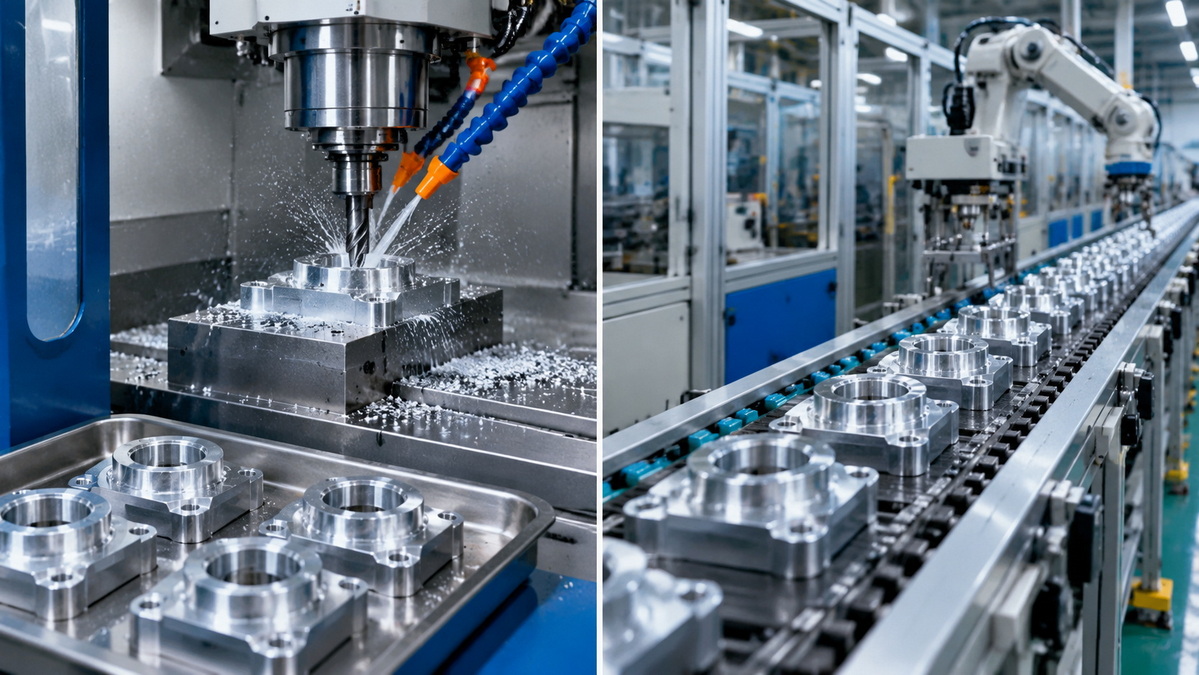
Small batch machining is CNC production of roughly 1 to a few hundred parts, sometimes up to 1,000 or more. It needs no dedicated tooling. You send a drawing, and the shop programs, fixtures and cuts the part.
Key strengths:
- Fast start: parts can ship in days rather than weeks.
- Design freedom: you can revise the drawing between batches at little cost.
- Tight tolerances: CNC holds precision that many mass processes only reach with expensive tooling.
- Broad materials: aluminum, stainless steel, titanium, brass and engineering plastics.
One guide describes CNC as the superior choice for low-volume production, typically 1 to 1,000 units, and for work needing high precision without upfront tooling cost. The trade-off is unit price. Setup, programming and first-article inspection are fixed efforts that exist whether you order 5 parts or 500.
Mass production relies on dedicated tooling: injection molds, stamping dies, cold-forging dies or automated high-volume machining cells. You pay heavily upfront. After that, each part costs very little.
Typical figures from published guides:
- Injection molds run from about $5,000 to $80,000, with 2 to 8 weeks of lead time. Molded parts then cost roughly $0.50 to $5.00 each, where CNC costs $15 to $50.
- Another source puts tooling at $3,000 to $100,000+, against $0 to $500 of CNC setup. Its unit costs are $0.10 to $10 for molding and $5 to $200+ for CNC.
These ranges are wide, which is the point. Tooling cost depends on part size, cavity count, steel grade and surface finish. Treat any single figure as an estimate, not a quote.
| Factor | Small batch machining | Mass production |
|---|---|---|
| Typical quantity | 1 to ~1,000 | Hundreds to millions (above the break-even) |
| Upfront cost | Low (programming, fixtures) | High (molds, dies) |
| Unit cost | Higher | Much lower at scale |
| Lead time to first part | Days | Weeks to months |
| Design changes | Easy and cheap | Costly (tool rework) |
| Best for | Prototypes, pilots, spare parts, variants | Stable, high-demand products |
| Main risk | Overpaying at scale | Locking in a flawed design |
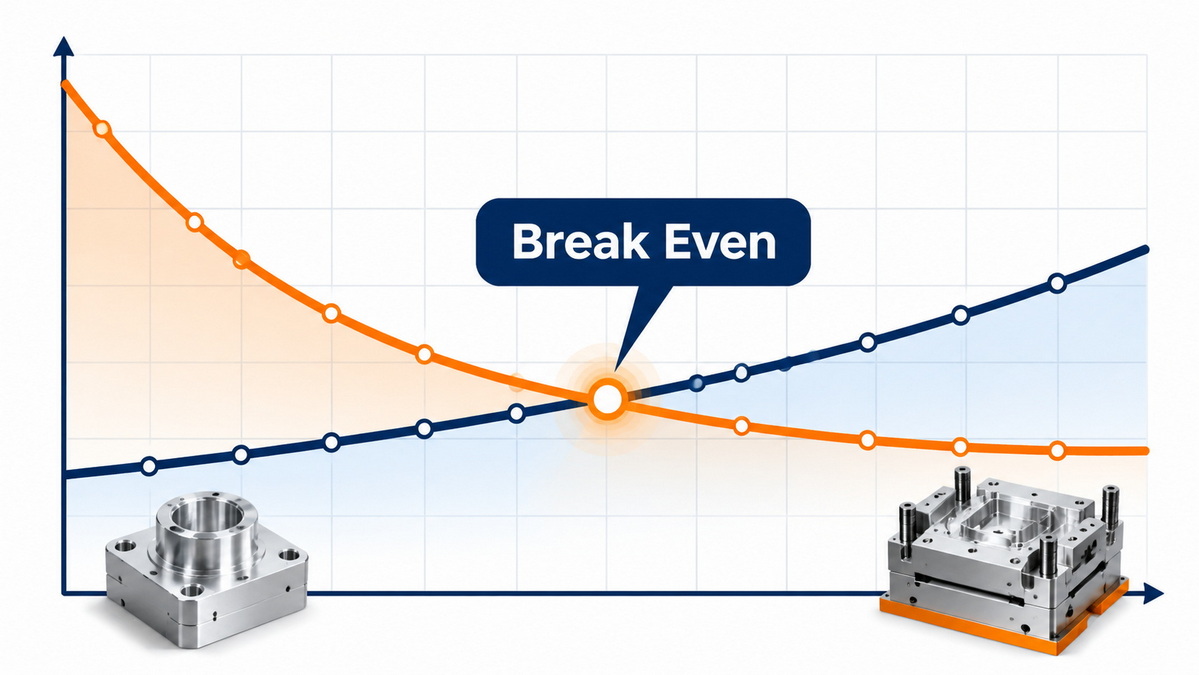
Use this simple model. Total cost = fixed cost + quantity × variable cost per accepted part.
For a mold versus CNC, the break-even quantity is:
Q = mold cost ÷ (CNC unit cost − molded unit cost)
Worked examples from published sources:
- A $12,000 mold, $30 CNC part and $3 molded part give a break-even of about 444 units.
- A 75 g PA66 bracket with a $12,000 mold, $22 CNC cost and $1.20 molded cost breaks even near 577 parts.
- A palm-sized ABS enclosure at about $45 per machined part, falling to $28 at 500 pieces, versus $3.20 molded at 1,000 pieces, crosses over near 220 units.
Ranges vary widely by source. Estimates run from about 200–500 units to 500–3,000 units, and up to 2,000 or even 20,000 units for complex parts in hardened steel. One fabrication guide warns that no universal threshold such as "switch at 250 parts" can decide your program. Always compare quotes with the same scope.
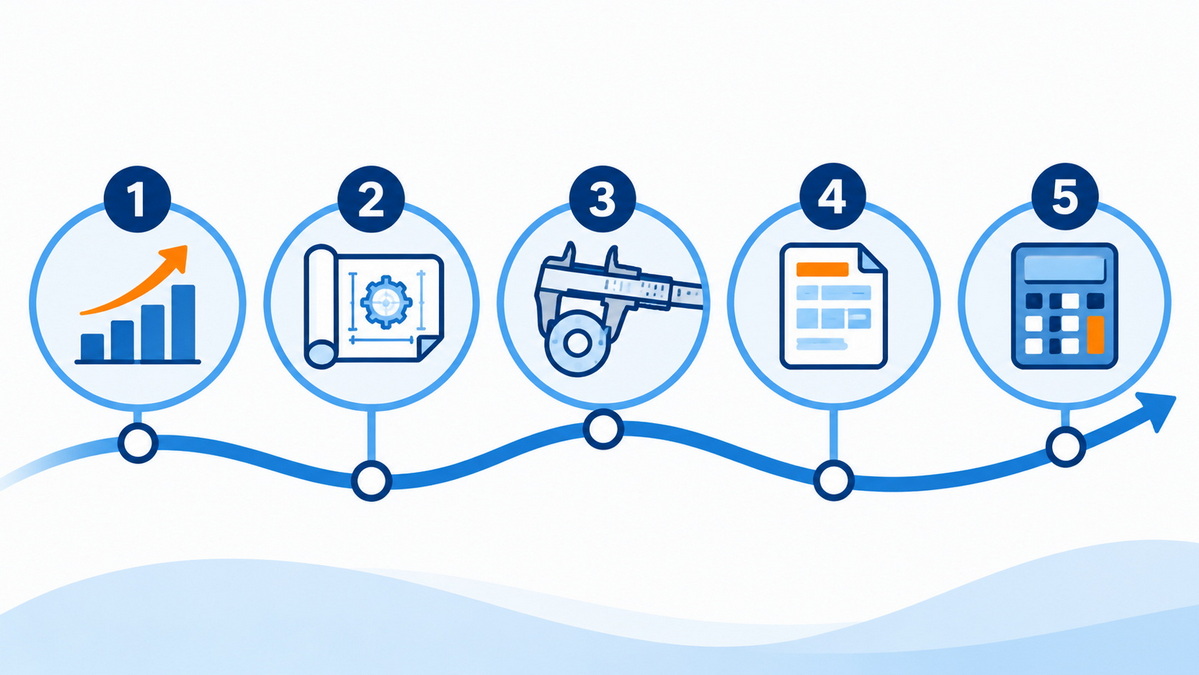
Follow this sequence when you request quotes.
1. Define realistic volume. Use first-year demand and a 3-year forecast, not a best-case guess.
2. Check design maturity. Has the part passed fit, function and field testing? If not, stay with machining.
3. List critical tolerances and materials. Tight tolerances and exotic alloys favor CNC.
4. Request two or three quote scenarios. Ask for 50, 500 and 5,000 pieces from the same drawing.
5. Calculate total cost of ownership. Include tooling, samples, inspection, scrap, freight and revisions, not just unit price.
A useful rule from one machining study: if setup and programming exceed about 40% of the total quoted price, the order quantity is probably too low for that quote.
Small batch does not mean expensive forever. Cost per part falls quickly as setup spreads out.
- One sourcing platform's RFQ data shows a typical small turned part falling from 6.75 euros at 10 units to 2.87 euros at 100 units (a 58% drop), then to 1.88 euros at 500 units.
- A cost benchmark reports that a $150 setup fee falls to about $0.15 per part across 1,000 units. It also finds CNC machining dominates from roughly 50 to 2,000 units, with injection molding breaking even between 500 and 2,000 parts.
Practical takeaway: ordering 100 parts instead of 10 often gives the steepest savings. If you will need more soon, batch your orders.
You do not have to pick one extreme. Bridge production fills the gap between prototype and full tooling.
Common bridge options:
- Repeat CNC batches of 50 to a few hundred parts while the design settles.
- Aluminum rapid tooling for short-run molding. One supplier reports aluminum molds cut upfront mold cost by 65–80% and shorten tool delivery to 2–5 weeks, though that is a vendor claim.
- Pre-hardened steel molds for mid-volume runs before committing to a full production tool.
Bridge tooling lets you launch initial market batches while the high-volume line is prepared in parallel. For many products, this reduces the risk of a costly mold revision.
Scenario 1: Medical or industrial prototype, 20 pieces. Choose CNC. A mold would cost thousands, and design changes are likely.
Scenario 2: Distributor needing 300 aluminum brackets twice a year. Stay with small batch machining. Repeat orders keep the cost per part stable with no tooling risk.
Scenario 3: Consumer housing at 20,000 units per year. Move to injection molding or stamping. The tooling cost is spread thin and unit price drops sharply.
Scenario 4: Sheet metal enclosure, 2,000 units. Laser cutting and bending may stay competitive. A stamping die only pays off if volume and design stability are confirmed.
Quotes can look similar while hiding different scopes. Check for:
- Sample and qualification costs. One quote may include a full inspection report while another includes samples only.
- Restart setup and minimum orders. Four small releases cost more than one uninterrupted run.
- Engineering changes. A single mold revision can cost thousands.
- Scrap rate and inspection. These affect cost per *accepted* part.
Procurement teams should compare total cost of ownership rather than the lowest quoted unit price.
We work with global brands, distributors and manufacturers across the full path from prototype to volume:
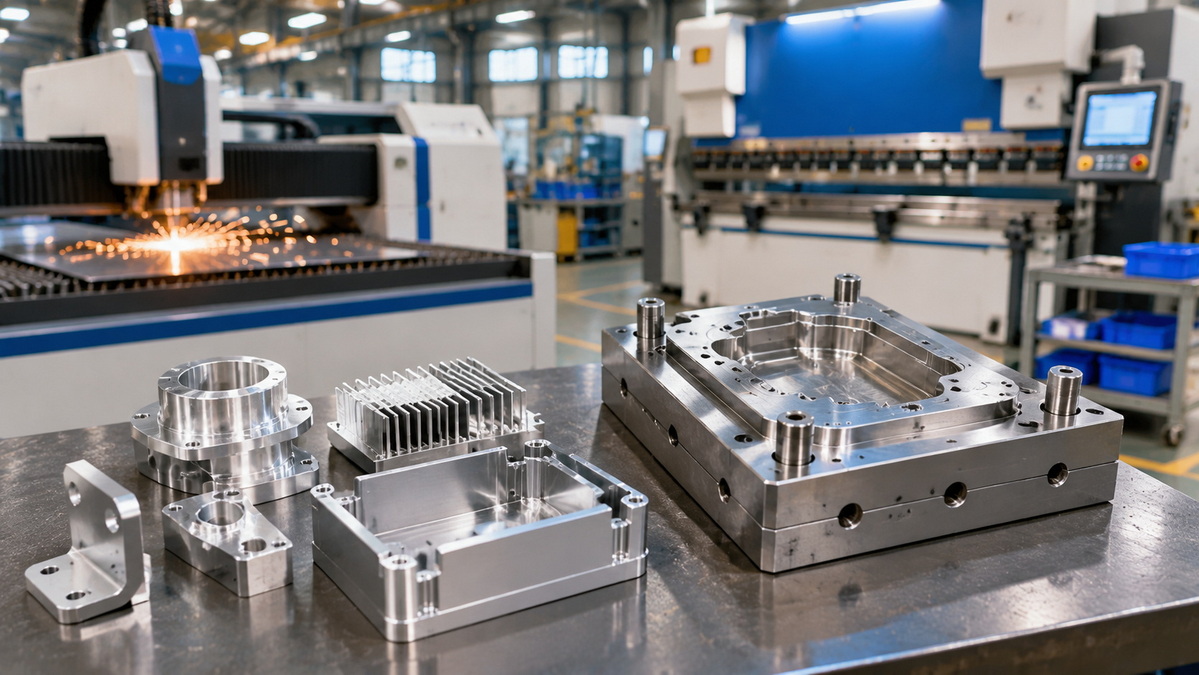
- Custom precision parts machining for prototypes and small batches.
- Mold manufacturing including injection molds, stamping dies and cold-forging dies.
- Sheet metal fabrication including laser cutting, bending and stamping.
Because we machine parts and build tooling under one roof, we can recommend the economical route without a bias toward one process. We can also quote both options side by side.
Not sure where your part falls? Send us your drawing (STEP or PDF), material and expected annual quantity. Our engineers will return a comparison quote for small batch machining and tooling-based production, with a clear break-even estimate. Contact U-Need today to start.
1. What counts as small batch machining?
It is typically 1 to a few hundred pieces, and sometimes up to about 1,000. The exact limit depends on part size and complexity.
2. At what quantity should I switch to mass production?
Published estimates range from about 200 to 3,000 units for molded plastic parts. Calculate it with your own tooling and unit quotes.
3. Is small batch machining always more expensive?
Per unit, usually yes. In total project cost, it is often cheaper below the break-even because there is no tooling.
4. Can I start with machining and move to molds later?
Yes. This is a common and low-risk strategy. Use machined batches to validate the design, then invest in tooling.
5. How can I reduce small batch machining costs?
Order larger or combined batches, simplify geometry, relax non-critical tolerances and standardize materials. Moving from 10 to 100 units can cut unit price by more than half.
6. What is bridge tooling?
It is lower-cost tooling, often aluminum, used for short production runs before committing to a full steel mold.
1.[Low-Volume Injection Molding: Bridge Tooling & Cost – FabDigit] [fabdigit]
2.[Injection Molding vs CNC Machining: The Break-Even Math – Renjie Precision] [renjie-precision]
3.[Low Volume Injection Molding for NPI – YG Innovation] [yginno]
4.[CNC vs Injection Molding: Cost, Lead Time & Tolerance Guide – Aluprototype] [aluprototype]
5.[CNC Machining Cost per Piece Volume Thresholds – Anebon] [anebon]
6.[CNC vs Injection Moulding: Break-Even for Prototypes and Small Batches – Unique RP] [unique-rp]
7.[CNC Machining vs Injection Molding for Plastic Parts – Nylonplastic] [nylonplastic]
8.[Low Volume Injection Molding Guide – Customparts-mfg] [customparts-mfg]
9.[Injection Molding vs CNC: Break-Even Volume – RCJM] [rcjmzg]
10.[Low Volume CNC Machining: The Complete Sourcing Guide – Haizol] [haizol]
11.[Cost Structures: Injection Molding vs CNC Machining – Zetar Mold] [zetarmold]
12.[Low Volume CNC Machining: Small Batch Production Guide – JLCCNC] [jlccnc]
13.[Cost-Per-Part Benchmark 2026 – Makerverse] [makerverse]
14.[Injection Molding Guide: Low-Volume Parts & Tooling Cost – GC Prototype] [gc-prototype]


