Views: 233 Author: U-Need Publish Time: 2026-08-23 Origin: Site
Content Menu
● How to Evaluate a CNC Milling Supplier
● Why Spain Is Relevant for CNC Milling
● Top CNC Milling Manufacturers and Suppliers in Spain
>> 1. U-Need Precision Machinery Co., Ltd.
>>> Core Strengths
>>> Core Strengths
>> 4. Soraluce
>>> Core Strengths
>> 5. Zayer
>>> Core Strengths
>> 6. IBARMIA
>>> Core Strengths
>> 7. CMASA
>>> Core Strengths
● CNC Milling Materials and Technical Requirements
>> Surface Finishing Requirements
● Common Sourcing Risks and How to Avoid Them
>> Incomplete Tolerance Definition
● An Important Detail Many Buyers Miss
● Buyer's Guide for CNC Milling Projects
>> Prepare a Complete RFQ Package
>> Review the Supplier's Quote
>> Approve Samples Before Production
>> Verify Factory Certifications
>> Plan Logistics and Packaging
● FAQ
>> 1. How can I verify whether a supplier's ISO certificate is still valid?
>> 2. What should I ask for before approving a CNC milling supplier?
>> 3. How do I know whether a supplier can truly hold my tight tolerances?
>> 4. Is 5-axis machining always necessary for complex parts?
>> 5. How can I prevent unauthorized material or process changes?
Spain is an established European market for CNC milling technology, advanced machining equipment, and precision-engineered industrial components. Its strongest manufacturing base is concentrated in the Basque Country, where machine-tool builders, automation companies, industrial engineering firms, metrology providers, and component manufacturers form a mature supply chain.
For buyers in aerospace, automotive, railway, renewable energy, industrial equipment, mold making, and high-value mechanical assembly, Spanish suppliers can offer strong engineering support, advanced machining platforms, and dependable European-market service.
However, the right supplier is not always the largest or most technically famous company. The best long-term fit depends on the required part complexity, material grade, production volume, certification requirements, delivery expectations, communication efficiency, and total procurement cost.
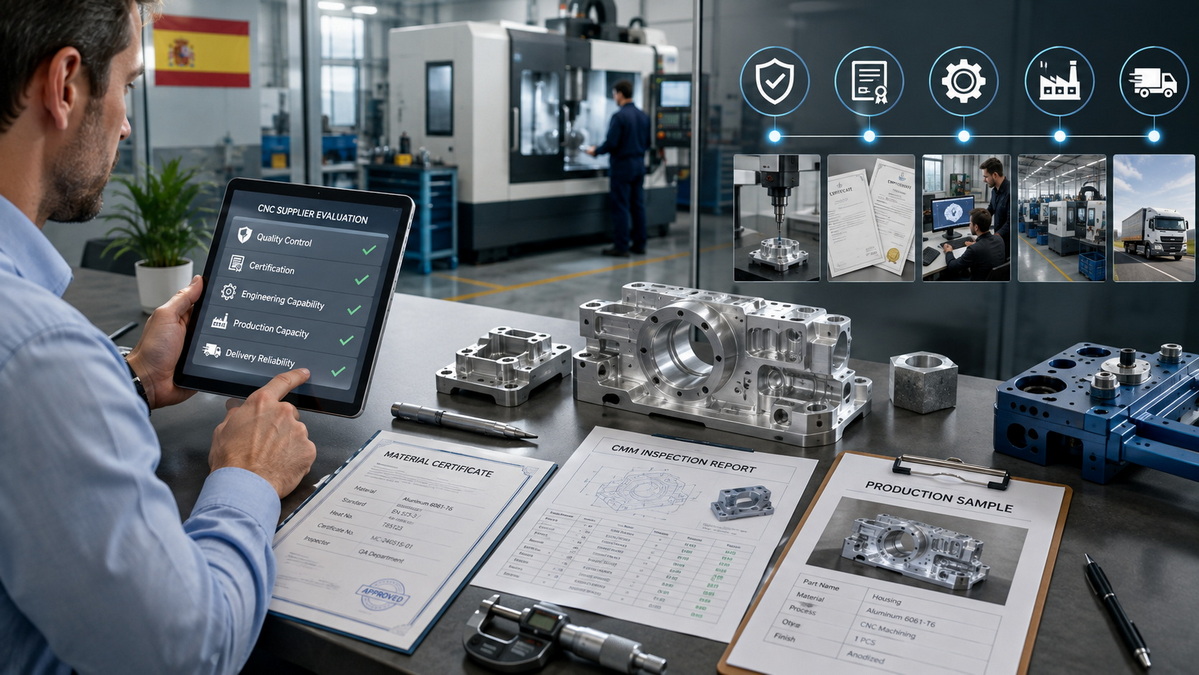
A professional supplier assessment should go beyond website claims, machine lists, or the lowest unit price. Buyers should compare factories based on their practical ability to manage quality, engineering changes, and repeat production.
Key evaluation criteria include:
- Manufacturing experience in the buyer's target industry
- CNC capability, including 3-axis, 4-axis, 5-axis, gantry, boring, and turning-milling capacity
- Engineering support for design-for-manufacturing review and fixture design
- Material traceability and control of approved material grades
- Inspection capability, including CMM reports, first-article inspection, and in-process measurement
- Current quality-management certifications and scope of certification
- Production capacity and ability to scale from prototype to repeat production
- Delivery stability, project communication, and change-control process
- Experience with international packaging, customs documents, and export logistics
- Ability to coordinate secondary processes such as anodizing, plating, heat treatment, welding, assembly, and laser marking
A dependable supplier should be willing to provide technical clarification before quoting. It should also identify drawing risks, tolerance conflicts, material issues, and manufacturability concerns instead of simply accepting every requirement without discussion.
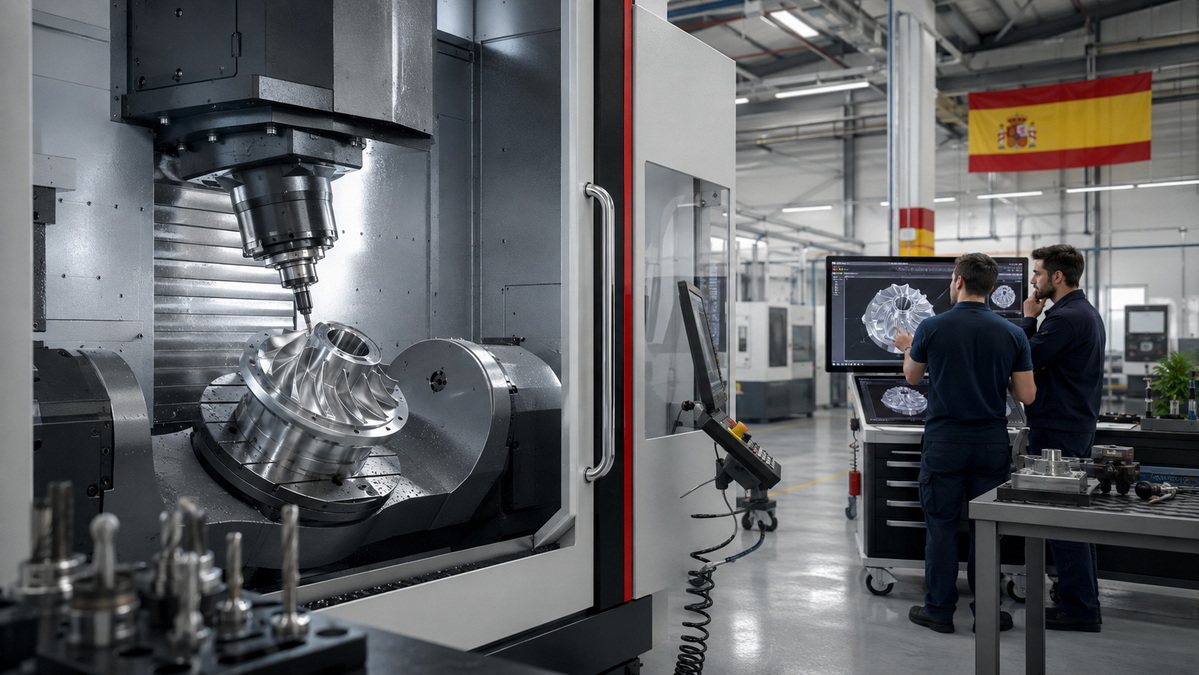
Spain has a strong reputation in the European machine-tool industry, particularly in large-format milling, precision boring, 5-axis machining, automation, and specialized production systems.
The Basque Country is the country's most important industrial cluster for machine tools and advanced manufacturing. Cities and industrial zones around Bilbao, Vitoria-Gasteiz, Elgoibar, Azkoitia, and Burgos have developed deep expertise in mechanical engineering, heavy-duty manufacturing, railway equipment, industrial automation, aerospace systems, and energy-related production.
For international buyers, Spanish CNC suppliers can be particularly suitable when a project requires:
- Heavy-duty milling for large metal structures
- Multi-axis machining for complex aerospace or energy components
- Customized machining-center configurations
- Local support within Europe
- Shorter road-freight lead times inside the EU
- Machine installation, operator training, and lifecycle service
- Production systems that integrate automation, metrology, and process control
For buyers sourcing finished custom parts rather than machine tools, Spain can also offer strong short-run and regulated-industry manufacturing capability. At the same time, many procurement teams combine Spanish or European engineering resources with flexible overseas production partners for prototypes, lower-volume runs, tooling, sheet metal, and cost-sensitive repeat orders.
| Company | Founded | Main Focus | Suitable For | Typical Order Profile | Quality Consideration |
|---|---|---|---|---|---|
| U-Need Precision Machinery Co., Ltd. | 2016 | Custom CNC machining, molds, sheet metal, tooling, assembly | Prototypes, custom OEM parts, low-to-high volume programs | From 1 piece to mass production | Confirm project-specific documentation and inspection requirements |
| Nicolás Correa | 1947 | Large CNC milling machines and machining centers | Heavy-duty industrial, aerospace, energy, and large workpieces | Engineered machine-tool projects | Confirm technical specification by machine configuration |
| Danobatgroup | 1954 | Machine tools, automation, milling, turning, grinding | Automated and high-value manufacturing systems | Customized capital-equipment projects | Confirm system-specific quality and acceptance requirements |
| Soraluce | 1962 | Milling, boring, multitasking, automation | Large structural parts and advanced machining environments | Customized machine projects | Confirm machine configuration and service package |
| Zayer | 1950s | CNC milling machines and machining centers | Large-format, gantry, bridge, and special applications | Engineering-driven equipment projects | Confirm technical fit for the target workpiece |
| IBARMIA | 1953 | Highly customized machining centers | 5-axis machining, aerospace, energy, advanced industrial production | Configured machine projects | Confirm capability based on process and part geometry |
| CMASA | Not publicly confirmed | CNC machining and welding | Aerospace, railway, prototypes, and short-run components | Prototype and short-run production | Verify the current scope and validity of certifications |
U-Need Precision Machinery Co., Ltd. is a China-based custom manufacturing company that supports global buyers with precision machining, mold production, sheet metal fabrication, tooling, finishing coordination, and assembly services.
The company is suitable for buyers looking for a flexible supplier that can support a project from early prototype development to repeat production. Its manufacturing scope includes CNC milling, CNC turning, 5-axis machining, EDM, wire EDM, grinding, injection molds, stamping dies, cold-forging dies, laser cutting, bending, sheet metal fabrication, and custom assembly.
U-Need is particularly relevant for small and medium-sized brands, distributors, product-development teams, and industrial OEM buyers that need efficient engineering communication and flexible order quantities.
- CNC milling for aluminum, steel, stainless steel, copper alloys, titanium, engineering plastics, and other machinable materials
- CNC turning and mill-turn services for shafts, housings, connectors, fittings, and rotational components
- 5-axis machining for complex geometry, compound angles, multi-face features, and reduced setup requirements
- Mold manufacturing for injection molding, overmolding, insert molding, stamping, and cold forging
- Sheet metal fabrication including laser cutting, bending, stamping, welding, and finishing
- EDM, wire EDM, precision grinding, and complex tooling processes
- Surface finishing coordination, including anodizing, plating, polishing, sandblasting, powder coating, and laser marking
- Assembly, packaging, and export support
U-Need may be a suitable sourcing partner for:
- Buyers needing prototypes before committing to production tooling
- Small and medium-sized brands with changing order quantities
- Industrial OEMs that need both machined parts and sheet metal components
- Companies sourcing custom housings, brackets, fixtures, machine components, assemblies, and molds
- Buyers looking to reduce supplier fragmentation by consolidating multiple manufacturing processes
- Product teams requiring design-for-manufacturing feedback before finalizing drawings
One important advantage for buyers is the ability to start from very small quantities. This is useful when a product is still under design validation, when a replacement part is needed, or when a buyer wants to test supplier quality before issuing a larger production order.
For example, a company developing a compact industrial sensor enclosure may first need ten CNC-milled aluminum samples for fit testing. Once design approval is complete, the same supplier may support fixture development, anodizing, laser marking, packaging, and larger repeat orders.
This reduces the risk of transferring data, quality requirements, and approved samples between multiple factories.
Nicolás Correa is one of Spain's most recognized manufacturers of CNC milling machines. Founded in 1947, the company is known for large CNC milling systems and machining centers designed for demanding industrial applications.
Its equipment is typically associated with high-rigidity machining, large workpiece capability, and sectors where machine stability and structural performance are important. These sectors can include aerospace, energy, mold making, capital equipment, transport infrastructure, and heavy industrial manufacturing.
- Large-format CNC milling solutions
- Heavy-duty machining systems
- High-rigidity machine structures
- Equipment for complex and large workpieces
- Long industrial operating history
- Suitable for capital-equipment investment projects
Nicolás Correa is best suited to manufacturers purchasing CNC milling equipment for their own facilities. It is not primarily a contract manufacturer of finished customer parts.
Buyers should provide detailed process data during evaluation, including workpiece dimensions, material type, annual production volume, spindle requirements, fixture concept, cycle-time target, automation expectations, and maintenance requirements.
Danobatgroup is a Spanish industrial group specializing in machine tools and advanced manufacturing solutions. Its history began with Danobat Cooperative in 1954, followed by the development of additional advanced manufacturing businesses.
The group works across CNC milling, turning, grinding, automation, digital manufacturing, and high-value industrial systems. It is relevant for organizations that require more than a standalone machine and instead need integrated production capability.
- CNC milling, turning, grinding, and automation systems
- Integrated advanced-manufacturing solutions
- Engineering support for complex industrial applications
- International project experience
- Strong relevance to railway, aerospace, energy, automotive, and industrial sectors
- Suitable for automated production cells and customized manufacturing environments
Danobatgroup is most appropriate for buyers planning long-term manufacturing investments. Its value is strongest when equipment selection includes automation, material handling, in-process measurement, digital monitoring, and service planning.
Buyers should compare not only the machine's initial price but also installation, commissioning, operator training, spare-parts availability, remote support, preventive maintenance, and expected lifecycle cost.
Soraluce is a Spanish manufacturer specializing in milling, boring, multitasking, and automated machining systems. It has more than six decades of experience in machine-tool development and is known for large-part machining solutions.
The company is especially relevant for projects involving structural components, heavy-duty materials, complex geometries, large work envelopes, and applications where high rigidity and stable machining performance are essential.
- CNC milling and boring systems
- Multitasking machining solutions
- Large structural-component machining
- Automation-ready equipment
- Specialized process engineering
- Suitable for aerospace, energy, mold, and heavy-industry applications
Soraluce is a strong consideration for manufacturers that need customized milling and boring systems for high-value production. The supplier is particularly relevant where parts are too large or too complex for standard vertical machining centers.
During supplier evaluation, buyers should request information on machine travel, table load, spindle torque, thermal-control strategy, probing options, chip-management system, automation interface, and acceptance-test procedures.
Zayer is a Spanish manufacturer of CNC milling machines and machining centers based in Vitoria-Gasteiz. The company has a long history in the design and manufacture of milling equipment and offers several machine configurations for different industrial applications.
Its portfolio includes bed-type milling machines, moving-column machines, bridge-type systems, gantry machines, and special-purpose solutions.
- Bed-type CNC milling machines
- Moving-column machining centers
- Bridge and gantry milling systems
- Special-purpose machine development
- Large-part machining capability
- Application-specific engineering support
Zayer is a suitable option for buyers needing equipment tailored to large, heavy, or non-standard workpieces. It can be relevant for industrial machinery manufacturers, mold makers, railway suppliers, aerospace companies, and energy-sector manufacturers.
To obtain a useful proposal, buyers should submit representative CAD files, workpiece drawings, material information, required machining operations, projected capacity demand, target cycle time, and future product-family requirements.
IBARMIA is a Spanish manufacturer of customized machining centers founded in 1953. The company operates from Azkoitia in Gipuzkoa and serves global customers with high-value machining systems.
Its machines are designed for customers that require significant adaptation of the machine configuration to suit their product geometry, material, process requirements, and production strategy.
- Customized machining-center configurations
- 5-axis machining capability
- Aerospace-oriented process solutions
- Thermal-control systems
- In-process measurement options
- Complex multi-face machining support
- High-value industrial applications
IBARMIA can be a strong choice for buyers involved in aerospace, energy, advanced equipment, precision structures, and complex machining programs. Its solution is particularly relevant when a standard machining center cannot meet the required work envelope, access angle, precision expectation, or automation requirement.
For aerospace and high-precision applications, buyers should confirm the machine's positioning accuracy, repeatability, thermal behavior, probing strategy, software compatibility, spindle performance, and support for process validation.
CMASA is a Spanish industrial manufacturer offering CNC machining and welding services. It is particularly relevant for buyers who need finished components, prototype parts, short-run production, or machined-and-welded assemblies.
The company's service scope includes simultaneous 5-axis milling and turning, dimensional control, welding, material handling, and inspection support. This makes it relevant to projects where the buyer prefers a European production partner for complex short-run or regulated-industry components.
- CNC machining for finished industrial components
- Simultaneous 5-axis milling and turning
- Prototype and short-run production
- Welded assembly capability
- Dimensional inspection and quality-control processes
- Suitable for aerospace, railway, and industrial applications
For aerospace, railway, and safety-critical work, buyers should confirm the current validity, legal entity, site scope, and manufacturing-process coverage of all stated certifications. It is also important to verify whether special processes such as welding, heat treatment, coating, or non-destructive testing are performed internally or by approved subcontractors.
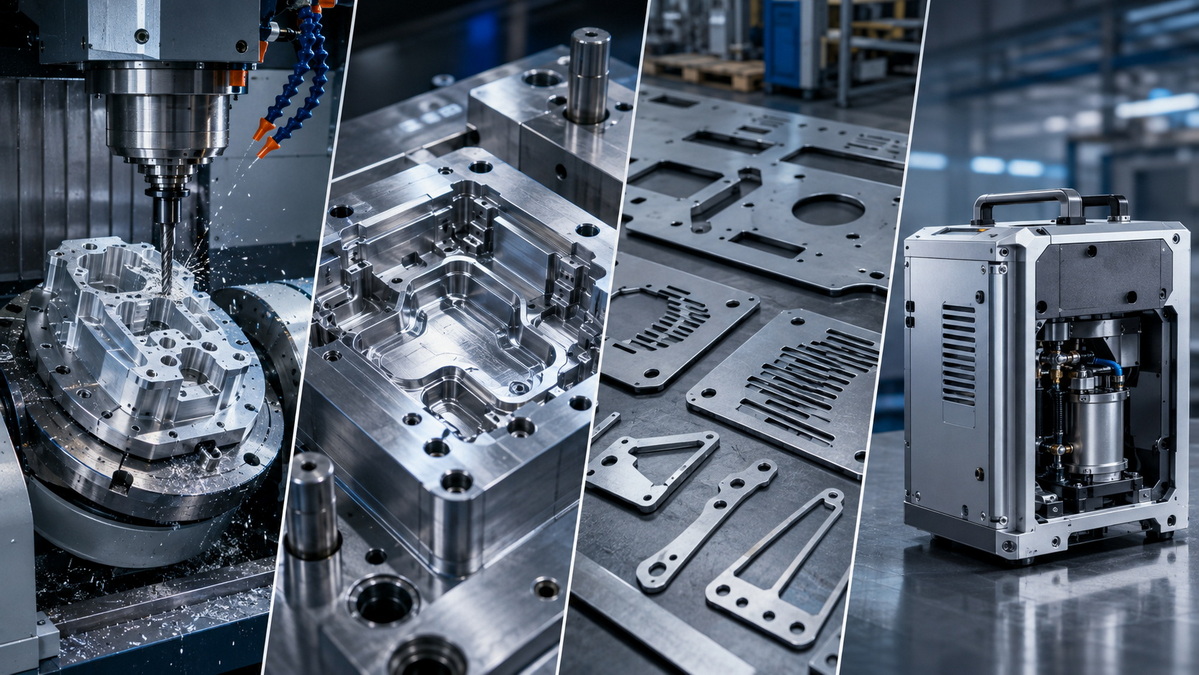
CNC milling can be used with a broad range of metals and engineering plastics. However, buyers should specify complete material information rather than using general descriptions such as "aluminum" or "stainless steel."
| Material Family | Common Grades | Key Requirements to Clarify |
|---|---|---|
| Aluminum | 6061-T6, 6082-T6, 7075-T6 | Alloy, temper, grain direction, finish compatibility |
| Stainless steel | 304, 316L, 17-4PH, 420 | Condition, hardness, corrosion resistance, passivation |
| Carbon and alloy steel | C45, 4140, 42CrMo4 | Heat treatment, hardness range, coating, machining stage |
| Titanium | Grade 2, Grade 5 | Traceability, machining allowance, surface integrity |
| Copper alloys | C110, C360, brass, bronze | Conductivity, plating, burr control, cosmetic requirements |
| Engineering plastics | POM, PEEK, PA66, PC, ABS | Resin grade, color, moisture control, flame rating |
A drawing should distinguish between general tolerances and critical functional tolerances.
For example, a non-critical exterior surface may accept ±0.10 mm, while a bearing bore, sealing surface, or assembly hole pattern may require significantly tighter control. Applying tight tolerances to every feature increases machining time, inspection time, scrap risk, and cost.
Buyers should clearly identify:
- Critical dimensions
- Functional datums
- GD&T requirements
- Flatness and perpendicularity requirements
- Hole position tolerances
- Thread standards
- Surface roughness requirements
- Assembly interfaces
- Cosmetic surfaces
- Critical sealing surfaces
Terms such as "black anodized," "polished," or "brushed" are often insufficient for production control. A complete finish requirement should include color reference, coating thickness, roughness requirement, masking instructions, cosmetic acceptance criteria, and corrosion-performance expectations.
Common finishing options include:
- Type II anodizing
- Hard anodizing
- Powder coating
- Electroplating
- Electroless nickel plating
- Passivation
- Zinc plating
- Black oxide
- Sandblasting
- Bead blasting
- Brushing
- Polishing
- Laser marking
One of the most common risks in CNC milling procurement is material substitution. A supplier may quote 6061-T6 aluminum but use another aluminum alloy, or quote 316L stainless steel but machine from 304 stainless steel.
The part may look acceptable during visual inspection but fail under corrosion, fatigue, temperature, conductivity, or mechanical-load conditions.
To reduce this risk:
- State the exact material grade and temper on the drawing and purchase order
- Require material certificates for critical components
- Request heat numbers or batch traceability where necessary
- Define whether substitutes are prohibited or require written approval
- Use independent material verification for high-risk components
- Retain approved reference samples for production comparison
A supplier may agree to manufacture a part at ±0.01 mm, but this does not automatically mean every feature can consistently hold that tolerance in volume production.
Machining stability depends on material condition, workpiece geometry, fixture strategy, machine type, tool wear, temperature, cutting parameters, and inspection method.
To avoid misunderstandings:
- Separate critical dimensions from general dimensions
- Use GD&T where assembly function requires it
- Define datum references clearly
- Request a manufacturability review before production
- Require first-article inspection for new projects
- Confirm the inspection method for each critical feature
Some suppliers advertise 5-axis machining but may use indexed 3+2 machining rather than simultaneous 5-axis machining. Both approaches can be useful, but they are not identical.
Simultaneous 5-axis machining is often needed for continuously changing surfaces, turbine-style geometry, complex medical components, aerospace structures, and difficult access angles. Indexed 3+2 machining may be sufficient for many prismatic parts with multiple angled faces.
Ask these questions before placing an order:
- Is the machining process simultaneous 5-axis or indexed 3+2?
- Which machine model will manufacture the component?
- What is the maximum workpiece size and weight?
- What materials are routinely machined on that machine?
- Can the supplier provide a sample inspection report for a comparable part?
- How will critical dimensions be measured?
Surface finish can vary between batches if specifications are incomplete or if finishing is outsourced without effective control.
To reduce variation:
- Approve a physical finish sample before mass production
- Specify required roughness where applicable
- Define coating thickness
- Identify no-coating zones and masking areas
- Clarify whether threaded holes must be protected
- Define cosmetic inspection zones
- Request corrosion-test requirements where needed
The lowest quoted unit price is not always the lowest procurement cost. Delayed samples, rejected lots, weak packaging, unclear freight responsibility, communication gaps, and unplanned engineering changes can all increase the total landed cost.
A common hidden cause of CNC-machined-part failure is poor datum planning.
A supplier can measure every listed dimension correctly and still deliver a component that does not assemble properly. This happens when critical holes, faces, or profiles are inspected from different reference points instead of the actual functional assembly surfaces.
For example, a machined housing may contain several mounting holes that appear dimensionally correct when measured individually. However, if the hole pattern is not controlled from the same functional mounting surface used in final assembly, the part may shift relative to its mating component.
Before issuing a drawing, confirm:
- Which surfaces locate the part in the final assembly
- Which features are functional datums
- Which holes are locating holes versus clearance holes
- Whether hole position is controlled from functional datums
- Whether flatness and perpendicularity requirements support the assembly method
- Whether the inspection fixture reflects the real assembly condition
This step often prevents more quality problems than simply tightening dimensional tolerances.
A complete RFQ package should include:
- 2D PDF drawings with revision number
- 3D CAD files in STEP, IGES, Parasolid, or other accepted formats
- Bill of materials for assemblies
- Exact material grades and permitted substitutions
- Surface-finish specifications
- Critical dimensions and GD&T requirements
- Required inspection reports
- Certification and traceability expectations
- Prototype quantity and expected annual volume
- Target lead time
- Packaging requirements
- Destination country
- Preferred Incoterms
- Confidentiality requirements
When comparing quotations, evaluate more than the unit price.
| Evaluation Area | What to Review |
|---|---|
| Technical capability | Machine type, process plan, tolerance capability, DFM feedback |
| Quality control | CMM availability, inspection plan, material traceability, first-article support |
| Delivery stability | Quoted lead time, capacity plan, communication speed, production planning |
| Commercial terms | Piece price, tooling cost, payment terms, shipping terms, packaging |
| Engineering support | Drawing clarification, fixture design, prototype feedback, change management |
| Production scalability | Capacity, repeatability, production fixtures, backup plan |
| Compliance support | Material declarations, restricted-substance requirements, export documentation |
A staged approval process reduces risk:
1. Review the supplier's technical feedback before issuing the order.
2. Confirm the drawing revision, material grade, finish, and inspection requirements.
3. Place a prototype or first-article order.
4. Inspect dimensions, material documents, finish, threads, packaging, and labeling.
5. Record approved deviations, if any.
6. Approve a pilot batch before mass production.
7. Monitor quality and delivery performance during the first repeat orders.
A certificate should be checked carefully before being used as a supplier-approval decision.
Verify:
- Legal company name
- Manufacturing site address
- Certificate number
- Scope of certification
- Issue and expiry dates
- Certification body
- Accreditation mark
- Whether machining activities are within the certificate scope
- Whether subcontracted processes are managed under documented control
A valid quality certificate is useful, but it should not replace part-specific validation. A supplier may have a valid management-system certificate while still lacking the right machine, fixture, inspection method, or material-control process for a particular part.
For Spain-based suppliers serving European buyers, road freight can simplify delivery and reduce transit time. For China-based suppliers, air freight is often suitable for prototypes and urgent samples, while sea freight is more suitable for planned batch orders.
Buyers should clarify:
- Incoterms
- Transit-time expectation
- Customs responsibility
- Insurance coverage
- Packaging standard
- Rust-prevention method
- Moisture protection
- Part separation and scratch protection
- Carton strength or pallet specification
- Commercial invoice and packing-list requirements
- Country-of-origin documentation
- Product-code classification requirements
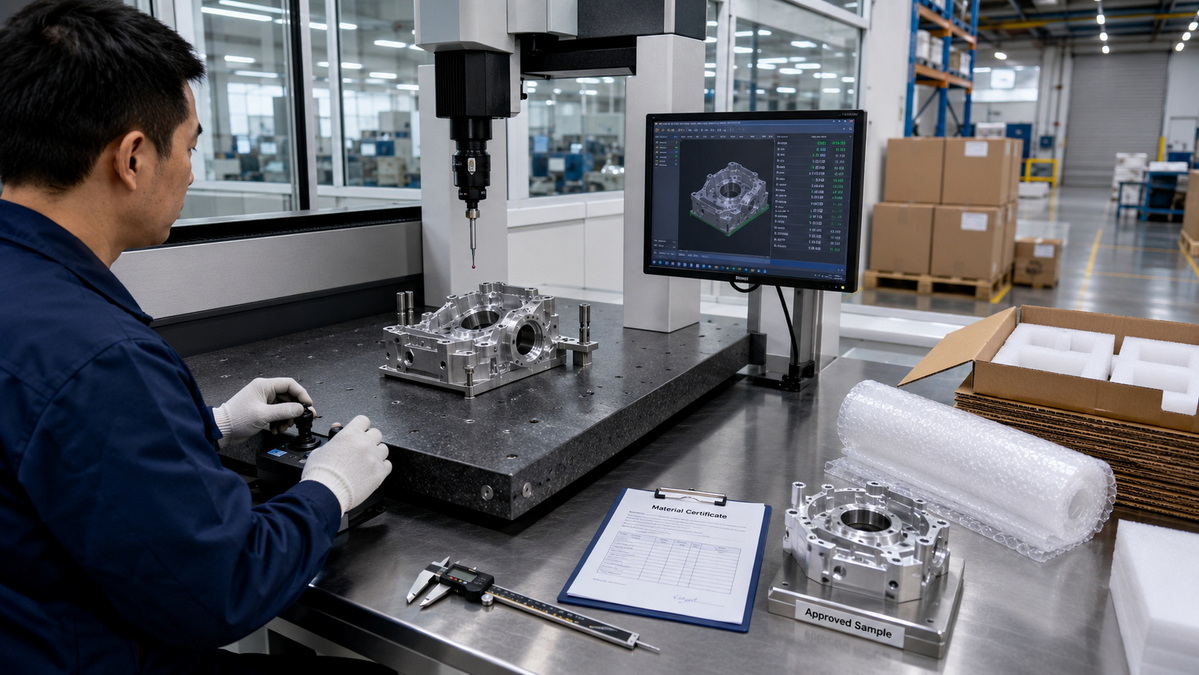
Spain offers a capable CNC milling ecosystem supported by experienced machine-tool manufacturers, advanced industrial clusters, and specialized engineering expertise. Companies such as Nicolás Correa, Danobatgroup, Soraluce, Zayer, IBARMIA, and CMASA serve different needs, from large-format milling equipment and customized machining centers to short-run CNC-machined components.
For buyers seeking flexible custom manufacturing support across CNC machining, mold production, sheet metal fabrication, tooling, surface finishing, and assembly, U-Need Precision Machinery Co., Ltd. provides a practical option for prototype development, lower-volume programs, and scalable OEM production.
A successful sourcing decision should be based on a complete RFQ, verified technical capability, controlled sample approval, material traceability, clear quality documentation, and realistic logistics planning. The supplier that asks the right technical questions before production is often the supplier most likely to protect your project after production begins.
Request the complete certificate and verify the legal company name, manufacturing address, certificate number, scope, issue date, and expiration date. Then check the issuing certification body's official database or contact the certification body directly. Make sure the certificate applies to the actual production site rather than only a sales office.
Request a technical capability review, machine list, sample CMM report, material-certificate sample, current quality certificate, inspection-process description, export experience, and example packaging photos. For critical parts, start with a paid sample or first-article batch.
Provide the full drawing, material, annual volume, and critical features. Ask the supplier to identify which dimensions require special fixturing, grinding, reaming, probing, or CMM inspection. A reliable supplier should explain the process rather than simply accepting every tolerance without comment.
No. Many components can be manufactured efficiently with 3-axis or indexed 3+2 machining. Simultaneous 5-axis machining is most valuable when the part has continuously changing surfaces, complex undercuts, difficult tool-access angles, or requires fewer setups to improve accuracy.
Include a written no-substitution requirement in the purchase order and quality agreement. Require written approval before any material, finishing, manufacturing-site, or subcontractor change. For critical parts, require revised first-article approval after significant process changes.
1.[AFM Cluster: Spanish Machine Tool and Advanced Manufacturing Industry]
2.[AFM Cluster: Advanced Manufacturing Sector Data]
3.[Danobatgroup: Industrial Group and Manufacturing Solutions]
4.[Soraluce: Milling, Boring and Multitasking Solutions]
5.[Zayer: CNC Milling Machines and Machining Centers]
6.[IBARMIA: Customized Machining Centers]


