Views: 222 Author: Rebecca Publish Time: 2026-01-16 Origin: Site
Content Menu
● What Are 3D Printing and CNC Machining
● Core Use Cases and Typical Users
● Additive vs Subtractive: Working Principles
● Materials and Mechanical Performance
>> When Material Properties Drive the Decision
● Accuracy, Tolerances, and Surface Finish
>> When Precision Is the Priority
● Part Complexity and Design Freedom
● Size, Geometry, and Surface Considerations
● Workflow and Lead Time in Practice
● Hybrid Strategy: Combining 3D Printing and CNC Machining
● Action Call: Discuss Your Next Project with a Manufacturing Expert
● FAQs: 3D Printing vs CNC Machining
>> 1. Is 3D printing cheaper than CNC machining
>> 2. Which is better for functional prototypes
>> 3. Can 3D printed parts replace CNC machined parts in production
>> 4. How do I choose between 3D printing and CNC machining for my part
>> 5. Can I combine 3D printing and CNC machining in one project
3D printing and CNC machining are complementary manufacturing processes: 3D printing offers unmatched design freedom and rapid iteration, while CNC machining delivers superior precision, material performance, and production durability. For overseas brands and manufacturers, the right choice usually depends on geometry complexity, material, tolerances, volume, and total cost over the full product lifecycle.

3D printing is an additive process that builds parts layer by layer from a digital 3D model, usually in polymers, resins, or metal powders. It is ideal for complex internal features, lattice structures, and low-volume customized parts with minimal tooling and setup cost.
CNC machining is a subtractive process that cuts parts from solid blocks or billets using computer-controlled mills, lathes, and multi-axis centers. It supports a wide range of engineering metals and plastics while preserving the base material properties and achieving tight dimensional tolerances.
The key decision around 3D printing vs CNC machining usually comes from engineers, product developers, buyers, and founders who must select the most suitable manufacturing process for prototypes, functional parts, or low-volume production. Common questions include which process is best for functional prototypes versus display models, and how cost, lead time, and scalability differ for each process.
For overseas OEM projects, teams also need to understand how to combine 3D printing and CNC machining in one integrated development and production strategy. This helps ensure that early prototypes and final production parts align in geometry, performance, and cost.
3D printing starts from a CAD model, slices it into layers, and then deposits or cures material layer by layer until the full geometry is built. Common technologies include FDM, SLA or DLP, and SLS, each with different surface finishes, mechanical properties, and cost structures.
CNC machining imports the same CAD data, then uses CAM software to generate toolpaths for cutting tools that remove material from a solid workpiece. Setup often includes workholding, tool selection, and programming; once optimized, the same CNC program can repeatedly produce identical parts with high throughput and consistency.
CNC machining supports a very wide range of materials, including aluminum, steel, stainless steel, titanium, brass, and engineering plastics such as POM, PEEK, and ABS. Because the process does not significantly change the internal structure, machined parts typically retain the full mechanical properties of the base material.
3D printing materials are more restricted and depend strongly on the specific technology used. While high-performance polymers and metals exist, many printed parts achieve only a fraction of the strength of the native material and can show anisotropy between layers.
Choose CNC machining when you need strong, load-bearing parts in metals or high-performance plastics, or when long-term durability, fatigue resistance, and safety are critical. Choose 3D printing when you need lightweight, complex structures that are difficult or uneconomical to machine, or when you prioritize fast concept validation and ergonomic or visual testing over ultimate strength.
CNC machining delivers higher precision and tighter tolerances than most 3D printing workflows, making it ideal for intricate fits, bearing seats, sealing surfaces, and other critical interfaces. Machined parts can reach smooth surfaces with the right tooling and finishing passes, often requiring minimal additional processing.
3D printing accuracy has improved significantly, but the layer-by-layer process can introduce stepping, visible layer lines, and surface roughness that require extra finishing. Tolerances are typically looser than CNC and may vary with part orientation, build size, and printing technology.
CNC machining is the better choice for tight-tolerance components, precision jigs and fixtures, and parts with critical mating features. 3D printing works well for concept models, housings, and brackets where small dimensional deviations are acceptable and where design freedom is more important than ultra-tight tolerances.
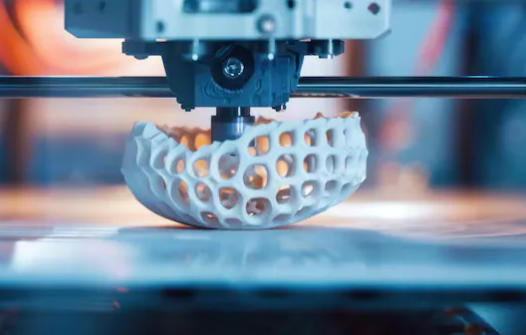
3D printing excels at complex, organic geometries and integrated assemblies that would be expensive or impossible to machine. Typical examples include internal channels, lattice structures for weight reduction, and topology-optimized components that remove non-critical material.
CNC machining is excellent for prismatic or smoothly contoured parts but faces limitations when internal cavities, steep undercuts, or deep pockets are required. Tool access, workholding, and tool deflection impose constraints on what can be produced efficiently, and these constraints directly affect machining time and cost.
For one-off parts and very small batches, 3D printing is often more cost-effective because it requires less setup, programming, and fixturing. The cost structure is mainly driven by material usage, print time, and post-processing rather than custom tooling.
CNC machining typically has higher initial setup and programming costs, but the per-unit cost drops significantly as volume increases. For medium to high production volumes, CNC machining often becomes more economical, especially when parts are simple enough to machine efficiently and the same design is repeated.
Both processes can produce small to medium-sized parts, though CNC is often favored for very small, high-precision components and larger parts that can be machined in sections. 3D printing can also be used for larger parts, but splitting and bonding sections may reduce precision and increase assembly work.
Surface finish is another important factor. CNC machining can produce smoother surfaces than most 3D printing workflows, especially for metal and engineering plastic components. For visual prototypes, housings, or ergonomic models, printed parts may require sanding, polishing, priming, or coating to achieve similar aesthetics.
A typical 3D printing workflow involves preparing the CAD file, orienting the part, generating support structures, and sending the job to the machine with relatively little operator intervention. After printing, parts go through support removal, cleaning, and in some cases curing or surface finishing.
CNC machining workflows usually require detailed process planning, fixture design, toolpath programming, and test runs before full production. After setup, however, CNC machines can run with a high level of automation and repeatability, making them efficient for sustained production of identical parts.
Many high-performing teams do not choose only 3D printing or only CNC machining; they combine both in a hybrid workflow. One common approach is to validate fit, ergonomics, and basic function with 3D printing, then refine the same design for CNC machining to verify strength, tolerances, and production cost.
In some projects, printed preforms or inserts are later post-machined on CNC equipment to achieve critical surfaces or final tolerances. This strategy can reduce scrap, save machining time, and maintain design flexibility while still delivering reliable, production-ready parts.
In industrial equipment and robotics, teams often use 3D printing for early brackets, covers, and internal routing trials, then move to CNC aluminum or steel for final load-bearing parts and mounting plates. This approach shortens time to first prototype while ensuring final parts withstand continuous loads and vibration.
In consumer products and electronics, complex housings may start as printed prototypes to validate ergonomics, button positions, and aesthetic details. Once the design is frozen, structural features, heat spreaders, and high-stress mounts are frequently machined in aluminum or high-performance plastics to prepare for scaling up production.
Choosing between 3D printing and CNC machining is rarely a simple either-or question. The most successful projects use 3D printing for design freedom and rapid iteration, then rely on CNC machining for repeatable, high-strength, production-ready parts.
If you are planning a new product, redesign, or cost-down project and are unsure which process best fits your requirements, it is worth consulting a full-service manufacturing partner that offers both 3D printing and CNC machining under one roof. A capable team can review your CAD files, clarify your priorities on cost, schedule, and performance, and build a hybrid roadmap that moves your parts from early prototypes to stable, scalable production with less risk and fewer surprises.
For single parts and very small batches, 3D printing is often cheaper because it has lower setup costs and does not require dedicated tooling. For larger production runs, CNC machining usually becomes more cost-effective as programming and fixturing costs are spread across many units.
For high-load, safety-critical, or high-temperature prototypes, CNC machining of metals or engineering plastics is usually the better choice because it preserves full material properties and tighter tolerances. 3D printing is suitable for early functional trials when absolute strength is less critical or for complex geometries that would be expensive to machine.
In some low-volume or highly customized applications, 3D printed parts can be used as end-use components, especially with advanced polymers and metal printing processes. Many high-volume or heavily loaded applications, however, still rely on CNC machining for long-term durability, consistency, and cost efficiency.
Start by clarifying the mechanical requirements, tolerances, geometry complexity, target volume, and timeline for your part. Then map these needs against each process's strengths; when uncertain, a practical approach is to print early prototypes and transition to CNC machining for verification and pre-production runs.
Yes. Many successful projects use a hybrid strategy, such as printing early models and then machining final parts, or post-machining printed preforms to achieve critical features. This combination helps reduce risk, manage cost, and maintain design flexibility from concept through production.
1. https://uptivemfg.com/3d-printing-vs-cnc-machining-which-process-is-right-for-you/
2. https://www.hubs.com/knowledge-base/3d-printing-vs-cnc-machining/
3. https://www.xometry.com/resources/3d-printing/3d-printing-vs-cnc-machining/
4. https://jlccnc.com/blog/cnc-machining-vs-3d-printing
5. https://www.3erp.com/blog/cnc-machining-vs-3d-printing/
6. https://www.makerverse.com/resources/cnc-machining-guides/cnc-machining-vs-3d-printing-which-technology-to-use/
7. https://cncmachines.com/cost-comparison-cnc-machining-vs-3d-printing


