Views: 217 Author: U-Need Publish Time: 2026-10-12 Origin: Site
Content Menu
● What Is CNC Swiss Screw Machining?
● Six Benefits of CNC Swiss Screw Machining
>> 1. Better Support for Long, Slender Parts
>> 2. Multiple Operations Within One Manufacturing Route
>> 3. More Consistent Relationships Between Features
>> 4. Efficient Production of Repeated Components
>> 5. Improved Surface Finish Potential
>> 6. Lower Total Cost for Suitable Parts
● CNC Swiss Machining vs. Conventional CNC Turning
● Material Selection and Guide-Bushing Compatibility
● Design Guidelines for Swiss-Machined Precision Parts
>> Identify Critical Dimensions
>> Review Holes, Threads, and Burr-Sensitive Areas
>> Account for Secondary Processing
● An Illustrative Application: A Slender Valve Pin
● How to Evaluate CNC Swiss Machining Quotes
>> Provide a Complete Manufacturing Inquiry
>> Compare Total Cost per Accepted Part
>> Validate Samples Before Repeat Production
● When Swiss Machining May Not Be the Best Choice
● Conclusion: Choose the Process That Fits Your Component
>> What Parts Benefit Most from CNC Swiss Screw Machining?
>> Does Swiss Machining Always Achieve Tighter Tolerances?
>> Is Swiss Machining Suitable for Prototypes?
>> Does Swiss Machining Require Ground Bar Stock?
>> Can Swiss Machining Eliminate Secondary Operations?
>> What Information Should I Provide for a Quote?
CNC Swiss screw machining offers important advantages for components that are small, slender, complex, or difficult to support during cutting. For global brands, distributors, and manufacturers, it can combine precision turning with additional operations while reducing transfers between machines.
However, Swiss machining is not automatically the cheapest or most accurate solution for every drawing. Its value depends on geometry, material, tolerances, production volume, and inspection requirements.
The most useful starting point is to identify what makes a component difficult to manufacture. Then choose the process that controls that difficulty.
This guide explains the benefits of CNC Swiss screw machining, its limitations, and the practical questions buyers should ask before committing to production.

CNC Swiss screw machining is a precision manufacturing process typically performed on a sliding-headstock lathe. Rotating bar stock passes through a guide bushing, which supports the material close to the cutting tool.
Instead of leaving a long section unsupported, the machine advances the material through the bushing as machining progresses. This arrangement helps limit bending and vibration.
Depending on its configuration, a Swiss-type machine can perform:
- External and internal turning.
- Drilling and cross-drilling.
- Threading and tapping.
- Milling flats and other accessible features.
- Back-working operations using a subspindle.
The term "screw machining" does not mean the process only produces screws. Modern Swiss machines manufacture shafts, pins, connector components, valve parts, and other precision components.
Some machines also support guide-bushing-free operation, which may suit shorter parts that do not need close support along an extended shaft.
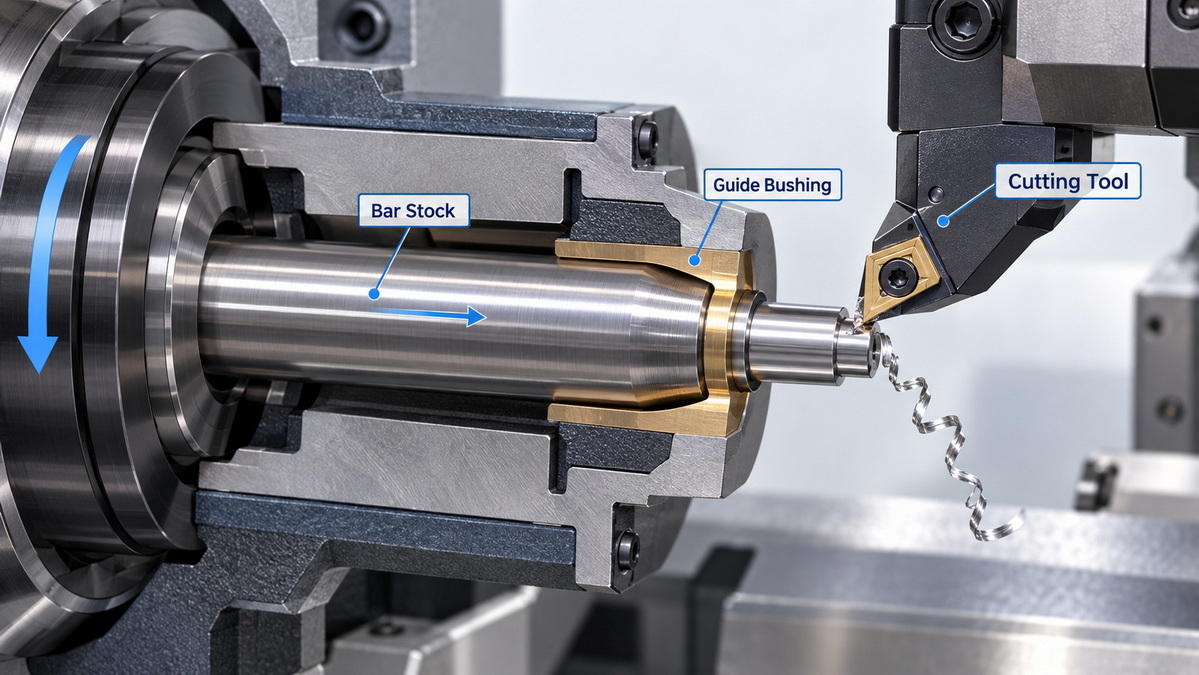
The defining advantage is support near the cutting zone.
A slender workpiece can bend under cutting forces when too much material extends beyond its support. This movement can affect diameter, straightness, and surface finish.
The guide bushing reduces the unsupported distance between the workpiece support and the tool. That makes Swiss machining especially valuable for slender components.
However, close support does not eliminate every source of variation. Bar straightness, bushing adjustment, tool condition, and cutting parameters still need careful control.
A suitably equipped Swiss machine can combine turning, drilling, milling, threading, and back-working.
For example, a connector pin may require a turned diameter, a milled flat, and a cross-hole. Completing these features within one coordinated route can reduce handling and simplify production.
Fewer transfers also mean fewer opportunities for clamping damage or alignment changes between operations.
Nevertheless, operation consolidation depends on the machine and part design. Heat treatment, coating, specialized finishing, or inaccessible features may still require separate processes.
Precision components often depend on relationships between features, not just individual dimensions.
Two diameters may need to share an axis. A shoulder may control assembly position. A cross-hole may need a defined location relative to a mating surface.
Keeping these features within a controlled machining route can help maintain consistency.
An advertised tolerance should never replace a drawing-specific assessment. A short external diameter and a deep bore present different challenges, even when their nominal tolerances are identical.
Automatic bar feeding and coordinated operations can support efficient repeat production.
On suitable machines, overlapping operations reduce idle time. Setup and programming costs can also be distributed across a larger number of accepted parts.
These advantages can make Swiss machining attractive for recurring orders.
However, machining cycle time is only one part of delivery performance. Material availability, scheduling, secondary processing, inspection, and packaging also affect shipment dates.
Stable support helps reduce vibration during cutting. Under suitable conditions, this can produce a consistent machined finish and reduce additional finishing work.
The required finish should still be defined by function.
A sealing diameter, sliding surface, and cosmetic area may have different requirements. Specify surface roughness where necessary, and define edge condition separately.
A general instruction such as "smooth finish" leaves too much room for interpretation. Swiss machining also does not automatically eliminate polishing, grinding, deburring, or cleaning.
The strongest commercial argument is often operation consolidation, rather than a universal reduction in material waste.
Swiss machining may reduce total cost when it avoids additional setups, limits manual handling, or improves the yield of acceptable components.
However, material is still removed as chips. Bar remnants, tooling, precision stock premiums, and inspection requirements can increase cost.
Compare complete manufacturing routes rather than assuming Swiss machining is always the least expensive option.
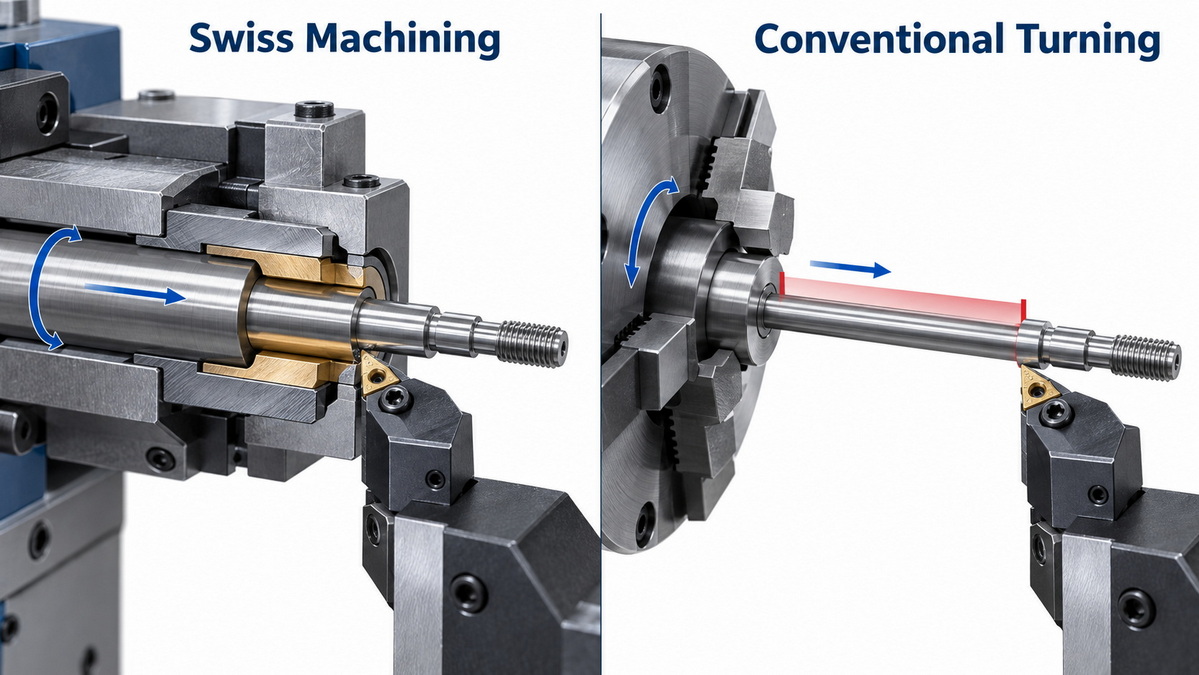
Both methods can produce high-quality components. The appropriate choice depends on the workpiece and its acceptance requirements.
| Consideration | CNC Swiss Machining | Conventional CNC Turning |
|---|---|---|
| Long, slender components | Close support makes it a strong candidate | May require additional support |
| Short, simple parts | Possible, but advantages may be limited | Often a practical option |
| Multiple small features | Can combine operations with suitable tooling | Capability depends on machine configuration |
| Starting material | Bar quality and bushing compatibility can be important | Requirements depend on workholding |
| Repeat production | Attractive when integration justifies setup | Competitive for many simpler turned parts |
Ask suppliers to explain their proposed process.
When both methods can meet the drawing, compare total cost, inspection evidence, delivery assumptions, and repeat-order flexibility.
Swiss machining can process stainless steel, brass, aluminum, titanium, and selected engineering plastics. However, machinability varies significantly between grades.
Stainless steel can create chip-control and tool-wear challenges. Titanium requires careful management of heat and cutting conditions. Plastics can deform and respond to temperature differently from metals.
Choose the material according to application requirements first. Consider strength, corrosion resistance, conductivity, operating temperature, and environmental exposure.
For guide-bushing operation, discuss:
- Bar diameter variation and roundness.
- Straightness and surface condition.
- Fit between the bar and guide bushing.
- Whether ground stock is necessary.
- Material identification and traceability.
Ground bar can help provide consistent dimensions and reliable bushing fit. It is not automatically required for every machine or application.
Confirm the stock specification before comparing prices.
Define which dimensions affect fit, sealing, movement, or interchangeability.
Avoid unnecessarily tight tolerances on nonfunctional surfaces. They can increase manufacturing and inspection work without improving performance.
Where relationships matter, provide clear datums and appropriate geometric controls. A diameter tolerance alone may not communicate the required alignment between features.
Small or deep holes can complicate chip evacuation and inspection.
Where the design permits, consider whether a through-hole would simplify machining compared with a blind hole.
Specify thread standard, pitch, size, and required engagement. Identify intersections where burrs could obstruct flow or interfere with assembly.
Define acceptable edge breaks rather than relying only on "remove sharp edges."
Heat treatment, plating, polishing, and other finishing operations can affect final dimensions and surface condition.
State whether dimensional acceptance applies before or after these processes.
The inspection plan should reflect the condition of the delivered component, not only its condition immediately after machining.
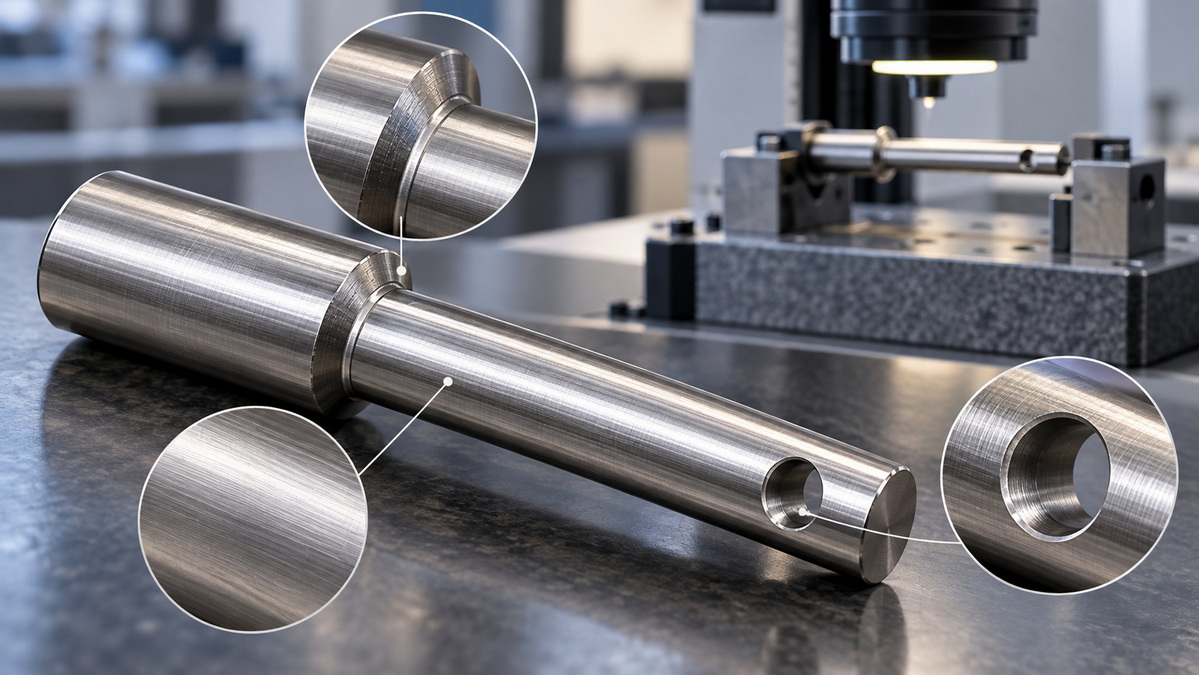
Consider a valve pin with a long shaft, two controlled diameters, a shoulder, and a cross-hole. This is an illustrative design scenario, not a documented customer project.
A conventional route might involve turning, a separate drilling setup, and subsequent deburring.
A suitable Swiss machine could support the slender shaft near the cut and integrate turning with cross-drilling. This makes Swiss machining worth evaluating.
The drawing still determines whether the process is appropriate. Useful questions include:
1. Which diameter controls fit or sealing?
2. Do the two diameters need a defined alignment relationship?
3. Could a cross-hole burr restrict flow?
4. Is post-machining treatment required?
5. How will the smallest critical features be inspected?
This approach connects process selection to component function rather than promising savings before production is validated.
Send a dimensioned drawing and a 3D model where available.
Include material grade, order quantities, expected repeat demand, surface requirements, secondary treatments, inspection expectations, and delivery needs.
Identify unresolved specifications. Otherwise, suppliers may quote different assumptions, making price comparisons unreliable.
Separate one-time engineering charges from recurring production costs.
Review material, machining, secondary operations, inspection, packaging, and agreed logistics costs.
A higher unit price may be justified if it reduces rework or assembly problems. Conversely, a simpler process may be preferable when it meets the same requirements.
Approve samples against the drawing and agreed acceptance criteria.
Request measurement results for critical features, not just photographs or a general statement that inspection passed.
For recurring orders, agree how tool wear, material changes, and process changes will be controlled.
A successful sample is valuable evidence, but it does not independently establish long-term production consistency.
Large diameters, bulky prismatic shapes, simple short parts, and frequently changing designs may favor another manufacturing method.
Very small quantities can also make specialized setup costs difficult to justify. Nevertheless, technically demanding prototypes may still benefit from Swiss machining.
Ask the supplier to compare Swiss turning with conventional turning or milling when the route is uncertain.
For suitable shorter components, guide-bushing-free operation may also be worth discussing.
The best recommendation explains both the advantages and the limitations of the proposed process.
The benefits of CNC Swiss screw machining are strongest when close workpiece support, multiple integrated operations, and repeat production address genuine manufacturing challenges.
Its value comes from matching the process to the drawing—not choosing a machine based on reputation alone.
U-Need supports global brands, distributors, and manufacturers with custom precision parts machining, mold manufacturing, and sheet metal fabrication in China. Its stated service scope includes injection molds, stamping dies, cold-forging dies, laser cutting, bending, and stamping.
Send U-Need your drawing, material specification, target quantity, and critical acceptance requirements. Request a manufacturing review to determine whether Swiss machining or another process is appropriate, which secondary operations are necessary, and how finished-part quality will be verified.
A useful quotation should explain the proposed route and its assumptions, not simply provide a unit price.
Small, slender, bar-fed components with several precision features are strong candidates. Examples include pins, shafts, connector components, and certain valve parts. Suitability depends on geometry, material, and functional requirements.
No. Close support helps control slender parts, but achievable tolerances depend on the feature, tooling, material, thermal conditions, and measurement method. Ask for capability confirmation against your drawing.
Yes, particularly when a prototype must validate the intended production route. However, specialized setup and programming may make a simple prototype more economical on another machine.
Not always. Ground stock can improve diameter consistency and bushing compatibility. The requirement depends on the machine, guide-bushing system, material condition, and finished-part specification.
It can combine several cutting operations. However, heat treatment, coating, specialized finishing, cleaning, and additional inspection may still be required.
Provide drawings, material grade, quantities, critical tolerances, surface requirements, secondary treatments, inspection expectations, and delivery needs. Clearly identify any specifications that still require clarification.
1.TOPS Precision — "Benefits of CNC Swiss Screw Machining You Must Know." Original article used as the starting point for restructuring the topic and evaluating its general benefit claims. [topsbest-precision]
2.Metal Cutting Corporation — "Deflection and Precision in Swiss Metal CNC Machining." Technical background on workpiece deflection, guide-bushing support, precision, and integrated machining capabilities. [metalcutting]
3.Ripley Machine — "Swiss Precision Turning: The Complete Guide." Background on Swiss machining operation, bar-stock considerations, guide-bushing fit, and process selection. [ripley-machine]
4.Production Machining — "Switching to Swiss Without a Guide Bushing." Discussion of guide-bushing-free operation and its relevance to shorter components and production economics. [productionmachining]
5.Absolute Machine Tools — "Guide Bushings for Swiss Lathes: Everything You Need to Know." Explanation of guide-bushing function and support near the cutting zone. [absolutemachine]


