Views: 215 Author: U-Need Publish Time: 2026-10-07 Origin: Site
Content Menu
● What Are CNC Machined Drone Parts?
● Why CNC Machining Is Important for Drone Manufacturing
>> Precision Helps Create Stable UAV Assemblies
>> Strong Materials Improve Component Reliability
>> CNC Machining Supports Fast Design Revisions
● CNC Machining vs. 3D Printing for Drone Parts
● Best Materials for CNC Machined Drone Parts
>> Aluminum 6061-T6 for General Drone Components
>> Aluminum 7075 for High-Strength UAV Components
>> Stainless Steel, Titanium, and Engineering Plastics
● Design for Manufacturability in Drone Components
>> Define Critical Features According to Function
>> Reduce Unnecessary Machining Setups
>> Use Practical Internal Corner Radii
>> Balance Lightweighting and Stiffness
>> Design for Inspection from the Beginning
● Vibration Control and UAV Component Design
● From Prototype to Scalable Drone Production
>> Custom Precision Parts Machining
>> Stamping and Cold Forging Tooling
● How to Evaluate a CNC Drone Parts Manufacturer
● Build Better UAV Components with U-Need
>> What drone parts are best suited to CNC machining?
>> Is aluminum 6061 or 7075 better for CNC drone parts?
>> What tolerance can CNC machining achieve for UAV components?
>> Can CNC machining make lightweight drone parts?
>> When should drone manufacturers move from CNC machining to injection molding or stamping?
>> Which surface finishes are suitable for CNC-machined drone components?
>> Why is vibration control important in drone part design?
CNC machined drone parts are essential when a UAV must be lightweight, structurally reliable, precisely assembled, and repeatable from prototype development to production. For global drone brands, distributors, and equipment manufacturers, the right manufacturing partner does more than cut metal. It helps transform flight-critical designs into manufacturable, inspectable, and scalable components.
U-Need is a trusted precision manufacturing partner in China, supporting global brands, distributors, and manufacturers with end-to-end solutions. Our capabilities include custom precision parts machining, injection mold manufacturing, stamping dies, cold-forging dies, laser cutting, bending, stamping, and sheet metal fabrication.
From machined motor mounts and sensor housings to sheet-metal electronics enclosures and production tooling, U-Need helps UAV manufacturers build a more coordinated, reliable, and scalable supply chain.
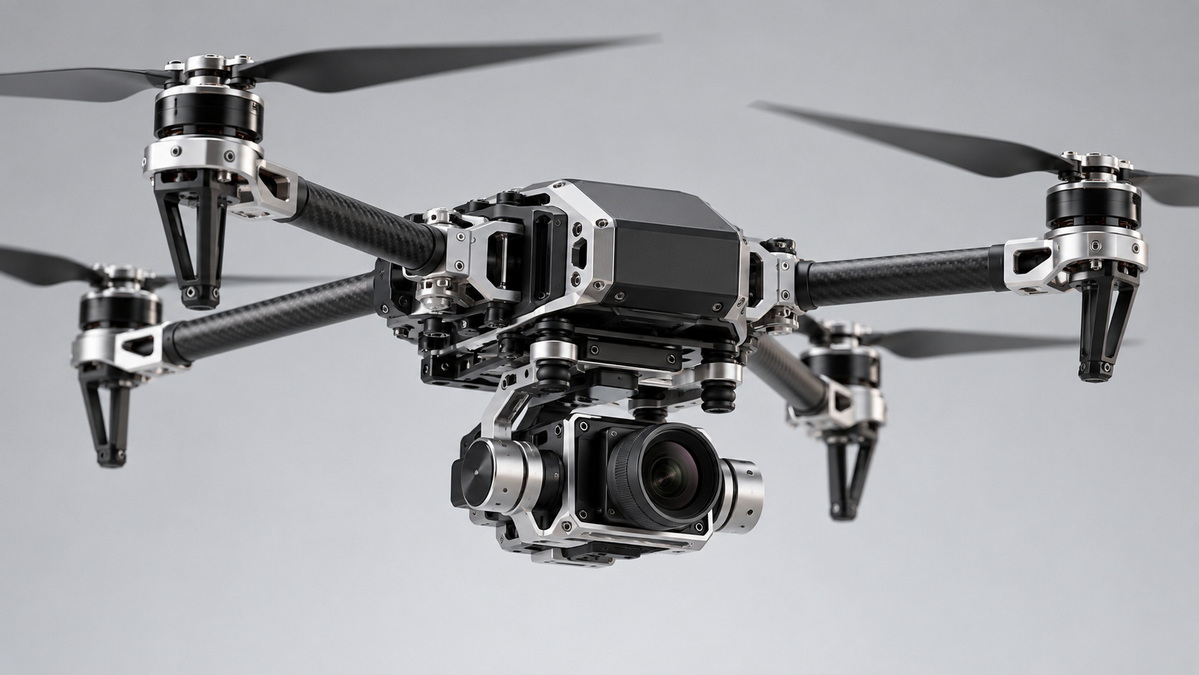
CNC machined drone parts are components produced by removing material from metal or engineering-plastic workpieces using computer-controlled milling, turning, drilling, tapping, and multi-axis machining processes.
These parts are widely used in unmanned aerial vehicles because they can provide high dimensional accuracy, repeatable quality, strong material performance, and complex functional geometry. CNC machining is especially valuable for drone components that must fit precisely with motors, bearings, sensors, cameras, battery systems, frames, and payload equipment.
Common CNC-machined drone components include:
- Motor mounts and motor base plates
- Drone arm connectors and frame joints
- Propeller hubs, adapters, and shafts
- Camera gimbal brackets and stabilization components
- LiDAR, GPS, thermal camera, and multispectral sensor housings
- Flight controller and communication-module enclosures
- Battery-tray brackets and locking mechanisms
- Landing-gear joints and folding mechanisms
- Payload-release components
- Custom inspection-drone fixtures and accessories
A professional drone is not simply a lightweight frame with motors and propellers. It is a dynamic mechanical system exposed to vibration, repeated loading, environmental changes, transport conditions, high-speed rotation, and occasional impact.
Even small deviations in a motor mount, bearing seat, propeller hub, or camera bracket can affect assembly efficiency, vibration behavior, flight stability, camera image quality, and long-term durability.
For this reason, CNC machining is commonly used for functional UAV prototypes, industrial drone components, premium commercial UAV assemblies, specialized payload systems, and low-to-medium-volume production programs.
Many drone parts must work together within limited space and under dynamic loading conditions. A motor mount must align correctly with the arm structure. A propeller hub must connect accurately to a rotating shaft. A gimbal bracket must hold a camera at the intended angle while reducing the transmission of vibration.
CNC machining supports this level of assembly accuracy by producing controlled dimensions, consistent mounting patterns, precision bores, flat mating surfaces, and repeatable interfaces.
Important precision features may include:
- Motor mounting-hole locations
- Propeller-hub concentricity
- Bearing-seat diameter
- Shaft alignment
- Sensor datum locations
- Flatness of mounting surfaces
- Thread quality and thread depth
- Gimbal interface geometry
- Battery-locking engagement features
However, not every drone component requires extremely tight tolerances. Over-specifying tolerances can increase cost, extend machining time, and make inspection more difficult.
The best approach is to apply tighter tolerances only to features that directly affect flight function, assembly alignment, load transfer, movement, sealing, or sensor positioning.
CNC machining gives drone manufacturers access to a wide range of established engineering materials. Unlike basic prototype materials, machined billet, plate, tube, and bar stock can provide more predictable mechanical behavior for demanding applications.
Frequently selected materials include:
- Aluminum 6061-T6
- Aluminum 7075
- Stainless steel
- Titanium
- Brass
- Copper
- POM / Delrin
- Nylon
- PEEK
- Polycarbonate
- Acetal
- Engineering-grade aluminum alloys
Material selection should always be based on the component's real function. A drone frame connector may require strength and stiffness. A payload housing may require corrosion resistance, electromagnetic compatibility, thermal stability, and attractive surface finishing. A vibration-isolation part may require low friction or controlled flexibility rather than high strength.
The strongest material is not always the best choice. The most effective material is the one that achieves the required balance between weight, strength, corrosion resistance, machinability, cost, thermal performance, and production volume.
Drone technology develops quickly. A UAV manufacturer may need to reposition a sensor, reduce the weight of a frame component, enlarge an electronics cavity, improve cable routing, or modify a mounting-hole pattern after field testing.
CNC machining is highly suitable for this stage because design changes can often be implemented by updating the machining program. A new mold or dedicated tool is not required for every revision.
This makes CNC machining useful across several development stages:
1. Initial functional prototype development
2. Engineering validation and flight testing
3. Design improvement and weight optimization
4. Pilot production
5. Low-volume commercial production
6. Replacement-part manufacturing
7. Pre-tooling production before molding or stamping
For drone brands that need to test, revise, and launch products efficiently, this flexibility can significantly reduce development risk.
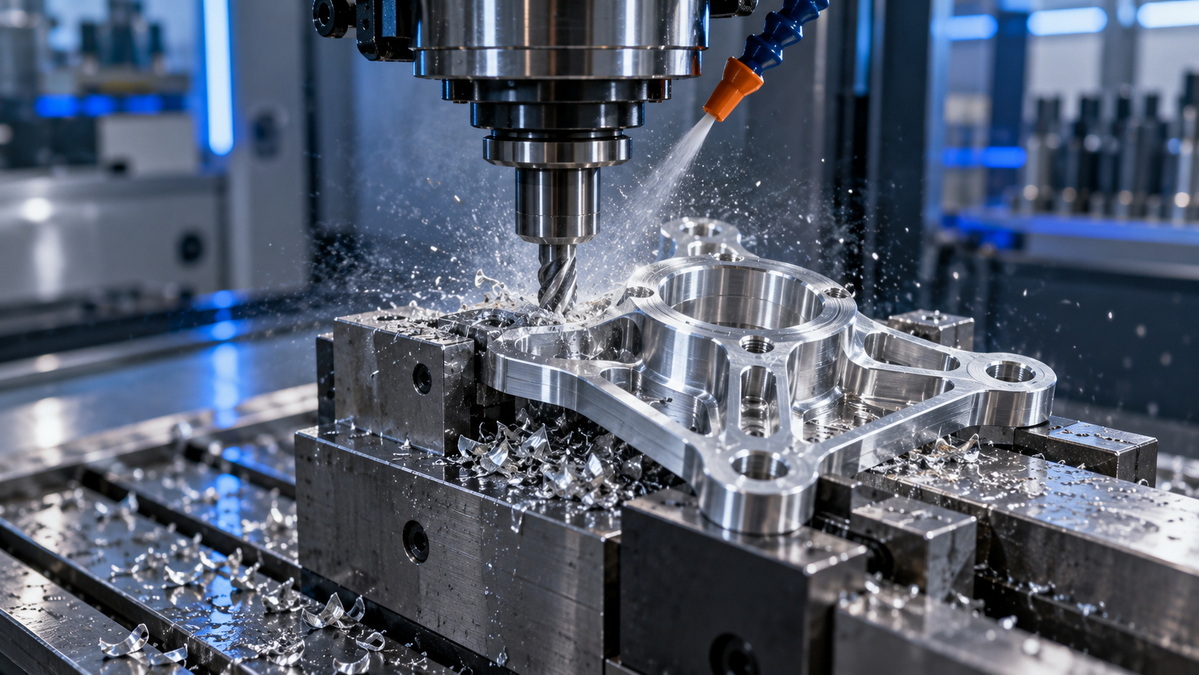
CNC machining and 3D printing can both support drone development. The right option depends on the component's function, required material properties, production quantity, and development stage.
| Decision Factor | CNC Machining | 3D Printing |
|---|---|---|
| Best use case | Functional, structural, precise, and production-ready parts | Early design concepts, fit checks, and geometry validation |
| Material options | Aluminum, stainless steel, titanium, brass, engineering plastics, and more | Polymers, resins, composites, and selected metal-printing materials |
| Surface finish | Controlled and generally smoother | Often requires sanding, machining, coating, or other finishing |
| Tolerance capability | Suitable for precision interfaces, bores, threads, and mating surfaces | Suitable for prototypes, but may require finishing for critical dimensions |
| Strength behavior | More predictable in conventional billet materials | May vary based on printing direction, process, and post-processing |
| Mold requirement | No dedicated mold needed | No dedicated mold needed |
| Cost efficiency | Strong for prototypes, bridge production, and medium-volume parts | Often effective for one-off concepts and highly complex noncritical forms |
| Typical drone use | Motor mounts, housings, shafts, brackets, fixtures, and structural connectors | Mockups, lightweight guards, rapid-fit models, and early concept parts |
For many UAV projects, the most practical method is a combined approach.
- Use 3D printing to verify product appearance, internal space, cable routing, and basic assembly fit.
- Use CNC machining for high-load, high-precision, durable, and flight-tested components.
- Use injection molding, sheet metal, stamping, or cold forging when the design is stable and production demand supports tooling investment.
Aluminum 6061-T6 is one of the most widely used materials for CNC-machined drone parts. It offers a useful balance of strength, corrosion resistance, machinability, availability, and cost.
It is commonly selected for:
- Drone brackets
- Motor-mount plates
- Electronics housings
- Frame connectors
- Camera mounts
- Battery supports
- Landing-gear components
- General structural fittings
Aluminum 6061-T6 is often a practical starting material for commercial UAV projects because it is easier to machine than some higher-strength aluminum alloys and can be finished with anodizing for improved appearance and surface protection.
Aluminum 7075 is a high-strength aluminum alloy often associated with aerospace applications. It can be a suitable option for drone parts that need greater strength-to-weight performance than standard aluminum components.
Typical uses may include:
- High-load motor mounts
- Lightweight structural connectors
- Reinforced arm joints
- Performance drone hardware
- Precision brackets under repeated load
- High-strength frame fittings
- Specialized payload-support components
Although 7075 can provide excellent mechanical strength, it should be selected carefully. Material cost, machining requirements, corrosion exposure, surface treatment, and part geometry must all be evaluated before final selection.
For outdoor drones used in humid, coastal, agricultural, industrial, or chemically exposed environments, surface finishing and protective design details are especially important.
| Material | Common Drone Applications | Main Benefit | Important Consideration |
|---|---|---|---|
| Stainless steel | Shafts, threaded inserts, pins, fasteners, wear components | Excellent wear and corrosion resistance | Adds more weight than aluminum |
| Titanium | High-load fittings, aerospace hardware, specialized structural components | High strength-to-weight potential | Higher material and machining cost |
| Brass | Electrical interfaces, inserts, connectors, fittings | Good electrical conductivity and machinability | Usually not suitable for lightweight structural parts |
| POM / Delrin | Bushings, low-friction moving parts, insulating components | Good dimensional stability and machinability | Limited use in high-temperature structural areas |
| Nylon | Guards, covers, flexible brackets, protective components | Tough and impact resistant | Can absorb moisture and change dimensions |
| PEEK | Heat-resistant or chemically demanding applications | High-performance engineering plastic | Premium material cost |
| Polycarbonate | Transparent covers and protective housings | Good impact resistance | May scratch without protective coatings |

A well-designed CNC drone part should not only function correctly. It should also be practical to machine, inspect, assemble, finish, and reproduce consistently.
The goal is not simply to make the lightest component or the most complex component. The goal is to create a part that provides the right balance of performance, manufacturability, cost control, durability, and inspection reliability.
Start by identifying the features that directly affect UAV performance.
These may include:
- Motor mounting faces
- Bearing bores
- Propeller-shaft interfaces
- Sensor alignment positions
- Camera-gimbal mounting patterns
- Electronic-enclosure sealing surfaces
- Locking features for batteries or payloads
- Structural load-transfer areas
- Datum features for final assembly
These areas should receive careful tolerance and inspection planning. Cosmetic or low-impact areas can often use more economical tolerances.
This approach improves manufacturing efficiency without compromising product function.
Every additional setup can increase production time and create additional opportunities for positional variation. Parts that require repeated re-clamping may cost more and require more complex inspection.
A more manufacturing-friendly design can reduce setup complexity by:
- Keeping important features accessible from fewer machining directions
- Avoiding unnecessary deep cavities
- Simplifying difficult-to-reach internal geometry
- Combining compatible features on the same accessible face
- Designing reasonable tool-clearance areas
- Considering multi-axis machining only where it creates real value
Four-axis and five-axis machining can be valuable for angled surfaces, compound geometry, complex housings, and multi-face components. However, advanced machining should be chosen because it improves the part—not simply because it is technically available.
Standard CNC cutting tools are round. This means internal corners naturally require radii.
A CAD model with sharp internal corners may require very small cutting tools, slow machining cycles, special toolpaths, or secondary operations. These factors can increase cost and delivery time.
Whenever possible, use internal corner radii that are compatible with standard cutting-tool sizes. This can improve machinability while preserving the intended component function.
Weight reduction is essential in drone design, but removing too much material can create new risks. Excessive pockets, thin walls, and large cutouts may reduce stiffness, increase vibration sensitivity, or create fatigue-prone areas.
An effective lightweighting strategy may include:
- Material removal from low-stress areas
- Reinforcing ribs in load-bearing zones
- Smooth transitions between thick and thin sections
- Rounded corners to reduce stress concentration
- Controlled wall thickness
- Optimized mounting locations
- Structural analysis before releasing the design
The best drone part is not necessarily the lightest possible part. It is the part that achieves the required strength-to-weight performance while remaining reliable in real operating conditions.
Inspection should be considered during the design stage, not after manufacturing begins. Critical dimensions need clear reference surfaces, accessible measurement points, and practical inspection methods.
A precision drone component should include:
- Clear datums
- Logical dimensioning
- Functional tolerance requirements
- Defined thread standards
- Accessible measurement surfaces
- Identified critical-to-function dimensions
- Surface-finish requirements where needed
- Material and heat-treatment requirements when applicable
When designers and manufacturing engineers align these details early, production becomes more predictable and quality verification becomes more efficient.
Vibration is one of the most important mechanical considerations in drone development. It can affect camera quality, sensor accuracy, electronic reliability, fastener security, structural fatigue, and flight stability.
Common causes of UAV vibration include:
- Propeller imbalance
- Motor imbalance
- Damaged bearings
- Shaft runout
- Loose fasteners
- Poorly aligned motor mounts
- Uneven propeller hubs
- Excessive payload weight
- Weak structural connections
- Poor vibration-isolation design
Precision-machined components can help reduce avoidable mechanical variation by providing more controlled mounting surfaces, concentric bores, balanced rotating interfaces, and repeatable assembly geometry.
For example, a well-designed CNC-machined gimbal bracket can provide a stable structural foundation for a camera system. Combined with correctly selected damping elements, it can help isolate high-frequency motor and propeller vibration from sensitive imaging equipment.
Similarly, accurate motor mounts and propeller interfaces can support more consistent assembly, reducing the risk of vibration caused by poor alignment.
A drone system often combines different manufacturing methods. CNC machining may be ideal for precision components, but it is rarely the only process needed in a complete UAV product.
A commercial or industrial drone may include:
- CNC-machined motor mounts
- Injection-molded protective housings
- Sheet-metal electronics enclosures
- Stamped clips and brackets
- Cold-forged fittings
- Machined shafts and hubs
- Molded battery covers
- Laser-cut internal supports
- Bent aluminum or steel frame components
- Custom testing fixtures and assembly tools
U-Need supports this wider manufacturing path through integrated precision manufacturing capabilities.
Custom machining is suitable for parts requiring controlled dimensions, complex geometry, durable materials, and reliable mechanical interfaces.
Typical machined UAV components include motor mounts, housings, brackets, gimbal parts, shafts, propeller adapters, arm connectors, sensor fixtures, and structural fittings.
Injection mold manufacturing supports scalable production of plastic drone components once the design has been validated and production demand is stable.
Typical molded drone components may include:
- Protective housings
- Battery covers
- Propeller guards
- Cable-management covers
- Sensor enclosures
- Landing-gear covers
- Remote-controller shells
- Internal plastic supports
Laser cutting, bending, stamping, and related sheet-metal processes can support drone electronics housings, battery compartments, brackets, mounting plates, ground-station equipment, and support assemblies.
Sheet metal can be especially useful when a project requires lightweight enclosures, shielding, bendable structures, or cost-effective medium-volume production.
For mature high-volume programs, stamping dies and cold-forging dies can help reduce the per-part cost of selected metal components. These methods are often considered after the component design is stable and production quantities justify tooling investment.
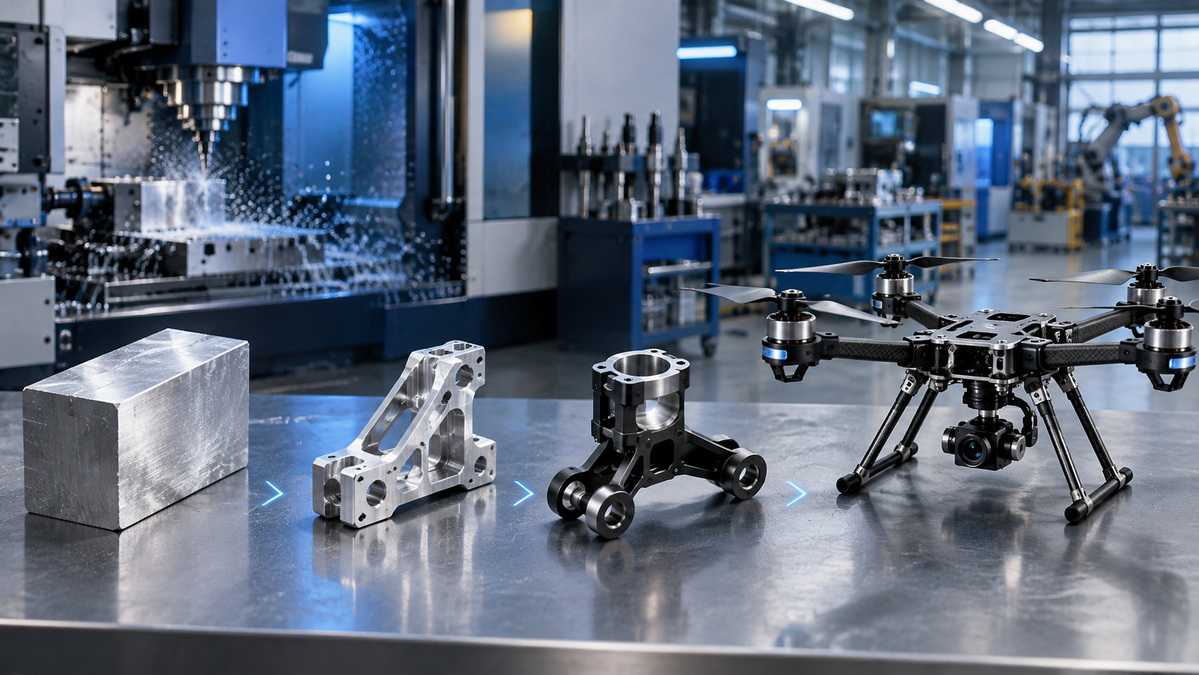
Selecting a precision manufacturer should involve more than reviewing a capability list. A reliable partner should be able to understand the functional requirements of the part, identify production risks, and provide clear communication throughout development and production.
When evaluating a manufacturer, consider the following questions:
1. Can the engineering team review CAD files and provide practical manufacturing feedback?
2. Can the supplier machine aluminum, stainless steel, titanium, brass, and engineering plastics?
3. Are three-axis, four-axis, five-axis, turning, drilling, tapping, and secondary operations available?
4. How are critical dimensions inspected?
5. Can first-article inspection reports be provided when needed?
6. Can material certifications be arranged for critical projects?
7. What finishing options are available for anodizing, hard anodizing, bead blasting, plating, powder coating, passivation, and polishing?
8. Can the supplier support both prototypes and repeat production?
9. Can the supplier coordinate CNC machining, sheet metal fabrication, mold manufacturing, stamping, and forging tooling?
10. How are engineering revisions, packaging requirements, approval samples, and traceability managed?
A capable manufacturer should not only say that it can achieve high precision. It should be able to explain how the part will be machined, held, measured, finished, protected, and delivered.
CNC machined drone parts play a major role in UAV reliability, payload integration, flight stability, and production scalability. From the first prototype to repeat production, precision manufacturing decisions can influence cost, assembly quality, vibration control, durability, and product performance.
U-Need helps global drone manufacturers, industrial equipment brands, distributors, and product-development teams source precision components and coordinated manufacturing solutions from China.
With capabilities covering custom CNC machining, mold manufacturing, stamping dies, cold-forging dies, laser cutting, bending, stamping, and sheet metal fabrication, U-Need can support a wide range of UAV manufacturing requirements under a more integrated production approach.
Share your 3D files, 2D drawings, target quantity, material preferences, surface-finish requirements, and critical dimensions with U-Need. Our engineering team will review the manufacturability of your drone parts and help identify a practical path from prototype development to scalable production.
CNC machined drone parts are critical for UAV systems that require precision, structural strength, reliable assembly, controlled vibration, and scalable production. Aluminum 6061, aluminum 7075, stainless steel, titanium, and engineering plastics can each serve different functional requirements.
Successful drone manufacturing depends on more than machining accuracy. It requires thoughtful material selection, practical part design, realistic tolerance planning, accessible inspection features, vibration-aware engineering, and the ability to move efficiently from prototype machining to scalable manufacturing methods.
U-Need provides integrated manufacturing support for drone and UAV projects, including custom precision machining, mold manufacturing, sheet metal fabrication, stamping, laser cutting, bending, and production tooling. This coordinated capability helps manufacturers develop and produce drone components with greater consistency and supply-chain efficiency.
CNC machining is highly suitable for drone parts that require precise dimensions, durable materials, or high-strength structural performance. Common examples include motor mounts, propeller hubs, shafts, arm connectors, gimbal brackets, sensor housings, electronic enclosures, landing-gear joints, battery-locking components, and payload mounts.
Aluminum 6061-T6 is often a practical choice for general brackets, housings, motor mounts, and structural components because it provides balanced strength, corrosion resistance, machinability, and cost. Aluminum 7075 is often selected when higher strength-to-weight performance is required, particularly for high-load structural components. The right choice depends on loading conditions, environmental exposure, surface treatment, budget, and weight targets.
Achievable tolerance depends on the part size, material, geometry, machining method, tool access, production quantity, and inspection process. Critical features such as bearing bores, motor interfaces, shaft locations, sensor datums, and sealing surfaces can often be machined to tight tolerances when the design and inspection plan support them. Not every feature should receive the same tolerance requirement.
Yes. CNC machining can produce lightweight drone components using pockets, ribs, thin-wall sections, cutouts, and optimized structural geometry. However, lightweighting should be balanced with stiffness, vibration control, fatigue life, impact resistance, and assembly requirements.
The transition usually makes sense when the design has become stable, production demand is predictable, and the expected unit-cost reduction can justify the cost of tooling. CNC machining remains useful for prototypes, pilot runs, bridge production, replacement parts, specialized UAV systems, and lower-volume precision components.
Common finishing options include anodizing, hard anodizing, bead blasting, powder coating, passivation, electroless nickel plating, polishing, and custom coating systems. The best finish depends on the base material, environmental exposure, cosmetic requirements, wear conditions, electrical needs, and mating surfaces.
Vibration can reduce camera-image quality, affect sensor readings, loosen fasteners, accelerate fatigue, and reduce flight-system reliability. Precision-machined motor mounts, propeller interfaces, brackets, and gimbal components can help improve alignment and create more consistent mechanical interfaces. Effective vibration control also requires balanced propellers, healthy bearings, secure fasteners, appropriate damping elements, and a structurally sound frame.
1. [Federal Aviation Administration — Aerospace Forecasts]
2. [Federal Aviation Administration — UAS Compendium to FAA Aerospace Forecast 2026–2046]
3. [NASA Technical Reports Server — Vibration Anomaly Indicator in UAVs in the Presence of Wind]
4. [The Aluminum Association — Industry Standards]
5. [NASA Technical Reports Server — Materials Data Handbook: Aluminum Alloy 7075]
6. [Federal Aviation Administration — Small Unmanned Aircraft Systems Regulations]
7. [CNC Machined Drone Parts: The Complete Manufacturing Guide]


