Views: 256 Author: U-Need Publish Time: 2026-10-09 Origin: Site
Content Menu
● What Is Electrical Discharge Machining?
● How Does EDM Machining Work?
● Why EDM Is Important in Precision Manufacturing
>> Wire EDM for Precision Profiles
>> Sinker EDM for Deep Cavities and Complex Shapes
>> EDM Hole Drilling for Small and Deep Holes
● Wire EDM vs. Sinker EDM vs. EDM Hole Drilling
● Materials Suitable for EDM Machining
● EDM Accuracy, Surface Finish, and Tolerances
● Understanding EDM Surface Integrity
● EDM Advantages and Limitations
>> Main Advantages of EDM Machining
>> Main Limitations of EDM Machining
● How to Prepare an EDM Manufacturing Request
● A Practical Manufacturing Example
● Integrated Precision Manufacturing Support
>> What materials can be machined by EDM?
>> What is the difference between wire EDM and sinker EDM?
>> Can EDM machine hardened steel?
>> How accurate is EDM machining?
>> Can EDM create sharp internal corners?
>> Is EDM suitable for mass production?
>> What information is needed for an EDM quotation?
Electrical Discharge Machining, commonly known as EDM machining, is one of the most important processes in modern precision manufacturing. It removes electrically conductive material through carefully controlled electrical sparks rather than direct mechanical cutting.
For global manufacturers, industrial distributors, tooling companies, and product developers, EDM is often the practical solution when a part includes hardened steel, titanium, tungsten carbide, Inconel, deep ribs, narrow slots, small internal corners, complex cavities, or high-precision holes.
At U-Need, EDM is integrated into broader precision manufacturing capabilities, including custom precision parts machining, injection mold manufacturing, stamping die production, cold-forging die manufacturing, and sheet metal fabrication. This integrated approach helps customers move from prototype and engineering review to tooling, production, inspection, and delivery with fewer supplier handoffs.
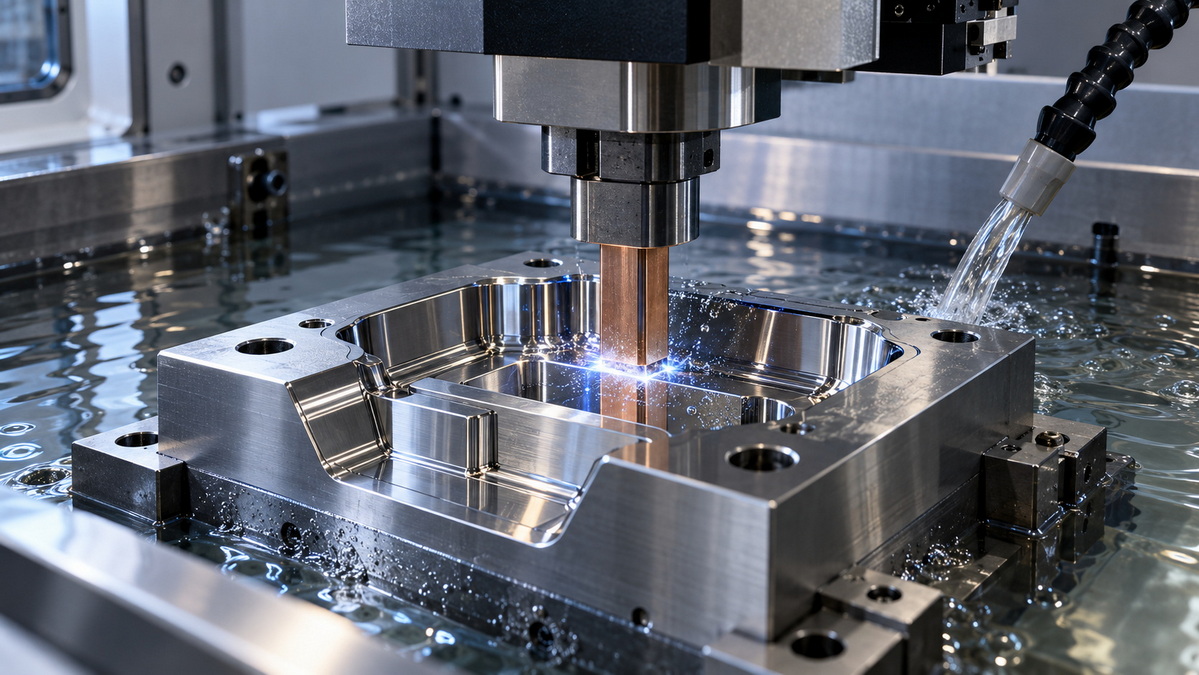
Electrical Discharge Machining is a non-contact manufacturing process that removes material from a conductive workpiece through repeated electrical discharges.
The process is also known as:
- Spark machining
- Spark erosion
- Die-sinking machining
- Wire-cut EDM
- Electrical spark machining
Unlike CNC milling, turning, drilling, or grinding, EDM does not remove material by forcing a cutting tool into the workpiece. Instead, a controlled electrical spark jumps across a very small gap between an electrode and the workpiece.
Each spark removes a microscopic amount of metal. Thousands of sparks occur in a controlled sequence, gradually creating the desired shape, cavity, hole, profile, or surface detail.
EDM is especially useful when conventional machining becomes difficult because of:
- Very hard materials
- Complex internal shapes
- Deep and narrow cavities
- Small-radius internal corners
- Thin walls
- Small holes
- High-aspect-ratio features
- Burr-sensitive parts
- Tight dimensional requirements
The key requirement is simple: the workpiece must be electrically conductive.
EDM can machine metals such as hardened tool steel, stainless steel, titanium, tungsten carbide, copper, brass, aluminum alloys, Inconel, nickel-based alloys, and other conductive materials.
However, EDM cannot directly machine standard plastics, wood, rubber, glass, ceramics without conductivity, or other insulating materials.
The EDM process uses controlled electrical energy to remove metal without direct contact between the electrode and the workpiece.
An EDM system generally includes five main elements:
- Workpiece: The conductive metal part, mold insert, die, blank, or component being machined
- Electrode: The conductive tool that creates the electrical discharge
- Dielectric fluid: The liquid medium that controls sparking, cools the process, and flushes away debris
- Power supply: The unit that regulates voltage, current, pulse duration, and discharge frequency
- CNC control system: The system that controls motion, positioning, spark gap, and machining path
The electrode and workpiece are positioned close together, usually separated by a microscopic gap. When voltage is applied, the dielectric fluid between the two surfaces becomes ionized.
A spark then jumps across the gap.
The temperature generated at the spark point is extremely high. A very small amount of material melts and vaporizes from the workpiece surface. The dielectric fluid removes the debris and restores insulation before the next discharge occurs.
This sequence repeats rapidly throughout the machining cycle.
The EDM machine automatically controls the distance between the electrode and workpiece. If the gap becomes too large, the spark may not occur. If the gap becomes too small, unstable electrical discharge or short-circuiting may happen.
Stable gap control is essential for maintaining accuracy, surface quality, machining speed, and electrode life.
EDM is not designed to replace every conventional machining process. CNC milling, turning, drilling, grinding, laser cutting, stamping, and forging remain essential manufacturing methods.
However, EDM becomes valuable when a component has features that are difficult, risky, or inefficient to machine with physical cutting tools.
For example, a CNC milling cutter may struggle to machine a deep, narrow rib in hardened H13 tool steel. A small cutting tool may deflect, vibrate, wear rapidly, or break. The result may include poor accuracy, inconsistent surface finish, excessive machining time, or damaged tools.
Sinker EDM can create that same rib by using a shaped graphite or copper electrode. The electrode does not need to physically cut through the material. It only needs to maintain a stable electrical gap.
This makes EDM highly suitable for:
- Hardened mold inserts
- Injection mold cavities
- Precision punch and die components
- Extrusion dies
- Aerospace components
- Medical device components
- Turbine blade cooling holes
- Fine blanking tools
- Micro-machined components
- High-precision prototype parts
- Complex metal molds and tooling
In practice, many advanced projects use a hybrid manufacturing route. A part may be CNC machined first, heat-treated afterward, then finished through wire EDM, sinker EDM, grinding, polishing, inspection, and assembly.
This approach allows manufacturers to use the most efficient process for each feature.
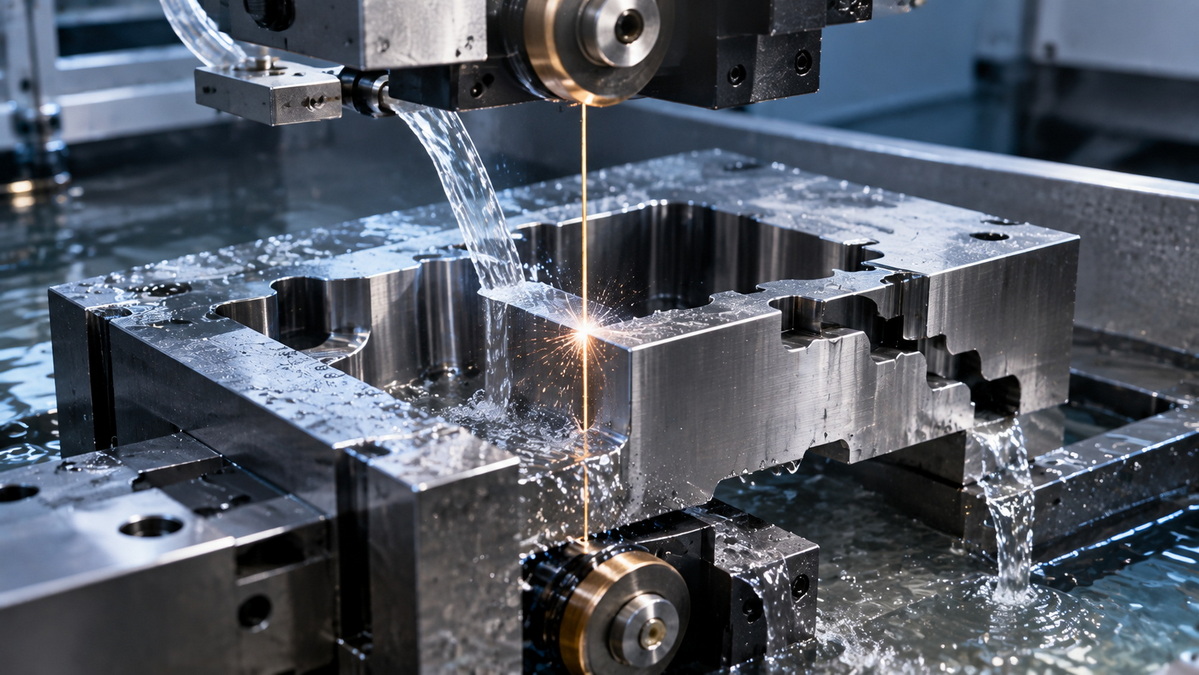
Wire EDM uses a continuously moving metal wire as the electrode. The wire is usually made from brass, coated brass, zinc-coated wire, or other conductive materials designed for stable electrical discharge.
The wire passes through the workpiece while following a CNC-programmed path. It removes material through controlled spark erosion rather than physical cutting.
Wire EDM is often used for through-cut features and precision profiles.
Typical wire EDM applications include:
- Precision punches
- Stamping dies
- Mold inserts
- Extrusion dies
- Fine blanking components
- Gears and splines
- Narrow slots
- Precision contours
- Aerospace brackets
- Medical components
- High-precision prototype parts
- Tool steel components after heat treatment
Wire EDM is particularly useful when the workpiece is already hardened. Instead of machining a soft component first and risking distortion after heat treatment, a manufacturer can heat-treat the material and then wire-cut the precision profile.
This can improve dimensional stability for critical tooling components.
Wire EDM also supports tapered cutting. By independently controlling the upper and lower wire guides, the machine can create angled profiles, tapered punches, tapered cavities, and complex contour features.
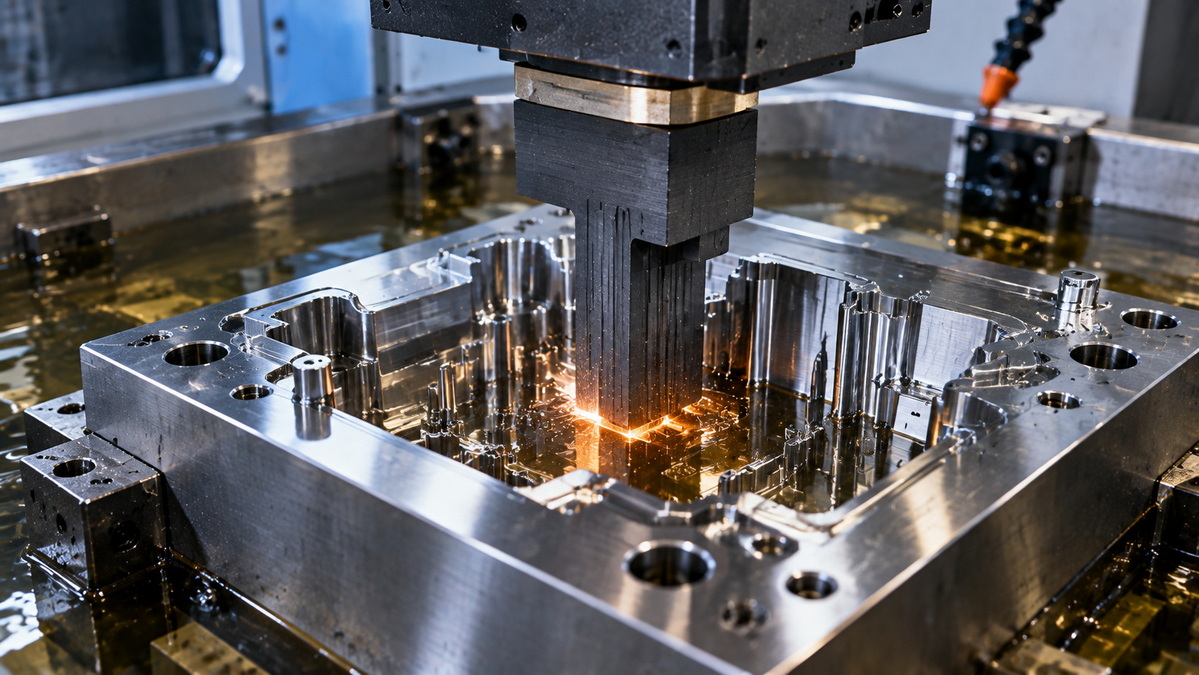
Sinker EDM, also called ram EDM or die-sinking EDM, uses a shaped electrode to create cavities and detailed features in the workpiece.
The electrode is often made from graphite or copper. It is manufactured in the inverse shape of the desired feature.
For example, if a mold requires a deep narrow rib, logo feature, sharp internal corner, textured cavity, or complex 3D shape, the electrode is machined to match that geometry. The sinker EDM machine then lowers the electrode into the workpiece while electrical sparks gradually reproduce the electrode shape.
Sinker EDM is widely used for:
- Injection mold cavities
- Mold cores
- Deep narrow ribs
- Complex internal cavities
- Detailed logo features
- Fine surface texturing
- Precision die components
- Hardened steel features
- Small-radius internal corners
- Medical and aerospace parts
- Difficult-to-machine 3D geometries
Sinker EDM is especially effective when a conventional cutting tool cannot reach the required area or cannot maintain stable accuracy.
For example, a mold cavity may include several deep and narrow ribs with small corner radii. Milling those ribs may require long, small-diameter tools that can deflect or break. Sinker EDM can create the same features with greater process stability.
EDM hole drilling uses a tubular electrode to create small, deep, and accurate holes in conductive materials.
The tubular electrode usually rotates during machining. Dielectric fluid flows through the center of the electrode to flush away debris and maintain stable sparking.
This process is often used for:
- Turbine blade cooling holes
- Wire EDM start holes
- Mold vent holes
- Small-diameter holes
- Deep holes in hardened steel
- Precision fuel-system components
- Medical device holes
- Micro-hole drilling
- Holes in titanium or nickel alloys
- Difficult-to-drill aerospace components
EDM hole drilling is highly useful when conventional twist drills may wander, break, leave burrs, or fail to achieve the required depth-to-diameter ratio.
| Process | Electrode Type | Best Used For | Common Applications | Key Consideration |
|---|---|---|---|---|
| Wire EDM | Continuously moving wire | Precision through-cut profiles | Punches, die plates, slots, gears, mold inserts | Requires access for the wire or a start hole |
| Sinker EDM | Shaped graphite or copper electrode | Cavities and complex internal features | Injection molds, deep ribs, detailed cavities | Requires electrode design and manufacturing |
| EDM Hole Drilling | Tubular rotating electrode | Small and deep holes | Cooling holes, vent holes, starter holes | Flushing and geometry affect hole quality |
The correct EDM process depends on the geometry of the part.
Choose wire EDM when the feature is a profile cut through the workpiece.
Choose sinker EDM when the feature is a cavity, deep rib, or complex internal shape.
Choose EDM hole drilling when the feature is a small, deep, or difficult-to-drill hole.
In some cases, all three EDM processes may be used in the same tooling project.
The most important material requirement for EDM is electrical conductivity.
EDM is commonly used for:
- Carbon steel
- Alloy steel
- Tool steel
- Hardened steel
- Stainless steel
- Copper
- Brass
- Aluminum alloys
- Titanium alloys
- Tungsten carbide
- Inconel
- Nickel-based superalloys
- Conductive ceramics
- Conductive metal-matrix composites
Material hardness is not the primary limitation for EDM. A hardened steel mold insert can often be machined by EDM even when its hardness would cause rapid wear on conventional cutting tools.
However, material properties still affect machining performance.
For example:
- Tungsten carbide may require careful parameter selection because of its hardness and brittleness
- Titanium may require controlled finishing conditions to manage surface quality
- Inconel and nickel alloys may require optimized flushing and pulse parameters
- Copper and brass can machine differently because of their thermal and electrical properties
- Hardened tool steels may require finishing passes for improved surface integrity
The best manufacturing route depends on material condition, geometry, tolerance, surface requirements, and production quantity.
EDM is capable of producing highly precise parts, but the final result depends on more than the machine itself.
A reliable EDM result requires control over:
- Material type and hardness
- Part geometry
- Feature size
- Electrode design
- Wire diameter
- Spark gap
- Pulse settings
- Flushing conditions
- Number of finishing passes
- Machine thermal stability
- Fixturing method
- Inspection method
- Surface-finish requirement
A common mistake is asking for the "maximum EDM tolerance" without considering the actual design.
A more useful engineering question is:
> "What tolerance and surface finish can be achieved consistently on this material, thickness, feature size, and production quantity?"
For example, a straight wire-cut profile in a stable hardened steel plate may achieve a different result from a deep sinker EDM cavity with thin walls and limited flushing access.
Fine finishing passes can improve surface quality and reduce the visible effects of spark erosion. Multiple skim cuts in wire EDM can improve dimensional accuracy and surface finish. In sinker EDM, reduced-energy finishing passes can produce a smoother cavity surface before polishing.
For mold-making projects, the final surface requirement may include:
- EDM finish
- Fine EDM finish
- Hand polishing
- Mirror polishing
- Texture preparation
- Grinding
- Lapping
- Coating preparation
The required finish should be clearly defined before manufacturing begins.
EDM is a thermal process. Each spark melts and removes a small amount of material, which means the surface layer may be affected by the machining conditions.
Depending on the energy level and finishing process, EDM may leave a thin recast layer on the surface. This layer is sometimes called the white layer because of its appearance under metallographic inspection.
For many mold, die, and industrial components, this is manageable and acceptable. However, surface integrity becomes more important for parts exposed to high fatigue loads, high pressure, repeated thermal cycling, sealing conditions, aerospace service, or medical applications.
Potential EDM surface considerations include:
- Surface roughness
- Recast layer thickness
- Microcracks
- Residual stress
- Heat-affected surface condition
- Dimensional change after polishing
- Corrosion resistance
- Fatigue performance
The right finishing method depends on the application.
For example, a precision mold cavity may require fine EDM followed by polishing. A high-performance aerospace component may require controlled finishing parameters, surface inspection, and additional verification. A stamping die may require a balance between wear resistance, edge condition, production speed, and maintenance requirements.
Clear communication during the engineering stage helps prevent unnecessary cost, surface-quality issues, and later rework.
- Machines hard conductive materials with minimal mechanical cutting force
- Creates complex geometries that are difficult to machine conventionally
- Produces fine detail in cavities, slots, holes, and profiles
- Works effectively after heat treatment
- Reduces the risk of tool deflection in deep and narrow features
- Can minimize burr formation
- Supports repeatable production for precision tooling and components
- Enables small internal radii beyond the practical limits of many milling tools
- Suitable for high-value, low-volume, and specialized parts
- Supports precision mold and die manufacturing
- Only conductive materials can be machined
- Machining speed is often slower than conventional milling for bulk material removal
- Sinker EDM requires electrode manufacturing
- Electrode wear must be considered in cavity machining
- Wire consumption contributes to operating cost in wire EDM
- Poor flushing can reduce speed and surface quality
- Surface integrity must be controlled for demanding applications
- EDM may not be the lowest-cost option for simple high-volume parts
The right process depends on the critical feature, not just the material.
For simple profiles, laser cutting, stamping, CNC machining, or waterjet cutting may be more efficient. For deep cavities in hardened steel, intricate mold details, or precision profiles after heat treatment, EDM may provide the better result.
A complete drawing package helps the manufacturing team evaluate feasibility, recommend the right process, and provide a more accurate quotation.
Prepare the following information before starting an EDM project:
1. 2D technical drawing with dimensions, tolerances, notes, material, and surface requirements
2. 3D CAD file in STEP, IGES, Parasolid, or another compatible format
3. Material grade and required hardness condition
4. Part quantity for prototype, pilot production, and regular production
5. Critical tolerances including profile, position, flatness, parallelism, and concentricity
6. Surface finish requirement including Ra value, polishing level, or texture requirement
7. Heat-treatment specification including hardness range and process sequence
8. Inspection requirement such as CMM report, material certificate, first article report, or PPAP documentation
9. Functional requirements including assembly fit, sealing, load condition, corrosion environment, and cosmetic requirements
10. Packaging and delivery requirements for finished precision components and tooling
Detailed information allows the manufacturing team to identify potential concerns before production begins.
For example, an extremely thin wall may require a specific machining sequence. A deep cavity may require special flushing design. A highly polished mold surface may require an EDM finish strategy that supports later polishing.
Early engineering review can reduce lead time, avoid expensive rework, and improve production consistency.
Consider an H13 steel injection mold insert with deep ribs, small internal radii, cooling features, and a cosmetic cavity surface.
A practical manufacturing sequence may include:
1. CNC rough machining of the steel blank
2. Stress relief or heat treatment where required
3. CNC finishing of accessible external surfaces
4. EDM hole drilling for small cooling or vent holes
5. Sinker EDM for deep ribs and difficult internal cavity details
6. Wire EDM for precision profiles or removable inserts
7. Surface grinding for datum surfaces
8. Fine EDM finishing for improved cavity quality
9. Hand polishing for cosmetic or transparent-part surfaces
10. CMM inspection and final dimensional verification
This process uses each manufacturing method where it provides the best balance of precision, manufacturability, lead time, and cost.
The same principle applies to stamping dies, cold-forging dies, precision fixtures, aerospace parts, medical components, and high-value industrial assemblies.
EDM is most effective when it is part of a coordinated manufacturing process.
A precision component may require multiple operations before it becomes a finished product. These operations may include CNC machining, turning, milling, grinding, heat treatment, wire EDM, sinker EDM, EDM hole drilling, polishing, coating, assembly, inspection, and packaging.
U-Need provides integrated manufacturing support for customers requiring:
- Custom precision machined parts
- Injection mold manufacturing
- Stamping die manufacturing
- Cold-forging die production
- Wire EDM and sinker EDM components
- Sheet metal laser cutting
- Sheet metal bending
- Sheet metal stamping
- Metal fabrication and assembly
- Prototype development
- Low-volume production
- Tooling and production support
This integrated capability is valuable for global brands, industrial distributors, OEM manufacturers, and product-development teams that need clear engineering communication and dependable project coordination.
A successful EDM project begins with a well-defined design, realistic tolerances, suitable material selection, and a manufacturing process matched to the function of the part.
When the required geometry exceeds the limits of conventional machining, EDM provides a precise and reliable path from concept to production.

Electrical Discharge Machining is one of the most capable methods for producing high-precision conductive metal components, hardened molds, dies, cavities, micro-holes, narrow slots, and difficult internal features.
Wire EDM, sinker EDM, and EDM hole drilling each solve different manufacturing challenges. Wire EDM is ideal for precision through-cut profiles. Sinker EDM is suited to complex cavities and deep internal details. EDM hole drilling is effective for small and deep holes in hard materials.
For the best manufacturing result, EDM should be selected as part of a complete process plan that considers material, geometry, tolerance, surface finish, volume, lead time, inspection requirements, and final part function.
U-Need supports precision manufacturing projects that require complex machining, mold production, die manufacturing, sheet metal fabrication, and coordinated engineering support from prototype through production.
EDM can machine electrically conductive materials, including carbon steel, tool steel, hardened steel, stainless steel, titanium, copper, brass, tungsten carbide, aluminum alloys, Inconel, and nickel-based alloys. Non-conductive materials such as ordinary plastic, wood, rubber, and glass cannot be directly machined by EDM.
Wire EDM uses a continuously moving wire electrode to cut precise profiles through a workpiece. Sinker EDM uses a shaped graphite or copper electrode to form cavities, ribs, and complex internal details. Wire EDM is commonly used for punches, die plates, and profile cutting, while sinker EDM is commonly used for molds and cavity features.
Yes. EDM is widely used to machine hardened tool steel, mold steel, and die steel. Because it removes material through controlled electrical sparks rather than direct mechanical cutting, EDM can machine hardened materials without the same cutting-force challenges found in conventional machining.
EDM generally produces fewer conventional mechanical burrs than milling, drilling, or stamping because the process does not use a cutting edge that pushes material outward. However, the surface condition still depends on machining parameters, flushing, finishing passes, and part geometry.
EDM can achieve high precision, but actual accuracy depends on material type, part thickness, feature geometry, electrode condition, wire diameter, machine stability, flushing, finishing passes, fixturing, and inspection requirements. The required tolerance should always be evaluated against the specific part drawing.
EDM can create much smaller internal corner radii than conventional milling. However, completely sharp internal corners are not possible because the final radius is influenced by the wire diameter, electrode geometry, spark gap, and machining parameters.
EDM is suitable for production where precision, difficult materials, or complex geometry justify the process time. It is widely used for mold manufacturing, stamping dies, aerospace components, medical parts, and high-value industrial components. For simple high-volume parts, stamping, forging, CNC machining, or other processes may be more economical.
A complete request should include a 2D drawing, 3D CAD model, material grade, hardness condition, quantity, tolerances, surface finish, heat-treatment requirement, inspection requirement, and functional notes. This information helps determine whether wire EDM, sinker EDM, EDM hole drilling, CNC machining, or a combined process route is most suitable.
1. [TOPS — What Is Electrical Discharge Machining? Ultimate EDM Guide]
2. [NIST — Electrical Discharge Machine Glossary]
3. [NIST — Effect of Electrical Discharge Machining on Miniaturized Charpy Test Results]
4. [Manufacturing Review — Optimization of EDM Machining Performance and Recent Research Trends]
5. [Makino — EDM: When Milling Just Won't Cut It]
6. [Makino — Wire EDM Machine Centers Tutorial]
7. [Makino — Sinker EDM Technology]
8. [Makino — The Case for Additive Technology in EDM]
9. [Springer Nature — A Critical Review of Electrical Discharge Machining for Superalloys]


