Views: 253 Author: U-Need Publish Time: 2026-07-25 Origin: Site
Content Menu
>> Main Characteristics of Horizontal Milling
>> Main Characteristics of Vertical Milling
● Horizontal vs Vertical Milling
● Advantages of Horizontal Milling
>> 3. Strong Performance on Large Parts
>> 4. Efficient for Repeated Work
● Limitations of Horizontal Milling
>> 3. Less Convenient for Visual Inspection
● Advantages of Vertical Milling
>> 4. Flexible for Many Job Types
● Limitations of Vertical Milling
>> 1. Less Effective for Heavy Cuts
>> 2. Chip Removal Can Be Slower
>> 3. Not Always Ideal for High-Volume Production
● How to Choose Between Horizontal and Vertical Milling
>> Use Horizontal Milling When:
● Where Each Method Is Commonly Used
● Expert Perspective for Manufacturing Buyers
● FAQ
>> 1. What is the main difference between horizontal and vertical milling?
>> 2. Which type of milling is better for precision work?
>> 3. Which process removes material faster?
>> 4. Is vertical milling cheaper than horizontal milling?
>> 5. Which one is better for prototyping?
>> 6. Can both machines be used for CNC machining?
Horizontal and vertical milling are two foundational machining methods used across precision manufacturing. The best choice depends on part geometry, material, production volume, setup efficiency, and the level of flexibility required on the shop floor.
When comparing horizontal vs vertical milling, the spindle orientation is the first difference to understand, but it is not the only one that matters. In real production, the machine you choose can affect cycle time, chip evacuation, surface quality, tooling wear, and overall manufacturing cost.
Milling is a subtractive process that removes material from a workpiece using a rotating cutter. It is widely used for flat surfaces, slots, pockets, contours, and precision features in industries such as mold making, automotive parts, industrial equipment, and custom precision components.
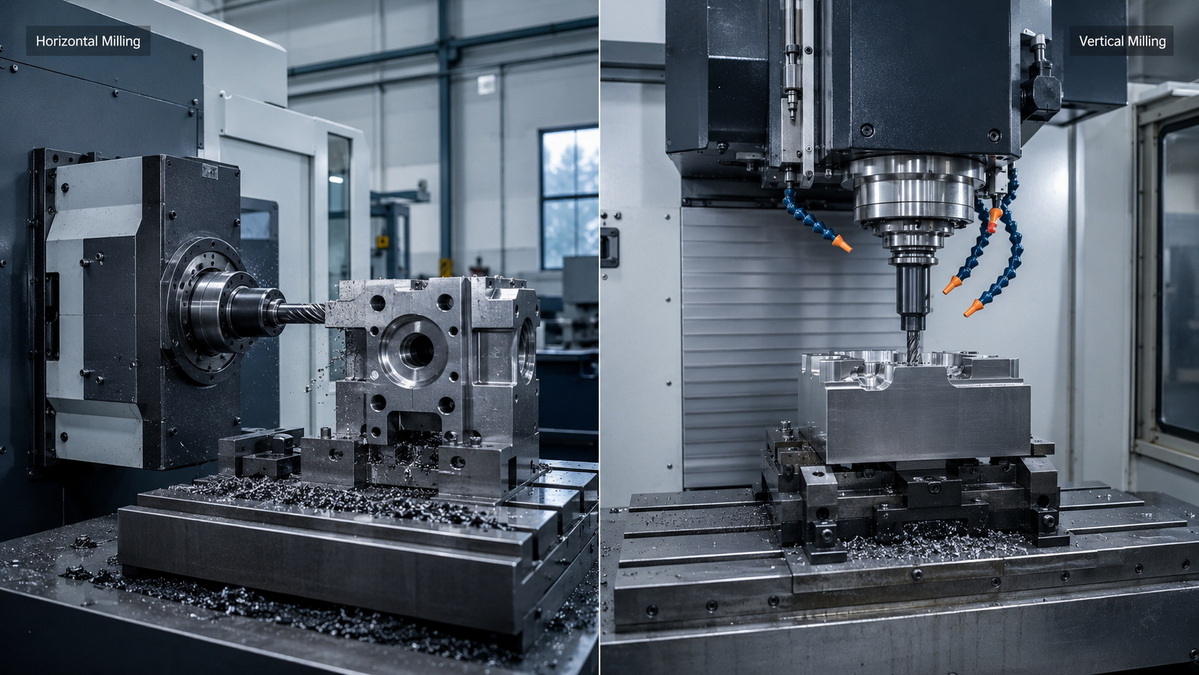
Milling is one of the most versatile machining processes in manufacturing. It can be used to produce simple flat faces or highly complex profiles with tight tolerances.
In modern production, milling is often performed on CNC machines to improve consistency, accuracy, and repeatability. This makes the process essential for both prototyping and mass production.
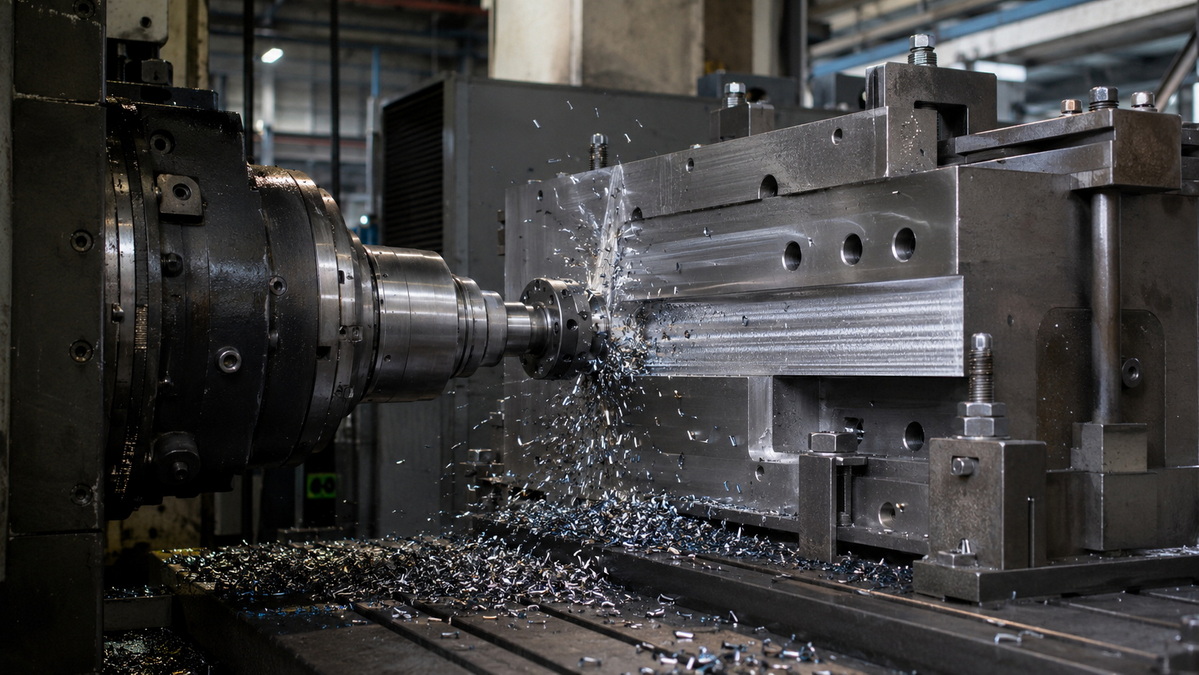
Horizontal milling uses a spindle mounted in a horizontal position, parallel to the worktable. The cutter approaches the workpiece from the side, which makes the process especially effective for aggressive material removal.
Because the cutting action is more stable in many heavy-duty applications, horizontal milling is often chosen for larger parts and production runs. It is also well suited to jobs that require deeper cuts and better chip clearance.
- The spindle is mounted horizontally.
- The cutter is typically shorter and thicker.
- The process is strong for heavy material removal.
- Chip evacuation is usually more efficient.
- It is often used in high-volume or repeat production.
Vertical milling uses a spindle positioned vertically, with the tool cutting down into the workpiece. This is one of the most common machine configurations in general machining environments.
Vertical milling is valued for its simplicity, visibility, and flexibility. It is often easier to set up and operate, which makes it a strong choice for short runs, prototypes, and custom jobs.
- The spindle is mounted vertically.
- The operator has better visibility of the cutting area.
- Setup is generally faster and simpler.
- It is well suited to detailed work and smaller parts.
- It is often more affordable than horizontal milling.

The table below highlights the most important differences between the two milling methods.
| Factor | Horizontal Milling | Vertical Milling |
|---|---|---|
| Spindle orientation | Horizontal | Vertical |
| Best for | Heavy cuts, large parts, repeat production | Precision work, flexible jobs, smaller parts |
| Chip evacuation | Stronger | Less efficient than horizontal in many cases |
| Setup | More complex | Simpler |
| Visibility | Lower | Better |
| Tooling | Shorter, thicker tools | Longer, thinner tools |
| Cost | Higher | Lower |
| Production fit | High-volume operations | Short runs and general machining |
The right choice depends on whether your priority is speed, flexibility, accuracy, or cost efficiency. In many shops, both machine types serve different but equally important roles.
Horizontal milling offers several practical advantages when the job involves larger components or demanding cuts. It is often the better choice when throughput and cutting power matter more than setup simplicity.
Horizontal mills are effective at removing large amounts of material quickly. This makes them useful for roughing operations and parts that need substantial stock removal.
Because the spindle is horizontal, chips can fall away from the cutting zone more easily. Better chip control often helps protect the cutting edge and maintain stable machining conditions.
Horizontal milling is well suited to large or heavy workpieces. The machine structure is generally designed to handle more demanding cutting forces.
When the same part needs to be produced many times, horizontal milling can improve productivity. The process is often favored in environments where consistency and cycle time are critical.
Despite its strengths, horizontal milling is not always the best option. It usually requires a higher investment, more space, and more experienced operation.
Horizontal milling machines are often more expensive to purchase and maintain. For smaller shops or lower-volume work, the cost may not be justified.
The setup process can be more involved than vertical milling. This may increase preparation time, especially for one-off parts or changing part families.
Because the cutting zone is not as easy to see, operators may find it harder to monitor the process closely. This can make certain adjustments less intuitive.
Vertical milling remains extremely popular because it is practical, flexible, and accessible. It is often the preferred option for general-purpose machining.
Vertical mills are generally easier to learn and run. This makes them suitable for a wide range of shops, including those with varied job types.
Operators can usually see the workpiece and cutter more clearly. Better visibility helps with setup, inspection, and fine adjustments.
Vertical milling machines are usually more affordable than horizontal models. They also tend to be easier to maintain and integrate into smaller facilities.
Vertical milling handles a wide variety of tasks, from face milling and slotting to precision shaping and small-part machining. This flexibility makes it especially useful in job shops and prototyping environments.
Vertical milling is versatile, but it has some limits when the application becomes more demanding. In many cases, those limits show up in speed, chip flow, or cutting depth.
Vertical mills are usually not the best option for aggressive stock removal. When deeper cuts are required, the process can become less efficient.
Chips may remain closer to the cutting zone compared with horizontal milling. That can affect cutting stability in some applications.
For repetitive work with large quantities, vertical milling may be less efficient than a horizontal setup. The machine may still produce excellent parts, but not always at the fastest rate.
Choosing the right milling process starts with the part itself. Geometry, material, tolerance requirements, and quantity all matter.
- The part is large or heavy.
- The job requires deep cuts or aggressive roughing.
- Production volume is high.
- Chip evacuation is a major concern.
- Cycle time is more important than setup simplicity.
- The part is smaller or more detailed.
- Flexibility matters more than maximum throughput.
- You need an easier setup process.
- The project is a prototype or short production run.
- Budget and footprint are important considerations.
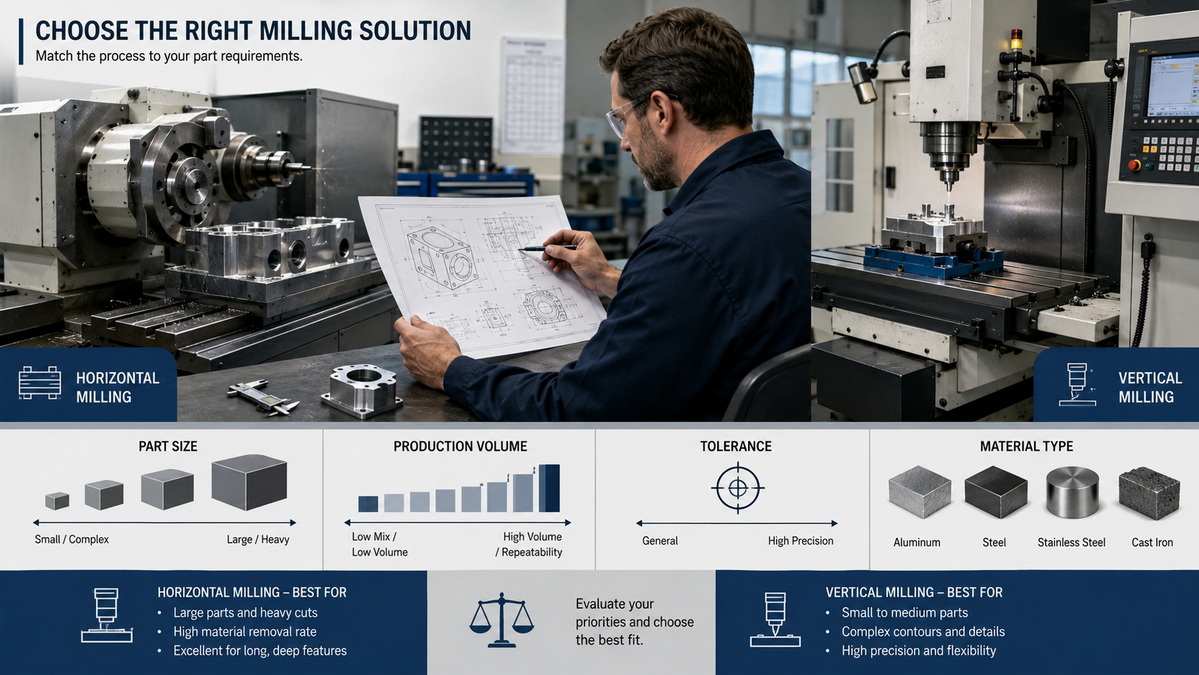
A good machine choice should match both current demand and future production needs. It should also fit the way your team works.
1. Part size and geometry. Larger and heavier parts often favor horizontal milling.
2. Material type. Harder materials may require more stable cutting and better chip control.
3. Production volume. Repeated production can justify a more efficient machine type.
4. Tolerance and finish. Precision requirements may favor one setup over another.
5. Operator experience. More complex machines can require more advanced training.
6. Available floor space. The machine footprint may influence the decision.
7. Budget. Purchase price and operating cost should both be considered.
Horizontal milling is often found in production environments where speed and repeatability are essential. It is commonly used for larger industrial parts, heavy-duty machining, and operations with high material removal requirements.
Vertical milling is widely used in tool rooms, prototype shops, and general machining facilities. It is especially common where flexibility, inspection access, and lower cost are important.
For many manufacturing teams, the smartest decision is not choosing one machine for everything. Instead, it is understanding which process best matches the workload.
If your parts change often, vertical milling usually offers greater flexibility and lower risk. If your work is repetitive and demanding, horizontal milling may deliver better efficiency and long-term value.
In real sourcing situations, the most effective approach is often a process review before production begins. That helps avoid unnecessary cost, weak process selection, and avoidable delays.
Horizontal and vertical milling each have clear strengths. Horizontal milling is usually the better choice for heavy cuts, larger parts, and higher production efficiency, while vertical milling is often the better fit for flexibility, visibility, and lower-cost machining.
The best solution depends on your part design, production target, and overall manufacturing plan. When the machine matches the job, quality and efficiency usually improve together.
The main difference is spindle orientation. Horizontal milling uses a spindle mounted sideways, while vertical milling uses a spindle mounted up and down.
Vertical milling is often preferred for precision work because it offers better visibility and easier setup.
Horizontal milling is generally more efficient for heavy material removal and deeper cuts.
Yes, vertical milling machines are usually less expensive to buy and maintain.
Vertical milling is often better for prototyping because it is more flexible and easier to adjust.
Yes, both horizontal and vertical milling machines can be configured for CNC operation.
1. RapidDirect. "Understanding the Differences Between Horizontal and Vertical Milling."
[https://www.rapiddirect.com/blog/horizontal-vs-vertical-milling/]
2. Fractory. "Horizontal vs Vertical Milling | Difference & Advantages."
[https://fractory.com/horizontal-vs-vertical-milling/]
3. Roberson Tool. "Vertical Milling vs. Horizontal Milling: Pros and Cons of Each."
[https://robersontool.com/vertical-milling-vs-horizontal-milling-pros-and-cons-of-each/]
4. The Engineering Projects. "How to Choose the Right Milling Machine: A Straightforward Guide."
5. Haidi Machinery. "How to Choose the Right Milling Machine for My Project."


