Views: 222 Author: U-Need Publish Time: 2026-05-08 Origin: Site
Short-run injection molding has become one of the most strategic tools in my work with global hardware brands that need real parts fast—without locking themselves into risky, high-volume tooling too early. From the perspective of both an on-the-ground manufacturing partner in China and a product development consultant, short-run injection molding is now the bridge between 3D-printed prototypes and full-scale production that serious teams simply cannot ignore. [protolabs]
Short-run injection molding is the production of a relatively low volume of plastic parts—typically from a few hundred up to a few thousand—using an injection molding machine and a dedicated mold. The process itself mirrors traditional molding: molten plastic is injected into a custom tool, cooled, and ejected to create repeatable, end-use components. [protolabs]
What makes short-run molding different is how the tooling and process are optimized for flexibility, speed, and lower upfront investment instead of pure per-unit cost minimization at very high volumes. For many teams, this is the "missing middle" between 3D printing (fast but limited) and long-run steel tooling (expensive and slow to change). [protolabs]
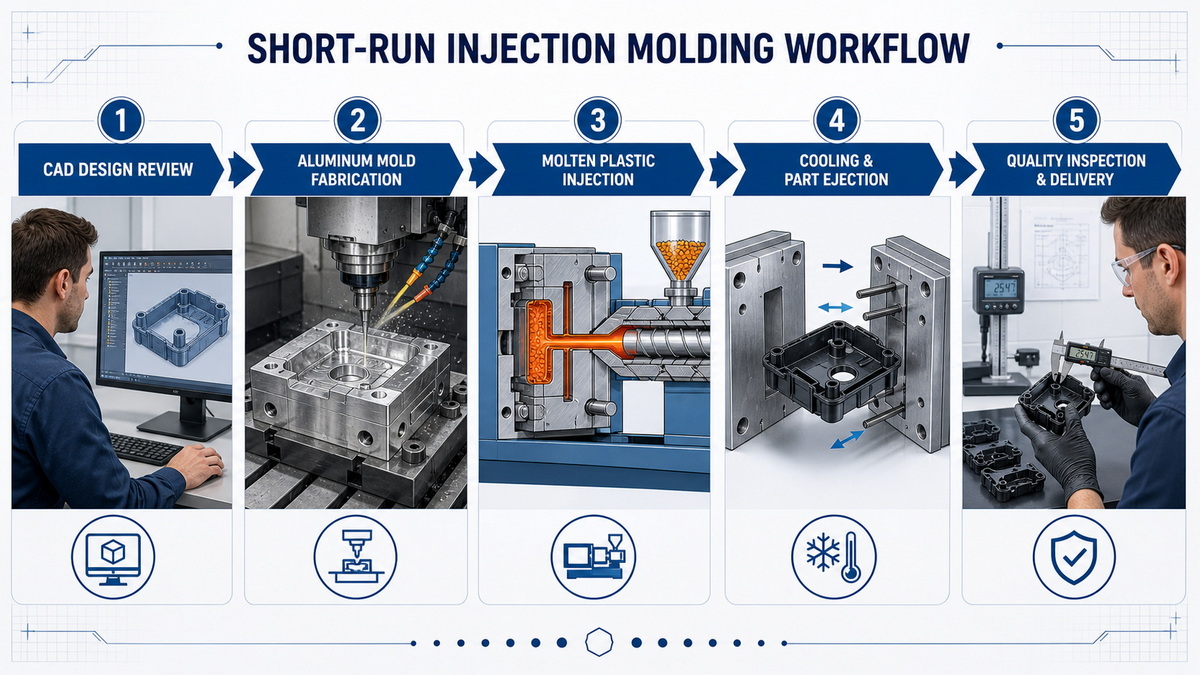
The global injection molding market is projected to reach well over USD 300 billion in the coming years, driven by demand in packaging, automotive, electronics, and healthcare. Within that larger market, short-run and low-to-mid-volume molding are expanding rapidly as brands prioritize faster market response and reduced inventory risk. [finance.yahoo]
From what I see with international OEMs, short-run molding delivers five core advantages that are now business-critical:
- Faster product launches and iterations
- Lower capital risk during early-stage or niche products
- Real, production-grade parts for testing and validation
- Reduced inventory and waste
- Greater supply chain flexibility in volatile markets [cubein]
Short-run injection molding dramatically compresses lead times compared with traditional high-volume programs. Because the tooling is simpler and volumes are lower, you can move from design approval to shipment in weeks instead of months. [protolabs]
For teams working in consumer electronics, automotive prototyping, or connected devices, this speed enables:
- Rapid market tests before committing to a global launch
- Faster iteration cycles on ergonomics, aesthetics, and fit
- Shorter feedback loops between engineering, marketing, and end-users [cubein]
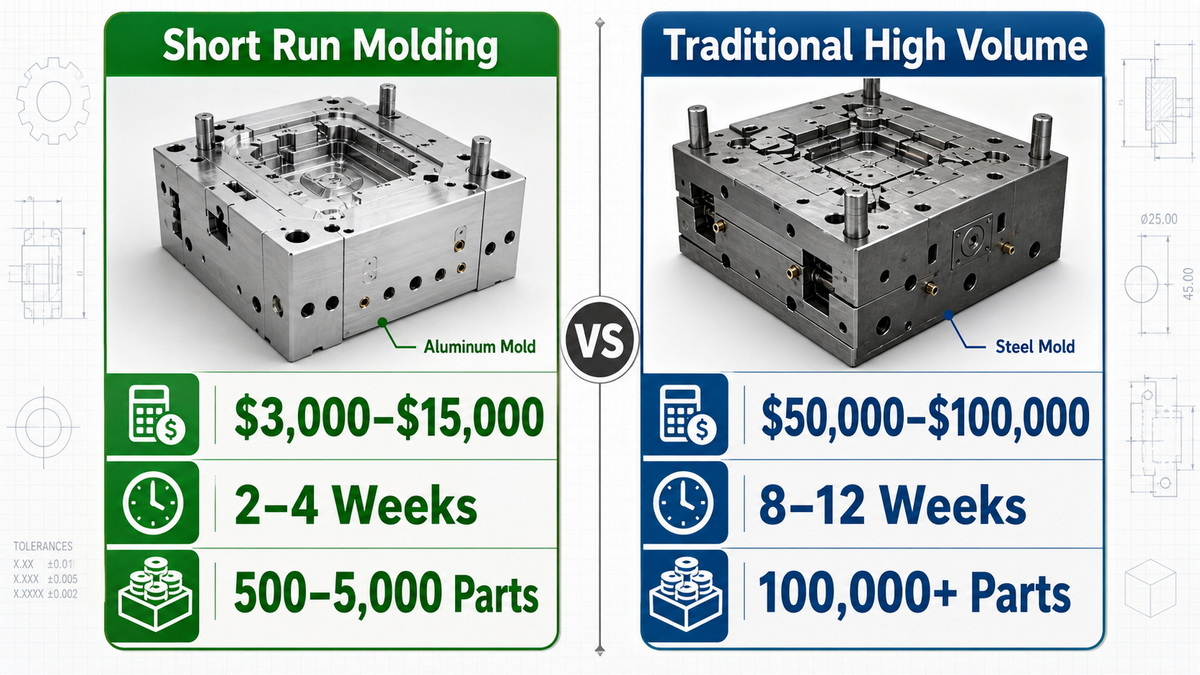
Traditional steel tools for long-run projects can demand six-figure investments, which are hard to justify for new, unproven products. In short-run molding, manufacturers often use softer tool steels or aluminum tooling, paired with streamlined mold designs, to cut tooling cost significantly while still achieving stable production. [businesswire]
This lower capital commitment is especially valuable for:
- Startups validating product–market fit
- Established brands exploring limited editions or regional variants
- Industrial OEMs testing new designs for harsh environments
In my experience, product teams rarely get the design perfect on the first attempt. Short-run molding embraces this reality by making change less painful. Because tooling is simpler and lower-cost, it is much easier to: [protolabs]
- Adjust wall thickness or add ribs after real-world testing
- Refine living hinges, snap fits, or assembly features
- Improve aesthetics, surface texture, or branding elements
Short-run molding produces only the parts you actually need—rather than over-producing to "average down" unit cost. This naturally cuts material usage, lowers obsolete inventory, and reduces the number of components that end up warehoused or scrapped. [protolabs]
As manufacturers increasingly measure their environmental impact, this leaner, demand-aligned approach supports more sustainable operations without sacrificing quality. [finance.yahoo]
With short-run injection molding, you can ship production-grade parts to customers for real-world use—not just lab testing. This allows you to: [protolabs]
- Validate performance in different climates and usage conditions
- Capture user feedback on feel, usability, and aesthetics
- Test pricing, positioning, and packaging with real components
Short-run batches function as a live experiment, giving you data and confidence before scaling into a fully optimized, high-volume program. [protolabs]
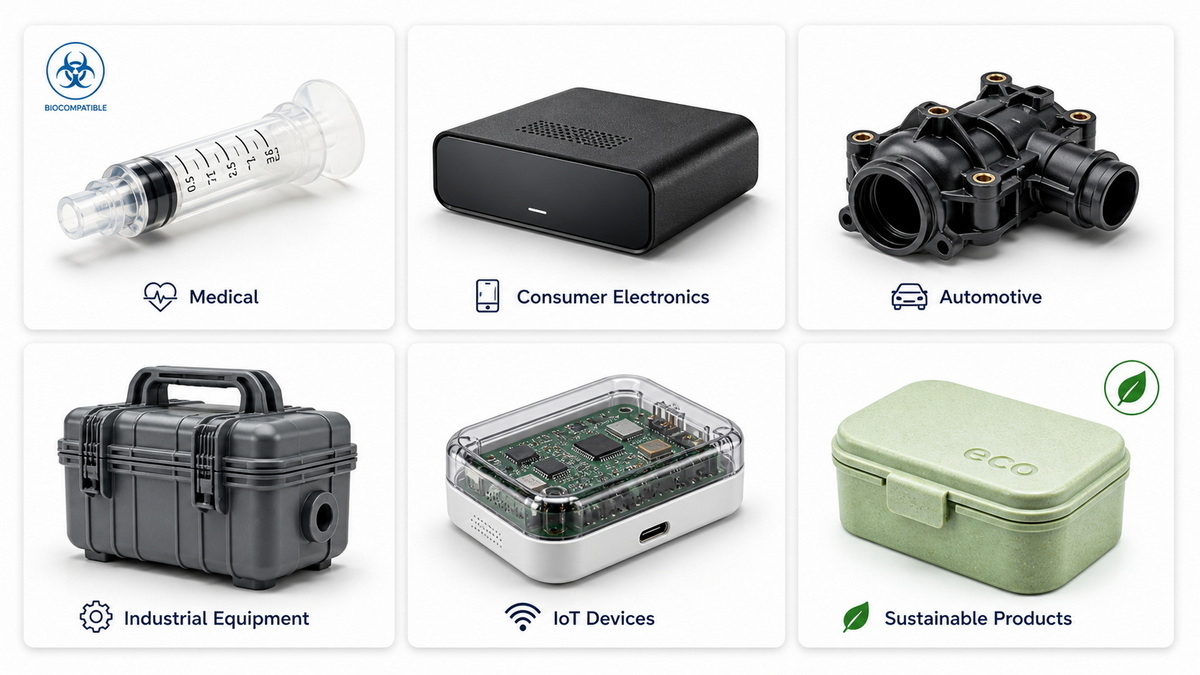
Short-run injection molding is now a standard tool across multiple verticals. Below is a concise view of where it fits best. [cubein]
| Industry | How Short-Run Molding Is Used |
|---|---|
| Consumer Products | Limited runs, seasonal or promotional editions, color or feature variants. protolabs |
| Medical Devices | Functional prototypes, clinical-trial volumes, regulatory test builds. protolabs |
| Automotive | Custom or low-volume parts, aftermarket accessories, prototype components. protolabs |
| Electronics | Enclosures, connector housings, wearables, IoT device shells. protolabs |
| Industrial Equipment | Replacement parts, pilot builds, tooling and fixture components. protolabs |
In each of these sectors, the combination of speed, flexibility, and moderate volumes makes short-run molding more attractive than either pure prototyping or committing immediately to long-run tooling. [protolabs]
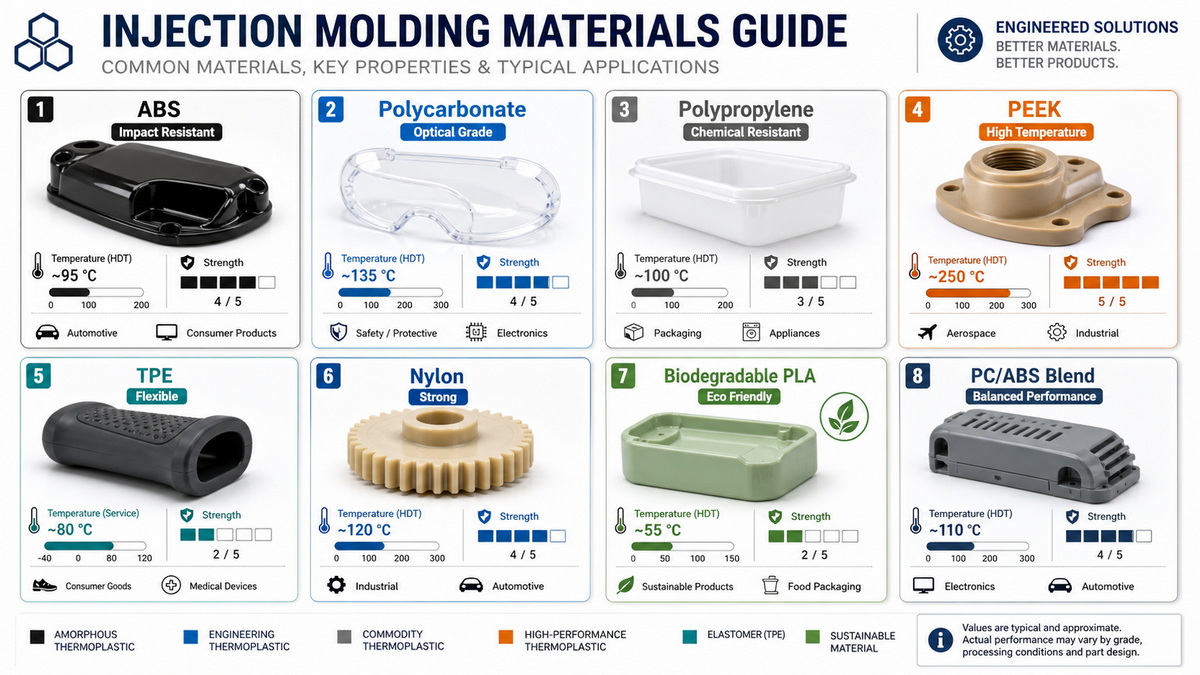
Short-run injection molding works with a wide range of thermoplastics, engineering resins, elastomers, and even biodegradable polymers. Material selection is not just a technical decision; it is strategic for performance, regulatory compliance, and brand positioning. [ptsmake]
Key material categories include:
- Thermoplastics – Common options like ABS, PC, and PP for general applications. [protolabs]
- Engineering Resins – High-performance materials when you need heat, impact, or chemical resistance. [ptsmake]
- Elastomers – Flexible, durable polymers for seals, grips, and vibration-damping parts. [ptsmake]
- Biodegradable Plastics – Lower-impact solutions for sustainability-focused brands. [finance.yahoo]
A reliable supplier will help you balance mechanical properties, aesthetic requirements, and cost while considering relevant standards (for example, medical, automotive, or food-contact regulations). [ptsmake]
Short-run molding is not a one-size-fits-all solution, but it excels in specific scenarios. [protolabs]
1. Functional Prototyping
When you need prototypes that behave like final parts—under load, in assembly, or in environmental testing—short-run injection molding outperforms 3D printing or soft urethane casting. [protolabs]
2. Bridge Production
If your high-volume steel tool is still in design or build, short-run tooling lets you ship early units to customers, secure revenue, and validate assumptions. [protolabs]
3. Low-Demand Or Niche Products
For industrial components or low-volume SKUs, it often never makes economic sense to invest in full-scale tooling; a robust short-run solution may carry the product for its entire lifecycle. [protolabs]
4. Customization And Regional Variants
Short-run molds make it realistic to offer market-specific features, localized branding, or limited runs for key accounts without overproducing. [cubein]
5. Seasonal And Limited Editions
Holiday, campaign, or co-branded products benefit from a controlled batch size and clear end-of-life, ensuring minimal leftover inventory. [protolabs]
From the standpoint of a precision manufacturing partner in China, the most successful short-run programs follow a clear, collaborative process.
Before discussing gate locations or draft angles, define:
- Expected annual and per-release volumes (e.g., 500, 2,000, or 5,000 units)
- Target launch window and any fixed deadlines
- Budget constraints for tooling and per-part cost
To avoid delays, provide:
- Final (or near-final) 3D CAD and 2D drawings with tolerances
- Clear notes on cosmetic vs. critical features
- Assembly context (mating parts, sealing methods, fasteners)
Confirm upfront:
- Material grade and suppliers
- Regulatory and performance test plan
- Sample quantities needed for validation (e.g., first shots, PPAP-style submissions)
Having a clearly defined validation plan avoids scope creep and ensures that your short-run project moves smoothly into approval and, if needed, into a larger-scale program. [finance.yahoo]
Short-run molding is powerful, but it is not free of trade-offs. [protolabs]
- Higher Cost Per Unit
Because fixed setup costs are spread over fewer parts, per-piece price may be higher than with a very large program. The key is to evaluate total landed cost, including inventory risk and time-to-market. [protolabs]
- Tooling Durability Limits
Softer or aluminum tooling used for short runs may not survive hundreds of thousands of shots, so a transition plan to hardened tools may be needed if demand increases. [protolabs]
- Lead Times For Very Complex Designs
Highly intricate parts may still require careful tool design, moldflow analysis, and a bit more time upfront. In these cases, short-run molds still help, but they must be approached with realistic expectations. [protolabs]
By 2026, several macro-trends are reshaping how brands and suppliers approach injection molding in general and short-run programs in particular. [finance.yahoo]
- Smart Manufacturing And IIoT Integration
Sensors, machine learning, and advanced analytics enable real-time process monitoring, predictive maintenance, and automatic parameter adjustments, improving yield and minimizing downtime. [cubein]
- Advanced Materials And Sustainability
New engineering resins, bio-based polymers, and recyclable materials are opening up applications that were previously impractical, while also supporting ESG and sustainability commitments. [finance.yahoo]
- Normalization Of Short-Run As A Standard Offering
Many leading molding suppliers now treat short-run capabilities as a core part of their portfolio, rather than a side service, giving brands more flexibility across the entire product lifecycle. [cubein]
From my perspective working with global customers, the most successful programs combine local responsiveness with the scale and technical expertise of a mature manufacturing ecosystem like China's. [shieldworksmfg]
A capable Chinese precision manufacturer can offer:
- Integrated capabilities: mold design, mold making, injection molding, and downstream assembly under one roof
- Competitive tooling and part pricing due to an extensive supplier network
- Ability to scale from hundreds to tens of thousands of parts if the product succeeds
When combined with clear communication, transparent quality control, and robust export experience, this model makes short-run injection molding not just a technical choice, but a strategic one for global brands. [smallmechanicalparts]
Selecting the right partner is critical to achieving the promised speed and quality of short-run molding. [smallmechanicalparts]
Look for:
- Proven case studies and references in your industry
- Clear quality systems, with data on defect rates and continuous improvement
- In-house engineering support for DFM, mold design, and material selection
- Transparent pricing, including tooling, sampling, production, and logistics
- Ability to scale up if your project takes off
If you are developing a new product, exploring a limited edition, or struggling with slow, inflexible suppliers, short-run injection molding can help you move faster with less risk. Partnering with an experienced precision manufacturer in China gives you access to advanced tooling, high-quality materials, and export-ready logistics under one coordinated program. [shieldworksmfg]
Reach out with your 3D files, target volumes, and launch timeline, and let an expert team walk you through the most efficient short-run strategy for your project—from concept to packed, ready-to-ship parts.
Short-run typically means from a few hundred up to a few thousand parts per tool or per release, depending on part size, complexity, and business goals. [protolabs]
Choose short-run molding when you need production-grade materials, consistent tolerances, and realistic cost structure for hundreds or thousands of units—not just a handful of prototypes. [protolabs]
Yes, many short-run tools can produce multiple batches over time, though their lifespan is lower than fully hardened steel molds; eventually, you may transition to a long-run tool if volumes justify it. [protolabs]
Yes, as long as your partner understands and supports the relevant standards, short-run molding is widely used for medical device development, clinical builds, and automotive prototyping or low-volume components. [finance.yahoo]
Timelines vary with part complexity, but many projects move from DFM approval to T1 samples in a few weeks, with production following shortly after successful validation. [cubein]
1. Uptive. "The Benefits and Applications of Short Run Injection Molding." [Link] [protolabs]
2. Protolabs. "What Is Short Run Injection Molding? Benefits and Use Cases." [Link] [protolabs]
3. Yahoo Finance / Industry Report. "Injection Molding Market Forecast & Trends 2025–2032." [Link] [finance.yahoo]
4. Market Data Forecast. "Injection Molding Market Size, Share and Analysis." [Link] [marketdataforecast]
5. Cubein. "Top Injection Molding Trends in 2026 and Beyond." [Link] [cubein]
6. ScienceDirect. "Made in China 2025 and Manufacturing Strategy Decisions." [Link] [sciencedirect]
7. PTSMAKE. "Custom Plastic Injection Molding Service in China." [Link] [ptsmake]
8. Shield Works. "Examining the Rise of Chinese Manufacturing." [Link] [shieldworksmfg]
9. Small Mechanical Parts. "Case Studies in Precision Machining." [Link] [smallmechanicalparts]


